Changes

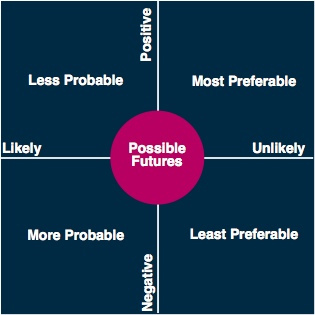
2x2 Matrix: possible futures, by Gaurau Mishra. CC-BY-2.0

2×2 Matrix: possible futures, by Gaurau Mishra. CC-BY-2.0

Almost four years ago, I posted Change is the Only Constant, a discussion of the December, 2012 report of the National Intelligence Council, a consortium of the 16 major U.S. intelligence agencies. Since 1997, they have issued comprehensive reports on future trends after each presidential election and posted the reports online. We can expect the next installment this winter.

The 2012 edition, which predicts alternate futures for the year 2030, outlines some things that are certain, like aging populations in the developed world; some which are possible, and some “black swans” – potential surprises for good or ill. Here are two key predictions.

  • The rate of change in all areas of life will continue to accelerate and will be faster than anything anyone living has seen.
  • World population will grow from 7.1 billion (in 2012) to 8.3 billion in 2030. Demand for food will increase 35% and for water by 40%.

Keep this in mind as we look at a some current events.  I should preface these comments by saying I’ve long had a rule of thumb: never trust a politician who says, “I have a plan to create jobs.” Both presidential candidates have said those exact words this year.

The fantasy is that by pulling the right levers – cutting or raising taxes, threatening or cajoling China, building a wall at our southern border, and so on, we can restore whatever American golden age our imagination conjures. Maybe the 50’s, when we were the only industrial nation not ravaged by WWII. Maybe the 90’s dot com boom, when even your Starbucks barista had stock tips to share.

We all know that’s not going to happen. The truth is even harder to face than any elected or would-be elected American official has yet been willing to share.

On May 16, the BBC reported that China’s Foxconn, the largest electronics manufacturer in the world, where Apple and Samsung smart phones are made, replaced 60,000 workers with robots.  Chinese manufacturers are investing heavily in robotics. So much for bringing jobs back from China.

For an article in the August 1 issue of Time, (“What to do about jobs that are never coming back”), Rana Foroohar spoke to Andy Stern, a former head of the Service Employees International Union:  “Stern tells a persuasive story about a rapidly emerging economic order in which automation and ever smarter artificial intelligence will make even cheap foreign labor obsolete and give rise to a society that will be highly productive–except at creating new jobs. Today’s persistently stagnant wages and rageful political populism are early signs of the trouble this could generate.”

In a Common Dreams article published last week,  You Can’t Handle the Truth,  Richard Heinberg, steps back for a much longer view of our situation and says:

“We have overshot human population levels that are supportable long-term. Yet we have come to rely on continual expansion of population and consumption in order to generate economic growth—which we see as the solution to all problems. Our medicine is our poison.

“And most recently, as a way of keeping the party roaring, we have run up history’s biggest debt bubble—and we doubled down on it in response to the 2008 global financial crisis.

“All past civilizations have gone through similar patterns of over-growth and decline. But ours is the first global, fossil-fueled civilization, and its collapse will therefore correspondingly be more devastating (the bigger the boom, the bigger the bust).

“All of this constitutes a fairly simple and obvious truth. But evidently our leaders believe that most people simply can’t handle this truth. Either that or our leaders are, themselves, clueless. (I’m not sure which is worse.)”

“…any intention to “Make America Great Again”—if that means restoring a global empire that always gets its way, and whose economy is always growing, offering glittery gadgets for all—is utterly futile, but at least it acknowledges what so many sense in their gut: America isn’t what it used to be, and things are unraveling fast. Troublingly, when empires rot the result is sometimes a huge increase in violence—war and revolution.” (emphasis added)

The last major decline of empires, he notes, resulted in World War I. The US and the rest of the world are, in Heinberg’s words, “sleepwalking into history’s greatest shitstorm.”

“…Regardless how we address the challenges of climate change, resource depletion, overpopulation, debt deflation, species extinctions, ocean death, and on and on, we’re in for one hell of a century. It’s simply too late for a soft landing.

“I’d certainly prefer that we head into the grinder holding hands and singing “kumbaya” rather than with knives at each other’s throats. But better still would be avoiding the worst of the worst. Doing so would require our leaders to publicly acknowledge that a prolonged shrinkage of the economy is a done deal. From that initial recognition might follow a train of possible goals and strategies, including planned population decline, economic localization, the formation of cooperatives to replace corporations, and the abandonment of consumerism. Global efforts at resource conservation and climate mitigation could avert pointless wars.

“But none of that was discussed at the conventions. No, America won’t be “Great” again, in the way Republicans are being encouraged to envision greatness. And no, we can’t have a future in which everyone is guaranteed a life that, in material respects, echoes TV situation comedies of the 1960s, regardless of race, religion, or sexual orientation…”

Heinberg’s conclusions aren’t easy to digest, and are tempting to deny. Keeping attention on even a few of the significant points in the articles referenced here leads to disturbing conclusions.

If 16 US Intelligence agencies are anywhere near correct in their numbers, in 14 years, 8.3 billion people will be competing for 40% less water and 35% less food (in this case, living up to their name, the intelligence agencies don’t waste anyone’s time denying the effects of climate change).

Can we imagine “global efforts at resource conservation” in which nations co-operate, and at least try to send relief where it’s needed?  Like after tsunamis or the earthquake in Nepal? Or are we headed toward a survivalist wet dream?  Futures aren’t set in stone, said the NIA. It all depends on how we behave (sinking feeling in the gut…).

I can see it both ways. Speaking of our current election, someone recently said to me, “I haven’t felt this bad about things since 9/11. Maybe it’s even worse.”  Maybe so. In the immediate aftermath of 9/11, we were a nation and a world largely united in awareness of our fragile humanity and revulsion at senseless suffering.

It strikes me that communities often pull together in the face of disaster when our leaders and governments won’t. That is Heinberg’s conclusion as well. Given our lack of competent leadership at the top, how can we build “local community resilience?”

I wish I knew. But since Iceland has more sense than to open it’s doors to American refugees, I’ll have time to think it over!  Meanwhile this quote from the Dalai Lama comes to mind:

“We can live without rituals. And we can live without religion. But we cannot live without kindness to each other.”

Changes are certain but futures aren’t set in stone…

Trust no one!

Paranormal conspiracy theorists and science fictions fans from Area 54 to Roswell will recognize my title as the motto of FBI Special Agents Fox Mulder and Dana Scully, whose whimsical escapades have returned to television.

x-files-2016-premiere

On a less amusing note, it’s the American attitude toward virtually all institutions, according to journalist, Jeff Greenfield, whose essay,”In Nothing We Trust,” aired on the PBS Newshour on Friday, February 5.

Greenfield cites a recent Pew Research poll showing that Americans mistrust most institutions; only 19% of us trust the government to do “what is right most or all of the time.”

In 1964, with a strong economy, the passage of the Civil Rights bill, and an easing of the cold war, the number was 77%. Ten years later, after a decade of war in Viet Nam and a scandal that drove a president from office, the number was 36%, and it has never topped 50% again.

It isn’t just our government, according to Greenfield. We don’t trust churches. Labor Unions. Banks. Large corporations.  Medicine. Greenfield notes, in his TV news segment, that only 21% of us have “a lot of faith” in TV news.

In great measure, says Greenfield, there are good reasons to mistrust these institutions. Think of the movie, Spotlight. The government of Michigan and the City of Flint.  Yesterday’s congressional hearings on 5000% price hikes in the pharmaceutical industry.

In a similar editorial, I once heard a journalist say that the first act of colonial governments was an attempt to discredit all the institutions of the colonized people; “obviously your god, your army, your government are not as good as ours or we wouldn’t be here.” We may be, said the journalist, the first nation in the history of the world to have colonized itself!

Our pervasive mistrust, according to Jeff Greenfield, makes things especially difficult, in a political year, for those seeking to gain the public trust. It may, in fact, reward those who fan the flames of discontent.

But how, he asks, can a republic long survive when it’s motto is, “In nothing we trust?”

The 2015 Pinocchio Awards

pinocchio

The Washington Post released it’s annual Pinocchio Awards for the year’s biggest falsehoods. To no one’s surprise, the 2015 winners are all involved in politics. No one gets to feel smug; all parties and political persuasions were represented.

I’m sure lying politicians are as old as politics. What was disheartening this year was the blatancy of the lies. Fifty one years ago, Marshall McLuhan coined the phrase, “The medium is the message.” In 2015 we may have seen the ultimate corollary of that:  if you say it on TV with enough bravado, swagger, or apparent sincerity, some or many will believe you, regardless of facts. We, as a culture, prefer easy answers to truth.

Here are the winners:

Donald Trump for false and repeated assertion that he saw thousands of Muslims on TV celebrating the fall of the twin towers. Only in Trump’s fevered imagination did such an event play out.

Hillary Clinton for her defense of her husband’s signing of the anti-gay “Defense of Marriage Act,” with an assertion that it headed off an anti-gay marriage constitutional amendment. There may have been talk, but there was no momentum for such an amendment.

Donald Trump for his claims that immigrants commit more crimes than American citizens. While some on this list have cherry-picked their statistics, Donald apparently never looks at statistics at all.

Sen. Chris Murphy (D-Conn) for saying in June that there have been 128 school shootings since Sandy Hook. His stats came from an anti-gun violence advocacy group with a flawed methodology that included suicides and accidents in the numbers.

Donald Trump for his claim that Obama wants to admit 250,000 Syrian refuges to the US. The number is 10,000 Syrians, and the US maximum figure for all refugees is 180,000 over the next two years.

"Freedom of Speech," 1943. In Norman Rockwell's America, truth and respect for all viewpoints mattered

“Freedom of Speech,” 1943. In Norman Rockwell’s America, truth and respect for all viewpoints mattered

John Kerry for claiming he and Al Gore organized the 1988 Senate hearings on climate change. He was not even there.

Mike Huckabee for stating that “global freezing” was a serious concern 40 years ago.

Sen. Elizabeth Warren ( D-Mass ) for proposed regulations for car dealership loans based on “wildly” exaggerated statistics.

Rudolph Giuliani, former NY City Mayor, for saying Obama has never called America a great or exceptional country. Apparently Mr. Guiliani has never listened to an Obama speech.

President Obama for “dubious” claims about the Keystone pipeline.

Sen Rand Paul (R-Ky) for claiming an elderly man was in prison for “putting dirt on his land,” when in fact he was convicted of mail fraud, conspiracy, and environmental violations such as selling land with illegal sewage systems that were likely to fail.

Democratic legislators: On the house floor, staged a demonstration of solidarity with a black youth, shot by a white police officer in an incident that various investigations determined was legitimate self-defense.

Sex Trafficking Statistics:  “There are not 300,000 thousand children at risk in the US, nor  100,000 children in the sex trade, nor is human trafficking a 9.5 billion dollar business, nor do girls become victims at an average age of 13, nor has the government arrested hundreds of perpetrators.”  All of these were claims made by “politicians, advocacy groups, and government officials” in 2015.

I’d love to feel smug and wag my finger at the politicos, but I can’t.  To paraphrase the Master whose birth we celebrated yesterday, “Let he who lives without falsehood cast the first aspersion.”

Politicians behave like this because it works for them, it gets them elected and reelected. For that, We the People are responsible.  We can do better than this…

The medium is…

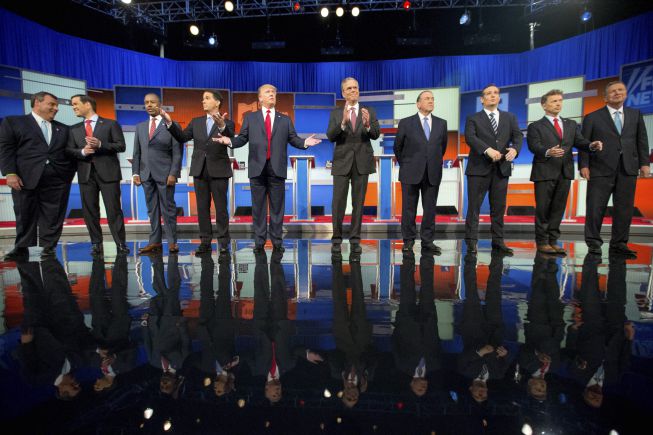
Republican debate

“The medium is the message”, said Marshall McLuhan in Understanding Media, 1964. Fifty-one years later, I’m still not certain we understand media, but a light bulb went on for me Thursday night regarding McLuhan’s iconic phrase. While watching the Republican presidential debate, I had a minor epiphany; that television cannot help transforming politics into entertainment.  

I am not suggesting that either party has a monopoly on show business.  Yes, the Republicans are likely to be funnier this year, with their Jerry Springer moments, and The Donald, who’s public persona is a weird combination of Rodney Dangerfield and Don Rickles.  I expect the Democrats to be far less interesting, more like infomercials on the home shopping channel.

There’s nothing new about politics as entertainment. If we believe television and movie depictions of pre-television and movie campaigns, there was plenty of bunting, and bluster, and brass bands in “the good old days.” But every now and then, wouldn’t it be refreshing to see something real happen on political TV?

The last time I saw reality break through was during the 2004 Democratic convention in Boston.  The Democrats had barred one of my heroes, the late Senator Robert Byrd, from the podium. Byrd could not be trusted to stay on script. Massachusetts Senator Kennedy invited Byrd to speak at the Old North Church, where Paul Revere worshipped, and his address was broadcast on Democracy Now. Byrd held up his well-worn pocket copy of the US Constitution and warned us that it was under attack…

Politics, of course, is not the only thing that TV flattens out. I recall several surreal moments with TV news. One early evening in college days, when I was living in an off-campus house, my roomies and I were watching a shoot out on Mod Squad on an old black and white TV. I went to the kitchen to fix a sandwich, and when I returned, the shootout had grown more intense; the house where the bad guys were hiding was on fire. But it looked different.  “Did somebody change the channel?” I asked.

“Nah, man,” said a house mate. “The news cut in. The cops are having a shootout with those guys who kidnapped Patty Hearst.” The visceral difference between watching a fictional versus a non-fiction firefight on TV was nonexistent without the dialog or voice over!

In a very real sense, that’s simply the nature of things according to both western depth psychology and Buddhist psychology. Every experience we have, noted James Hillman, begins as an event in the psyche. And Buddhist thinkers will tell you that our so-called realities are far more like the dreams we have at night than most of us dare to believe. Yet, as a practical matter, in order to make the right decisions, we have to be able to tell them apart, and that means turning a critical eye on the stuff we see on television.

I have recommended it before, but as we begin another presidential election mini-series, I can think of no better guidebook than Neal Gabler’s Life the Movie: How Entertainment Conquered Reality, 2000.  In it, he says:

“the deliberate application of the techniques of theater to politics, religion, education, literature, commerce, warfare, crime, everything, has converted them into branches of show business, where the overriding objective is getting and satisfying an audience.”

Unless we choose to live with the wolves, we’re going to be part of that audience, but at least we can remember that wonderful Buddhist bumper sticker:  “You don’t have to believe everything you think.”

Anatomy of the Deep State by Mike Lofgren

Be warned, this post has disturbing content.  If it was a movie, I’d rate it “R,” not because of sex or violence, but because it concerns a penetrating essay on the current state of the US government.  Change the channel now if you’re squeamish.

If you’re still here, good, because disturbing or not, I think everyone ought to read Anatomy of the Deep State, by Mike Lofgren, a former GOP Congressional aide who retired after 28 years as a staff member for Congress and the Senate.  This article is a distillation of ideas he explored in his recent book, The Party is Over: How Republicans Went Crazy, Democrats Became Useless, and the Middle Class Got Shafted.

party is over

Lofgren says what many of us have long suspected, that our visible political landscape is merely the tip of a much bigger iceberg – that our various issues, debates, and elections often have little to do with the real trajectory of power in this country.  Much of this “real” trajectory is hidden in plain sight.  With almost three decades inside the belly of the beast, Lofgren can show us where to look.

He cites many examples.  During the political circus surrounding the 2011 debt ceiling “crisis,” our leaders had no problem finding money to topple Gaddafi.  A few months later, during the government “shutdown”, while debates raged over canceling meat inspections and air traffic control, we gave $112 million to Syrian rebels, to keep that conflict going.  And since 2007, as our bridges collapse, schools fail, and cities go bankrupt, we’ve spent $1.7 billion on an NSA building in Utah the size of 17 football fields.  Its purpose is to house a yottabyte of data.  A yottabyte, the largest number computer scientists have so far coined, equals 500 quintillion pages of text.  “They need that much storage to archive every single trace of your electronic life,” Lofgren says.

The best news, according to Lofgren, is that what he calls the Deep State is far from invincible.  He notes how sufficient ineptitude draws pushback even from allies, citing our two failed wars and the Snowdon revelations among other things.  Past elites have often reacted to challenges in one of two ways.

Some have tried to “stay the course,” and Lofgren observes that,“The dusty road of empire is strewn with the bones of former great powers that exhausted themselves in like manner.”  Others have followed reformers, as diverse as Franklin D. Roosevelt, Charles de Gaulle, and Deng Xiaoping.  What each of these men developed in common was a deep understanding that their cultural stories and myths were ossified and that survival depended upon renewing both vision and action.

Mike Lofgren, a self-described “former proud Republican” now says, “there is…a deep but as yet inchoate hunger for change. What America lacks is a figure with the serene self-confidence to tell us that the twin idols of national security and corporate power are outworn dogmas that have nothing more to offer us. Thus disenthralled, the people themselves will unravel the Deep State with surprising speed.”

The first step in dealing with any problem is understanding its nature.  In this time of deliberate political and economic obfuscation, I highly recommend Anatomy of the Deep State as one of the best and most succinct diagnoses I’ve yet seen of what ails us.

Final notes on the Grail and the Wasteland

An ailing king lives at the heart of the Wasteland. We often find this figure in fairy tales, such as “The Water of Life,” where efforts to heal him launch the story.  Jungians interpret the king as the “dominant ruling attitude” of a culture or individual, which grows atrophied unless it is periodically renewed.

water of life king

In seeking a simple description of our own collective attitude, I thought of an often misquoted phrase spoken by President Calvin Coolidge in 1925: “The chief business of the American people is business.”  This attitude swept the world in the years since then and sheds much light on our current Wasteland with an ecosystem in crisis.  Sadly, few people know what else Coolidge said in that speech:  

“Of course, the accumulation of wealth cannot be justified as the chief end of existence…So long as wealth is made the means and not the end, we need not greatly fear it…But it calls for additional effort to avoid even the appearance of the evil of selfishness. In every worthy profession, of course, there will always be a minority who will appeal to the baser instinct. There always have been, probably always will be, some who will feel that their own temporary interest may be furthered by betraying the interest of others.” (1)

***

In the earliest versions of the legend, the king is healed when the hero asks this question:  “Who does the Grail serve?”  In these tellings, the Grail is a stone or a large platter that nourishes each person according to their heart’s desire.  This suggests a cornucopia, a potential earthly and spiritual abundance.  There have always been cycles of growth and cycles of famine, cultural florescence and decay.  In the legend, that question, “Who does the Grail serve?” appears to lie near the heart of these cycles.  Somehow we intuit that what Campbell termed “Greed for more  than one’s share” on a large scale is a formula for disaster.

***

In my two previous posts, I mentioned hearing many accounts of people seeking new ways of doing most everything.  I’ve collected so many stories it took several days figure out how to present them.  Simplicity won out in the end; here is one brief account, with more to follow in the future.

I’ve listened to Jill Stein on several occasions, most recently on BillMoyers.com in November, 2013.  Stein, a Harvard Medical School graduate, “became so outraged by how politics adversely affected her patients” that she ran as the Green Party candidate for president in 2012.

Naturally, she was not allowed to participate in the presidential “debates,” which don’t really deserve the name, but in 2012 she and Green vice-presidential candidate, Cheri Honkala, were arrested for simply trying to enter the debate hall.  “We were arrested, taken to a secret detention facility, and handcuffed to metal chairs for eight or nine hours until the debate was long over.”  

Jill Stein, 2012 Green Party candidate for president

Jill Stein, 2012 Green Party candidate for president

You’d expect her to be discouraged after this blatant violation of civil liberties, as well as a host of other abuses she cited during the interview, but she was not, saying instead that,

“America is ready to move. And when we start moving together…all we have to do is realize how numerous, strong and inspired we are. And then we are unstoppable. You know, in the words of Alice Walker, the biggest way people give up power is by not knowing we have it to start with. It’s by flicking that switch and rejecting the disempowerment that’s beaten into us every waking moment by every media source that surrounds us.”

I encourage everyone to watch the interview or read the transcript.  There much that was frightening but even more that was hopeful in this discussion of our current situation.  As time goes on, I’ll feature other optimistic stories I have collected, featuring “ordinary” people searching for those Grails that can transform and renew the world and the lives we are living.

Delisting the Wolf – Your Help is Needed!

If wolves are removed from Endangered Species protection, the day may soon return when there are none in the lower 48. I’ve worked with these magnificent creatures as a volunteer at the Folsom City Zoo Sanctuary, and in my opinion, that would be a tragedy. Please read this article and make your comment on the Federal website.
Update: As of November 6 at 5:00pm, the website is up again and I was able to comment.

Mungai and the Goa Constrictor's avatarMungai and the Goa Constrictor

The U.S. Fish and Wildlife Service is in its comment period on their proposal to remove the wolf from the Endangered Species Act in the lower 48.  Hearings are being held throughout the country.  If you can go, please do.  If that’s not possible, please write or call.  They need to hear from people who want the wolf protected, not only from those who don’t.

AMENDMENT
Many thanks to my good friend, Carmen Mandel, for providing a DIRECT LINK to add your comments. Please add yours. There are almost 32,000 signatures, as I write this, but this figure falls a long way short of previous opportunities.
This is so important
Please add your comment now
Your Voice in Federal Decision-Making

ALTERNATIVE WAYS TO COMMENT
Please click here for details

Click here for more details:
The U.S. Fish and Wildlife Service

Related links:
Defenders of Wildlife
Grey Wolves Left Out…

View original post 59 more words

James Hillman on world change and political polarization

James Hillman, 1926-2011

James Hillman, 1926-2011

For decades, James Hillman brought us unique observations on modern life from the perspective of a depth psychology that embraced soul as its highest value.  Recently, I’ve wished I could hear his take on our current climate of political divisiveness, but Hillman, who died two years ago at the age of 85, wasn’t here to watch our most recent shenanigans.  Happily, I recently stumbled upon a pair of interviews in which Hillman discussed this very subject and set it in a context of massive cultural change.

Author and journalist Pythia Peay published the first interview on The Huffington Post in February, 2011 (Jungian Analyst Explains the Psychology of Political Polarization).  The occasion for their talk was the mass shooting in Tucson, which had happened a month earlier.  The most prominent victim was Representative Gabrielle Giffords.

Tragically, memory of that event, just two and a half years ago, has been lost in the wake of more recent carnage, including the Nevada school shooting earlier this week.  Though Hillman’s comments focused on the role of political divisiveness in the attempt to kill a congresswoman, his additional statements now seem eerily relevant to the 12 year old in Sparks who was so alienated that he ended his life with murder and suicide.

Hillman began with a general discussion of polarized thinking.  “Polarity,” he reminds us, is an electrical engineering term.  Batteries have poles; the psyche is far more nuanced than that, dwelling in shades of gray rather than black or white.  Ideological extremes subvert our ability to judge individual issues on their merit.

When asked if violently polarized politics caused the shootings, Hillman changed the focus to another kind of cultural rigidity and its effect on the Tucson shooter:

“I think that this kid was made a loner by an American educational system in which there is no room for the weird or the odd…We need to have an educational system that’s able to embrace all sorts of minds, and where a student doesn’t have to fit into a certain mold of learning. Our educational system has become so narrowed to a certain formula, that if you go through a weird phase, you’re dropped out — often at the age of schizophrenia, 19-23 — and that’s the danger.”

Arguments in the wake of gun violence bog down in specifics, like background checks and how many bullets a magazine should hold – we don’t ask why and how we’re producing more and more people prone to mass violence.  In the end, says Hillman, for a culture that pays so much lip service to “the individual,” we are terrified of real individuality, and attempt to stamp it out.

In the second interview, America and the Shift in Ages, Hillman suggests that much of that rigidity has to do with futile attempts to shore up outmoded systems and institutions during a period of massive change.  Not just one but “three or four” myths that are central to our culture are collapsing.

Everything we fear has already happened said Hillman:  “The fragility of capitalism, which we don’t want to admit; the loss of the empire of the United States; and American exceptionalism. In fact, American exceptionalism is that we are exceptionally backward in about fifteen different categories, from education to infrastructure. But we’re in a stage of denial.”  Other beliefs and structures are crumbling as well, he said.  White supremacy, male supremacy, the influence of monotheistic religions, and the belief that we are “the good people.”

If such institutions do not appear to be in decay, it’s because they are so staunchly defended, and that, Hillman says, is a sign of their lack of vitality — “If they were vital they wouldn’t need to be defended. And the fanaticism we’re witnessing goes along with the deterioration of the vitality of these myths.”

Many of our fundamental beliefs are under scrutiny and need to be.  Hillman mentions the meaning of “freedom.”  For many, freedom means, “I can do any goddamn thing I want on my property; that I am my own boss and don’t want government interference; that I don’t want anybody telling me what I can and can’t do.”  This, he says, is the freedom of an adolescent boy.  What of the different kinds of freedom, such as “freedom from the compulsions to have and to own and to be someone?”  What of the freedom Nelson Mandela found in prison?

Hillman cites economic assumptions that need to be questioned as well.  Falling demand needs to be stimulated, according to current assumptions, but from an ecological point of view, that’s exactly what the world needs at this time.  Sustainability models, which may be our hope for the future, terrify those in positions of power.

Many of our current fears, says Hillman – from fear of immigrants crossing our borders, to fear of failing education, to fear of cancer, to economic insecurity, terrorists, and of course fear of “the other” political party, results from the lack of a wider framework in which to understand the massive shifts that are already underway.

There is no going back, but as obsolete structures crumble, we can glimpse, if we look, new forms emerging.  Hillman gave the example of a “Bioneers” conference he attended where Paul Hawken showed a film that was simply the names of individuals and organizations involved in trying to innovate ways of building communities, economic systems, and ways of dealing with the natural world.  Hawken said there were thousands of names, and the film could roll for weeks.

Hillman said it’s important not to try to fit emerging structures into the patterns of the past.  For our peace of mind, a new kind of faith is required:   “I think it’s a matter of being free-wheeling, and trusting that the emerging cosmos will come out on its own, and shape itself as it comes. That means living in a certain open space — and that’s freedom.”

Dawn over Oostende, Belgium, 2007.  Photo by Hans Hillewaert, CC-BY-SA-3.0

Dawn over Oostende, Belgium, 2007. Photo by Hans Hillewaert, CC-BY-SA-3.0

Such words are a fitting conclusion to the lifework of a man who lived in defense of Anima Mundi, the World Soul and who taught that animals, trees, and rivers are intelligent and alive, and that at some deep level of the psyche, we can hear their voices.  In Hillman’s life work, observation of the modern psyche led to conclusions that mesh with the myths of the ancestors.

A thousand years from now, people will read of our times and shudder, as we do in contemplating the rigors of life in the middle ages.  A few visionaries stood out from the rest, those like Saint Francis, Dante, and Leonardo, who pointed toward a more benevolent and expansive future.

We cannot write our own history, but we can wonder how it will look to those in the future.  I am convinced that James Hillman will be remembered when most of what passes for news on TV is blessedly forgotten.