
One Nation Under Stress

The title of this post comes from a new book reviewed on NPR, One Nation Under Stress:  The Trouble With Stress as an Idea, by Dana Becker, PhD.

According to Dr. Becker, “stress” is a recent concept.  The first article on stress in the New York Times was published in 1976.  The first diagnoses of “nervous disorders” or “neurasthenia,” came from the work of Dr. George Beard ca 1869.  In the NPR interview, Becker says that physicians of the time considered “American nervousness” to come from outside factors, related to the increasing pace of life after the civil war.  “Stress,” as we understand it today, is the polar opposite.

Now we have internalized stress, focusing on the risks to our health and the ways we should cope with it, through diet, exercise, yoga, and so on.  Our experience of stress derives from our ideas of stress, Becker says.  The internal emphasis on health is necessary, but we let it divert us from questioning the external causes of stress.  She gives an example in the NPR interview: many articles are written to help working mothers cope with stress – far fewer are written about the need for affordable daycare.  We may eat kale and do yoga to survive the 24/7 world, but we seldom ask why this is the norm and what the alternatives are.

This argument echoes a major concern of James Hillman, who I frequently write about here.  Though he was once Director of Studies at the Jung Institute in Zurich, in 1992 he co-authored a book called We’ve Had a Hundred Years of Psychotherapy and the World is Getting Worse.  In it, he said:

“Every time we try to deal with our outrage over the freeway, our misery over the office and the lighting and the crappy furniture, and the crime in the streets, whatever – every time we try to deal with that by going to therapy with our rage and our fear, we deprive the political world of something.”

In her NPR interview, Dana Becker presented a balanced view of stress – it’s fine to treat the symptoms, which are personal, as long as we don’t gloss over the underlying causes, many of which are not.  The promise of new view of a modern ailment is enough to put One Nation Under Stress near the top of my “to read” list.

Who would you choose to write your biography?

Although I enjoy reading and mulling over the WordPress Daily Writing Prompts, I’ve never used one as a subject before.  That changed on March 11 with a post called Ghostwriter by blogger Michelle W. who asked, “If you could have any author – living or dead – write your biography, who would you choose?”  The answer for me is Carl Jung, and it has been fruitful to remember why.

When I was in high school, a teacher who was a mentor to me said, “You should really study psychology.  Not all that behaviorist crap, but Jung.”  As a college freshman, I remembered his words when I spotted a copy of Man and His Symbols, an introduction to Jung’s ideas that he began and his close colleagues finished after his death in 1961.  After that, I read his autobiography, Memories, Dreams, Reflections.  These are excellent books to get the gist of his thought.

Dr. Carl Jung, 1875-1961

In our fast-food world, where medication and brief therapy are the norms, Jungian analysis survives at the margins.  Two key exceptions, where Jung’s ideas entered the mainstream, come to mind.  The Meyer-Briggs Personality Profile is structured on his theory of psychological types; even the words, introversion and extroversion were his.  And through one of his patient’s contact with Bill Wilson, co-founder of Alcoholics Anonymous, Jung’s insistence on the psyche’s spiritual orientation found its way to the core of 12 step programs.

More more widely known are Jung’s contributions to the study of literature and folklore.  The theory of archetypes, which found expression in areas like Joseph Campbell’s work on the hero myth, were first stated for our times by Jung.

All these credentials, however impressive, are not the reason I’d choose him as a biographer.  Here’s something he said in a lecture in London in 1939:

“We have no symbolic life, and we are all badly in need of the symbolic life. Only the symbolic life can express the need of the soul – the daily need of the soul, mind you! And because people have no such thing, they can never step out of this mill – this awful, banal, grinding life in which they are ‘nothing but.’ . . . These things go pretty deep, and no wonder people get neurotic. Life is too rational; there is no symbolic existence in which I am something else, in which I am fulfilling my role, my role as one of the actors in the divine drama of life.”

When I first read these words, at about the age of 20, I recognized a kindred spirit, one who could articulate things I only felt and struggled with.  I read the words now and still feel the sense of kinship.

There’s not that much in my outer life to write about.  Any biographer I’d hire would have to be the kind of person who looks beneath the surface and understands that it’s really about the effort to find one’s role “as one of the actors in the divine drama of life.”

If you could have anyone do it, who would you pick to write your biography?

Scott Fenstermaker’s blog, “People-Triggers,” aims to “Understand what makes us do what we do.” In a fine article called, “The Personal Myth,” Scott explores some recent research on the importance of the stories we tell ourselves in shaping and creating our experience of self and world. “People who come out of psychotherapy testing higher on well-being indicators tend to tell similar personal stories with themes of conquered demons and redemption.The newer story may be no more factually true than the old, because all personal stories are fables, but the newer version is healthier.” In 1983, James Hillman wrote Healing Fictions, a book with a similar argument. This article quotes and links to some up-to-date research emphasizes the importance of the “screenplays” we’re always composing in our heads.

peopletriggers's avatarPeople-triggers

“It ain’t so much the things we don’t know that get us into trouble, it’s the things we do know that just ain’t so.” —Mark Twain

MythsSome (very reputable) psychologists are absolutely convinced that DNA is destiny. Other (very reputable) psychologists are convinced that your personality is shaped by what happens to you as an infant – or perhaps even in the first few minutes of life. This is what I love about psychology: the theories are all over the map and yet somehow everyone is still credible.
One very interesting dimension to personality has to do with the stories that we tell ourselves. Research has increasingly revealed that our personal life stories – our mental self-narratives – contribute substantially to our personalities and behaviors. An excellent New York Times article from 2007 summarizes much of this current research.

As the interpreter of our world, the mind is very…

View original post 707 more words

Who is it that can tell me who I am?

This line from King Lear is part  of the title of a 1999 lecture by Dr. Joanne Stroud, one of the founders, along with James Hillman, of The Dallas Institute of Humanities and Culture.

Lear:  Who is it that can tell me who I am?
Fool:  Lear’s shadow.  (Act 1, Scene 4)

The exchange is a fitting lead in to Stroud’s lecture which centers on ideas of identity in the western tradition, especially in Jungian psychology.  For Jung, “the shadow,” comprised of the disowned parts of a person or culture, is one of the first archetypal energies we encounter when we begin to look within, hoping to find out what and who we are.

I recommend Stroud’s transcript for its outline of Jung’s ideas as they bear on the western imperative, “Know Thyself,” which was inscribed at the entrance to Apollo’s temple at Delphi.

Temple of Apollo at Delphi by Navin Rajagopalan, CC By-SA 2.0

I’m guessing that the question “Who can tell me who I am,”  is an undercurrent in the lives of everyone who has read this far.  In addition to our own introspections, don’t we ask friends, teachers, novelists, religions, therapists, books, and even politicians in certain election years?

There is much to be learned from these sources, information that’s useful when choosing a career, a spouse, a place to live, or when plotting a novel or writing a poem.  But that’s not what Lear asked or Apollo demanded at Delphi.  The answer to the question of identity is like a rainbow, sometimes visible on the horizon, but elusive no matter how we chase it.  The time comes when we have to ask the Dr. Phil question,  “How’s that working for you?”  Could it be that “identity,” as it is commonly imagined – as a kind of cosmic birth certificate – cannot be found?

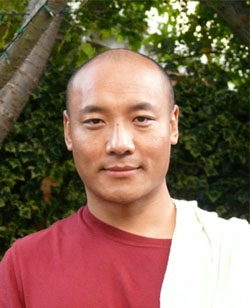
That’s very good news according to Anam Thubten Rinpoche, a Tibetan Buddhist master I have written about before.  I’ve taken some half-dozen daylong retreats with him since 2005, most recently in January of this year.  I’ve wanted to write about the event, but it isn’t easy.  Rather than add to our store of beliefs and concepts, Anam Thubten suggests we try letting them go.  In his second book, The Magic of Awareness 2012, he says, “Good concepts are like a golden chain.  Bad concepts are like an iron chain.  They all equally bind you in the end.”

Reading that, I always think of meeting new people in social settings.  “What do you do?” is usually one of the first questions.  Do you ever resist being pigeonholed when that happens?  At such moments don’t we understand that “I” am more than my roles and my vital statistics.  Anam Thubten would add that we are greater than all our ideas of identity, which are just more sophisticated pigeonholes.

Anam Thubten

Next time I will try to describe the simple ways he invites us to drop our stories long enough to glimpse the reality that lies behind them.  If that’s biting off much more than I can chew, at least it’s easier than trying to answer Lear’s question.

Huh, what? Oh yeah, I remember

Until the 20th century, most people in the western world believed in objective memory, that what we remember is an accurate mirror of events that actually happened.

With the birth of psychoanalysis and concepts of the Id and unconscious mind, that began to change. Modern brain research confirms that not only do memory and imagination overlap, but that memories can be deliberately changed or altered.  Such manipulation is a core element of The Cloud by Matt Richtel, a page turning thriller I started to read after seeing this interview with the author on Sciencthrillers.com  http://www.sciencethrillers.com/2013/author-interview-matt-richtel-the-cloud/

The Persistence of Memory by Salvadore Dali, 1931

Freud was ambivalent about the accuracy of his patients’ memories. At the start of his career, he attributed several several cases of hysteria to real childhood sexual abuse that his methods uncovered.  Later he said that such episodes were patient “phantasies.”

The issue surfaced again at the end of the 20th century, with “recovered memory” therapy causing tremors in the field, to say nothing of lives disrupted by allegations of sexual abuse, in what is now widely viewed as abuse by helping professionals who implanted memories in the course of trying to treat patients.  “False memory syndrome” still evokes passionate disagreement in the field.  The AMA and the American Psychiatric Association, as well as the Royal College of Psychiatrists in Britain have condemned recovered memory therapy, and in the late 90’s, a number of patients who once believed they’d been victims of childhood abuse successfully sued the therapists who had led them to that belief.

Since the turn of the century, the “hard science” of biology has confirmed what most therapists since Freud have known – that memory is always mixed with imagination.  The area of the brain that perceives an object overlaps the part of the brain that imagines the same object.  In 2009, scientists implanted memories (involving smells) in flies by using light signals to trigger “genetically encoded switches.”

The day after I started reading The Cloud, I heard “Sure, I remember that,” on Marketplace, in which the work of Elizabeth Loftus was highlighted. Loftus, of UC Irvine, is one of the key researchers who have demonstrated how easy it is to implant memories, in this case using altered photographs. http://www.marketplace.org/topics/life/freakonomics-radio/sure-i-remember.  I invite you to listen to this timely piece, which is only five and a half minutes long.

Yep.  We now something new to worry about – hacking at the cellular level!  I’ll have to remember to worry about it later, though.  Right now I have to get back to my novel…

Once Upon a Time: On the Nature of Fairy Tales by Max Luthi

Why do fairytales continue to fascinate?  Why do we  think of Red Riding Hood when we find ourselves alone in the woods or even a city park?  Why does Hollywood still reap profit from retelling the old stories?  Why do they move us so deeply?

On the Nature of Fairy Tales by Max Luthi (1909-1991) is a wonderful place to begin to look under the surface of these deceptively simple tales.  The eleven essays gathered in this book explore different features of fairytales such as structure, symbolism, and meaning.  Luthi views the tales as a unique literary genre.  He knew and referred to the major schools of folklore research – the sociological, the psychological, and the comparative historical approaches – but he always returned to the stories themselves.  The meanings he found there were more than enough.

Fairytales have “a crispness and precision” in part, according to Luthi, because they eliminate most descriptions.  We hear of a dark forest, a cottage, a witch, but any and all details come from our own imagination.  In a similar way, there is no real character development.  “The fairy tale is not concerned with individual destinies,” but this lends the tales a universal meaning.  The prince or princess stands for all of us, “as an image of the human spirit.”

At its core, the fairytale is about our “deliverance from an unauthentic existence and [the] commencement of a true one.”    Prince or princess, goose girl or goatherd, all have lost their way.  Their radiance, which is our radiance, is hidden.  The kitchen lad wears a hat to hide his golden hair.

Sometimes the hero or heroine sets off into the forest alone.  Sometimes they sit and weep.  “Crying, the sign of helplessness, summons assistance – again a feature recurring in innumerable fairy tales.  Precisely as an outcast can man hope to find help.”  The caveat is that one must be kind and compassionate to all living creatures in order to find the right kind of help at the right time.  Even ants will repay a kindness that can save the hero’s life.

Luthi quotes Mircea Eliade who said that fairytale listeners experience an “initiation in the sphere of imagination.”  In Luthi’s view, fairytales echo the truths of the great spiritual traditions – both we and the world are far more than what we seem.

Pandora’s box, repression, and gun violence

From my perspective, the big news this week was the start of senate hearings on gun violence, which evoked a wide range of passions across the spectrum of public opinion.  More poignant than any testimony in Washington was the death of Hadiya Pendleton, a 15 year old honor student who performed at President Obama’s inauguration on the 21st.  The day before the speechifying began, Hadiya was shot and killed in public park in a “nice” section of Chicago, about a mile from the president’s house.  Police think it was a case of mistaken identity.

I thought of Hadiya Pendleton as I was out walking the dogs in a “nice” local park.  I remembered a lecture one of my psych professors gave 20 years ago.  We were studying defense mechanisms, and of these, repression gets a lot of bad press.  Nobody wants to be repressed or live in a repressive society.

My professor expressed an alternate view in his lecture:  repression kept a lid on many antisocial behaviors.  He quoted James Hillman who said, “What used to be the darkest dreams of Freud’s neurotic patients are now played out on our streets.”

The human psyche has not changed in 100 years, but our world has altered dramatically.  Men no longer need to wear boiled shirts, and women are free to bare their ankles.  We’ve learned to embrace the individual conscience and the search for an “authentic me,” but we don’t know what to do if someone’s “authentic me” turns out to be a sociopath.

We’ve found out the hard way that you  can’t just unrepress the good stuff.  When we let our angels out of the box, the demons get a pass too.  Which brings to mind the story of Pandora.

In order to punish humans for Prometheus’ theft of fire, Zeus sent Pandora to earth with a sealed jar (later mistranslated as “box”) and instructions not to open it.  We all know what happens in folklore with orders like that.

Pandora by John Waterhouse, 1896

By the time Pandora got the lid back on, all the evils of the world had been released.  Only hope remained in the jar.  Pandora’s dilemma is ours.

When it comes to our violent behaviors, inhibition was not such a bad thing.  Now that it’s out of the box, the question becomes, what do we do with our hope?

The Psychology of Superheroes

superheroes

Robin Rosenberg grew up with superhero comics. Later she shared them with her children, and after becoming a clinical psychologist, she studied them through the lens of psychology and discovered that “superhero stories are about morality and loyalty, about self-doubt and conviction of beliefs. I also saw that, like any good fiction, the sagas of superheroes bring us out of ourselves and connect us with something larger than ourselves, something more universal.”

Rosenberg published “We Need a Hero” in the current Smithsonian Magazine http://www.smithsonianmag.com/arts-culture/The-Psychology-Behind-Superhero-Origin-Stories-187938991.html#ixzz2IrHHrBBI.  The article inspired me to read The Psychology of Superheroes a collection of essays that Rosenberg edited in 2008 on what makes these caped crusaders tick.

Sometimes it seems that superheroes can’t get no satisfaction, but is that accurate?  Not according to the opening essay in the collection, “The Positive Psychology of Superheroes,” by Christopher Peterson and Nansook Park.  “One of the defining features of a superhero is an over-riding mission to serve the larger world and to defend it.  In this sense, superheroes have profoundly meaningful lives.”   

Peterson and Park assert that meaning is more important than pleasure in leading a satisfying life. That’s a good thing, because with a few exceptions, superheroes are challenged on the relationship front.  I’ve always thought it’s the flaws embodied in the secret identities of Clark Kent and Peter Parker that bonds us to these characters.  In one sense, they’re just like us, and their stories suggest that we too may choose the highroad.

Though superpowers isolate them from others, sometimes superheroes band together with superior results, according to the second essay in the collection, “The Benefits of a Group,” by Dr. Wind Goodfriend. This article may shed some light on why The Justice League of America functions more efficiently than your team at work or committees at church.

Another topic discussed in the book is the question of nurture vs. nature in the development of superhero psychology.  Superman may have his powers through genetics, how did he come to use them for altruistic rather than narrow and selfish ends?  Did he inherit those qualities too, or were they a result of his wholesome upbringing on a farm in America’s heartland?  What would have happened if his pod had landed in New York City?

Good and evil are usually clearly drawn in superhero stories, but not always. In “Anti-Heroism in the Continuum of Good and Evil,” Dr. Michael Spivey and Steve Knowlton discuss the ambiguous, gray-zone nature of super anti-heroes and sympathetic villains (think of Darth Vader and Gollum).  Each of the 18 essays in The Psychology of Superheroes addresses some facet of the super-psyche that you may or may not have wondered about.

Humans have relished hero tales for millennia.  Superman joined the ranks 75 years ago, and if you’ve been to the cineplex lately, you know that his saga is going to continue this summer.  The trailer for Man of Steel 2013 zeroes in on Clark’s inner struggles to understand who he is and why he is here.  Earlier incarnations of Superman did not live in a world of such moral ambiguity and mistrust of the government, themes which place this telling squarely in the 21st century.

As The Psychology of Superheroes makes clear, what we really admire is not the superpowers but the hero, the one who overcomes their doubts and demons and then acts to make the world a better place. This book is a fascinating read in its own right and will whet your appetite for the new movie.  It will give you some new perspectives on movies you’ve seen in the past as well as the comic books that once inspired some of us to run around wearing capes made out of bedsheets.