The Second Coming by W.B. Yeats

We have all heard and read more words this week than we want or need. The ones that keep coming back to me were written in 1919, in a poem called “The Second Coming,” a haunting vision written by William Butler Yeats in the wake of the first world war.

W.B. Yeats by John Singer Sargent. Public Domain W.B. Yeats by John Singer Sargent. Public Domain

The Second Coming

Turning and turning in the widening gyre
The falcon cannot hear the falconer;
Things fall apart; the centre cannot hold;
Mere anarchy is loosed upon the world,
The blood-dimmed tide is loosed, and everywhere
The ceremony of innocence is drowned;
The best lack all conviction, while the worst
Are full of passionate intensity.

Surely some revelation is at hand;
Surely the Second Coming is at hand.
The Second Coming! Hardly are those words out
When a vast image out of Spiritus Mundi
Troubles my sight: somewhere in sands of the desert
A shape with lion body and the head of a man,
A gaze blank and pitiless as the sun,
Is moving its slow thighs, while all about it
Reel shadows of the indignant desert birds.
The darkness drops again; but now I know
That twenty centuries of stony sleep
Were vexed to nightmare by a rocking cradle,
And what rough beast, its hour come round at last,
Slouches towards Bethlehem to be born?

***

Yeats was a member of The Golden Dawn, an early 20th century occult organization centered in Britain that sought to recover lost elements of the western mystery traditions.  Their once-secret teachings are now posted online, where we can see that the group practiced the kind of visualizations that could give rise to spontaneous “images out of Spiritus Mundi,” the World Spirit, one of the Golden Dawn’s concepts.

Elsewhere we can read that the poet worked out his own concept of world cycles or “gyres” as he put it here.  We find theories of world cycles from many cultures in many times.  The Greeks said there once was a Golden Age, but now it is Iron.  We’ve all heard of the Age of Aquarius, though unfortunately astrologers now tell us it won’t begin for a few hundred years.  Eastern cultures envision vast cycles that rise and fall and rise again eternally.

In all of these visions, this is the Iron Age, the Kali Yuga, a time of degeneration, where the ceremony of innocence is drowned.  Different traditions differ on where it goes from here.

In one account, offered by Paramahansa Yogananda, the crucifixion marked the nadir of this particular world age.  Things are getting better; right now we are experiencing inertia, a last gasp of the dark ages.  Even in this hopeful account, nothing is fixed or pre-determined.  It’s up to us.  How we live our lives, what we think, and what we do, matter more than we know.  More than we can imagine.

In truth, we already know this, just as we know that despair is not an option.  It seems to me the only choice we have is to live moment by moment as if we are the people we want to be, living in the world we want to live in.  There may not be anything more important.  Isn’t it true that the sum of our collective thoughts and actions is going to shape our world and the one future generations are going to inherit?

The Alchemist by Paulo Coelho: a book review

I started reading The Alchemist soon after its publication in 1988, but I didn’t finish it then, for reasons I don’t clearly remember. I picked it up again after author and writing friend, Amy Rogers, recommended the book for its affinity with the folk and fairytales I’ve recently spent so much time writing about.

She was right.  This time the story drew me in with its “Once upon a time” feeling.  It is not a fairytale by any measure; it’s far too sophisticated, yet it’s filled with folklorish magic.  The hero, Santiago, is named just once, when we meet him.  Through the rest of the tale, he is simply “the boy.”  Ironically, this generic quality, so typical of fairytales, allows us to identify with his journey, project our own yearnings into his far more closely than a modern, “three dimensional” characterization would have allowed.  In addition, the plot twist that ends The Alchemist is drawn directly from a folktale that appears around the world.

The Alchemist is a tale of spiritual self-realization.  From the start, Santiago tries to follow his “personal legend,” a term taken from alchemy.  At first, it is an instinct.  His search becomes explicit after a gypsy tells him his treasure lies near the pyramids.  A “chance” meeting with Melchizedek , the mysterious priest and king mentioned in Genesis, sets him on the path after he witnesses the unrequited longing of those who abandon the quest for their legends for the sake of expediency.  In order to follow his personal legend, Santiago learns to listen to the Soul of the World in his heart.  The world soul, or Anima Mundi is one of the key principles in the alchemical manuscripts that survive.

Anima Mundi, or Soul of the World, in alchemy

Anima Mundi, or Soul of the World, in alchemy

Paulo Coelho was born in 1947 in Rio de Janeiro.  When he was a teenager and told his mother he wanted to be a writer, she praised the steadiness of his father, an engineer, and asked if he knew what it meant to be a writer.  After research, Coelho concluded that a writer, “always wears glasses and never combs his hair” and “has a duty and an obligation never to be understood by his own generation.”

At age 16, because of his introversion and refusal to follow a traditional career path, his parents had him committed to a mental institution from which he escaped three times before his release at age 20.  He agreed to attend law school but dropped out to become a hippie and travel through South America, Mexico, North Africa, and Europe.  Upon his return to Brazil, he worked as a song writer, an actor, journalist, and theatre director.

In 1986, he walked the 500 mile pilgrimage road of Santiago de Compostela to the cathedral where St. James the apostle’s remains are believed to be buried.  Since the middle ages, it has been one of three major Christian pilgrimage destinations, along with Rome and Jerusalem.  On the way, Coelho had a spiritual awakening, which he described in his autobiographical novel, The Pilgrimage, 1987.  He published The Alchemist the following year, with a small Brazilian publisher that ran 900 copies and decided against a reprint.  Sales now total 65 million.

Paulo Coelho, 2012, by Sylvia Feudor.  Copyright free.

Paulo Coelho, 2012, by Sylvia Feudor. Copyright free.

I do not clearly remember why I disliked The Alchemist when I first read it more than 20 years ago.  I suspect, to put it in Santiago’s language, that at the time, I feared I’d lost hold of my own personal legend.  I’m glad I picked up The Alchemist again.  Our world is darker, harder, and more cynical now, and more than ever I think we need Coelho’s gentle parable.  However difficult it may be, it’s good to try to remember this conversation between King Melchizedek and Santiago:

“What’s the world’s greatest lie?” the boy asked, completely surprised.

“It’s this:  that at a certain point in our lives, we lose control of what’s happening to us, and our lives become controlled by fate.  That’s the world’s greatest lie.”

A retreat with Anam Thubten, January, 2013

Thanks to a recent comment by Sara Lier, I have the correct attribution for one of my favorite quotes.  It was Muriel Rukeyser, the American poet and activist, who said, “The universe is made of stories, not atoms.”

I think Anam Thubten Rinpoche  would agree.  In his latest book, The Magic of Awareness 2012, he says enlightened consciousness is available any time we can let go of our story lines.  He talks a lot about meditation as resting, as a cessation of effort including all efforts to meditate, to get enlightened, or collect any other spiritual goodies:

“Deeply resting is the point where we are no longer looking for anything else.  As long as there is an act of searching for God or truth  or eternal self, it is not only that we haven’t found it; we are actually moving away from it with great speed.”

The magic of awareness cover

We can all remember moments when we were “no longer looking for anything else.”  They are often our most joyous moments.  Anam Thubten’s teaching centers on this experience, on the deep truth and joy it contains.

The illusion of separation of self and other, self and the world, lies at the heart of all our troubles according to Buddha’s teaching, which Anam Thubten restates for the 21st century.  Good or bad, any concept of “I” leads to a friend-or-foe, fight-or-flight relationship with the world.  Yet “this ‘I’ is a fictitious entity that is always ready to whither away the moment we stop sustaining it…All we have to do is simply sit and pay attention to our breath, allowing ourselves to let go of all of our fantasies and mental images.” (from No Self, No Problem, 2009).

There’s nothing dumb about statements like that, since the teachers who make them never confuse the relative and ultimate levels of truth.  This is my car and that one is yours, and things work out better between us if we remember which is which.  The problem comes if I decide your car is better than mine.  If I conclude I’m the kind of person who never gets what he wants.  Maybe I’m undeserving…

The ego, the sense of a separate self, can spin such stories forever.  Fortunately, it doesn’t take much to glimpse the alternative vision.  “Try this,” says Anam Thubten.  “Pay attention to your breath in silence.  Look at your mind.  Immediately we see that thoughts are popping up.  Don’t react to them.  Just keep watching your mind.  Notice that there is a gap between each thought.  Notice that there is a space between where the last thought came to an end and the next one hasn’t arrived yet.  In this space there is no “I” or “me.”  That’s it.”  That, he says, is our ultimate and eternal nature.

Ideas like this do not demand belief, just consideration and perhaps later exploration.  The books listed here are a good place to start, as well as the website for Anam Thubten’s Dharmata Foundation, located in Point Richmond, California.

Einstein once said the only important question is whether or not the universe is a friendly place.  It is, according to Anam Thubten, as soon as we let go of our conditioned ideas that it is something else.  That realization, or at least a glimpse of it, is always closer than we think, no matter who we are and what we are doing.

Who is it that can tell me who I am?

This line from King Lear is part  of the title of a 1999 lecture by Dr. Joanne Stroud, one of the founders, along with James Hillman, of The Dallas Institute of Humanities and Culture.

Lear:  Who is it that can tell me who I am?
Fool:  Lear’s shadow.  (Act 1, Scene 4)

The exchange is a fitting lead in to Stroud’s lecture which centers on ideas of identity in the western tradition, especially in Jungian psychology.  For Jung, “the shadow,” comprised of the disowned parts of a person or culture, is one of the first archetypal energies we encounter when we begin to look within, hoping to find out what and who we are.

I recommend Stroud’s transcript for its outline of Jung’s ideas as they bear on the western imperative, “Know Thyself,” which was inscribed at the entrance to Apollo’s temple at Delphi.

Temple of Apollo at Delphi by Navin Rajagopalan, CC By-SA 2.0

I’m guessing that the question “Who can tell me who I am,”  is an undercurrent in the lives of everyone who has read this far.  In addition to our own introspections, don’t we ask friends, teachers, novelists, religions, therapists, books, and even politicians in certain election years?

There is much to be learned from these sources, information that’s useful when choosing a career, a spouse, a place to live, or when plotting a novel or writing a poem.  But that’s not what Lear asked or Apollo demanded at Delphi.  The answer to the question of identity is like a rainbow, sometimes visible on the horizon, but elusive no matter how we chase it.  The time comes when we have to ask the Dr. Phil question,  “How’s that working for you?”  Could it be that “identity,” as it is commonly imagined – as a kind of cosmic birth certificate – cannot be found?

That’s very good news according to Anam Thubten Rinpoche, a Tibetan Buddhist master I have written about before.  I’ve taken some half-dozen daylong retreats with him since 2005, most recently in January of this year.  I’ve wanted to write about the event, but it isn’t easy.  Rather than add to our store of beliefs and concepts, Anam Thubten suggests we try letting them go.  In his second book, The Magic of Awareness 2012, he says, “Good concepts are like a golden chain.  Bad concepts are like an iron chain.  They all equally bind you in the end.”

Reading that, I always think of meeting new people in social settings.  “What do you do?” is usually one of the first questions.  Do you ever resist being pigeonholed when that happens?  At such moments don’t we understand that “I” am more than my roles and my vital statistics.  Anam Thubten would add that we are greater than all our ideas of identity, which are just more sophisticated pigeonholes.

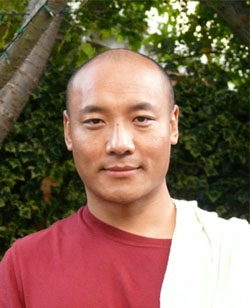
Anam Thubten

Next time I will try to describe the simple ways he invites us to drop our stories long enough to glimpse the reality that lies behind them.  If that’s biting off much more than I can chew, at least it’s easier than trying to answer Lear’s question.

Reflections on Story Water

My second post on this blog, on July 1, 2010, featured a poem called “Story Water” by the 13th century Persian mystic, Rumi.  It came to mind in the light of recent events.

Friday morning, as I worked on post #420, I got up for coffee and flipped on the radio.  The post concerned what folklore can teach us about living in difficult times.  After I heard of the murdered children, I put it aside.  Some events seem too much for stories.  Yet reflection later reminded me that stories are always with us, one way or another.  Rumi knew this.  He knew how the stories we hear feed our inner tales and the importance of choosing wisely where to place our attention.

On friday night, hundreds of people in Newtown, Connecticut went to church.  As I heard how they turned to a story of hope in a dark time, I thought of one of the first such stories I told myself.

One day in first grade, a classmate went home sick.  The following monday, the teacher told us she died.  I had seen dead birds in the woods behind our house, but that was the first time I realized death could visit at any time.  It could steal our friends and loved ones away in a heartbeat.

The dead girl’s name was Cindy Erwin, and she was the minister’s daughter.  I figured her father’s vocation gave her an in with Jesus, and she would be fine.  I never worried about Cindy, although I’ve never forgotten her name.  I knew it was the rest of us who were in trouble.

Stories like this, the ones we tell ourselves, shape our lives in ways we can barely imagine.  Everyone young or old who lived through events at Sandy Hook School or watched them unfold on TV will remember the day as long as they live and tell themselves stories about what happened and why and what it means.

According to Rumi, few of us know the answers with certainty.  That’s why we have stories.  That’s why they matter so much.  I think he would have agreed that in the end, the world is made of stories, so it matters very much which ones we tell each other and ourselves.  In ways we don’t understand, they shape the world as it unfolds.

STORY WATER by Rumi

A story is like water
that you heat for your bath.

It takes messages between the fire
and your skin. It lets them meet,
and it cleans you!

Very few can sit down
in the middle of the fire itself
like a salamander or Abraham.
We need intermediaries.

A feeling of fullness comes,
but usually it takes some bread
to bring it.

Beauty surrounds us,
but usually we need to be walking
in a garden to know it.

The body itself is a screen
to shield and partially reveal
the light that’s blazing
inside your presence.

Water, stories, the body,
all the things we do, are mediums
that hide and show what’s hidden.

Study them,
and enjoy this being washed
with a secret we sometimes know,

and then not.

The Life of Pi: A movie review

What you’ve heard about this movie is true: it’s the tale of a boy who winds up in a lifeboat in the Pacific with a Bengal tiger. It’s also true that most critics have praised The Life of Pi. I’m with them; this is a magical film.

Pi Patel livess an idyllic childhood in Pondicherry, India.  His father owns a zoo, and Pi develops a love for the animals as well as a spirituality that embraces the Hindu gods, Jesus, and Allah.

As he tries to practice all three faiths, his father, convinced of the supremacy of reason, warns that “If you believe in everything, you will end up not believing in anything at all.”  Pi’s father also demonstrates graphically that tigers are not your friend, a lesson that shakes Pi’s trust in nature.  The real blow falls after economic hardship forces Pi’s family to relinquish the zoo.  They sail for Canada with all the animals on a freighter, but a storm sinks the vessel, and Pi is the only human to survive.

What god do you pray to and what do say when your way of life and your family are suddenly gone, and you’re alone in a lifeboat with a zebra, an orangutan, a hyena, and a tiger named Richard Parker?  Initially, there is little time for prayer in the struggle to survive.  Soon it’s just Richard Parker and Pi.  There are cans of water and boxes of biscuits for 30 aboard the lifeboat, as well as a book on survival and a pencil that Pi uses to journal in the margins.

An optimist, Pi’s spirituality returns with expressions of gratitude and surrender as the ocean moves through her various phases, with deadly storms, cornucopias of fish and rain, and scenes of unearthly beauty.

Einstein once said the only important question is whether or not the universe is a friendly place. The adult Pi, who narrates the tale, believes it is. Was his ocean a friendly place or not? Both and neither, his story seems to say; it’s far more vast than that.

The western fantasy of objective truth leads us to believe there are true stories and false ones. The eastern view, shared at least in part by novelists and movie makers, is that our stories create our realities.

What does your heart say?  What does it lead you to believe?  That’s the question the grown-up Pi seems to asks us with his story and a half smile on his face.  It’s the same enigma the ocean and Robert Parker put to him.

The end of the world as we know it

Having slept through Black Friday, the next big event on my calendar is the Mayan apocalypse, scheduled for December 21.

I had no intention of blogging about this until I received the Winter 2012 issue of the University of Oregon Quarterly, where an article by Alice Tallmadge, “Doomsday or Deliverance?” discusses this prophecy in the context of end-of-the-world folklore.

Associate professor Dan Wojcik, director of the UO folklore program, plans to travel to Chichen Itza, one of a huge number of visitors expected for the event, which for some heralds the shift to a higher world age, in the same spirit as the Harmonic Convergence of 1987.  The main organizer of that event, as well as the biggest publicist of 12/21/12, was Jose Arguelles (1939-2011).  In his obituary, the New York Times described his philosophy as “an eclectic amalgm of Mayan and Aztec cosmology, the I Ching, the Book of Revelation, ancient-astronaut narratives, and more.”

On the other end of the spectrum, Alice Tallmadge reports that sales of survivalist goods have spiked in recent months.  A recent Reuters poll found that 15% of people worldwide, and 22% of Americans believe the world will end during their lifetime.  The apocalypse has been a feature of Christian theology from the start, but professor Wojcik notes a recent uptick in secular end-time beliefs:  pandemics, overpopulation, and climate change are seen as threats to the planet without any hope of spiritual redemption.

Things that have a beginning have an end, from gnats, to humans, to stars, and all of creation in the western view of time as linear.  When the world survives a predicted ending date, the error is put down to miscalculation; the expectation persists.  What is it about end-time predictions that continue to fascinate most of us and motivate many believers?  The old saying, “Fool me once, shame on you, fool me twice, shame on me” doesn’t hold in this realm.

I wonder if it parallels our continuing love for disaster film?  Stories of terrible struggle and danger where we get to imagine ourselves among the survivors or among the happily raptured, coming through the ordeal to enjoy “a new heaven and earth.”  The ultimate do-over.

They don’t get any better than one of my all time favorite “disaster films,” made decades before the phrase was coined:  San Francisco (1936), with Clark Gable, Spencer Tracy, and Jeanette MacDonald surviving the 1906 earthquake.

Here’s hoping all our December disasters turn out as well!

And finally, for extra credit, here’s a different kind of celebration, with REM performing “It’s the End of the World As We Know It (and I Feel Fine).  Enjoy!

A life lived for others

This has been a season of losses.  A friend recently died of something that should not have been fatal, and after the special treatments stopped working, we had to let go of our dog, Holly, who I wrote about in June.  That’s partly what motivated my recent reflections on what matters most in our lives.  The question comes up as well in the experience of a great friend and teacher who recovered from a serious illness this year.

Lama Kunga Thartse Rinpoche was born in Tibet in 1935.  At the age of eight, he entered Ngor monastery where he was ordained as a monk at 16.  In 1972, Rinpoche emigrated to the United States and later founded Ewam Choden Tibetan Buddhist Center in Kensington, CA (see the link on my blogroll).

Early this year, he was diagnosed with lymphoma.  He underwent chemotherapy while his nearby friends and students saw to his diet and daily needs.  Friends the world over offered prayers and traditional healing ceremonies.  His cancer is now in remission and he just returned to a full teaching schedule seeming more vigorus than ever.

Lama Kunga Thartse Rinpoche

A week ago Sunday, I joined some of Lama Kunga’s students and friends in the bay area to celebrate his birthday and his return to health.  This is a man who had lots of help in his time of need because he lives his life as everyone’s friend.  In Buddhism, compassion for all sentient beings is the most important attribute we can cultivate.  The Dalai Lama has said, “We can live without religion and meditation, but we cannot survive without human affection.”

Buddha gave different teachings for different kinds of practitioners.  The first was Hinayana, the “lesser vehicle,” which aims at enlightenment to end suffering for the individual.  Of far greater importance today is Mahayana, the “greater vehicle,” where the goal is to reach enlightenment for the benefit of all sentient beings.  People are naturally drawn to those who fully embody such an ideal.

His Holiness, the Dalai Lama

Though not nearly as well known as the Dalai Lama, Lama Kunga also has the magnetic personality of one who sincerely tries to benefit all other beings.  I hadn’t seen him in almost a year, but at his birthday party, we fell into conversation as if it had been just a week.  We talked about things like Tibetan ways of cooking  potatoes, but I found myself as uplifted as I have been after hearing him speak about subtle points of philosophy.

Some instructors teach with their whole being and not just their words, yet remain very human too.  Lama Kunga is an avid golfer.  In a 2002 interview in Golf Digest he said, “I would like to be reincarnated as a better golfer someday.”  One of his golfing buddies reports that he sometimes uses “colorful sounding phrases in Tibetan” on the course.

When I was a junior in high school, one of my teachers said, “I really think life is only satisfying when we live for something greater than ourselves.”  In the decades since then, the people I’ve most admired lived that ideal.  “Rinpoche” is an honorific that means “precious one,” a title that friends of Lama Kunga know he richly deserves.