No-Self, Part 3

Jack Kornfield is a widely respected author, teacher of Vipassana or Insight meditation, and a founder of the Spirit Rock Meditation Center, http://www.spiritrock.org.

In a classic discussion of spiritual practice in general, and Buddhist practice in particular, A Path With a Heart, Kornfield devotes a chapter, “No Self or True Self?” to the question of identity.  Two key points emerge:  not to take this too literally, and not to be upset by the concept.  He notes that his teacher, Achaan Chah, said, “If you try to understand it intellectually, your head will probably explode.”

Achaan Chah spoke of this paradox one evening in his monastery in a way that was quite astonishing for a Buddhist master.  He said, “You know, all this teaching about ‘no self’ is not true.”  He went on, “Of course, all the teachings about ‘self’ are not true either,” and he laughed.  Then he explained that each of these sets of words, “self” and “no self,” are only concepts or ideas that we use in a very crude approximation, pointing to the mystery of a process that is neither “self” nor “no self”

Another of Kornfield’s teachers, used to laugh at how easily and commonly we would grasp at new identities.  As for himself, he would say, “I am none of that.  I am not this body, so I was never born and will never die.  I am nothing and I am everything.  Your identities make all your problems.  Discover what is beyond them…

Those teachers and authors I have quoted over the last several posts share an interest in an experience I stumbled into – the seemingly counter-intuitive freedom that comes with relaxing our grip on rigid concepts of what we are and what we are not.  At any time this seems troublesome, the real question becomes, who or what feels enhanced or diminished by the words, “self” or “no-self?”

An excellent resource on this and other questions is the Spirit Rock website given above. Under the “Meditation 101” tab is another tab called “Audio Resources,” with links to literally hundreds of recorded talks, given at Spirit Rock and elsewhere, that plunge into seemingly difficult topics like this.

No Self, Part 2

People and things appear solid and self contained. We mostly experience ourselves as if we just appeared on earth the way Superman did – one day the wonder-baby showed up from outer space. Buddhism suggests that this conventional view is just a story, an idea, that doesn’t align very well with what we discover if we pay attention. In other words, Buddha told some different stories, that align more closely with experience, and with happier experience.

Like other great spiritual teachers, the Buddha knew he was telling stories (google on the Heart Sutra), and in particular, he warned his followers, that just because we suffer if we get attached to the story of a separate self, we will also suffer if we attach to the story of no-self – if we take it as a hard truth, a doctrine, a dogma.

Why does belief in a separate self cause suffering? Because it leads to a foxhole existence. Halt, who goes there, friend or foe? It also brings an awareness of physical mortality as loss – we aren’t going to last and neither is anyone we care about. My favorite analogy is one of the simplest: we experience ourselves as waves on the ocean, rushing to shore.  It may be exhilarating when we’re young and death is something that happens to old people, but let a few decades whiz by, and the rocks and shore look a whole lot closer. And aside from that, how often does the sense of separation cause an uncomfortable sense of disconnection?  A million variations on loneliness.  And how much more suffering do we create for ourselves and others in an effort to scratch the itch, dull the pain?

Jerry Uelsmann - Untitled

Buddha tried to shift our understanding. Yes, we are waves for a while, but our true nature is ocean. Ocean changes but it doesn’t go anywhere.  A wave that knows it is and will ever be ocean has a lot less to worry about.

***

Our true essence goes beyond birth and death.  It can never get sick.  It can never get old.  It is beyond all conditions.  It is like the sky.  This is not a theory.  This is the truth that can only be realized in the realm of enlightened consciousness.  This consciousness is surprisingly accessible to each of us. – Anam Thubten

When that awakening happens there is no longer any desire to become something other than who we are. Every previous idea of who we are vanishes, along with the pain, guilt, and pride associated with our body. In Buddhism this is called no-self. This is the only true awakening. Everything else is a spiritual bypass.– Anam Thubten (emphasis added).

Try this.  Pay attention to your breath in silence.  Look at your mind.  Immediately you see thoughts are popping up.  Don’t react to them.  Just keep watching your mind.  Notice that there is a gap between each thought.  Notice that there is a space between the place where the last thought came to an end and the next one hasn’t arrived.  In this space there is no “I” or “me.”  That’s it. – Anam Thubten (emphasis added).

***

The sense-of-self is an assumed reality.  Only the idea of “me” separates us from the unconditioned truth of our being…It is possible to simply stop believing in the validity of the view of separation and free it from its isolated position by bringing the view of separation itself into awareness.  This means we are cued to the subtle pain caused by separation, and simply release the thought of separation without picking it back up. – Rodney Smith

***

I like the rainbow analogy; I can grasp it because we’re not dealing with something that appears to be solid like a person or a rock.

Let’s say a rainbow decided to practice a meditation common to eastern traditions, by asking the question, “Who am I?” and watching what thoughts pop up.  The rainbow starts out believing it is a thing, but what kind of thing?  Strangely enough, if this rainbow is very determined, it will not find anything called “rainbow!”  It sets out to discover its true rainbow self, and simply but it simply cannot be found.

What am I?   –    A rainbow.
What is a rainbow? – Umm…

What am I? – A person.
What is a person? – Umm…wanna check my ID?

If this rainbow has a lot of courage, it will discover it is made of water droplets.  And sunlight, since there are no rainbows until the storm breaks up.  And it is made of the time of day, since there are no rainbows at night.  And it its existence depends on the perspective of people watching.  Drive another five or ten miles down the highway and we may not see the rainbow anymore, though others behind us may.

As Thich Nhat Hahn would say, our rainbow discovers it is made entirely of non-rainbow elements.  It exists, but it is “empty” of a true, essential, rainbow-self.  The poor little guy may freak out at first, and yet…

Rainbow over Carmel Beach

Ultimately, it may be quite a relief. Rainbows don’t live very long.  Not even as long as flies.  Yet water and sunlight and clouds and daytime and people watching the sky are not going away…

To sneak in a Shakespeare quote:

Nothing of him that doth fade,
but doth suffer a sea-change,
into something rich and strange.

TO BE CONTINUED
No-Self, Part 1

For several months, I have been side-stepping the article I really want to write, because it is difficult, potentially upsetting to some readers if I say it wrong, and because “who do I think I am?”

I have been wanting to write about the Buddha’s teaching of “No-Self,” or Anatta, in the up-close and personal way I have come to experience it.

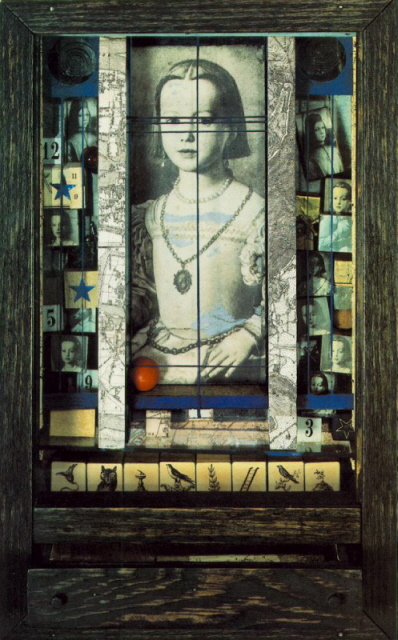
Joseph Cornell - "Medici Princess"

One of the saner things I did at the end my mis-spent youth, was to begin practicing meditation and contemplative spirituality.  Twenty-five years later I was still at it.   I had experienced incremental results: better, health, concentration, relaxation, and so on.  But something was still missing.

Around 2005 I was itching to drop some of my baggage of meditation techniques, theories and beliefs and “cut to the chase.”  To simplify!  It was like walking into a cluttered room and deciding some of the crap has to go.  My thoughts turned to  Zen practice because I had read The Three Pillars of Zen, and I couldn’t think of anything more bare-bones than just to sit and breathe, which I was (hopefully) going to continue doing anyway.

I had shied away from Buddhism because I once tried to read Thich Nhat Hahn and misunderstood what he had to say about “No-Self.”  I thought he was saying the soul or “true-self, that part of us that feels very valuable, is not real.  Buddhists do not say that “self” isn’t real, so much as they say it isn’t real in the way we think it is real.

I like the analogy to a rainbow.  A rainbow is real (while it lasts) but it isn’t real in the way it appears – and we’re better off not pinning our hopes to the pot of gold at the end.

Jerry Uelsmann - "Undiscovered Self"

Anyway, in 2005, I attended a Zen Sesshin (several days of morning-to-night practice) taught by a Catholic priest (which isn’t as uncommon as people might think).  It was…nice.  Not bad, not great, but overall, relaxing and…nice.  I appreciated the simplicity and it hooked me enough that I kept sitting like that once I got home.  And a few months later, nice turned into something a lot more powerful.

One evening during the holiday season, as I thought of family members and friends who were gone, and a parent who was ailing, I felt a profound sense of loss, of precious things slipping away.  But in the next instant a thought came; with perfect, instant, compelling clarity.  The thought just appearedWho is sad? And in that instant, there was nobody there! All that saddness was gone because there was no one there to feel sad.

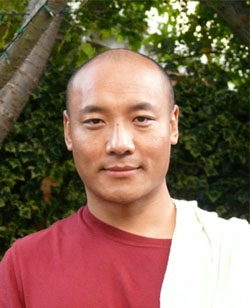
I didn’t need the priest to confirm that it was the real deal, though he did a while later when I spoke to him again.   I got a further confirmation when I attended a daylong retreat led by Anam Thubten, a Tibetan Buddhist teacher whose message is summarized in the title of his book, No Self, No Problem.  His basic suggestion for meditation is simply to rest from all physical and mental effort:

As we begin to rest and pay attention, we begin to see everything clearly.  We see that the self has no basis or solidity…We might want to apply this simple inquiry whenever problems arise.  If we feel angry or disappointed, simply ask, “Who is the one being angry or disappointed?”  In such an inquiry, inner serenity can effortlessly manifest…When all the layers of false identity have been stripped off, there is no longer any version of that old self.  What is left behind is pure consciousness.  That is our original being.  That is our true identity. No Self, No Problem pp. 5-6.

Anam Thubten

Anam Thubten’s website:  http://www.dharmatafoundation.com/about.aspx

TO BE CONTINUED.

Story Water

Here is a take on the potential of stories from the 13th century poet and mystic, Rumi.

STORY WATER

A story is like water
that you heat for your bath.

It takes messages between the fire
and your skin. It lets them meet,
and it cleans you!

Very few can sit down
in the middle of the fire itself
like a salamander or Abraham.
We need intermediaries.

A feeling of fullness comes,
but usually it takes some bread
to bring it.

Beauty surrounds us,
but usually we need to be walking
in a garden to know it.

The body itself is a screen
to shield and partially reveal
the light that’s blazing
inside your presence.

Water, stories, the body,
all the things we do, are mediums
that hide and show what’s hidden.

Study them,
and enjoy this being washed
with a secret we sometimes know,

and then not.

Barks, Coleman (ed).  (1995).   The Essential Rumi. San Francisco:   HarperCollins.