Notes from 2017: Six ways to be miserable (and one way to be happy).

Public Doman

Public Doman

The following aphorisms on traits to avoid were written by Patrul Rinpoche, a 19th c. Tibetan master. A contemporary Tibetan lama, Phakchok Rinpoche, gave a teaching on the text that was printed in Tricycle in January, 2016. Here are the aphorisms:

The proud will never be pleased.

The jealous will never be happy.

The greedy will never be satisfied.

The hateful will never be reconciled.

The stingy will never have enough.

The ignorant will never accomplish.

By contrast, here is what the Dalai Lama advised to cultivate happiness and wellbeing:

“If you want others to be happy, practice compassion. If you want to be happy, practice compassion.”

Notes on Saint Stephen

100-saint-stephen

Today, December 26, is known as Saint Stephen’s Day, and in the UK, as “Boxing Day.” I’ve never understood the latter term – nor does Wikipedia, which says, “There are competing theories for the origins of the term, none of which are definitive.”

Saint Stephen was the first Christian martyr. A young and zealous deacon in the early church, he was tried for blasphemy. After denouncing the authorities who sat in judgement upon him, he was stoned in the year 34. Saul of Tarsus, who later became Saint Paul, famously held the cloaks of those who threw the stones.

The word, “martyr,” has lost much of its meaning through overuse. Now we use the word for someone who complains a lot. In church history, a few of the early martyrs seemed to choose their fate. There are stories of judges who said, “Look, if you just shut up, I’ll let you go,” but they wouldn’t. They believed that this literal following of Christ was a fast-track ticket to heaven.

The last thing the world needs now is religious zealots of any variety – those willing to use physical or legislative violence to try to destroy other people’s freedom to believe what they want to believe. Atrocities committed in the name of God – any God – are especially heinous. I suspect that much of that sort of violence, like politically motivated violence, boils down to fear. If my self-knowledge is so shallow that I don’t really know where I stand, then a contrary opinion that threatens my world view must be discredited or or silenced.

There are ways other than projecting my views onto some vengeful God. The Dalai Lama, one who humbly but joyously lives by the words he speaks, has said, “We could do without religion, and we could do without ritual, but we cannot survive without kindness.”

-Great words to remember on Boxing Day, which I’m pretty sure has to do with re-gifting rather than post-Christmas pugilism…

Prayers for Standing Rock

prayer-for-standing-rock

At 10:00am Central time, on Sunday, December 4, there will be a world-wide half hour of prayer and meditation “with the water, the earth, and the global community of supporters” of the Standing Rock Sioux nation, of those whose lives depend on the Missouri River, and all who understand the importance to all beings, of clean drinking water and reverence for sacred space.

You can register to participate at praywithstandingrock.com, donate to the water protectors, and sign a petition to President Obama, requesting that he end the violence against unarmed, peaceful protestors, who understand that water is more important than oil.

Here is an interview with Wendy Egyoku Nakao, abbot of the Los Angeles Zen Center, on why she, her and her organization, and more than 500 clergy of all denominations support the Sioux nation:

“I think we are heading for more confrontation in the days ahead. The First Nation peoples are taking a ceremonial and prayerful stand for healing from historical trauma and declaring their right to live on this earth. The DAPL folks have continued their actions, with the support of the Morton County law enforcement, regardless of injunctions, and are poised to go under the Missouri River. The mainstream media all but ignores what is happening. The current POTUS has been weak on the issue; the future POTUS is invested in Energy Transfer Partners. I encourage everyone to Stand with Standing Rock and protect the Water. Water is Life.”

Timely quotes from Reinhold Niebuhr

Reinhold Niebuhr,By Source, Fair use, Link

Reinhold Niebuhr,By Source, Fair use, Link

Reinhold Niebuhr (1892-1971) was an American theologian, ethicist, commentator on politics, and professor at Union Theological Seminary for 30 years. Among his most acclaimed books are, Moral Man and Immoral Society, and The Nature and Destiny of Man, which Modern Library named as one of the 20 best nonfiction books of the 20th century.

Neibuhr’s  best known work, however, is the Serenity Prayer: “God, grant me the serenity to accept the things I cannot change, the courage to change the things I can, and the wisdom to know the difference.”

In the wake of this year’s election cycle, his musings on history and politics have a special poignancy and relevance:

“The tendency to claim God as an ally for our partisan value and ends is the source of all religious fanaticism.”

“Frantic orthodoxy is never rooted in faith but in doubt. It is when we are unsure that we are doubly sure. ”

“Religion, declares the modern man, is consciousness of our highest social values. Nothing could be further from the truth. True religion is a profound uneasiness about our highest social values.”

“Religion is so frequently a source of confusion in political life, and so frequently dangerous to democracy, precisely because it introduces absolutes into the realm of relative values.”

Neibuhr’s most haunting observation to me is this, which implies that not a single one of the countless empires that have risen and fallen before ours made much of their greatness until it was gone:

“One of the most pathetic aspects of human history is that every civilization expresses itself most pretentiously, compounds its partial and universal values most convincingly, and claims immortality for its finite existence at the very moment when the decay which leads to death has already begun.”

Harbor Scene with Roman Ruins, Leonardo Coccorante (1680-1750), public domain

Harbor Scene with Roman Ruins, Leonardo Coccorante (1680-1750), public domain

Within

Enso (public domain)

Enso (public domain)

There is Buddha in each of us right now who can never be defeated by the force of inner darkness, the force of greed, hate, attachment, and delusion, and that Buddha has no form, no image.  That Buddha, indeed, is residing in all of us as our pure, quintessential being.

We must always turn our attention inward whenever we have the desire to seek divinity, the divine, or Buddha, God, or Brahma.  This desire to seek something divine happens quite a lot, especially when we are spiritual.  From now on, whenever that desire arises, we might want to remember to immediately turn the attention inward, knowing…that whatever we are seeking is already inside.

Hungry Ghosts

Section of Hungry Ghosts Scroll, Kyoto, late 12th c., Public Domain

Section of Hungry Ghosts Scroll, Kyoto, late 12th c., Public Domain

In traditional Buddhist cosmology, there are six major realms of existence. Only two of these, the human and animal realms, are visible. The other four, which include both heavens and hells, are not manifest to our physical senses. Unlike Christian heaven and hell, none of these are forever – the length of one’s sojourn depends on karma.

Many contemporary teachers, while not denying the metaphysical reality of these regions, focus on our inner “location” in the here and now. One who is filled with love and compassion dwells in heaven. The one seething with anger, red in the face, like a devil, at that moment experiences one of the hells.

Hungry ghosts have a region all to themselves; their dominant trait is insatiable craving. Hungry ghosts are depicted with huge bellies but tiny throats and mouths – desperate hunger and thirst that can never find relief.

Never enough, there is never, ever enough,” is the mindset of hungry ghosts, both in the imagined subtle realm and in this world. Addictions and insatiable cravings of all sorts make us hungry ghosts. The pre-repentant Ebenezer Scrooge, the archetypal miser, is the best known western hungry ghost. Now, the Panama Papers reveal how widespread is this disease, and how it drives the leaders and elites in nations throughout the world. Nor do we, at least in “the free world,” get to sit back and righteously condemn “those bad people.” Not in Buddhist thought, at least, where everything is interconnected.

The people of Iceland forced their Prime Minister out of office within 48 hours of the time the story broke. They did the same with the bankers in 2008. We, who have elected officials of both parties who tolerate bailouts and corporate shell games, are are not separate from the hungry ghosts who are fucking this world.

In his public discourse, Buddha never commented one way or another on metaphysical truths. There’s plenty to worry about here and now, he said. If greed locks us into the hell of the hungry ghosts, generosity, the mindset of Scrooge on Christmas morning, opens the gates of heaven.
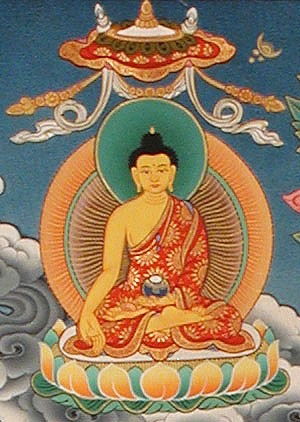
Ratnasambhava, the primordial Buddha of "the wisdom of equality," manifests the virtue of generosity.

Ratnasambhava, the primordial Buddha of “the wisdom of equality,” manifests the virtue of generosity.

Perhaps there are no big or small acts of generosity. Our world, the people in it, and we ourselves, need nothing more urgently at this time.


A “small” thing

I’ve read about this, but it never happened to me before.

Late yesterday afternoon I was driving home from the bay area. I’d been up at 6:30 to attend a second day of Dharma teachings. The weather was fine, traffic was moving, I was listening to a decent audio book, but a wave of fatigue overtook me, and all I could think of was stopping for a stretch and caffeine at a Starbucks up the road.

I pulled up behind a small truck and half a dozen cars at the Benicia Bridge tollbooth. The truck seemed to take forever getting through, as if there was an argument about the toll. With some mixture of fatigue and (hopefully) the wisdom I had absorbed from the teachings, I waited patiently, and finally reached the window. I handed a five dollar bill to the cashier.

“No need, sir,” she said. “The lady ahead of you paid your toll.”

As I said, previously, this was something I had only read about before. I was suddenly wide awake, wondering how I could pass the gift on. Carry $10 next time I came to that bridge and pay for the stranger behind me, yes, but what about day to day actions? I don’t cross toll bridges often, and as I felt the effect of that small gesture ripple through me, all I could think of was how to pass it on.

“Don’t bother trying to save the world,” one of the lamas had said. “What right choice is in front of you now?”

What a powerful question, and how worthwhile it is to keep it in mind!