Artifacts of our ambition

artifacts1

Last night at dusk I went out to turn off a backyard sprinkler and noticed a broken garden plaque that lay among fallen leaves and plums.  It’s been there for quite some time, one of those objects I don’t know what to do with but like too much to throw away, so I leave it where it lies.  Last night, in the twilight, I noticed it.

A phrase sprang to mind:  “You look for the artifacts of their ambitions.”  This is the first line in Michael Koryta’s superb supernatural thriller, So Cold the River.  The main character goes on to say, “The reality of someone’s heart lay in the objects of their desires.  Whether those things were achieved did not matter nearly so much as what they had been.”

The plaque was a primitive image of the sun – the word “SOL” is still visible.  We got it in Mendocino a long time ago and hung it on the fence at a time when gardening was one of our major activities.  Its importance waned under the time pressures that came with more “gainful” employment,” but this little artifact, like a Velveteen Rabbit made out of stone, can still speak when I stop to listen.

After I snapped this photograph, I went looking for other such artifacts, both in a box of old pictures of mine and among vintage postcards, photos, and tintypes I’ve collected.  If you are a packrat like me, you surround yourself with such things. 

Dreams change, and ambitions, just like our lives, can be fleeting. The artifacts often outlive them. Nothing shows that more clearly than this picture of my father, my sister, and me by a stone wall I helped build.

father, me and jan

The Kodachrome is fading and my father is gone, but not long ago, I checked Google’s satellite view, and that stone retaining wall, some 3,000 miles from where I now live, still appears to be standing.  How can you even begin to say what it means when you’re five and your father shows you how to place stones in a wall and trowel the concrete into place between them?  “The reality of someone’s heart lay in the object of their desires.”

boys of summer

I’ve always liked this team photo, with its mix of bravado and shyness in front of the camera.  Did any of these boys of summer dream of playing in the majors?  Did any of them come close?  Did they love the game any less than the 2013 all stars who played in front of millions of viewers last week?  I’m guessing that at the moment this picture was taken, they may have loved it more.
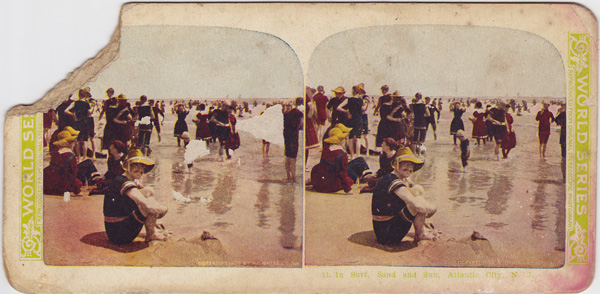
stereo picture

What about the fellow in the foreground of this stereopticon slide? Do we even want to know about his ambitions?  Close up, he looks like Groucho Marx in a yellow hat.  The picture is labelled “Surf, Sand, and Fun, Atlantic City, NJ.”

cemetary photo

This is a poignant image, from a photo I took of an arrangement in a glass box, embedded in a gravestone in an old Italian cemetery in Binghamton, NY.  Virgin Mary stands amid plastic roses, her image distorted by thick old glass.  I spent a summer there working in a factory, and returned again and again to this cemetery, which was full of angels and lambs and redeemers, for don’t these all speak of a nearly universal ambition – the longing for redemption, in the here, the hereafter, or both?  The world is alive and things within it can speak to us if we listen.

And finally, one of my more important artifacts.  I kept this photo of a young 19th century woman over my desk while writing my first novel.  This, I thought, was how the book’s heroine would have looked if she’d posed for a picture.  So this photograph, taken more than a hundred years ago, of a woman whose dreams I cannot begin to fathom, became an icon for one of my own ambitions.

old photo of young woman

I didn’t tell her story very well, but as the character in So Cold the River observes, that often doesn’t matter.  Sometimes when I look at this picture now, it holds a greater mystery than it ever did when I used it as a writer’s prompt.  Now I can see its own inscrutable mystery.

James Hillman often quoted John Keats who said, “Call the world if you please ‘The vale of Soul-making.’ Then you will find out the use of the world.”  In the same letter to his brother and sister, Keats added that our pains and troubles “school an Intelligence and make it a Soul.”

Artifacts of our ambitions are things we notice as the eyes of soul begin to open.


Despicable Me 2

despicableme2

In this year of superheroes and sequels, with intrusive digital effects everywhere you turn and an actor who should know better wearing a stupid dead crow on his head, it is July and I’ve been to the movies exactly twice.

I had the most fun at Despicable Me 2, and was delighted to find it a beautifully crafted film.  If you’ve been waiting…and waiting…and waiting some more for a movie worth venturing out to the cineplex, the drought has lifted with this one.

Disclaimer:  I get nothing in return from anyone for writing this review, but I’m still sort of hoping that karmic forces, somehow and somewhere may award me a minion or two for my efforts.  Come on – wouldn’t you like a few of the happy little guys to do the chores around your home?

You know you would…

Informed Citizen Disorder

Words can sometimes illuminate.  Bill Moyers’ recent interview with Marty Kaplan, Professor of Entertainment, Media, and Society at USC, gave me a phrase that crystalizes the sense of despair that increasingly follows attending to current events.  “Our spirits have been sickened by the toxins baked into our political system,” Kaplan says.  That’s one definition of what he calls, “Informed Citizen Disorder.”

Marty Kaplan by adamrog, CC-by-SA-3.0

Marty Kaplan by adamrog, CC-by-SA-3.0

Kaplan has an impressive and varied resume; a degree in Microbiology from Harvard; a Ph.D in Modern Thought and Literature from Stanford; twelve years as a Vice President at Walt Disney Studios.  Kaplan wrote speeches for Walter Mondale and co-authored the screenplay for The Distinguished Gentleman (1992) starring Eddie Murphy.  He was the founding Director of the Norman Lear Center at USC, which studies “the social, political, economic and cultural impact of entertainment on the world.”

In the interview with Moyers, called Weapons of Mass Distraction, Kaplan spoke of the weeks he recently spent in Brazil, watching the widespread protests against “political corruption, economic injustice, poor health care, inadequate schools, lousy mass transit, [and] a crumbling infrastructure” while the government spends billions to host the 2014 World Cup and the 2016 Summer Olympics.

One of the obvious questions Kaplan asks is where are the protests in our country?  With ills so blatant and parallel to Brazil, where is our outrage?

“Sickened spirits,” is one of his answers.  Another is misdirection; what passes for journalism often has us asking the wrong questions as it feeds us “the infotainment narrative of life in America.”  Learned helplessness is another factor that Kaplan often cites.

Learned helplessness entered the language of psychology in a now-famous experiment conducted by Martin Seligman in 1967.  Dogs were subjected to electro-shocks with no means to avoid them.  Eventually, they stopped looking for an escape and entered a passive and “hopeless” mode.  In the experiment’s final phase, when means of avoidance were introduced, the dogs did not discover them, because the helplessness had been so thoroughly learned they no longer even tried.  Researchers had to retrain them to manipulate their surroundings again.

The analogies to our situation are obvious.  Citing incidents like the lack of change after Sandy Hook, Kaplan wonders how many times can we stand to have our hearts broken?  Answering a question from Moyers on “Informed Citizen Disorder,” he adds:  

“Ever since I was in junior high school, I was taught that to be a good citizen meant you needed to know what was going on in your country and in your world. You should read the paper, you should pay attention to the news, that’s part of your responsibility of being an American.

And the problem, especially in recent years, is the more informed I am, the more despondent I am, because day after day, there is news which drives me crazy and I want to see the public rise up in outrage and say, no, you can’t do that, banks. You can’t do that, corporations. You can’t do that polluters, you have to stop and pay attention to the laws, or we’re going to change the laws.

…every time that doesn’t happen…something bad happened and nothing was done about it…the sadder one is when you consume all that news…all the incentives are perverse. The way to be happy, to avoid this despondency is to be oblivious to it all, to live in Aldous Huxley’s ‘Brave New World.'”

Despite everything, Kaplan remains an optimist.  “I have kids,” he says, “I have to be.  The world has kids, we have to be.”  The alternative to optimism, Kaplan warns, is to “medicate yourself with the latest blockbuster and some sugar, salt, and fat that’s being marketed to you.  The only responsible thing that you can do is say that individuals can make a difference and I will try…”

Not the happy-happy answer we’d get from the “infotainment” world, but though Kaplan is an optimist, he’s not going to feed us bullshit.  I urge everyone to listen to the interview or read the transcript.  A key finding with learned helplessness that researchers discovered and Kaplan cites, is that since it is based on perception rather than fact, it can be quickly reversed.  We’re not there yet, he thinks, but maybe as people become more and more unhappy with the state of affairs around them, a critical mass is building that will lead ordinary citizens to demand change as we have done in the past.

More good news on the food front

Last week, two posts on npr.org opened a startling window on the capacity of well tended small gardens. The first article, “Why Micro-Gardening Could Go Big,” discussed the UN’s Food and Agriculture Organization (FAO) as a large supporter of micro-gardens, defined as “intensely cultivated small spaces.”  They claim that an 11 square foot garden can produce “as much as 200 tomatoes a year, 36 heads of lettuce every 60 days, 10 cabbages every 90 days, and 100 onions every 120 days.”

Micro-garden by Nick Saltmarsh, 2009.  CC-by-3.0

Micro-garden by Nick Saltmarsh, 2009. CC-by-3.0

The post features a number of links to other sites with numerous links of their own, and it soon becomes clear that many groups and individuals are finding new ways of boosting yields.  As I discussed recently (Good news on the food front), unless agriculture finds ways of keeping pace with population growth, disaster is a mathematical certainty.

These articles show that there are far more efficient configurations than traditional, single row gardens. Raised beds and containers are common features of the gardens pictured online.

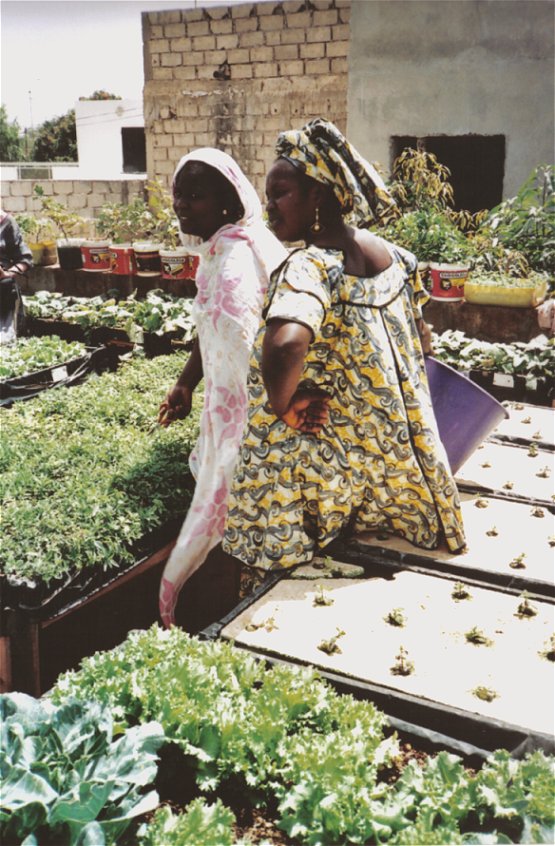
Rooftop garden, Senegal, CC-by-2.0

Rooftop garden, Senegal, CC-by-2.0

One nice thing about these photos is that they make you want to get your hands dirty! Maybe not this afternoon, with temps in the mid 90’s, but I’ve already got a spot in mind for the fall and spring.  We used to have a veggie garden when we lived north of here and had more time and far better soil.  With micro-gardens you don’t need large amounts of time or good soil to get started.

Photo by USDA.  CC-by-2.0

Photo by USDA. CC-by-2.0

NPR’s second post, Micro-Garden Madness, has additional photos of places where people are growing things.  Unlike the ambitious plots at the local community gardens, where you often see couples and families work long hours on weekends and evenings, the smaller gardens can work for people who spend their evenings and weekends in strange pursuits like blogging.

Phil Weiner co-founded a company that makes products aimed at micro-gardeners.  “Everyone in the world should have a victory garden,” he says.

Can we even begin to imagine what such a world would be like?  With these articles and photos, we can begin to envision such a transformation.

Tis the season?

First Christmas catalog arrival date for 2013 - July 5

First Christmas catalog arrival date for 2013 – July 5

At the risk of being accused of having an idle mind, let tell you that over the last few years, I have tracked the arrival date of the first Christmas catalogs.  It was the end of July in 2010, and over the next two years, the trend seemed to reverse – no Santa’s in the mail until August.  This year we’ve hit a new low.  The first one, inviting me to “Celebrate life’s special moments,” was delivered July 5, with two more arriving the next day.

Here I am, just beginning to mourn the beginning of shorter days as a new threat looms on the horizon – if “the most wonderful time of the year” can almost breach the Independence Day bulwark, can “holiday music” be far behind?  Are you ready for “Little Saint Nick” in the stores in September?  Note to self – carry earbuds everywhere!

Every year it seems I come to a greater appreciation of the pre-repentant, “Humbug” Ebenezer.

And when the days grow short and the weather turns cold, I’ll be singing along with Joni Mitchell – “Wish I had a river I could skate away on.”

Your Own Damn Life: an interview with Michael Meade in The Sun

Michael Meade is an author, storyteller, and a passionate advocate of soul values in a world that increasingly ignores them; I’ve written about Meade or mentioned him in half a dozen posts.

In The Water of Life (revised, 2006) he shares his discovery that stories can be a matter of life and death.  As a teen in New York, when confronted by gang members from a rival neighborhood, Meade didn’t just lie his way out of serious injury or worse – he storied his way out, with an elaborate made-up tale that won over the assailants long enough for him to make his escape.  Readers of my recent posts will recognize a thriving trickster in Meade when he was just a kid!

I recently found an interview between Michael Meade and John Malkin in the The Sun that is as timely today, or more so, than in November, 2011, when it was published.  In the interview, “Your Own Damn Life,” Meade quotes an African proverb, “When death finds you, may it find you alive.”  Alive, he goes on to say, “means living your own damn life, not the life that your parents wanted, or the life some cultural group or political party wanted, but the life that your own soul wants to live.”

In the past, meaningful stories could guide soul evolution, but now, with the culture and the natural world both in crisis, Meade points to our lack of coherent, guiding tales.  A culture falls apart, he says, when youthful imagination and energy are stunted and when the traditional wisdom of elders is forgotten.  At one extreme, “You’re not supposed to be worrying about the end of the world as a teenager; you’re supposed to be bringing your dream to it. The world seems old and troubled now, and the young are no longer allowed to be as young as they should be.”  At the other extreme, we have a lot of “olders” but not many wise “elders.”

When traditional stories collapse, Meade says, the guiding and healing stories must come from within.  “That means going to the core of your own life and finding the story seeded within.”  Meade has tried to facilitate such explorations through his writings and talks, which first became known in the 80’s when he, James Hillman, and Robert Bly hosted a series of men’s conferences.

Meade continues to teach, write, and offer a variety of community services through the non-profit Mosaic Foundation he founded in Seattle where he lives.  If you’ve read this far, you will find Meade’s interview in The Sun and the Mosaic page hightly rewarding and likely sources for new ideas.


Weekend Video: The Real Meaning of Life

For now, the heat has broken. It’s Sunday. Went for an early dog walk and had the park almost to ourselves. Now the dogs are dozing at my feet and there’s a cup of coffee nearby – a good frame of mind to watch a short but inspiring video I found posted on Life Out of the Box, a blog that always rewards the time I spend exploring it.

lifeoutofthebox's avatarLife Out of the Box

LOOTB Weekend Video: The Real Meaning of Life

Here’s a great video that we found by one of our favorite philosophers Alan Watts. We’ve shared another video of his in the past, What Do I Desire, because his philosophy on life is so in line with the mentality we have here with Life Out of the Box. In this video he explains what the real meaning of life is and that it’s not about the destination of success that we’re after, but rather the journey along the way. His words continue to inspire us to go after our dreams and live the life we desire and we hope they do the same for you all on this beautiful Saturday morning. Make it a weekend to remember friends!

View original post

July 6 is the Dalai Lama’s birthday

His Holiness with a participant at the Young Minds Conference in Sidney, Australia, June 17, 2013

His Holiness with a participant at the Young Minds Conference in Sidney, Australia, June 17, 2013

His Holiness the Dalai Lama is 78 today.  Regarded by many as an emanation of Avalokiteshvara, the Buddha of Compassion, here is a summary of the Dalai Lama’s mission in the world from the website of the Gyuto Vajrayana Center in San Jose.

Three Main Commitments of His Holiness

Firstly, on the level of a human being, His Holiness’ first commitment is the promotion of human values such as compassion, forgiveness, tolerance, contentment and self-discipline. All human beings are the same. We all want happiness and do not want suffering. Even people who do not believe in religion recognize the importance of these human values in making their life happier. His Holiness refers to these human values as secular ethics. He remains committed to talk about the importance of these human values and share them with everyone he meets.

Secondly, on the level of a religious practitioner, His Holiness’ second commitment is the promotion of religious harmony and understanding among the world’s major religious traditions. Despite philosophical differences, all major world religions have the same potential to create good human beings. It is therefore important for all religious traditions to respect one another and recognize the value of each other’s respective traditions. As far as one truth, one religion is concerned, this is relevant on an individual level. However, for the community at large, several truths, several religions are necessary.

Thirdly, His Holiness is a Tibetan and carries the name of the ‘Dalai Lama’. Therefore, his third commitment is to work to preserve Tibet’s Buddhist culture, a culture of peace and non-violence.