The Neverending Story: A Movie Review

Several people had wonderful things to say in response to preceding birthday post, where I restated what has become the mission statement of this blog:  to look for the fantasy in all realities and the reality in all fantasy.  The comments were almost too kind – but not quite – and they prompted me to begin several posts on people and things that have shaped my thinking about imagination.  What jumps to mind first is movie released in 1984.

The Neverending Story, 1979, a fantasy novel by German author, Michael Ende, was translated into English in 1983.  A film was released the following year, which I saw in the early ’90’s, after one of my psych professors said, “It’s a story about our culture’s war on imagination.”

A lonely boy named Bastian loves to read.  One morning on the way to school, he ducks into a bookstore to escape pursuing bullies.  He asks the grumpy store owner about an intriguing book called, The Neverending Story.  “It isn’t safe,” the owner says.  At an opportune moment, Bastian “borrows” the book and carries it into the school attic to read.

The book relates how the kingdom of Fantasia is under attack by the Nothing, a dark void that consumes everything it touches.  The creatures of Fantasia appeal to their ruler, The Childlike Empress, but the Nothing has made her ill.  She summons Atreyu, a warrior of Bastian’s age, to conquer The Nothing, and gives him a magical talisman, the AURYN to guide him on the quest.  The force behind The Nothing summons Gmork, a wolf-like beast who craves power, to kill Atreyu.

The AURYN. Stephen Spielberg keeps the original prop in his office

Nowadays we’d call this a middle-grade book, but 33 years ago, when The Neverending Story was written, that label didn’t exist.  Most books written for young people, then and now, focus on personal issues.  Bastian is lonely and has trouble at school, but this is just the inciting action, not the real subject of the story.  The book and movie are unique in presenting a very adult theme – imagination and the forces arrayed against it – in fiction for this age group.

Atreyu finds no clues concerning the Nothing, so he risks the Swamps of Saddness to find the wisest being in Fantasia. Those who succumb to the sadness sink into the swamp and are lost. This is the fate of Atreyu’s beloved horse, Artax.

The wise being  cannot help, but directs Atreyu to the Southern Oracle, 10,000 miles away.  While trudging through the swamp with Gmork on his trail and little chance of success,Atreyu begins to sink into despair.  A Luckdragon named Falkor rescues him and carries him most of the way to the oracle.

Atreyu and Falkor

The oracle tells Atreyu that the only way to save Fantasia is for a human child, who lives beyond the borders of the realm, to give the Childlike Empress a new name. Then the oracle crumbles, a victim of the Nothing.

Falkor and Atreyu seek the border, and find the Nothing, which has become incredibly strong. Atreyu encounters Gmork who explains that Fantasia is “humanity’s hopes and dreams,” while the Nothing is “human apathy, cynicism, and the denial of childish dreams.”

Atreyu kills Gmork but is wounded and nearly falls victim to the Nothing. He is rescued once again by Falkor, but when he regains consciousness, only fragments of Fantasia remain, floating in the void.  The two make their way to the Ivory Tower, where Atreyu tells the Empress he has failed.

She says no, he has succeeded.  His quest was the only way to draw the attention of the human child, who is listening to them as they speak.  Bastian realizes she is talking of him.  As the Nothing begins to consume the Tower, the Empress begs him to say her name.  Bastian races to the attic window, and cries, “Moonchild!” into the face of an approaching storm.  He finds himself face to face with the Empress, who reveals that the Nothing has consumed all of Fantasia but a single grain of sand.

The Empress gives Bastian the last grain of sand of Fantasia

The Empress tells Bastian that his imagination and wishes have the power to restore the land to its former glory. In the final scene, we see Bastian soaring on Falkor through skies in Fantasia and his own world.  I wasn’t crazy about the ending.  There’s a Disney quality though out, since in the days before digital animation, films like this relied  on animated models and actors in costumes, but that was not necessarily a liability.  Jim Henson pulled it off without missing a beat in Dark Crystal, 1982.

In the last scene of The Neverending Story, I’m aware of watching a children’s movie, which disappoints, since most of the film was greater than any such category.  Even so, in the 20 years that have passed since I saw the movie, I’ve never forgotten the chords it struck concerning imagination.  Please take a look at this clip of Atreyu meeting Gmork to get a sense of the movie’s scope:

In succeeding posts, we’ll look at some views of Depth Psychology and certain spiritual traditions.  For both of them, literalism is the enemy of living with soul and imagination.   The Neverending Story tells us this is a battle we each must fight in our own hearts and minds.  The world of practical affairs and the marketplace have never had much use for the world’s dreamers.  Can we still manage to hear the cries of the Otherworld beings who fade into nothing at our lack of attention?  “Rosebud” in Citizen Kane is the dying cry of someone who lost Fantasia.

The Neverending Story echoes world folklore in showing the need otherworld creatures have for humans.  Irish and Scottish fairies steal mortal children.  The fairy queen sought out Thomas the Rhymer to be his consort for seven years, the same length of time the sea nymph, Calypso, held onto Odysseus in ancient Greece.  Why do such beings need us for redemption?

These are just some of the questions this apparently simple “children’s movie” raises.  They are far to complex to answer here, but I plan to take some additional forays into imaginal realms in the next few posts, so please stay tuned.

Happy Belated Birthday!

June 28 was the second anniversary of this blog, and I forgot about it until yesterday.  I’ve been preoccupied with offline things.

An out of town series of Tibetan teachings involves a lot of driving as well as study and practice.  The special needs of a very elderly dog (who is doing better for now) takes time and energy.  A neighbor and I were splitting large tree trunks when the rented splitter conked out, and we have to get back to it this week.  Most recently, Mary and I have been discussing a possible trip to Iceland (that’s Iceland not Ireland), with a small group of storytellers in late September.  You’re sure to hear more if it pans out.

A year ago, I appear to have been a more contentious blogger.  I wrote a summary of my experiences at the one year anniversary that made Freshly Pressed: http://wp.me/pYql4-10O.  One thing I mentioned then still happens – I post something and get up thinking,”That’s it.  I’ve run out of things to say.  It was a nice run while it lasted.”

On other occasions, I’ll read an older post and wonder, “What on earthwas I thinking?”

My rule of thumb for such moments is, “Don’t sweat it.”  A few days go by, and I get caught up in another idea.  Now I even know what my mission statement is, though I give myself permission to ignore it when necessary:

“To explore the reality in all fantasies and the fantasy in realities.”

One more thing hasn’t changed – readers keep me going.  People who visit and leave a comment, who point out a flaw or something they like, make it all worthwhile and keep me going.

Thank you very much!!!

UFO Files, Part Deux

Okay, time for a mea culpa on the recs contained in my last post on the National Geographic Channel’s  Hunting UFOs series http://wp.me/pYql4-2b2. I grabbed the clicker after 20 minutes. The program was part Blair Witch and part reality TV, and I’m not fond of either.

And as for the tweets, I think we better hope the aliens don’t speak English.  On the other hand, if they do, it probably means they’ve been tuning in to our TV signals for years.  If they’ve been watching commercials and Fox news, this set of tweets won’t phase them.

For me, the most interesting item to emerge from all of this was a quote from Stephen Hawking that I pasted into a comment and will repeat here.  He warned that if more advanced alien life forms landed on earth, we could see a replay of the fate of Native American populations at the hands of European colonizers.

“We only have to look at ourselves to see how intelligent life might develop into something we wouldn’t want to meet.” – Stephen Hawking 

So life continues, as do our explorations, for as two researchers who are beyond reproach observed, “The truth is out there.”

Mulder and Scully of The X-Files

Hunting UFO’s and Your Chance to Tweet Outer Space

Tonight at 9:00pm, the National Geographic Channel will present “Chasing UFO’s,” with a team of three investigators checking out reported sightings in Texas, Fresno, and other hotspots of alien activity.

The National Geographic Team – move over Men in Black!

In a recent survey, National Geographic discovered that 80 million Americans – a third of the population – believe in UFO’s.  Seventy-nine percent of us think the government has kept UFO information hidden, and more than half believe there are real Men in Black who threaten people who report sightings.

Aliens grok Geena Davis in “Earth Girls are Easy,” 1988

But wait – there’s more going on tomorrow than just watching other people have all the fun.  There’s something to take our minds off wondering how to land a job as a UFO Chaser.  It’s the Wow Reply Project.

In August, 1977, Jerry Ehman, a researcher at the Ohio State Big Ear radio observatory, spotted a coherent alpha-numeric sequence on a computer printout of signals from deep space.  He grabbed a red pen, circled it, and wrote “Wow!” in the margin.

Tomorrow night, National Geographic gives us the chance to Tweet back to whatever alien intelligence may have tried to contact us.  You can schedule your reply at this link: http://channel.nationalgeographic.com/channel/chasing-ufos/the-wow-reply/.

And in case you’re a bit stuck in figuring what to say, the Geographic has solicited suggestions from several experts, including Stephen Colbert, to help us.  Check out Colbert’s recorded message, which begins, “Greetings intelligent alien life forms.  I am Stephen Colbert, and I come to you with an important message from all the peoples of the earth.  We are not delicious.”

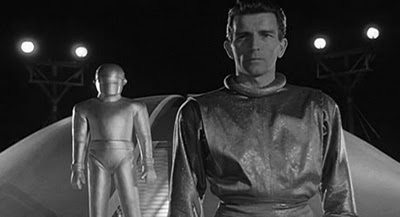
From “The Day the Earth Stood Still,” 1951

It isn’t easy to make up a tweet for space beings.  What can you possibly say?  “Greetings, aliens. I had cheerios for breakfast, how bout you?” See, this is going to take some work, and there isn’t much time, so we better get busy!

Paracosms in Writing and Music

When I turned to the editorial page of the local paper this morning, I learned a new word and a wonderful concept.  http://www.sacbee.com/2012/06/27/4591277/springsteens-global-attraction.html.

David Brooks, a writer for The New York Times, and several friends “threw financial sanity to the winds” to follow Bruce Springsteen on tour through France and Spain , because supposedly the crowds are even more intense than their American counterparts. 

Young European fans know every word of songs The Boss recorded twenty years before they were born.  Their enthusiasm “sometimes overshadows what’s happening onstage,” says Brooks.  The moment that spawned his article was seeing “56,000 enraptured Spaniards, pumping their fists in the air…and bellowing at the top of their lungs, ‘I was born in the USA.‘”  

How could this be, especially since in Springsteen’s music, USA often means New Jersey?

Brooks asked himself the same question and borrowed a term from child psychology to help understand it.  The word is paracosm, meaning a world in imagination, “sometimes complete with with imaginary beasts, heroes and laws that help us orient ourselves in reality.  They are structured mental communities that help us understand the wider world.”

Children do it, says Brooks, and as adults we continue the habit.  Then he adds the observation that is the point of this post:

“It’s a paradox that the artists who have the widest global purchase are also the ones who have created the most local and distinctive story landscapes.”

Springsteen’s New Jersey.  J.K. Rowling’s English boarding school.  Tony Hillerman’s Navajo country.  221B Baker Street.  Downton Abbey.  Tolkein’s Edwardian rural England, aka, The Shire.

Hob Lane, near where Tolkien lived as a boy

I often think of the books I hate to see end, the kind that inspire fans to continue the story on their own, as I described in a recent post on fan fiction http://wp.me/pYql4-298.  Character remains the essential ingredient – we want to follow Harry, Ron, and Hermione wherever they may lead us – but in his article David Brooks points out the critical nature of the world where they more and act and love and fight.  We wouldn’t really want to see the Hogwarts gang on Sunset Boulevard anymore than we’d want Sam Spade in St. Mary Meade, working a case with Miss Marple.

“If you build a passionate and highly localized moral landscape, people will come,” says Brooks, echoing Field of Dreams, a movie that largely took place in a cornfield.  “If your identity is formed by hard boundaries, if you come from a specific place…if your concerns are expressed through a specific paracosm, you are going to have more depth and definition than if you grew up in the far-flung networks of pluralism and eclecticism…sampling one style then the next, your identity formed by soft boundaries, or none at all.”

I think this is an important thing to consider – one you seldom read about in books on writing but which instantly resonates when called to mind in the context of our favorite fiction.

But let’s end with The Boss

One of Springsteen’s best known songs, “My Hometown,” moves me the way “Born in the USA” moved a stadium full of Spaniards.  Hometown for me is part of a paracosm, a special kind of imaginary landscape.  I’ve said elsewhere that when I was young, we moved around too often for me to have any sense of a hometown, yet the moment I say the word I can see it vividly, with eyes opened or closed.

We’ll let the master paint the picture, since someone (I forget who) once observed that only a troubadour of Springsteen’s calibre could make you nostalgic for New Jersey.

Enjoy the paracosm.

American Dreaming

This Norman Rockwell magazine cover, showing Thanksgiving on Walton’s Mountain, is a perfect illustration of The American dream.  The power of Rockwell’s vision of an American earthly paradise is so compelling that we long to believe it even though we know life was never like that and certainly isn’t now.  I started thinking about the power of the dream after reading an excellent article in Time Magazine:  “The American Dream:  A Biography” by Jon Meacham, in the July 2, 2012 issue).  Meacham’s conclusion supports what all of us know but wish we didn’t – the dream is in danger like never before.

The phrase, “American Dream,” first appeared in James Truslow Adams’s The Epic of America , an optimistic history published in 1931, as we neared the depths of the great depression.  Adams wrote of:  “that American Dream of a better, richer, and happier life of all our citizens of every rank which is the greatest contribution we have as yet made to the thought and welfare of the world.”

Even in 1931, there seemed to be cause for optimism:  the day Adams finished his manuscript, President Herbert Hoover turned on the lights of the Empire State Building.  Technical marvels coincided with the Time article as well, but they didn’t belong to us.  On Sunday, three Chinese astronauts manually docked a spacecraft to their orbiting space station, a key milestone in their quest to reach the moon.  On the same day, a Chinese deep sea craft set a national diving record, reaching a depth of 7000 meters in the Mariana Trench.

It took two centuries and a civil war before the right to “life, liberty, and the pursuit of happiness” was officially extended to everyone, and yet for a time, America offered a better chance to reinvent oneself, to start again, to rise above the limitations of birth than any other place in the world.  Abraham Lincoln called himself “a living witness” that any child could grow up to be president.  Somewhere along the line, things changed.

One interesting point that Meacham makes is that “there is a missing character in [the] popular version of the story of America’s rugged individualism:  the government, which helped make the rise of the individual possible.”  The Pacific Railroad and Homestead acts, signed by Lincoln, had much to do with knitting the country together and making allowing dreamers to “go west” or “light out for the Territory” like Huckleberry Finn as well as his creator.  It was government, under a southern president, that enforced the Civil Rights Act, and during the 60’s, launched the drive that put men on the moon and started us on the road to a micro-electronics revolution.

In the end, dreams do not depend on facts and figures, but more on a sense of hope and possibilities.  What was different in 1931 that allowed James Truslow Adams to write The Epic of America?  In it, he said, “If the American dream is to come true and abide with us, it will, at bottom, depend on the people themselves.”

If it did then, it does now.  What happened over the last eighty years?  There aren’t any easy answers, but there are many things we can and should be thinking about.

American Literary Merit Short Story Contest

A friend on a writer’s mailing list sent this notice of the ALMA short story contest.  First prize is $1000 and inclusion in the ALMA Short Story Compilation for 2013.  Word limit is 3000.  Due date is Nov. 12, 2012.  The entry fee is $15 before Aug. 12 and $20 after that.  Here are the details:

http://americanliterarymeritaward.com/ALMA_Contest.html

Everything Changes

Lewis Richmond, an ordained Zen priest and author of Aging as a Spiritual Practice, began his studies 40 years ago with the renowned teacher, Shunryu Suzuki Roshi.  Richmond relates that one day, after a talk, a student said, “Suzuki Roshi – you’ve talked for an hour, and I haven’t understood a word you’ve said.  Could you please tell me one thing about Buddhism I can understand?”

The master waited for the laughter to die down and said, “Everything changes.”

“Everything changes” is a truth we often would rather forget, but sometimes events make that impossible.  Our oldest dog, Holly, has serious medical issues.  She has come to the end of her life.  This month has been a daily exercise in letting go, in watching her, in trying to gauge the quality of her life and which interventions make sense.

The vet confirms that she’s not in any pain.  She is still feisty and cuddlesome in turn.  She turns up her nose at dog food much of the time, but still likes buttered toast and hot dogs, so antibiotics make sense.  So does medication to increase the blood flow to her kidneys, which are failing.  We take turns administering “subcutaneous fluid replacement therapy” each morning, which was scary at first, but has become a very serene, if bitter-sweet, time to bond with her and reflect.  With quiet music and morning sun slanting into the room, we calm ourselves so Holly calms down and stroke her head while 150 ml of solution flow through the drip.

We brought her home as a puppy when she was eight weeks old.  She’ll be 16 at the end of the month if she lasts that long – we don’t know – it could be days or weeks or months.  It’s hard to believe how quickly sixteen years goes by.

Is there anything that doesn’t change?  All of the major religions say yes, there are the ways to unravel the knot.  A reminder of why there is nothing more important may be Holly’s final gift.