The Wind Through the Keyhole, by Stephen King: A Book Review

I recently said I look for “imaginative escapism” in summer reading, and Stephen King’s, The Wind Through the Keyhole, 2012, qualifies on both scores.

This book is a celebration of stories by a consummate storyteller.  It is structured as a frame tale, three levels deep – a story within a story within a story, something you find in some our oldest epics and story collections like The Odyssey and The Arabian Nights.

In case we we miss that connection, King says it another way through his main character, Roland Deschain, who tells his traveling companions, “There’s nothing like stories on a windy night when folks have found a warm place in a cold world.”  Later, during a story concerning his younger self, Roland says, “A person’s never too old for stories…Man and boy, girl and woman, never too old.  We live for them.”

This is the eighth of King’s Dark Tower Novels, and the first I have read, but the introduction caught me up well enough to proceed.  Roland Deschain is a gunslinger in Mid-World.  A gunslinger is a cross between a knight errant and an old west marshall.  Many gunslingers are descendants of “the old White King, Arthur Eld.”

Mid World borders our own and is “filled with monsters and decaying magic.”  In places, there are gates between the worlds, or places where “the veils are thin.”  Three of Roland’s companions come from New York.  The fourth is a billy bumbler, a talking, dog-like creature.

Roland and his companions – his ka-tet – barely have time to find shelter from a starkblast, a devastating storm, with winds like a hurricane, the sudden onset of a tsunami, and temperatures so cold that trees snap and explode.  While the friends shelter by the fire in the only stone building in a deserted town, Roland tells of one of his first assignments as a gunslinger.

In the first story, “The Skin-Man,” Roland rides with his partner, Jamie Red-Hand, to the desolate mining town of Debaria, where a shapeshifter has slaughtered dozens of people.  This a gritty western world, like the bleakest of early Clint Eastwood’s westerns, and the monster is more deadly than the bad and the ugly Clint faced down.

While talking to an 11 year old survivor of an attack, a boy whose father and a dozen others were slaughtered, young Roland tells the second tale, “The Wind Through the Keyhole,” about another 11 year old, Tim Ross, who goes on a dangerous quest to save his mother who has been injured by a treacherous step-father.  Tim sets off to find Maerlyn, aka Merlin, at the heart of The Endless Forest.

Picture an 11 year old on an Arthurian quest, who stumbles into a swamp filled with gators and is saved by a group of plant people who communicate telepathically and give him a strange disk with buttons and lights that speaks and answers his questions in a female voice.  Her name is Daria.  Once she tells him she’ll be “offline” for half an hour, “searching for a satellite link.”

Just when he’d begun to believe she really had died, the green light came back on, the little stick reappeared, and Daria announced, “I have reestablished satellite link.”

“Wish you joy of it,” Tim replied.

Well, why not?  Is a magical iPhone so different from an enchanted sword or magical ring?  A master storyteller like Stephen King can pull of escapades like this because he always has me asking the one question that really matters in storytelling.  To quote Neil Gaiman, that question is, “What happened next?”

There’s adventure, courage, cruelty, humor, horror and much more as Roland Deschain takes us in and leads us back out of three levels of story.  One constant throughout all the tales is the wind, and I think Roland speaks for King when he says:

In the end, the wind takes everything, doesn’t it?  And why not?  Why other?  If the sweetness of our lives did not depart, there would be no sweetness at all.

The Wind Through the Keyhole is a very satisfying summer read – and quite a bit more.

RIP Maurice Sendak

If you haven’t heard, Maurice died today of a stroke, at age 83.  Here is a nice five minute interview he gave in 2002 that ran on the PBS Newshour tonight.  It’s illuminating to hear him say, “I don’t know how to write for children.  I don’t think anyone knows how to write for children, and those that say they do are frauds.”

He goes on to say, “I write for me,” and adds that it isn’t always easy to be driven by something internally that is “riotous and strange.” What a great gift he gave to riotous strangers!

http://www.pbs.org/newshour/bb/entertainment/jan-june12/wildthings_05-08.html

A Bookstore Expedition

Lego Indiana Jones

I called it an expedition to motivate myself.  “Bookstore” these days means Barnes & Noble, and I don’t like to go there very much.  I think you’ll see why in the course of this post.

I went to look at their middle-grade fantasy books.  It’s time for summer reading, and some of the classics in this genre weave just the right spell of imaginative escapism:  books like Inkspell, Spiderwick, and  The Emerald Atlas.  Imagine my dismay when I got there and found the middle-grade section gone!  For years these books lived in the right-rear corner of the children’s section, but now all the signs said, “Young readers, grades 3-6.”  I looked through the children’s section and found a few familiar titles, but the group as a whole was no longer on display.

“Explorer” by Stephen Noble, http://www.stephennoble.com

The rationale became clear when I left the children’s section. Right at the entrance were two large racks of “Teen Paranormal Romance,” sporting the best display of any genre in the store – trade paperbacks with covers, not spines, showing. Marketing must have decided that closing the middle-grade commons would motivate younger girls to move up to a more lucrative market. Apparently books like Garth Nix’s Arthurian stories for boys, or Newberry winners like Lois Lowry and Madeline L’Engle, no longer warrant shelf space. A book or two might have been stuck in between the 3d grade readers, but if so, I missed them.

I don’t begrudge Barnes & Noble its marketing efforts, but it’s been many years since I discovered anything new in their stores.  Discovery used to be part of going to bookstores.  “Browsing” once was the order of the day, and some of those discoveries changed my life.  Like the time when I was 18, and on pure impulse, bought a copy of Folklore in the English and Scottish Ballads.  The spark that title ignited still burns.

Now I make most of my book discoveries online.  This morning, Amazon sent me an email, based on my search and reading preferences:  “Best Middle-grade books in May.”  Where am I likely to go to read sample pages and shop?

I went on my expedition a week ago, two days before Barnes & Noble and Microsoft announced their partnership to champion the Nook.  As I sat down to write this post, their merger seemed huge.  It’s not about the big six publishers anymore, is it?  The future belongs to the big three – Amazon, Apple, and B&N / Microsoft.

The big six had their chance to open ebook divisions, or even join ranks in a partnership, but sticking to rear-view vision, that boat has sailed.  Now its hard to imagine any business model that can save them.  Their mantra has been, “People will always want paper,” but will they?  I don’t know.  What follows is speculation as I look at the books on our shelves.

Books that are read only once – meaning the vast majority of paperbacks, will do fine as ebooks.  Most textbooks for most grades of school should do well as ebooks too, and lighten the load of student backpacks.

Coffee table books might warrant larger readers, which will probably soon be embedded in coffee tables.  You see desk mounted touch-screen computers on shows like Hawaii Five-O.  I bet it won’t be long until they appear in furniture stores.  Same with fine art prints for the walls – think of a blend of existing digital picture frames with wall mounted HDTV’s.

So what books do I really value in paper?  Books like Lord of the Rings and Wind in the Willows, books I treasure and read again and again, yet those are pretty rare purchases and won’t keep printers in business.

Spiritual books of all sorts, for I underline those and fill them with post-it notes.  How-to books, on subjects from  gardening to computer programming texts.  I used the latter until they fell apart at work.  Any book where I write notes in the margin.  Right now, ereader bookmarks and margin notes are inadequate, but this should be an easy fix in the future.  Software that lets me use my laptop keyboard when I plug in on USB will fix much of the problem.

I don’t want print to go away.  I don’t want to see used bookstores close or raise their prices to “antique” levels.  There’s magic in turning pages, in the smell of ink and paper.  I’ve read so many stories that begin when someone finds a mysterious, yellowing book of lore, that I can’t go into an old bookstore without wondering if “today will be the day.”  It’s hard to imagine those stories with mysterious, yellowing, kindles!

No, I don’t want print to go away, but it’s hard to imagine any other future for the printed word.  Can you?

Andy Grove on How to Create American Jobs

In the wake of this week’s jobs report, here is a Businessweek article from the July 1, 2010 in which Andy Grove, lays out a path to American economic renewal. If anyone has the chops for this, it’s Grove.  One of the three founders of Intel, he helped light the fire that gave us Silicon Valley and changed the world.

(l-r), Andy Grove, Robert Noyce, and Gordon Moore in 1978, on the 10th anniversary of Intel. Photo courtesy of Intel

The bad news is that Grove’s formula depends on intelligent and focused government action. In 2010, that didn’t seem as hopeless as it does now.  Yet perhaps ideas are like seeds; the good ones grow, even though they may take a while to germinate.

One key problem, according to Grove, is our loss of hi-tech manufacturing jobs, not only because of the human cost, but because of our loss of the expertise that production brings.  He says the US has already fallen too far behind to ever catch up in technologies like solar panels and batteries for fuel efficient cars.  “Not only [do] we lose an untold number of jobs, we [break] the chain of experience that is so important in technological evolution. As happened with batteries, abandoning today’s “commodity” manufacturing can lock you out of tomorrow’s emerging industry.”

Grove suggests we need an employment-centered economy and political leadership.  He cites the performance of several Asian economies, including China, the source of so much hand-wringing in the face of perceived U.S. decline.

Andy Grove, 2010

Grove recommends government incentives to aid the growth of key industries and keep the manufacturing base at home. He ends the article with a chilling bit of history:

Most Americans probably aren’t aware that there was a time in this country when tanks and cavalry were massed on Pennsylvania Avenue to chase away the unemployed. It was 1932; thousands of jobless veterans were demonstrating outside the White House. Soldiers with fixed bayonets and live ammunition moved in on them, and herded them away from the White House. In America! Unemployment is corrosive. If what I’m suggesting sounds protectionist, so be it.

I suggest everyone concerned with employment and US technical expertise take a moment to read what Grove has to say:  http://www.businessweek.com/magazine/content/10_28/b4186048358596.htm

Kit

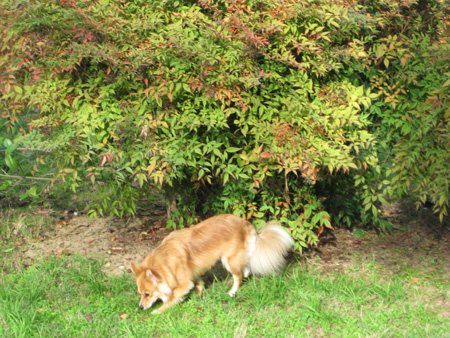
She answers to Kit, but her real name is Kitsune, the Japanese word for fox.  That’s because when we adopted her four years ago today, she looked so much like a fox.

We’d been looking for a second dog for over a year and had even spent six weeks with a foster animal with the option to keep, but it didn’t work out.  We’d put the word out, and one afternoon it paid off.  The owners of a mom and pop kennel called concerning a year old animal that needed a home.

Kit had been rescued by a roommate from a couple who mistreated her and were planning to dump her by the side of a highway.  She was frightened of men, and at first ran away when I tried to pick her up, yet by the end of the day, she was at home in our home, and after a walk in the park the next morning, she was my new best buddy.

First walk in the park

She was just over eight pounds when we got her, and her ribs showed. Now she has the opposite problem – she’s on low fat kibble. Officially, she’s a Chipom, a Chihuahua / Pomeranian mix, although we suspect there’s something else in there, because she’s bigger than either of those breeds. We’ve wondered how much the dog DNA tests cost, sometimes wondering if she really might have a fox in the family tree.

Kit is foxlike in more ways than appearance, not all of them good.   Rescue dogs often carry baggage and hers manifests as aggression, which can be very sudden.  Work with a trainer has helped moderate it, but we’re still not done.  Kit is smart like a fox too, not always in healthy way.  Everyone thinks their dog is brilliant; let’s just say that this one, among other tricks, has learned how to paw the button to lower the backseat windows while driving.  We have to put on the lock as if she was a kid.  And an instant after such indiscretions, she’ll turn on the charm that makes strangers ask, “What kind of dog is that?”

Like any complex creature, she’s full of contradictions. She’s as brave as a dog twice her size, and the unquestioned alpha to the others, and yet she’s a wimp when it comes to rain. With tail between legs she’ll duck for cover if the drops start to fall on her arctic quality fur.

In the end, it’s like William Stafford said in his poem, “Choosing a Dog:”

“It’s love,” they say. You touch
the right one and a whole half of the universe
wakes up, a new half.

The Secret Life of Pronouns

Who knew that pronouns can predict romantic compatibility, reveal power dynamics, lying, and who will recover from trauma?  James Pennebaker, a psychologist at the University of Texas at Austin has been tracking the truth of pronouns for 20 years.

James Pennebaker

He includes them in the group he calls “function words,” necessary parts of speech that are invisible to us in conversation:  the, this, though, I, and, an, there, that, he, she, where, when.  Pennebaker contrasts these with “content words,” which carry meaning and evoke images in our minds, words like, school, family, life, friends.

In a recent NPR interview, Pennebaker related that he and his students studied couples’ compatibility in the context of speed dating, http://tinyurl.com/7skcgf4.  Computers proved an essential tool for analyzing results, since try as we might, we really don’t hear function words.  By entering both the transcript and the speed dating outcomes, Pennebaker’s team discovered a strong correlation between matching function word usage and the decision to get together after the first meeting.  The computer predicted who would hit it off more accurately than the couples themselves.

This is not because similar people are attracted to each other, Pennebaker says; people can be very different. It’s that when we are around people that we have a genuine interest in, our language subtly shifts.

“When two people are paying close attention, they use language in the same way,” he says. “And it’s one of these things that humans do automatically.  They aren’t aware of it, but if you look closely at their language, count up their use of ‘I, and, the,’… you can see it. It’s right there.”

The other discovery Pennebaker discussed in the interview centers on power dynamics.  When two people with different status or power interact, the subordinate uses “I” much more frequently.  Pennebaker suggests self consciousness is the cause, concern about how we’ll be perceived.

Finally, Pennebaker weighed in on the My Fair Lady question:  if we change our language, do we change?  After 20 years of research, Pennebaker says no.  Change who you are and your language will change, but not vice-versa.

What’s interesting is that several people I respect claim that changing your handwriting changes personality.  Organize your penmanship, for instance, and other aspects of your life will follow.  This suggests the added visceral dimension makes the difference.  Makes you wonder – The rain in Spain falls mainly on the plain.  Probably doesn’t work as well on a keyboard…

You can read about Pennebaker’s research in The Secret Life of Pronouns, 2011:

People and the Planet: A Report by the Royal Society

On April 26, The Royal Society, the UK’s 350 year old academy of science, released the results of a 21 month study of patterns of population and consumption.  Sir John Sulston, chair of the working group, put it very simply:

“The world now has a very clear choice.  We can choose to address the twin issues of population and consumption.  We can choose to rebalance the use of resources to a more egalitarian pattern of consumption, to reframe our economic values to truly reflect what our consumption means for our planet and to help individuals around the world to make informed and free reproductive choices.  Or we can choose to do nothing and to drift into a downward vortex of economic, socio-political and environmental ills, leading to a more unequal and inhospitable future.”  http://royalsociety.org/news/Royal-Society-calls-for-a-more-equitable-future-for-humanity/

The Society issued a 132 page report that makes several key recommendations  http://royalsociety.org/policy/projects/people-planet/report/:

  1. The international community must bring the 1.3 billion people living on less than $1.25 per day out of absolute poverty, and reduce the inequality that persists in the world today. This will require focused efforts in key policy areas including economic development, education, family planning and health.
  2. The most developed and the emerging economies must stabilise and then reduce material consumption levels through: dramatic improvements in resource use efficiency, including: reducing waste; investment in sustainable resources, technologies and infrastructures; and systematically decoupling economic activity from environmental impact.
  3. Reproductive health and voluntary family planning programmes urgently require political leadership and financial commitment, both nationally and internationally. This is needed to continue the downward trajectory of fertility rates, especially in countries where the unmet need for contraception is high.
  4. Population and the environment should not be considered as two separate issues. Demographic changes, and the influences on them, should be factored into economic and environmental debate and planning at international meetings, such as the Rio+20 Conference on Sustainable Development and subsequent meetings.

Please look at this video clip of Sulston summarizing the findings of the report, which he will present at the United Nations on May 1, ahead of the Rio+20 conference.

Of special interest to me was Sulston’s critique of GDP as the key measure of economic wellbeing for nations.  GDP, he says, drives growth to levels that cannot be sustained.  Michael Meade once observed that unbridled growth in the body is cancer, and unbridled growth in the body politic is a parallel ill.

Growth is such an ingrained measure of wellbeing that re-imagining global socio-economics will not be simple or easy.  One tactic, according to the working group, is to factor in real costs:  what are the real costs of disappearing forests and species?  What is the real cost of water when the study predicts that 1.8 billion people will live with severe water scarcity by 2025?

The issue of water brings to mind my previous post, “Another Regulation Conundrum,” http://wp.me/pYql4-21e, which describes a couple’s 40 year effort to create an self-sustaining and non-polluting homestead.  One of their projects was recycling household “gray water.”  The county building codes have no provision for such experimental ways of doing things, and the couple has racked up large fines and an eviction notice.  In a very real sense, the status quo is the problem.  According to the Royal Society, not only our building codes but the mindset behind them must change or the quality of life for everyone will continue its spiral of decline.

One parting thought:  the study was released on Thursday.  Why haven’t we heard it mentioned on any US media?

Another Regulation Conundrum

My previous post centered on regulations to force bloggers to disclose seemingly small-fry issues, like whether they were comped with an ebook for reviewing independently published authors.

Thursday’s paper ran a story from the New York Times on a more weighty and poignant regulatory issue.  The article, “Marin County battles hippie holdout,” tells of David Lee Hoffman, an entrepreneur of artisan teas, who designed and built 30 structures during the 40 years he lived on a rural hillside.  Inspired by youthful treks through Tibet and Nepal, Hoffman, 67, and his wife, Ratchanee, have tried to create a sustainable, non-polluting, homestead.  In the process, by ignoring repeated notices of violations of county building codes, they racked up $200,000 in fines and have just been ordered to vacate their home until the violations are fixed. The case is now before a judge.  http://www.sacbee.com/2012/04/26/4443307/hippie-askldj-flaksj-dfklaj-sdlfkj.html

photo by Jim Wilson, New York Times

The Hoffman homestead contains such fanciful structures as the Worm Palace, a Solar Power Shower Tower, and a moat, which is integral to recycling household water.  One of the county’s chief concerns is their method for disposing of human waste, which uses worm colonies to help turn human waste into humus.  Composting toilets are not legal in Marin.  The county also says it’s worried about an excess of rain, which could flood the moat and send the gray water into nearby creeks.

Hoffman says, “I did what I felt was right.  My love of the planet is greater than my fear of the law.”

***

There’s nothing simple about the regulations that govern our lives, and many of them serve us well.  I like clean water and knowing the content of the food I eat.  I want pure aspirin when I have a headache, and I want to trust the odometer when I shop for a used car.  If I buy a hot dog during a ballgame, I don’t want to have to think , of Upton Sinclair’s, The Jungle.  And I might not want to live downstream from the night soil in the Hoffmans’ garden.

And yet…

Most of us know, in the corners of our awareness, that many of our problems are beyond the capacity of our current institutions.  We know that business as usual is part of the problem.  That regulators do not create solutions.  As Einstein said, “One cannot alter a condition with the same mind that created it in the first place.”

How do we enable people like the Hoffmans, willing to devote their lives to imagining new ways of living?  If we fine and evict people for living their dreams, pretty soon we’re going to run short of dreamers.