An Era-less Era?

A critique group friend gives me back issues of The New York Times Book Review.  In the stack she gave me this week, I found a provocative article in the March 11, edition called “Convergences,” by Douglas Coupland.

Coupland noticed something unexpected during TV coverage of the 10th anniversary of 9/11:  nothing appeared very different than it had a decade ago.  The clothes, the cars, the hair, seemed pretty much the same.  This led him to speculate that:  “…we appear to have entered an aura-free universe in which all eras coexist at once – a state of possibly permanent atemporality given to us courtesy of the Internet.  No particular era now dominates.  We live in a post-era era without forms of it’s own powerful enough to brand the times.”

He then says, “The zeitgeist of 2012 is that we have a lot of zeit but not much geist.” (To Coupland’s credit, he does a mea culpa for this sentence).  He goes on to say there is something “psychically sparse” about the present, and writers and artists are creating new strategies to track it.  He then reviews Gods Without Men by Hari Kunzru, and calls it an example of “translit,” a new genre that fractures time and space while telling a single story.  In other words, it isn’t time-travel, or intercut parallel tales, like Pulp Fiction, but a singular narrative that unfolds all over the map.

Yet if Translit is a new genre, Once Upon A Time, a popular TV program, got there before Gods Without Men.   Though it doesn’t have as many sub-stories, structurally it’s the same.  Maybe part of our zeitgeist is a world where highbrow and lowbrow forms are equally likely sources of innovation.  (That sentence, containing the word, “zeitgeist,” was payback).

Once Upon A Time

Besides, who says this decade lacks “forms of its own powerful enough to brand the times?”

OK, when I was in grade school, my nightmares were not of winding up naked in public, but in my pajamas [this is true], so this particular fashion crime draws my attention.  But my reason for this post isn’t cultural artifacts – it’s something I’ve wondered about for a long time, that Coupland’s article brought to mind:  how and when the distinctive feel of a decade is formed?

Sometimes there’s a distinctive moment.  What we know as “the sixties” started the day John F. Kennedy was shot.  The last decade began on September 11.

Some decades don’t start with a single event; at a certain point, everyone simply knows the times have changed.  The eighties began when the good times started to roll.  In our current decade, something is rolling, but not good times.  We sense it, though it doesn’t yet have a name.  Read the paper or turn on the news, and you find a miasma of anger and greed, driven by fear and disillusionment.

This morning, with my coffee, I read details of how the New Orleans Saints bounties for injured opponents especially targeted head shots, even as overwhelming evidence points to concussive injuries as the source of higher than average rates of dementia in retired NFL players.  A little while ago I read of women arguing over a Facebook profile outside a waffle house.  Police arrived after shots were fired.  No external foe can destroy us, but we are doing pretty well on our own.

Lately politicians have been touting “American Exceptionalism.”  I first came across the term in Andrew Bacevich’s book, The Limits of Power:  The End of American Exceptionalism, 2008.  Both the politicians and Bacevich mean economic, political, and military superiority, things no country ever retains indefinitely, though they all believe they will when they have it.

President Obama got in trouble for speaking the truth when he said every nation thinks it’s exceptional.  Every nation has the potential to be, if you think in terms of character.  In those terms, our story might fall in the Translit genre – a narrative told across long reaches of time and place.  This decade would be a chapter set deep in the second act, when things are cascading downhill from bad to worse.  The darkness is pretty thick.  Who knows how the story is going to end?

Impending Doom?

A bright spring morning after days of clouds and rain. A good night’s sleep. So why did I wake with a sense of impending doom?  There are no foreboding events on the horizon.  I haven’t violated any obvious rules of mental hygiene, i.e., I don’t stay up late watching slasher movies.  A few times in the past, such uneasiness has preceded nasty events, but not very often.

I did some yoga and meditation, which helped but didn’t dispel the mood.  What I really wanted to do was get outdoors, so I took a walk at a local park.  Afterwards, I felt like a cup of coffee and went to Starbucks.

As I sat down, a man who looked vaguely familiar said, “Morgan?”

I couldn’t quite place him and had to ask his name.  Turns out he and I were friends almost 25 years ago.  He went to work for the state, and I started taking night classes after work, and we lost touch.  I thought he had moved away, but he still lives where he did back then, little over a mile away as the crow flies.

We talked for a while and traded phone numbers.  He said he built a boat and mentioned fishing.  I thought of baseball once the season starts.  The sense of impending doom was gone.  And yet, if it hadn’t been there when I got up…

I wouldn’t have gone to the park…
and would have made coffee at home…
so I wouldn’t have been at Starbucks to cross paths with an old friend.

When I really pay attention, I find I do not understand how anything works.

Fairytales for Midlife

Joseph Campbell’s groundbreaking series, “The Power of Myth,” broadcast on PBS in 1988, sparked a tremendous interest in myth and folklore.  A number of fine studies followed during the next few years.  One of my favorites was a series of books on fairytales by Allan B. Chinen, a San Francisco psychiatrist.  In his second book, Once Upon a Midlife, 1992, Chinen discusses stories about the problems and tasks that face us in middle age, “when the Prince goes bald and the Princess has a midlife crisis.”

once upon a midlife

Of the 5,000 fairytales from around the world that Chinen reviewed, 90% were “youth tales,” aimed at young people trying to find their place in the world.  The protagonists leave home, struggle to find their courage, fall love, find a treasure, and come into their kingdom or find a job.  Chinen calls the other 10%, “middle tales.”  The focus is middle-aged men and women, “juggling the demands of family and work, grappling with self-doubt and disillusionment, and ultimately finding deep new meaning in life.”

Allan Chinen

The first of the middle tale themes Chinen explores is “the loss of magic,” embodied in the German tale of “The Elves and the Shoemaker.”  Youthful protagonists thrive when they locate a source of magic; they lose it only if they are mean or greedy.  In middle tales, the magic fades in the course of living.  At some point, we realize we’re not going to write the Great American Novel; we don’t have an unlimited number of do-overs left; we don’t have the skill or the energy to realize all of our youthful dreams.  What is left?  If we listen to the stories, Chinen says, we begin to see other roads between the extremes of naiveté and despair, roads that leads toward renewal.

The next theme is “reversals,” often involving men and women dropping traditional gender roles.  The headline in this week’s newspaper Arts & Entertainment section was, “The Era of the Empowered Princess.”  That may be the theme in Hollywood, but not in traditional “youth tales.”  Where the emphasis is socialization, stories all over the world  praise traditional roles.  Things change in middle tales.  Men sometimes say, “To hell with work,” or quit the army, while women grow more assertive and often save the day, as in “The Wife Who Became King,” a story from China.

The third middle tale theme is a new awareness of death and evil.  Youth stories don’t dwell on either one; bad things happen to others, “out there.”  Dragons die, bad sorcerers die, and sometimes evil step-mothers, but never the hero or heroine, and neither of them are evil.  In middle tales mortality gets personal.  Evil gets personal too; no longer does it simply lie “out there.”  The expansiveness of youth gives way to the psyche’s need for wholeness, which means we have to “confront the shadow,” the darkness we carry within.  The best stories, honed by generations of telling, lead us to realizations by the path of wisdom and by the path of humor.  In “The Tell Tale,” a Japanese story, a woodcutter spies his wife in the arms of a pawnbroker.  At first he is seized by a murderous rage.  Rather than kill his wife and her lover, he concocts a ridiculous story and uses it to trick his wife, humiliate the pawnbroker, and makes enough money to live with his wife in comfort – and fidelity – for the rest of their days.  There is far more of the trickster than the knight-in-shining-armor in these stories.

The final middle tale theme in Once Upon a Midlife is renewal, which in these stories, most often involves descent to the underworld.

“Stripped of all their defenses, individuals come face-to-face with the core of their being.  There they find a primordial source of life, beyond conventional notions of good and evil, male and female.  Whether understood as the inner Self, or God, or the life force, this primal source helps men and women reforge their lives…[they] emerge from their suffering with deep healing – and the ability to heal others.”

To anyone interested in the interpretation of folklore, I recommend this page which lists all of Allan Chinen’s books.

My 301st Post

Confession time.  I slipped in post number 300 without saying anything. Double-digit posts, like end-of-decade birthdays, make me a little nervous.  Such events seem to require wisdom, but I don’t do wise-on-demand especially well.  So here are some blogging thoughts, commemorating post 301, which I think we can all agree is a more humble and friendly number than 300.

Blogging as a means of discovery.  I’ve experienced this in other modes of writing, notably fiction.   At times I’ve also kept a journal, not to record my thoughts, but to discover what they are.  Because of its public nature, I wasn’t sure for some time that blogging had that capacity.  I discovered once and for all that it does while working on some recent two-part posts.  Every time I ended with, “I’ll share my conclusions next time,” I wondered what those conclusions were going to be.  Typically all I had was a hunch – nothing as solid as a conclusion.  I found in every case that the act of writing itself generated conclusions.  

It’s immensely satisfying to know that blogging can help me discover where I am in the present moment.  Everything changes, and it’s important not to be bound to outworn habits of thinking, feeling, and acting.  If the public nature of blogging sometimes causes self-consciousness, it also demands a rigor that (hopefully) keeps me from entertaining or posting my silliest notions.

Just Blog.  If you visit writing blogs, read writing magazines, or go to a writer’s conference, you’re likely to hear about using social media to “build your platform.”  I don’t want to put this idea down, just look at it critically.  I’ve met several successful ebook authors who work very hard to promote their fiction and think up inventive ways to do it.  But the reason for their success is compelling fiction.  Promotion works because they have something worth promoting.

I started this blog because I’d been told I should get a platform.  That idea lasted only a week or two.  Curiosity about blogging as a unique medium took over.  There are lots of Zen stories advising us to do what we’re doing with single minded focus.  Just run.  Just cook.  That kind of thing.  My effort here is, “just blog.”  If the day comes when I need a platform, I’ll do what I have to do.  Like I said in a recent post, I’m skeptical of “whisperers.”

What to write about my social and political concerns?  I don’t like blogs that harp, yet I find it hard not to write about these issues.  I’ve never had so much concern about the future of our democracy, or feared that the very word, “democracy,” is an artifact of nostalgia, like a Norman Rockwell painting.  Consider the following definition from Webster’s College Dictionary:  oligarchy:  a form of government in which the ruling power belongs to a few persons.

Back in the ’90’s, my employer, like many others, provided free training in Steven Covey’s 7 Habits of Success.  One of the concepts that stayed with me is “circle of influence vs. circle of concern.”  Covey taught that outcomes I can affect lie within my circle of influence.   My circle of concern, however, includes things I cannot change.  If I spend my time worrying over these, I miss the chance to do what is in my power.

It’s like the serenity prayer:  God grant me the serenity to accept the things I cannot change, the power to change the things I can, and the wisdom to know the difference.  Covey goes a step further.  He says that changing the things I can will grow my circle of influence.  For example, complaining about the government is a useless hobby, but it is within my power to write to elected representatives.  All of them say direct communication carries weight because so few bother.  If I do so, my circle of influence grows a little bit.

Growing one's circle of influence by acting within it

What about blogging? Does this activity alter outcomes?  I believe it can, by carrying information if nothing else.  Have you heard about the “99% Spring,” initiatives starting on April 9?  Here’s a link: http://billmoyers.com.  Elsewhere on the website, Bill Moyers offers these words of hope:

Many of you have asked what you can do to fight back. Here are some thoughts. First, take yourself seriously as an agent of change. The Office of Citizen remains the most important in the country.

Second, remember, there’s strength in numbers. Find others like you in your neighborhood, apartment building, community – and act together. The old African proverb is still true, “If you want to walk fast, walk alone; if you want to walk far, walk together.”

Amen to that!  There is strength in numbers and strength in sharing hope.  As bloggers, that lies within our circle of influence.

Writings.  I appreciate all of your comments; they are one of the main things that keeps me going.  I’ve been especially happy with the response to recent articles on mythology and folklore.  This is like returning to something I lived and breathed 20 years ago.  In one way, it seems like a new emphasis for thefirstgates, but in another, it clarifies what I’ve been reaching for all along.  I’ve said this before and I’ll say it again, for it has really become my mission statement:  To discover the reality in our fantasies, and the fantasy in our realities.

Thanks to you all and stay tuned!  Here’s to the next 101 posts.

R.I.P Earl Scruggs

Show of hands – how many here can sing “The Ballad of Jed Clampett” from memory?  Sigh – fewer of us than there used to be!  That was only one of the marvelous songs that banjo virtuoso, Earl Scruggs left us, though as the theme for The Beverly Hillbillies, it may be his best known piece.

Earl died Wednesday, at 88, of natural causes.  An Associated Press memorial says:

It may be impossible to overstate the importance of bluegrass legend Earl Scruggs to American music. A pioneering banjo player who helped create modern country music, his sound is instantly recognizable and as intrinsically wrapped in the tapestry of the genre as Johnny Cash’s baritone or Hank Williams’ heartbreak…The legacy he helped build with bandleader Bill Monroe, guitarist Lester Flatt and the rest of the Blue Grass Boys was evident all around Nashville, where he died in an area hospital. His string-bending, mind-blowing way of picking helped transform a regional sound into a national passion.

As an added bonus, at the bottom of this article, you can see a clip of Lester and Earl on a Hillbillies episode, singing a fun version of a great American folk song, “The Wreck of the Old 97.”  You get to hear Miss Jane sing a verse, and watch Jed dance!

http://news-briefs.ew.com/2012/03/29/earl-scruggs-dies-bluegrass/?iid=rcfooter-music-earl+scruggs%2C+bluegrass+pioneer%2C+dies

Swan Maidens and Fairy Lovers, Part 2

It’s good to know that glasses can help us drink.  The problem is, we don’t know the purpose of thirst. – Antonio Machado

I hope I didn’t create the impression that I have any solid answers to the questions The Bride of Llyn y Fan Fach raises. Just “hints followed by guesses,” to quote T.S. Eliot.

In stories of this type, from all over the world, beautiful Otherworld women enter the lives of mortal men and then leave.  It’s not too great a stretch to imagine they represent the beauty, the love and fulfillment, the joy and intensity we long for in the world, but usually find to be fleeting.  The occasion for the lake woman’s departure is a tap on the shoulder that counts as a “blow.”  In a literal sense, this is absurd.  I take it to mean that the radiance of the Otherworld is like a spectacular sunset:  it illuminates our world but does not endure.  If it hadn’t been a tap, it would have been something else.  Perhaps as T.S. Eliot said, “Human kind cannot bear very much reality.”

Renunciation is not giving up the things of this world, it’s giving up the idea that they last – a Zen master.

Traditional fairytales are not linked to specific dates and places, but this one is.  This indicates a modern sensibility shaping the story pattern, and it seems especially clear in the lake woman’s belief that the world is a veil of tears.  The usual fairytale heroine does not cry at weddings, where people are “entering trouble,” nor does she laugh at funerals where people are “leaving their troubles.”  Her legacy is the gift of healing to help alleviate suffering.

In the lake woman’s view, this world is not our home, but while we are here, compassion is the highest virtue.  This sentiment could have come from Celtic Christianity.  It is also very eastern and reminds me of the theory that the Celts are linked, by diffusion, with the Aryan warriors of India.  Either way, this is a very different world from the Cinderella tales or stories like The Water of Life which suggest you can find your prince or princess and live a happy life together.

And you know the sun’s setting fast, And just like they say, nothing good ever lasts. – Iris DeMent

At the opening of this story, we learn that the young man’s father “died in the wars.”  The dates vary in different texts. One says the end of the 12th century, and others, the 13th century.  The latter date would coincide with the conquest of Wales by Edward Longshanks, the villain in Braveheart.  Edward invited all the bards in Wales to a council and had them killed, understanding that a nation without stories ceases to be a nation.  What Longshanks didn’t understand was that Celtic stories survive wherever there is a pub, a hearth fire, or a quiet country lane, yet I think the sadness of a conquered people infuses the story.

We know there is another world.  The question is, how far is it from midtown and how late is it open? – Woody Allen

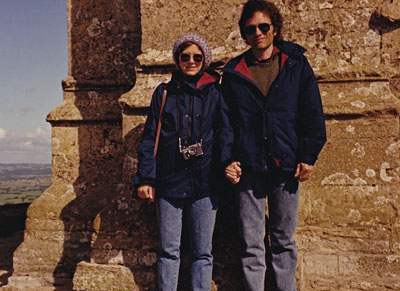
Twenty years ago, Mary and I travelled with a small group of storytellers on a tour called, “The Quest for Arthur’s Britain.”  Our guides were a remarkable couple, Robert Bella Wilhelm and his wife, Kelly, who have devoted their lives to storytelling and the sacred.  I’m happy to say they are still at it.  You can check out their website for details on storytelling trips to the Orkney Islands in May, to Iceland in September, and to Hawaii in Jan., 2013:  http://www.storyfestjourneys.com/

On Glastonbury Tor, Sept., 1991

We spent the last days of this journey at an Elizabethan manor house in the Black Mountain foothills, not too far from Llyn y Fan Fach.  It was one of a very few times in my life that I heard no traffic sound at night and saw no lights of a city.  When the moon was down, it was pitch black.  You could see the shapes of trees against the stars, but little else.

One night I strolled to the end of the yew walk.  The lights from the manor were hidden.  No light, no wind, no sound.  That alone was uncanny, but there was something more.  My Jungian training, which had taught me to understand spirits and fairies as archetypes of the psyche, vanished in a visceral rush of ice down the spine.  Part of me wanted to know what lay beyond, out in the open fields, but I couldn’t bring myself to take another step.  The hair on my neck stood up until I got back to the manor.

Do I believe in other worlds?  I did that night, and I think I do still.  I’m glad I knew the old stories and their lesson:  as human beings, this world is our home, for good or ill.  The peril is very great – too great – for those who venture too close to any other.

Swan Maidens and Fairy Lovers, Part I

When I was an active storyteller, I loved to tell one of the best known legends of Wales.  It’s found in many collections under various names, most often, “The Bride of Llyn y Fan Fach.”  Variations of this story are found all over the world.  A mortal man marries an Otherworld woman who breaks his heart, but sometimes brings marvelous children into the world.

Llyn y Fan Fach and the Bannau Sir Gaer by Rudi Winter. CC by-SA 2.0

I’ve started to write about this legend on other occasions, discarding drafts that rapidly grew beyond the scope of a blog post or two or three.  What prompted me to begin again was a visit to Barnes & Noble.

Barnes & Noble knows what sells.  An entire row is now filled with “Paranormal Romance.”  The covers feature illustrations of winsome teenage girls.  The genre isn’t new; Charles de Lint, a Canadian author, has written stories like this for thirty years.  The popularity is new, and almost all of today’s novels invert the usual folklore setup, in which a mortal man meets a fairy woman.  Not only that, but the odds of a happy ending in these tales are worse than the chance of hitting a single number at roulette.

The Swan Maiden

The Swan Maiden is the most widespread “mixed marriage” type of folktale.  It is also considered the most primitive, since the Otherworld woman’s native form isn’t human.  Usually it’s a bird.  Swan maiden stories are found all over Europe, as well as the middle east, Russia, India, China, and Japan.  There’s a parallel water buffalo woman story in Africa.  According to one researcher, the motif is 30,000 – 40,000 years old, as shown by a bison-woman cave painting.

In swan maiden tales, a man sees a flock of swans glide to earth at night.  Removing their swan robes, they change into beautiful women who bathe or dance together.  Enamored of one in particular, the man takes her robe so she won’t fly away, and eventually persuades her to marry him. Later they have children.  One day the swan-wife hears her children sing of where her husband has hidden the robe, or they tell their mother when they see her in tears.  The swan maiden puts on her robe and flies away forever, leaving the children with their father.

The Welsh Stories

I have a passion for Celtic stories, and those from Wales in particular, but Celtic fairies seldom give a mortal a break.  They put out a Scottish woman’s eye simply because she could see them.  When Thomas the Rhymer succeeded in pleasing the fairy queen for seven years, what did she give him as a reward?  A tongue that could only speak the truth!  Think about how that would serve you at work.  No mystery about why Thomas never married – “Does this make me look fat?”

In Welsh mixed-marriage tales, a mortal man wins the hand of a fairy wife who agrees to stay with him under certain conditions.  They have children, the husband accidentally breaks a condition, usually by touching his wife with iron, and she leaves.  He never sees her again, though she sometimes slips back to visit her children, whose descendants are beautiful and wise.  Here is the best of these stories:

The Bride of Llyn y Fan Fach

At the end of the 12th century, a young man lived with his mother, a war widow, in Carmarthensire in Wales.  Every day he drove their small flock of cattle to the lonely tarn known as Llyn y Fan Fach.  The cows preferred the grass there to any other pasture.

Llyn y Fan Fach, copyright Stuart Wilding, licensed for reuse CC by-SA

One morning, the man (who isn’t named in the tale) beheld a beautiful woman sitting on the water combing her hair.  All he had to offer was a bit of bread, but he walked to the shore and held it out.  She glided over the water and said, “Hard baked is thy bread.  Hard am I to hold.”  Then she dove under the waves.

Unable to think of anything else but her, he brought unbaked dough the next day.  She appeared at noon, glided to the shore, and said, “Unbaked is thy bread.  I will not have thee.”

The lady combs her hair on the water

The third time, the bread was just right.  The lady gave her assent and her father offered a sizable dowry of cattle, goats, and horses, after the young man agreed to one condition – his wife would leave him if he struck her three blows without cause.

Things went well at first, and they had three sons.  Then one day the couple was to attend a christening.  The lady delayed getting ready.  She sent her husband back to the house for her gloves, saying she would saddle the horse.  When she didn’t do so, the young man playfully tapped her on the shoulder with the gloves.  “Not ready yet?”

“Be more careful,” she said.  “For you have just struck the first blow without cause.”  [This incident echoes other stories where the husband touches his fairy wife with an iron bit while bridling a horse, but that detail is missing here.]

A few years later, at a wedding, the wife burst into tears.  The husband tapped her shoulder and asked why she wept.  “I weep for this couple who are now entering trouble,” she said.  “Be careful, my love, for your trouble draws closer.  That was the second blow without cause.”

The man stayed vigilant, and things went well for several more years.  Then one day his wife burst into laughter at a funeral.  He tapped her on the shoulder again and asked why she laughed.  “I laugh because this man has left a world full of trouble,” she said.  “But now your trouble is here.  Farewell, my husband.  You have just struck the third blow without cause.”

Ignoring his protests, she marched to the lake, and all her father’s animals followed.  A pair of oxen dragged a plow six miles to the lake, and the furrows can be seen to this day.  Of the unfortunate husband, we know nothing more.  Longing for their mother, the three sons went to the lake at night and she appeared.  “You are to be of help to the world,” she said.  “I shall instruct you in the arts of medicine.  You and your descendants will be great and skillful physicians.  Whenever you need my advice, I will appear.”

In time, they became the personal physicians of the Prince of South Wales.  The legend of the Bride of Llyn y Fan Fach comes from a book called The Physicians of Myddvai, 1861, by a Welsh printer named Rees.  The Welsh Historical Society has herbal recipes attributed to the lake woman’s descendants, and the last of the line, Dr. C. Rice Williams lived into the 1890’s.

***

What do we make of a story like this?  First, we can recall Marie-Louise Von Franz’s comparison of myth and folklore. The great myths and legends tend to be more polished.  Their plots are coherent enough to satisfy modern demands.  In contrast, folktales are more primal and more opaque.

One unique feature of this tale is the specificity of location and the lake lady’s descendants.  Greek families traced their ancestry to the heroes of Troy, and my mother had a coat of arms dating back to the Normal Conquest.  A similar dynamic is one explanation for the unique segue of this fairy tale into history.

The real mystery for me has always been, why is the husband is doomed from the start?  Who would count a shoulder tap as a “blow?”  Why do mortals never win when they give themselves to Otherworld lovers?

I’ve asked myself why since the day I found a book of local fairytales in a used bookstore in Wales on a visit 20 years ago.  Though I don’t have certain answers, I have some thoughts which I will offer next time.  Meanwhile, does anyone else have any ideas?  Why would the girl’s father set an impossible condition, and why would she actually leave over such a minor slight when the text says she really loves her husband?  I welcome any suggestions you may have.

Bill Moyers Interviews Andrew Bacevich on the Middle East

On January 4, I published a post called, “Sabre Rattling Over Oil:  Better Get Used to It.”  http://wp.me/pYql4-1AT

I quoted from a 2008 interview between Bill Moyers and Col. Andrew Bacevich in which Moyers says, “Our finest warriors are often our most reluctant warmongers.”  Now we the privilege of hearing these two in a new discussion on Moyers & Company as we seem to drift helplessly toward our third war in a decade, and voices of reason and restraint are drowned out in the hysterical ranting of politicians.

Please be sure to look for the show on PBS this weekend, or watch it on billmoyers.com  http://billmoyers.com/episode/moving-beyond-war/

Andrew Bacevich on Moyers & Company

This week, on an all-new Moyers & Company, Bill Moyers and Bacevich explore the futility of “endless” wars, and provide a reality check on the rhetoric of American exceptionalism.

“Are we so unimaginative, so wedded to the reliance on military means that we cannot conceive of any way to reconcile our differences with groups and nations in the Islamic world, and therefore bring this conflict to an end?” Bacevich tells Moyers.

Bacevich also answers the question of whether Iran is a direct threat to America with a definitive no. “Whatever threat Iran poses is very, very limited,” he tells Moyers, “and certainly does not constitute any kind of justification for yet another experiment with preventive war.”

Andrew Bacevich is a West Point graduate and Vietnam veteran who retired as a colonel after 23 years in the military, to teach history and international relations at Boston University.