Music (?) of the Season

Caution: entering Grinch zone.

Silence makes a lot of people uncomfortable, so in stores, you often hear music intended to be soft and inoffensive.  Most of the time, it’s pretty innocuous.  Now and then the muzak version of “Light My Fire” will force me to confront the passage of time, but that isn’t really a bad thing.

So why do stores at this time of year feel compelled to play the musical equivalent of leaf blowers on a Saturday morning?  I’m talking about all the denatured “Christmas” songs, the fluff ones, the ones designed not to offend, which wind up offending everybody because they are so insipid.  Do you like hearing, “Jingle Bell Rock?”  Or “Rocking around the Christmas Tree?”  If so, post a comment.  I probably won’t believe you and will assume you’re pulling my chain, but comment anyway.  Pa rum pum pum pum.

Today I ventured out to several stores, and I’ll share some of my findings.  My current working hypothesis is that stupid music confuses our brains and makes us less rational shoppers.  Let’s see how the data holds up.

First stop was JC Penny’s.  I like Penny’s, and they also shot up in my esteem for opting out of the Black Friday midnight madness.  I was hunting for a specific gift.  When I didn’t find it, I thought about browsing, but just then, “Holly Jolly Christmas,” came over the sound system.  I hurried for the exit.

Next I went to a Best Buy.  I went to look at DVD players and noticed there was no music at all – I could actually hear myself think!   In the end, I wasn’t sure which model to get, so I decided to think it over and come back later.  As I was leaving the store, after that moment of clarity, I began to wonder if that is not the point of obnoxious holiday music – to befuddle our minds and rob us of clarity?  What happens to your brain when you hear “Little St. Nick?”  All I can think is, “Make it stop,”  and I’m ready to throw down a credit card if that will do the trick!

Next stop was OSH, for a string of tree lights. No Christmas songs, for which they get kudos, but their music was equally strange – the worst of old time rock, with songs like, “Sugar Shack,” and “These Boots are Made for Walking?” I did as the lyric suggested and walked right out of there.  The strange thing is, I go to OSH throughout the year for minor hardware needs, and they never play music like that.  What possessed them to do it now?

That question launched my backup theory of holiday music – mass possession of store managers by evil entities.  Perhaps I should save that one for another occasion…

By then it was time for lunch, so I stopped at Fresh Choice, one of those make-your-own-salad restaurants.  I like eating there, but never again at this time of year!  The music was one part Dean Martin – Christmas songs you could tap dance to – and one part “The Little Drummer Boy,” which played twice while I was there.  Twice!!!  I am not making this up!

After I bolted my food and hurried out of the restaurant, I remembered the New Age adage that we attract to ourselves what we dwell upon. I did my best to clear my mind before my final stop of the day, at Beverly’s, a crafts store.

However you want to explain it, something worked.  Not only did I find exactly the gift I was looking for, but the music was nice instrumental Christmas songs.  I caught the sound of a harpsichord as I stood in the check out line, and I made a point of telling the clerk how much I enjoyed their civilized music.

So here are a few more Grinchly survival tips for the season, not necessarily in order of importance:

1)  Humor is everything.  Actually, this is number one in importance.

2)  If someone is doing something right, let them know.

3)  Earbuds are not a bad idea.  You may look silly if you’re not a teen, but I’m going to carry them next time.

I’ll be back with more tips as the season drags on, but meanwhile,  Be careful out there!

The Muppet Movie: A Review

Muppets

“As long as there are muppets, for me there’s still hope.” – Walter

Walter, the worlds greatest Muppet fan, his brother Gary, and Gary’s girlfriend, Mary, travel to LA from their home in Smalltown, USA.  They are appalled to find the Muppet theater in disrepair.  Gary learns that Tex Richman plans to tear down the theater to drill for oil.  Walter, Gary, and Mary set out to reassemble the Muppets for a telethon to raise the $10 million dollars they will need to save the day.  Unfortunately, all the Muppets are scattered.

Kermit sings in a church choir and lives alone in the house he and Miss Piggy planned to share.  Fozzy is the lead singer in a tribute band, the Moopets, who play in a sleazy casino in Reno.  Gonzo is a plumbing mogul, with his top-of-the-line toilet, “The Royal Flush.”  Animal is in a Santa Barbara anger management clinic, and Miss Piggy is a plus-sized fashion editor at Vogue-Paris.

Kermit and the Smalltown crew reassemble the cast, but the project meets numerous difficulties, including the disrepair of the theater, the rift between Kermit and Piggy, the lack of practice of the cast, and a host of nasty tricks from Tex Richman.  In the end, guess what?  Goodness and virtue prevail.

The TV station is reluctant to air the telethon, afraid it can’t compete against the leading kids’ show, “Punch Your Teacher.”  Richman and the sleazy Moopets say the Muppets are anachronisms.  Not for us long time Muppet fans, but what about younger viewers?  Is this a movie for kids or adults?  Both, of course, though young ones aren’t likely to enjoy the screenwriting jokes I laughed at, as when one of the grumpy old men, listening to Richman unfold his scheme, says, “That sounds like a significant plot point.”

“It better be,” says his partner.  “Things have gotten a little slow.”

Will a younger audience grow to love Kermit, Piggy, Gonzo, and Walter?  I don’t know.  Take them and find out.  It isn’t the best Muppet movie, but if you love Jim Henson’s creations, I think you’ll likely pass it on.  Humor, hijinx, goodwill, and Rainbows do not go out of style.

Humbug Revisited: A Brief History of Christmas

It’s coming on Christmas
They’re cutting down trees
They’re putting up reindeer
And singing songs of joy and peace
Oh I wish I had a river I could skate away on
– Joni Mitchell

I can’t get the name of Walter Vance out of my mind.  He was the 61 year old pharmacist, with a history of heart problems, who collapsed in a West Virginia Target store shortly after midnight on Black Friday.  Witnesses told MSNBC that many shoppers ignored Vance and walked around or even stepped over him as he lay on the floor.

When NPR held a call-in show to ask about listeners’s Black Friday shopping experience, one caller reported that a woman had grabbed an item out of her cart, saying, “It isn’t yours until you’ve paid for it.”  The incident mirrors a scene in a commercial that ran incessantly in the days leading up to the event.

Sales receipts were no guarantee of safety either – just ask the shooting victims in several parking lot robberies.

Exhausted after an all-night shift, one Target employee drove her car into a canal.

All of these reports emerged after the infamous pepper spray story that had the media wagging its head – the very same media that helped whip crowds into a feeding frenzy during the previous days

None of this is new.  Christmas has always been the church’s most problematic holiday.  The Hallmark version we know today was in part, carefully crafted by early 19th century merchants, in a manner not different in essence, from the effort to persuade millions of seemingly sensible people to spend Thanksgiving night in big-box stores.

Santa Claus by Thomas Nast, 1865. Would you want this guy roaming around your home late at night?

The Bible does not give a date for the birth of Jesus.  Apparently, birthdays were not a big issue back then.  Origen of Alexandria, a 3d century theologian, wrote that “only sinners like Herod and Pharaoh celebrate their birthdays.”  December 25 was not fixed as the date of Christmas until the 4th century, and the nativity was largely ignored until the 9th century reign of Charlemagne.

Through the early middle ages, Christmas was overshadowed by Epiphany, which commemorates the visit of the Magi.  It was not until the high middle ages that Christmas emerged as a popular feast day.  “Feast” is an understatement.  In 1377, Richard II’s guests consumed 28 oxen and 300 sheep.  Caroling became popular then, though chroniclers complained of lewd lyrics.  The same writers blamed pagan holidays like Saturnalia and Yule for the “drunkenness, promiscuity, and gambling,” of the celebrations.

In 1645, in an effort to rid England of decadence, Oliver Cromwell and his Puritans banished Christmas in England.  The Pilgrims on the Mayflower were even stricter.  From 1659-1681, Christmas was outlawed in Boston.  English customs were shunned after the revolution, and Christmas did not become an official American holiday until 1870.

We can read on history.com that, “The early 19th century was a period of class conflict and turmoil. During this time, unemployment was high and gang rioting by the disenchanted classes often occurred during the Christmas season.”  The New York City police force was organized in 1828 in response to a Christmas Riot.  History.com continues:   “This catalyzed certain members of the upper classes to begin to change the way Christmas was celebrated in America.”  

In the absence of television, one thing 19th century chambers of commerce used to push their version of Christmas was Washington Irving’s, The Sketchbook of Geoffrey Crayon, a series of stories of life in an English manor house.  “The sketches feature a squire who invited the peasants into his home for the holiday. In contrast to the problems faced in American society, the two groups mingled effortlessly.”  Historians now claim the book does not describe any actual customs, but ones that Irving wished for and thus invented.  

Even more important to the evolution of Christmas was Charles Dickens’s, A Christmas Carol, with its strong message that celebrating this holiday can make you a better person.  Dickens’s book meshed with the Victorian emphasis on family , as well as a new appreciation of children.

Referring to the 19th century upswing of Christmas popularity, history.com says: “Although most families quickly bought into the idea that they were celebrating Christmas how it had been done for centuries, Americans had really re-invented a holiday to fill the cultural needs of a growing nation.”

The optimism of “a growing nation” that we see in historical prints and Christmas cards seems as quaint these days as the cards themselves.  For a sense of the collective mindset this year, I look at this photo of students at the Charles W. Howard Santa School in Midland, MI.  This year the Santas are learning to gently lower children’s holiday expectations.

Photo by Fabrizio Constantini, New York Times

I wonder what Santa said to the boy who showed up with a multi-page spreadsheet, cross referencing all the toys he wanted to different stores and prices. (What was he doing on Santa’s lap to begin with)?

***

Even a little research reveals that there is no “right” way to celebrate Christmas.  This holiday has been re-invented numerous times.  If individuals and families opt out of what no longer works and try to create saner traditions, no one will ever miss them.  I’ll go ahead and lead off with a clip from my favorite Christmas movie of all time, in the scene that inspired this post, and leads me to wonder if the pre-repentant Scrooge isn’t due for re-evaluation.

Meanwhile, Be Careful Out There, and in case you were wondering, I’m off to see the new Muppet Movie today.  I’ll soon be back with a report.

The Empire Mine

The visit of a friend over the holiday weekend was an excuse to drive out of the valley fog and into a stunning late fall day as we made our way to the Empire Mine State Park, a mile east of Grass Valley.  This is the site of California’s richest gold mine, in operation from the 1850’s through 1956.  We lucked out:  on Saturday they were holding a special open house.  Park personnel in historical costume were greeting visitors and explaining things in both the “cottage,” where the mine owner lived with his family, and at the diggings themselves.

The Empire Cottage

Gold was discovered in 1848, and by 1850, the rivers were panned out.  There was plenty of gold, but larger operations were needed to extract it.  The Empire Mine got off to a shaky start as it bought out numerous small claims, but faced serious difficulties in getting at veins of gold that laced the strata of quartz at deeper levels.  Starting in 1879, William Bourn Jr., who gained a controlling interest, and his cousin, George Starr, the mine superintendent, created a very successful enterprise, largely because of the technical know how and labor of a large number of miners from Cornwall, England, a region where hardrock mining for tin and copper was a thousand years old.  By 1890, Grass Valley was estimated to be 85% Cornish.

Cottage from the ornamental garden

Bourn ran the mine from 1879 until 1929 when poor health forced him to sell it to Newmont Mining. In today’s terminology, these miners, photographed in 1905, are the 99%. According to one of the living history guides, the least prestigious job was that of a “mucker.” After a blast, they would load the ore carts and push them up the tracks to one of the main shafts where the rock would be hauled to the surface. The muckers could fill six or seven carts an hour, and each held a ton of ore.  Muckers made $3 for a 10 hour shift.

Miners descending the main shaft (postcard)

In 1905, that wage beat the median income of twenty-two cents an hour.  In addition, the mine prospered during the 1930’s – The Great Depression didn’t happen in Grass Valley.  The safety record appears to be pretty clean too.  Not only are hard rock mines the safest, but after the San Francisco earthquake in 1905, when miles of steel rails were twisted beyond use by railroads, Bourn bought them up to reinforce the shafts.  In movies you see mines shored up with timber.  At Empire, the shafts were braced with steel.

Inside one of the shafts (state park photo)

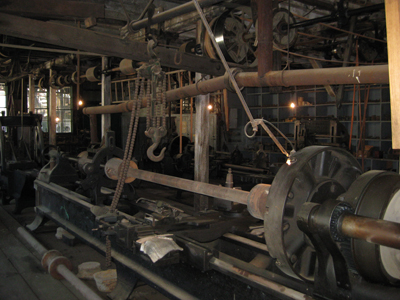
Still, with more than a bit of claustrophobia, I would have sought work in one of the craft shops above ground.  Carpenters and metalworkers on site made and repaired almost everything used in the mining operations, including the ore carts and their wheels.

Empire Mine Carpentry Shop

The metal shop

The blacksmith shop (state park photo)

The mine was closed as a non-essential industry but the War Production Board at the start of WWII. It reopened in 1945 but the price of gold was fixed at its 1934 level of $35 an ounce. By 1956, each ounce cost $45 to produce, and the mine closed in January, 1957.

During its years of operation, the Empire mine produced 5.6 million ounces of gold – roughly five billion dollars at current prices. The state owns the surface structures and grounds, but Newmont mining retains mineral rights, and there’s still gold underground. If the price of rises high enough, mining operations could resume. The real value these days, however, is the historical interest and beauty of the place.

Swimming pool below the cottage

Rose gardens behind the cottage

The heritage roses behind the cottage had all been cut back, but small plaques identified the roses and their dates. Most came from the 19th and early 20th century, but a few were earlier than that. When they are in bloom, you can buy cuttings.

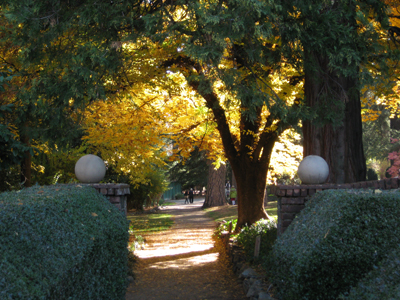
View from the formal gardens toward the mine

I had been to the Empire Mine once before, in the 80’s one January day when the trees were bare, the pool was dry, and no one was no one around. I’d been wanting to return for most of this year, but something always came up until this past Saturday. I had no idea how much I would enjoy the site, and I highly recommend it if you are ever in California’s central valley, with a yen to explore the foothills and the gold country.  http://www.empiremine.org/

Be Careful Out There: Shopping Rage

The title of this post is taken from the sergeant who read the daily assignments on the ground-breaking, 80’s cop show, “Hill Street Blues.”  Every day he would warn his people, “Be careful out there!”

Sadly, the same caution may be needed this year by holiday shoppers, after an incident in southern California that police are calling, “competitive shopping rage.”  At 10:20 pm on Thanksgiving night, shoppers were lining up in the Porter Valley Walmart to purchase discounted Xboxes, when a woman began pepper spraying them “to gain a shopping advantage.”

Ten people were treated for pepper spray, and ten others for bumps and bruises suffered in the confusion.  The assailant got away, and it isn’t clear if she scored an Xbox.  The store is going through register receipts to see if she left a credit card trail.  The woman could face felony battery charges if apprehended.  We all should be thankful she didn’t bring a gun.

I really want to condemn something or someone for this insanity, but that would be false.  A better question would be, how am I complicit in the greed that has come to surround the birthday of the Prince of Peace?  And to reference my previous post on Andrew Weil, how happy is this kind of grasping likely to make someone on Christmas morning?

The 21st Century May Be Bad For Your Mental Health

To appreciate this post, you need to know a little of how it came about.  Yesterday morning, in my dentist’s waiting room, I started reading an article in  the Nov. 14 Newsweek by Dr. Andrew Weil.  He and others have noted that modern affluence breeds depression.  They have also observed that the Amish, with a 19th century lifestyle centered on simplicity, have only 1/10 the amount of depression of other Americans.  Just as I hit this tantalizing statement, the dentist, who was running ahead of schedule, called me in.  After my appointment, I finished the article.  “Our brains aren’t equipped for the 21st century,” says Weil.

One of the things we are not equipped for is our 24/7, hi-tech, multi-tasking world, a point that made me chuckle as I pulled out my smart phone, photographed the pages, and emailed them to myself.  Just call me a poster boy for the legions of technically savvy neurotics.  It turns out I didn’t need to send the page to myself.  Weil’s article is available online, and I highly recommend it:  http://www.thedailybeast.com/newsweek/2011/10/30/andrew-weil-s-spontaneous-happiness-our-nature-deficit-disorder.html.

The article is taken from his latest book, Spontaneous Happiness, just released this month, where Weil says it’s not just technology that’s the cupric in our epidemic of depression.  Increasing numbers of psychologists and therapists identify one of our key problems as Nature Deficit Disorder.  Weil says:  

“Behaviors strongly associated with depression—reduced physical activity and human contact, overconsumption of processed food, seeking endless distraction—are the very behaviors that more and more people now can do, are even forced to do by the nature of their sedentary, indoor jobs.
………………………………………………
“Human beings evolved to thrive in natural environments and in bonded social groups. Few of us today can enjoy such a life and the emotional equilibrium it engenders, but our genetic predisposition for it has not changed.”

Weil discusses the bad news in detail, but doesn’t end there.  He is firmly in the camp of “positive psychology,” the discipline that concentrates on human wellbeing rather than pathology.  He summarizes positive measures we can take, things he discusses in greater detail in the book.

  • Find a mindfulness practice.  (I was impressed that Weil listed this as suggestion #1.  I’ll follow this up by posting some resources soon).
  • Spend as much time as possible outdoors.
  • Find some form of aerobic exercise.
  • Sleep in total darkness, if possible, and avoid very bothersome noise, even if it means wearing earphones.  Weil discusses why uninterrupted sleep, and freedom from noise pollution are important.
  • Attend to diet – he has written of this in detail in previous books.
  • Cultivate social relationships.
  • Spend some time each day unplugged from all forms of gadgetry.

Finally, Weil, like almost everyone else who writes on wellbeing, cites gratitude as a critical factor.  This morning I ran into an acquaintance who has had a number of physical problems.  He has paid a price, but also found something diamond-solid that is now at the core of his life:  three times he has been clinically dead, and he’s seen and experienced “the light,” that people in that extremity sometimes encounter.  He knows it is waiting for him, and meanwhile, shares his experience with others he thinks will benefit.  He says he intends to do so, “as long as God decides to keep me around.”

Simply encountering him put me in tune with the theme of the season, and reminded me of all I have to be thankful for.  That is my hope for everyone reading this – may you find unshakeable joy in your life just as it is, and may you be able to share it with others.

Handmade books

Recently, I came across an estimate of the number of ebooks that will be published next year. I think it was 3 million, but I don’t really remember, and I cannot recall if that was in the US or worldwide. Funny that such a huge number of books was such a non-event for my brain – or maybe it isn’t funny.  Maybe it’s very natural.  Add to that, say, 780,000, the number I remember for traditionally published books last year, and you get, 3,780,000 / 365 = 10,356.16 books per day in 2012.  Even if I am high by an order of magnitude, that’s still more books  being published in one day than I will read in ten years.

Of that total number, I’m guessing a dozen or so will matter to me.  The others will be non-events.  These reflections led me to recall when I was in art school, and there was a large revival of handmade paper as art and craft.  One thing people did with handmade paper was make books by hand.

Books!  Do you remember the sense of wonder books can evoke?  Remember how mysterious they were as when you were just learning to read?  The books you carried everywhere, as a kid and as an adult?  The books that opened new worlds to you or opened new ways of looking at this one?  Have you ever prowled used bookstores, remember stories of people just like you who discover hidden books on magic or other forgotten lore?

It must be this kind of love and fasciation that inspires the artists I picked at random while searching for “handmade books.”  There is nothing comprehensive about these choices .  There are far too many wonderful people making books these days for that.  Hopefully these few pictures will give an idea of what’s possible.  Check the links for further information.

Wooden Book by Barbara Yates

Barbara Yates is an environmental artist who recycles dead trees into art for parks and retreat centers

History of Western Europe by Brian Dettmer

Brian Dettmer’s work reminds me of a dream I’ve had on several occasions, where I am reading a book but cannot decipher the key passages.  Here is the link for his work and Barbara Yates’s:  http://mywiki.ws/The_Most_Unusual_Books_of_the_World

***

Handmade book by Geraldine Newfry

Check out the section on handmade books on Geraldine Newfry’s blog, The Creative Life Unfolds: http://newfry.typepad.com/newfry/handmade_books/

***

Handmade book by Lauren Evatt Finley

There are a number of step-by-step photos of the binding process in the handmade book archive section of Ms Finley’s blog, The Disarranged Studio:   http://laurenfinley.wordpress.com/category/handmade-books/

***

A tintype journal

Website for this tintype journal: http://www.thisnext.com/tag/handmade-books/

***

Handmade book by Carol Roemer

Carol Roemer is an artist whose primary medium for the last ten years has been handmade books. This is her website:  http://www.carolroemer.com/handmadebooks.html

***

This is the cover of a scrapbook “Garbonzobeenz1” made for Christmas photos of her first Christmas in a new house, with her first grandchild.

The website where I found this illustration, twopeasinabucket.com, is an extensive site devoted to scrapbooking, using traditional and digital tools. It should be of interest to anyone who won wants to explore this craft. http://www.twopeasinabucket.com/gallery/member/18824-garbonzobeenz1/1253837-christmas-magic-handmade-book/

***

And finally, here is an electronic pop-up book made by Jie Qi, a grad student in the MIT lab’s Hi-Low Tech group:

***

It’s interesting that many people who recognize the magical and iconic nature of books are visual artists and craftspeople.  It wouldn’t be the first time “outsiders” bring a fresh perspective to a discipline.  I’m not suggesting a fuzzy nostalgia for the old days:  I no more want to trade WordPress for a Gutenberg press than I want to exchange my mac air for an eniac.

What I am suggesting is that the work of these artists leads me to a deeper appreciation of the wonder of what we book creators are doing.