Happy Belated Birthday!

June 28 was the second anniversary of this blog, and I forgot about it until yesterday.  I’ve been preoccupied with offline things.

An out of town series of Tibetan teachings involves a lot of driving as well as study and practice.  The special needs of a very elderly dog (who is doing better for now) takes time and energy.  A neighbor and I were splitting large tree trunks when the rented splitter conked out, and we have to get back to it this week.  Most recently, Mary and I have been discussing a possible trip to Iceland (that’s Iceland not Ireland), with a small group of storytellers in late September.  You’re sure to hear more if it pans out.

A year ago, I appear to have been a more contentious blogger.  I wrote a summary of my experiences at the one year anniversary that made Freshly Pressed: http://wp.me/pYql4-10O.  One thing I mentioned then still happens – I post something and get up thinking,”That’s it.  I’ve run out of things to say.  It was a nice run while it lasted.”

On other occasions, I’ll read an older post and wonder, “What on earthwas I thinking?”

My rule of thumb for such moments is, “Don’t sweat it.”  A few days go by, and I get caught up in another idea.  Now I even know what my mission statement is, though I give myself permission to ignore it when necessary:

“To explore the reality in all fantasies and the fantasy in realities.”

One more thing hasn’t changed – readers keep me going.  People who visit and leave a comment, who point out a flaw or something they like, make it all worthwhile and keep me going.

Thank you very much!!!

UFO Files, Part Deux

Okay, time for a mea culpa on the recs contained in my last post on the National Geographic Channel’s  Hunting UFOs series http://wp.me/pYql4-2b2. I grabbed the clicker after 20 minutes. The program was part Blair Witch and part reality TV, and I’m not fond of either.

And as for the tweets, I think we better hope the aliens don’t speak English.  On the other hand, if they do, it probably means they’ve been tuning in to our TV signals for years.  If they’ve been watching commercials and Fox news, this set of tweets won’t phase them.

For me, the most interesting item to emerge from all of this was a quote from Stephen Hawking that I pasted into a comment and will repeat here.  He warned that if more advanced alien life forms landed on earth, we could see a replay of the fate of Native American populations at the hands of European colonizers.

“We only have to look at ourselves to see how intelligent life might develop into something we wouldn’t want to meet.” – Stephen Hawking 

So life continues, as do our explorations, for as two researchers who are beyond reproach observed, “The truth is out there.”

Mulder and Scully of The X-Files

Hunting UFO’s and Your Chance to Tweet Outer Space

Tonight at 9:00pm, the National Geographic Channel will present “Chasing UFO’s,” with a team of three investigators checking out reported sightings in Texas, Fresno, and other hotspots of alien activity.

The National Geographic Team – move over Men in Black!

In a recent survey, National Geographic discovered that 80 million Americans – a third of the population – believe in UFO’s.  Seventy-nine percent of us think the government has kept UFO information hidden, and more than half believe there are real Men in Black who threaten people who report sightings.

Aliens grok Geena Davis in “Earth Girls are Easy,” 1988

But wait – there’s more going on tomorrow than just watching other people have all the fun.  There’s something to take our minds off wondering how to land a job as a UFO Chaser.  It’s the Wow Reply Project.

In August, 1977, Jerry Ehman, a researcher at the Ohio State Big Ear radio observatory, spotted a coherent alpha-numeric sequence on a computer printout of signals from deep space.  He grabbed a red pen, circled it, and wrote “Wow!” in the margin.

Tomorrow night, National Geographic gives us the chance to Tweet back to whatever alien intelligence may have tried to contact us.  You can schedule your reply at this link: http://channel.nationalgeographic.com/channel/chasing-ufos/the-wow-reply/.

And in case you’re a bit stuck in figuring what to say, the Geographic has solicited suggestions from several experts, including Stephen Colbert, to help us.  Check out Colbert’s recorded message, which begins, “Greetings intelligent alien life forms.  I am Stephen Colbert, and I come to you with an important message from all the peoples of the earth.  We are not delicious.”

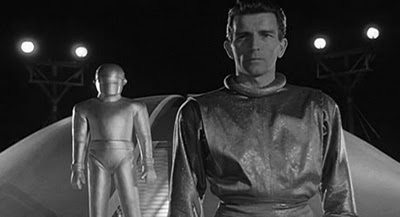
From “The Day the Earth Stood Still,” 1951

It isn’t easy to make up a tweet for space beings.  What can you possibly say?  “Greetings, aliens. I had cheerios for breakfast, how bout you?” See, this is going to take some work, and there isn’t much time, so we better get busy!

Fan Fiction on the Radar

A year ago, I wrote a post on Harry Potter fan fiction,  http://wp.me/pYql4-14b.  My information came from an article in Time on the occasion of the release of the final Potter movie.  I had no idea how popular fan fiction had become, since my only prior experience was with its 20th century incarnation as cheaply printed fanzines on the magazine racks at Tower.  I sometimes skimmed but never bought.

All of that has changed.  The genre was featured last Friday in a Wall Street Journal article, “The Weird World of Fan Fiction.”  No wonder the Journal took notice.  E.L. james, author of the Fifty Shades of Gray erotic trilogy, which sold 15 million copies in three months, got her start writing fan fiction based on the Twilight Series (Edward as a powerful CEO and Bella as his sex slave).

The article mentions other well known writers whose first work was fan fiction. Meg Cabot, author of The Princess Diaries began writing Star Wars stories when she was 11.  Naomi Novik, author  of the Temeraire series, which has been optioned by Peter Jackson, continues to write fan fiction.  For her it is play, and she has more than 400 stories online, set in the worlds of Star Trek, Sherlock  Holmes, and The Avengers.

In addition to fan fiction writers who have broken into the mainstream, some have gathered huge numbers of online readers at sites like fanfiction.net or wattpad.net.  One story based on The Hunger Games has been read two million times.

Fan fiction isn’t new.  Conan Doyle fans in the late 19th century wrote their own Sherlock Holmes stores as authors continue to do.  The theme for an upcoming TV series with a female Watson appeared first on fanfiction.net.  One can argue that both Homer and Shakespeare in his histories, created stories akin to fan fiction; they used pre-existing worlds, situations, and characters.

The Journal gives a sense of the wild playfulness of fan fiction authors.  There is Pride and Prejudice in Space. We have Alice and the Mad Hatter battling zombies, and The Lord of the Whiskers, which populates Middle Earth with cats.  Male-male romance appears to be common, with Kirk and Spock, and Harry and Draco among readers’ favorite couples.  There are character cross-over stories too, like characters from the TV series, Glee, winding up in Middle Earth.

Published authors are mixed in their response.  Some, like J.K Rowling and Stephanie Meyer welcome the spinoff stories.  Others like George R.R. Martin and Anne Rice are dead set against fan fiction, and threaten lawsuits, though suits are seldom launched except when fans try to move borrowed worlds into mainstream publication.  Orson Scott Card was initially opposed to fan fiction but has come to embrace it.  This fall he will host a contest for Ender’s Game fan fiction.  Fans can submit works to his website, and the winning stories will be published in a anthology.  “Every piece of fan fiction is an add for my book,” Card said.  “What kind of idiot would I be to want that to disappear?”

I understand the draw of fan fiction.  My first real literary effort was a sequel to The Wind in the Willows that I wrote in the fifth grade because I didn’t want the story to end.  In college I was seized with great, “What am I going to do now?” angst when I finished Lord of the Rings.  One of the things I did was work with a group of independent filmmakers on a 20 minute epic entitled, Billy the Kid Meets the Wizard of Oz

The word, “amateur” comes from the Latin, amare, to love.  With that in mind, I look forward to checking out some of the web sites where these amateurs post their work.

Michael Meade on Genius

We all know what genius means in the modern sense of the word:  people like Einstein, Shakespeare, Leonardo, and Beethoven.  As far as I know, the image of the solitary genius, often suffering and at odds with the culture, is an artifact of the romantic era.  The word and original concept came from Rome, where it meant something else.

“In ancient Roman religion, the genius was the individual instance of a general divine nature that is present in every individual person, place, or thing.  The rational powers and abilities of each and every human being were attributed to his soul, which was a genius.” Wikipedia.  

The Three Graces – Pompeii fresco

In his blog on the Huffington post, Michael Meade has started a series on genius that delves into this classical meaning. Meade says:

“Genius involves deeply subjective qualities and an inner pattern that marks each person as unique in some way and genius tries to leave that mark on the world. Since the genius in a person is ageless it can awaken at almost any age.”

He then adds,

“An old Greek word for happiness translates as having a satisfied genius. Recognizing and following the promptings of one’s inner-genius can be one of the most fulfilling experiences of life even if all else has been reduced to garbage and scraps.”

Michael Meade

In these terms, genius has little to do with most of our cultural assumptions about the word, like IQ, conventional success, or 15 minutes of fame.  It is more like what we mean when we speak of “marching to one’s own drummer.”

I invite everyone to read Meade’s post and watch for the next in his series which will focus on “the genius zone.”

http://www.huffingtonpost.com/michael-meade-dhl/genius-fame_b_1563235.html

An Author’s Guide to Publishing in 2012, by Amy Rogers.

Those who have followed thefirstgates for a while will be familiar with Dr. Amy Rogers.

Amy Rogers

I reviewed her excellent first novel, Petroplague, in September, 2011 http://wp.me/pYql4-1ep.  In March of this year, she contributed a two part guest post detailing some of the rapid changes in today’s publishing landscape, an issue she follows in depth http://wp.me/pYql4-1MR.  Last Friday, Amy gave an updated presentation on  publishing options to the Sacramento branch of the California Writer’s Club during our monthly breakfast meeting.

Not long ago, there were only two publishing choices:  traditional publishing and the so called vanity press.  Now we have a spectrum of possibilities which keep getting harder to navigate.  Hybrid arrangements are multiplying:  traditional agencies offering ebook options, and agented independent publishing companies.

Rogers began her presentation by stressing the importance of every writer evaluating their individual goals.  Why do we want to publish this particular book?  How will we measure success?

Do we seek the implied approval that selection by a traditional publisher confers?  If so, do we have the time to invest in the process, knowing there is no guarantee of ultimate success?

If we choose to go the independent route, are we ready and willing to spend the time and/or money on five key tasks required for any book to be successful:  editing, cover design, layout, getting an isbn number, and marketing/distribution?

With a sense of our goals, Amy Rogers presentation, posted in full on her blog, will prove especially valuable.  A downloadable pdf version, is available too http://tinyurl.com/739ga5s.

After reviewing the presentation, take the time to explore Ms Rogers’ website, ScienceThrillers.com.  With a Ph.D in immunology, teaching experience in microbiology, and a writing career that began in grade school, Amy is uniquely qualified to write and review thrillers involving the depredations of “wee beasties.”  ScienceThrillers has grown to include reviews of books in multiple genres, publishing news, book giveaways, notices of writing contests, and her own quarterly newsletter.  It’s a site I’m very happy to recommend.

Remembering Doc Watson, an American Original

Doc Watson was born in the Blue Ridge Mountain town of Deep Gap, North Carolina, 89 years ago. When he was a year old, he went blind of an untreated eye infection. When he was 11, his father made him a banjo from the skin of a dead cat.  “He brought it to me and put it in my hands, and said, ‘Son, I want you to learn to play this thing real well. One of these days we’ll get you a better one,’ he said. ‘Might help you get through the world,’ ” Watson recalled. http://www.npr.org/blogs/therecord/2012/05/29/153697428/doc-watson-folk-music-icon-dies-at-89

Doc Watson

His parents did everything they could to see that their son had tools to make his way in the world.  His father paid a week’s wages at the sawmill where he worked for a phonograph and 50 records.  Watson earned the money for his first mail order guitar by cutting trees on his father’s farm.  He played on street corners and with dance bands until he was “discovered” by a Smithsonian folklorist who was looking for another musician in the ’60’s.

Statue of Watson in Boone, NC, where he used to play for tips to support his family

Since then, Doc Watson has given his own unique take on bluegrass and mountain music to the entire world.  He died today, after surgery a week ago.  There will never be another musician like him.

Here is a great rendition of “Shady Grove,” one of my all time favorite bluegrass pieces, by Doc Watson, David Grisman, and David Holt.

Chants in the Desert

Yesterday NPR interviewed two monks of the Benedictine Abbey of Christ in the Desert in Abiquiu, New Mexico, concerning the Gregorian Chants that are part of the fabric of their lives.

Monastery of Christ in the Desert

The occasion was the release of a CD of their music, “Blessings, Peace, and Harmony.”  Brother Christian Leisy explained that an email from Sony arrived proposing the recording.  “We thought at first it was spam,” he said, “but apparently someone at Sony felt the world wasn’t getting any better, and they wanted to work with a community that might focus on some of the peace elements.”

Chanting does exactly this.  Abbot Phillip Lawrence explained that scientific studies of the effects of contemplative chanting match those of meditative practice:  relaxation, stress reduction, lowered blood pressure and a general sense of wellbeing.

I bought my first album of Gregorian Chants in high school.  Even though I was usually given to rock n roll, there were times when I was drawn to this seemingly strange music with the power to draw me outside of ordinary concerns.  I’ve collected other music like it since then.  Abbot Lawrence understands the power of different types of contemplative music.  He stayed for a time in a Tibetan monastery and found that the deep chanting that is part of that spiritual discipline has the same power as the music he is familiar with.

I highly recommend the interview and the song samples to anyone interested in contemplative music:  http://www.npr.org/2012/05/27/153707577/deep-in-the-desert-monks-make-transcendent-music