The Wind In the Willows by Kenneth Grahame: An Appreciation

It was a golden afternoon; the smell of the dust they kicked up was rich and satisfying - Illustration for The Wind in the Willows by Arthur Rackham, 1940

Kenneth Grahame was a turn of the century British author who was Secretary of the Bank of England “in his spare time” (according to A.A. Milne).  In 1908, Grahame published The Wind in the Willows, his third novel.  Unlike his first two books, The Wind in the Willows was not an immediate success, though its early supporters included Theodore Roosevelt, who wrote to the author in 1909, “I have read it and reread it, and have now come to accept the characters as old friends.”

Arthur Rackham was perhaps the best known artist of “the golden age of illustration,” from 1870-1930.  His illustrations for The Wind in the Willows were his last work, published posthumously in 1940, a year after Rackham died of cancer.

Shove that under your feet, he observed to the mole, as he passed it down into the boat - Arthur Rackham, 1940

I cannot think of a more auspicious partnership in the history of book illustration, though I am biased.  I’m writing about The Wind in the Willows because I stopped by a blog that asked, “What is your favorite book?”  This has been mine since my mother read it to me when I was four.  When she finished, I begged her to start it again.  I began school determined to learn to read as soon as I could so I would not have to wait on anyone else’s convenience to row up the river with Rat and Mole.

The badger's winter stores, which indeed were visible everywhere, took up half the room - Arthur Rackham, 1940

I called this post an appreciation rather than a book review, because my intent is not to be systematic. Besides, in his introduction, A.A. Milne warns us not to dare anything so foolish:

One does not argue about The Wind in the Willows.  The young man gives it to the girl with whom he is in love, and if she does not like it, asks her to return his letters.  The older man tries it on his nephew, and alters his will accordingly.  The book is a test of character.  We can’t criticize it because it is criticizing us.

She arranged the shawl with a professional fold, and tied the strings of the rusty bonnet under his chin - Arthur Rackham, 1940

The magic of this volume lies in text as well as the illustrations.  This is story of friendship, of terror in the Wild Wood, of the ache of standing outside looking in on Christmas eve.  There is slapstick and comedy, and a battle against heavy odds to restore the natural order along the river bank, but the center of the story for me has always been Chapter 7, “The Piper at the Gates of Dawn.”

Otter’s son Portly has gone missing, and one mild summer evening, Rat and Mole row the backwaters trying to find him.  They catch the strains of a haunting tune:

“It’s gone!” sighed the Rat, sinking back in his seat again.  “So beautiful and strange and new!  Since it was to end so soon, I almost wish I had never heard it.  For it has roused a longing in me that is pain, and nothing seems worth while but just to hear that sound once more and go on listening to it for ever.  No!  There it is again!”

The animals follow the sound and it leads them to a place where a great Awe falls upon them and they are granted a vision:  [Mole] raised his humble head; and then, in that utter clearness of the imminent dawn, while Nature, flushed with fullness of incredible color, seemed to hold her breath for the event, he looked in the very eyes of the Friend and Helper.”

The animals find the baby otter and the vision fades, leaving them in misery as they feel what they have lost, but then, a capricious little breeze, dancing up from the surface of the water, tossed the aspens, shook the dewy roses, and blew lightly and caressingly in their faces, and with its soft touch came instant oblivious.  For this is the last best gift that the kindly demigod is careful to bestow on those to whom he has revealed himself in their helping:   the gift of forgetfulness.  Leset the awful remembrance should remain and grow, and overshadow mirth and pleasure, and the great haunting memory should spoil all the after-lives of little animals.

The minister in the church I attended when I was young once said from the pulpit that “The Piper at the Gates of Dawn,” was the best theology he knew outside the Bible.

Together, Kenneth Grahame and Arthur Rackham preserved and shared a vision of an older, idyllic England of quiet lanes and riverbanks and launched it into a new century that needed such a dream, after one World War and on the eve of a second.  Last time I looked for a gift for a friend, a facsimile edition was available (from Modern Library I believe).

There are other nice editions like the one illustrated by Michael Hague and published in 1980, for there are more ways than one into this dream.

Wind in the Willows cover by Michael Hague, 1980

I guess you could say I’ve been dreaming along with the great British storytellers all my life – with Rat and Mole, with Pooh and Piglet; in Middle Earth and Narnia; with King Arthur and his knights; with Welsh wizards and Irish warriors and Tam Lin in Faerie; Harry Potter is simply the latest feast from the cornucopia I first encountered when I was four years old.

If you have not yet discovered the magic of The Wind in the Willows (and I don’t mean Mr. Toad’s Wild Ride @Disney) I suggest you give it a look as soon as can.  In my experience (as in Bilbo’s) there is no telling where the road will take you.

The wayfarer saluted with a gesture of courtesy that had something foreign about it - Arthur Rackham, 1940
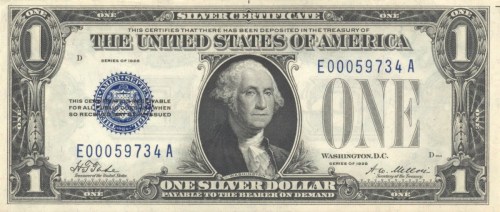
Remember Real Money?

US Silver Certificate

In 1965, my father, who worked for IBM, was assigned to the south of France for two years, so the family packed up for Europe.  Back then, except for a few parodies in Pink Panther and James Bond movies, Americans in Europe got some respect.  Our money got a whole lot of respect – everyone wanted dollars.

My mother, who was an artist and appreciated fine drawing and engraving, drew the line at most European currencies.  “It looks like play money,” she said.  No wonder!  It was colorful and had big heads!  Real money, like good old yankee greenbacks, was sober and serious – it was monochrome and the heads were decently small.  I laughed the other day at a fast food restaurant.  I handed the clerk a twenty and he held it up to the light.  No one trusts a big-head!

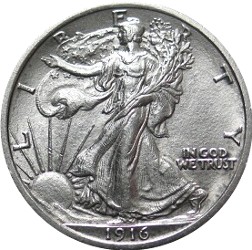
Our coins contained silver through 1965

My father was involved in the early development of magnetic card readers.  I remember his mood of euphoria the day engineers succeeded in programming a “1” and a “0” on a magnetic strip.  He announced that someday none of us would carry money at all.

“That sucks,” I said – my usual answer to my father when I was a teenager.  I thought of him today as I used my iPhone to buy a frappacino and then glanced at the budget headlines as I carried it out the door.

Money has always been abstract:  the great Lakota medicine man, Black Elk, called gold, “the yellow metal that drives men crazy.”  To his people, gold was just a pretty stone in the river – nothing to get excited about.

Now money is virtual as well – I used a pattern of pixels to buy my drink.  That doesn’t mean it doesn’t have as much power as it ever did – you can’t see or touch the wind, but this year especially, we have seen what it can do.  Still, in some ways, the increasingly non-material nature of money makes it seem all the more open to abuse.  As I understand it, the Fed doesn’t even have to print big-heads to increase the money supply – a few keystrokes will do it.

Standing liberty quarter

In truth, I love the convenience of electronic money.  A decade ago, when I was managing our affairs and my fathers, I had to write out 30-40 checks a month, a task that took a lot of time and was always subject to error, for my mind wanders when it is bored.  One Friday evening I wrote a payee the entire amount of my paycheck.  Luckily, that honest woman called me a few days later and said, “Uh, sir, I think you made a mistake.”

Abstract or not, we use our money for concrete things – a meal, a car, a house, a movie ticket, a new pair of shoes.  One immediately thinks of bartering, but these days, that seem rather strange.  In the last elections, a conservative senate candidate from Nevada suggested people might think of barter if their medical costs were too high.  Her opponents jumped on that statement, and their slogan, “Chickens for checkups” was a factor in her loss.

There is one aspect of money we do not think of often – in some of its forms, it is beautiful.  When I was a kid, I collected coins – just pennies for the most part.  I tended to spend anything bigger on baseball cards.  Now I have come to appreciate the sheer beauty of the two types of coins pictured here:  walking liberty halves, and standing liberty quarters.  These pictures show the amazing quality of the engraving.  Coins in this condition are premium, but fortunately, more heavily circulated specimens can be purchased for just a few dollars.  It’s quite an exercise in imagination to hold a coin that is 80 or 100 years old and wonder about its story.

It’s a lot more fun to think in these terms – of the beauty of money – than it is to think of our headlines or watch politicians on TV.  One thing “those European countries” did when we lived abroad, was periodically throw their governments out.  Even now, some nations hold votes of no confidence, which amount to a mass recall.  I remember feeling superior to that  – our system worked after all.  Now as I look at the big-heads in my wallet  – my mother’s old criterion for funny money – I doubt that I am alone in the fantasy of charging our leaders with high crimes of cluelessness and voting the rascals out.

The Letters of Georgia O’Keeffe and Alfred Stieglitz

In 1916, when they met, Alfred Stieglitz was 52, and an internationally known photographer whose avant-garde gallery in Manhattan made him one of the most influential men in early 20th century American art. Georgia O’Keeffe was 28, and an unknown schoolteacher from Texas.  Their professional and personal relationship spanned three decades and is documented in 25,000 pages of correspondence.  The first volume of these letters has just been published as, My Faraway One: Selected Letters of Georgia O’Keeffe and Alfred Stieglitz, Volume I, 1915-1933, edited and annotated by Sarah Greenough.

Georgia O'Keeffe and Alfred Stieglitz, 1944

Sarah Greenough discussed this correspondence recently on NPR:  http://www.npr.org/2011/07/21/138467808/stieglitz-and-okeeffe-their-love-and-life-in-letters.  Stieglitz and O’Keeffe were prolific correspondents, sometimes writing two or three letters a day, up to 40 pages long.  These documents “track their relationship from acquaintances to admirers to lovers to man and wife to exasperated — but still together — long-marrieds.”   

The two began living together soon after O’Keeffe moved to New York.  They were married in 1924.  Greenough notes that tensions began to appear between them almost immediately, but the deciding moment in their relationship came in 1929, when O’Keeffe visited New Mexico and discovered the landscape of her soul.  Stieglitz had promoted her work in New York, but in New Mexico, O’Keeffe found the subjects and colors that made her famous.  You cannot really think of her living anywhere else, just as you cannot think of Stieglitz outside of New York.  The two maintained their relationship at a distance, struggling to grow as individuals and as a couple, until Stieglitz’s death in 1946.

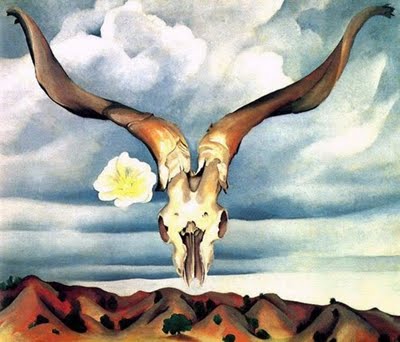
"Ram's Head," by Georgia O'Keefe

More is generally known about O’Keeffe than Stieglitz, for her powerful canvases have a distinct 20th century feel, and her life has become emblematic for generations of women struggling to champion their own personal and creative gifts.

"Light Iris" by Georgia O'Keeffe

Stieglitz is not as important to contemporary artists, but his influence on early 20th century American art and especially modern photography cannot be overstated.  He was an early and ardent champion the idea of photography as an art.  Later 20th century masters of the medium – Paul Strand, Edward Weston, Ansel Adams, and Minor White – all made the pilgrimage to New York to seek the “master’s blessing,” and those who won his approval never doubted themselves again.  In her NPR interview, Sarah Greenough notes that Stieglitz was “amazingly egotistical and narcissistic,” but he had the ability to establish “a deep communion with people.”

Stieglitz was also a “hinge” on which the transition to modern photography swung.  Prior to Stieglitz, most people made and saw photographs in terms of their literal subject matter.  Stieglitz used the medium of visible shapes to evoke states of awareness and feeling that move beyond the visible.  He named his efforts, “equivalents,” a term which Minor White later picked up, championed, and made known to subsequent generations of photographers.

No one before Stieglitz had made photographs as evocative of meaning beyond their literal subjects:

"New York Central Yard," by Alfred Stieglitz

Georgia O'Keeffe's Hands by Alfred Stieglitz

Equivalent, 1930, by Alfred Stieglitz

O’Keeffe and Stieglitz met almost 100 years ago, but their relationship seems utterly contemporary, laced as it was with tension between self-expression and commitment to the other.  Even so, their attitude might be summed up by what Minor White reported after his visit to Stieglitz’s gallery.  White wondered if he had what it took to become a serious photographer.

“Have you ever been in love?” Stieglitz asked.  White said he had.

“Then you can photograph,” was the reply.

Midnight in Paris: A Movie Review

https://i0.wp.com/cdn2-b.examiner.com/sites/default/files/styles/image_content_width/hash/48/f6/48f651f5883697520af2afd5b5372777.jpg

Midnight in Paris, written and directed by Woody Allen, is a delightful romantic comedy and another of Allen’s meditations on the relationship between art and life, this time with time-travel in the mix.  Want to see Ernest Hemingway speaking exactly the way he wrote?  Kathy Bates holding forth as Gertrude Stein?  Want to see an insufferable pseudo-intellectual get his comeuppance, and the right couple go walking off together in Paris in the rain?

Gil (Owen Wilson), a successful screenwriter visits Paris with his fiance, Inez (Rachel McAdams), and her family.  Gil dreams of moving to Paris to finish his novel about a man who opens a nostalgia shop.  Inez wants her parents to help her talk sense into Gil and get him to settle down in Malibu.  Gil wants Inez to walk with him in Paris in the rain.  Inez tells him not to be silly, they would get wet.

After a wine tasting with Paul (Michael Sheen), the sort of pompous know-it-all that Allen loves to parody, Gil decides to walk home by himself.  At the stroke of midnight, an old-time car pulls up beside Gil.  Revelers invite him in and transport him to a party where he meets F. Scott and Zelda Fitzgerald, who introduce him to Hemingway, who takes him to Gertrude Stein, who agrees to read his novel.

Even Inez notices how strangely Gil begins to act – sequestering himself to write by day and taking long walks at night.  He tries to demonstrate how he travels into the past, but she stalks off just before midnight and misses the car when it pulls up.  Gil meets Pablo Picasso and his beautiful mistress, Adriana (Marion Cotillard), who instantly captures his heart.

While shopping for furniture with Inez, Gil meets a sweet young antiques dealer, Gabrielle (Lea Seydoux), who shares his love of the 20’s and Cole Porter.  He discovers a battered copy of Adriana’s diary and finds a loving passage describing himself.  Returning to the past, he confesses his love to Adriana, who has left Picasso.  That night an ancient coach pulls up to carry the pair to her Golden Age, La Belle Epoque.  They stop at Moulin rouge and meet Toulouse Lautrec, Degas, and Paul Gauguin.

Adriana begs him to stay, but as Gil sees the famous painters dreaming of the Renaissance, he sees through his Golden Age illusion and decides to return to his present.  On the way, he stops off to see Gertrude Stein, who has finished his novel.  She likes it but thinks it needs a touch of the supernatural.

Back in his own time, he confronts Inez about her affair with Paul (Hemingway brought it to his attention).  She and her family leave.  Gil is left by himself in a storm, on his own, in the “ordinary” streets of Paris – which might not be so ordinary.  He runs into Gabrielle who loves to walk in the rain and says she would like it very much if he walked her home.

My brief description does not do justice to story and all the whimsical sub-plots – like the detective that Inez’s father hires to follow Gil, who makes a wrong turn and winds up lost in the court of Louis XIV.  This is a delightful movie.  If the story seems at all intriguing, I guarantee you will laugh out loud during the movie and walk out with a smile on your face.

A Walk in the Park and Minor White

The other day, I fired up Google to look at opinions on the appropriate age for protagonists of young adult vs. middle grade fantasy. The reason, as I have said here recently, is that I am reviewing all my ideas and assumptions about the story I’m working on. Everything is on the table.  I was thinking of the greater freedom middle grade fantasy allows; as one blogger put it, “in middle grade, tall ships and laptops can exist in the same universe.”

Opinions on the age divide between the two genres varied, and in particular, no one seemed to know where to put a 14 year old lead character – what I am currently leaning toward for my heroine.  She started out 14, became 16 for a while, and is probably going to get younger again.

At the end of this search I was not only frustrated with the lack of clear answers, but also slightly disgusted with myself.  I have written about not being bound by rules, and these are the most inane sort of rules.  I remembered my very first post on this blog, when I quoted from Neil Gaiman’s editorial notes for the collection of stories called, Stories (William Morrow, 2010).  Gaiman says:  “I realized that I was not alone in finding myself increasingly frustrated with the boundaries of genre:  the idea that categories which existed only to guide people around bookshops now seemed to be dictating the kinds of stories that were being written.”

The next day, Mary and I were walking in the local park and I was relating the results of my search and grousing a bit.  I said, “It would be nice to forget the whole business of getting published.”  She shrugged and said, “Why don’t you?”

Why don’t I indeed?  And we’re not talking here of the old cliche, “I just write for myself,” which implies indifference to quality or being read.  We’re talking of what T.S. Eliot meant when he said, “Take no thought for the harvest but only for the proper sowing.”

Why don’t I?  The reason is simple.  I’m still learning my craft as a writer, still a little hungry for external validation, but I have travelled this arc from apprentice to journeyman before.  I thought of the words and photographs of Minor White who influenced me more than anyone else when, after two years of college, I changed majors and schools to study art and photography.  Minor White’s dedication to photography as a spiritual practice was one of the reasons I went.

White, (1908-1976), began taking photographs in 1938 after spending five years writing poetry.  In 1946, Ansel Adams invited him to join the faculty of the first American fine arts photography department at the California School of Fine Arts in San Francisco.  White’s work always had an inward focus; he evolved the concept of “equivalents,” a word first coined by the photographer, Alfred Stieglitz, who served as a mentor for White’s and Adams’s entire generation.

Equivalents are photographs, often of mundane subjects, that are seen with an almost visionary regard for form and light.  At their best, “equivalents” evoke powerful and even semi-mystical responses in the viewer, unrelated to the literal meaning of the image.  Later in his working and teaching career, White wrote extensively of Zen and camera work.

Snow Door by Minor White

Zen has always been associated with certain arts, traditionally, painting, poetry, archery, flower arranging, and the tea ceremony. Zen Master Dogen (1200-1253) wrote a manual for cooks.  My friend, Rosi Hollinbeck, has written about the inspiration she gets from Natalie Goldberg who writes about writing from the perspective of a long time Zen practitioner:  http://rosihollinbeckthewritestuff.blogspot.com/2011/03/book-for-writers-and-lovers.html.

For me, it was Minor White who opened a doorway into the practice of art as a spiritual discipline.  At the core of any such discipline are moments of selflessness, where the subject-object split disappears, and mindfulness replaces concern for the “product.”

I hadn’t thought of Minor White in some time, but the memory brought a great sense of relief, because I remembered that once before I had learned a craft well enough that it sometimes became transparent, became a doorway to “the still point in the turning world.”  Sometimes I didn’t realize when it was happening; sometimes I did, as with this image of a crumbling barn in western New York.

"Near Oswego, NY," 1973, by Morgan Mussell

Seen from this perspective, the answer to Mary’s question, “Is it possible to forget about results in writing,” becomes, “It is necessary!”

I was fortunate enough to meet some of the great photographers of White’s generation – Ansel Adams and Imogen Cunningham.  I never met Minor White himself.  It’s probably just as well.  He was a heros then, and some heroes can loom so large it is hard to let them go when the time comes.

Minor White, 1973. Photo by Robert Haiko

I don’t really have heroes now; heroes are for young men.  What I have is tremendous gratitude and respect for those who, like Minor White, served as mentors and guides.  These are people who found a way to walk their own individual paths, and in doing so, showed us that it remains possible.

True North

In December, 1975, my sister sent me a small wrapped box with a note attached.  Our mother had died suddenly the previous May, but my sister found a small package, wrapped for Christmas the year before, at the back of a closet.

Inside was a compass.  I’m sure my mother intended it as a pragmatic gift – I was spending a lot of time on back roads and camping out in the southwestern deserts where you really want to know where you are and where you are going, but ever since, that particular compass and compasses in general, have carried a lot of symbolic meaning for me.  Finding true north.  Finding one’s way.

The earlier name for a Compass Rose was Wind Rose

My ideas have changed since I got that compass.  I used to imagine “one’s way” as “one way.”  As if our lives were like trains, and we are either on the track or off.  Now I imagine something more like “possible futures,” (a classic sci-fi term).  Not a single track, but an ongoing dance between ourselves and the world, of choices and unfolding events.

***

Recently I posted that I am rethinking the plot of the novel I’m writing because my forward progress had slowed and a step back showed there were flaws and gaps in my core conception.  Later I realized some of the story elements had become so common as to have already become cliches.  I understand how fast that can happen; Thomas Edison used to speak of times when “ideas were in the air,” and I’m sure there were far fewer inventors in his day than young adult writers in ours.

I’ve taken my own advice recently, and done a lot of free-writing, easily filling up single spaced pages with several alternate plots that seems fresher to me, but remain similar in setting and character to the story I was working on before.  One in particular sparked my excitement.  Then I spotted a review of a recently published, YA novel that had features strangely in common with my current conception.

Conventional wisdom urges us not chase popular stories, but these days, my impulse is almost the reverse – it almost seems harder to run away from what other people have done!  Something else we are told often is, “tell the story that only you can tell.”  To me, this sounds a lot like the “true north” idea.  Our thoughts, our emotions, our memories are not stable, so why should our stories be?  That kind of imagined fixity  is something the conscious mind loves, but the unconscious or whatever you wish to call the wellsprings of our creativity, does not share in such linear thinking.

I used to admire an Arizona man named Frederick Sommer, who took hauntingly surreal photographs in the desert.  Once an interviewer asked him why he photographed, seeming, from the tone of the article, to want some kind of deep philosophical rationale.  Instead, Sommer shrugged and said, “You’ve got to do something during the day.”  I’ve always loved the irreverence of his response.  I remember it in moments when I begin to take myself and work too seriously.  As ego involvement grows, I risk mistaking what I do for what I am.

Frederick Sommer

In retrospect, I learned a lot when I was writing software.  I learned that when something isn’t working, you look at it closely, and if necessary, try something else.  I may have missed schedules but I seldom missed sleep.  The years that I spent writing software convinced me that I can solve problems – that if I keep looking long enough, I’ll find a creative solution that was there all along, overlooked.

I write for a lot of reasons.  One of them is that I have to do something during the day.

Joseph Cornell’s Dreamtime

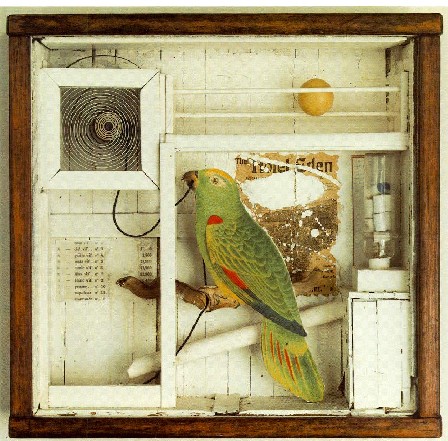
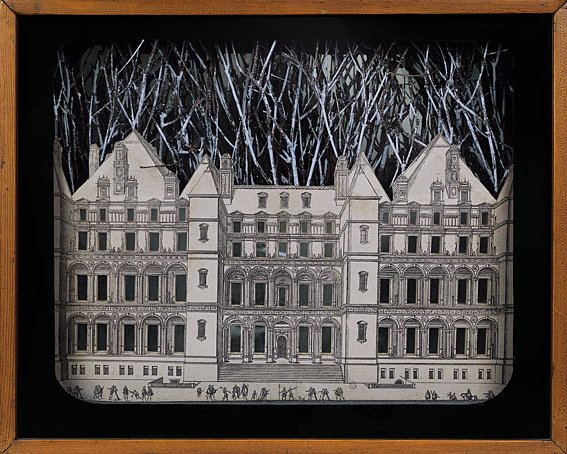
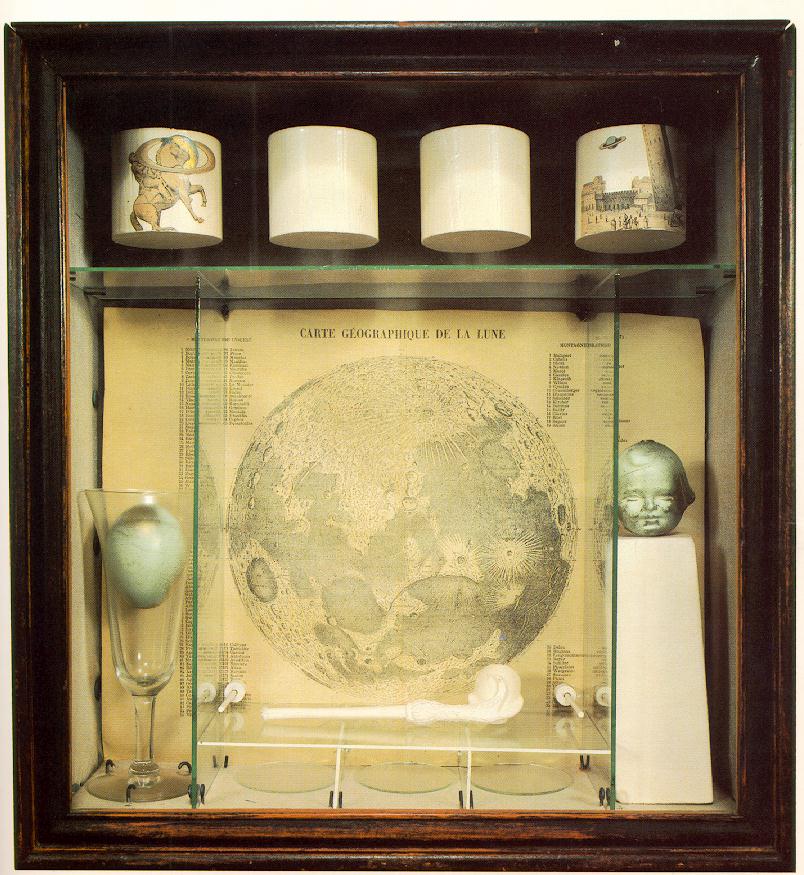
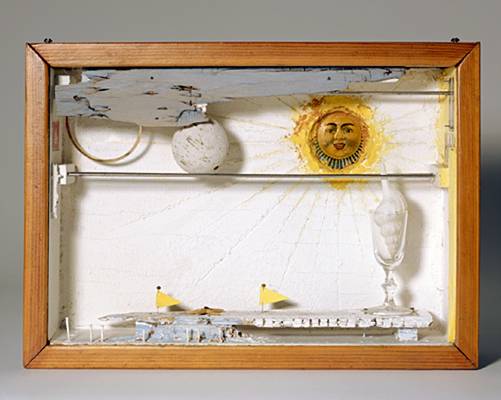
Looking at Malcolm Forbes’ toys in the previous posts reminded me of one of my favorite American artists, Joseph Cornell (1903-1972), who built windows into our dreams, into other times, and other worlds.

Untitled (Hotel Eden) ca. 1945

Cornell, who was wary of strangers and self-taught as an artist, led a reclusive life, most of it in a wood-frame house in a working class neighborhood in Queens. Though he had galleries and collectors from an early age, I have never seen him listed among the “major” American artists of the 20th century. One of my college art history professors suggested he was “ahead of his time,” in the missed-the-boat sense, noting that in the 60’s, Robert Raushenberg gained art world super-star status with constructions and collages similar to those Cornell had begun in the 30’s.

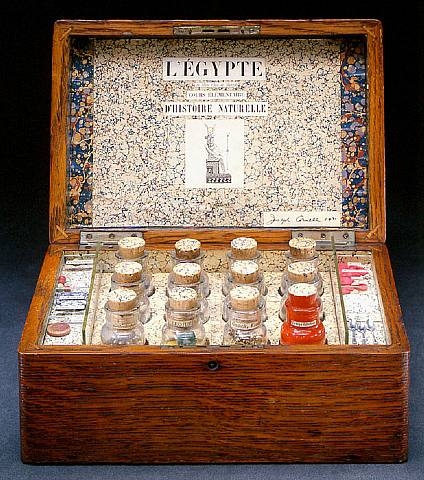
Setting For a Fairytale

I think there was much more to it than that; I find it significant that Cornell, described as “frighteningly well read,” had a special affection for the poetry of Emily Dickinson, another reclusive soul, and Arthur Rimbaud, who firmly rejected the literary and artistic “establishment” of his time.

Cornell said what he wanted in his art was “white magic.” It’s hard to imagine such a subtle ambition surviving the grand gestures and conscious self-promotion of the artists of Warhol’s generation. Cornell’s distance from that mileau seems to have been deliberate.

Untitled (Soap Bubble Set) 1936

In a wonderful article on Joseph Cornell in 2003, the centennial of his birth, Adam Gopnik says:

What’s nostalgic in Cornell’s art is not that it’s made of old things…What’s nostalgic is that, behind glass, fixed in place, the new things become old even as we look at them: it is the fate of everything, each box proposes, to become part of a vivid and longed-for past…a bottomless melancholy in the simple desolation of life by time. The false kind of nostalgia promotes the superiority of life past; the true kind captures the sadness of life passing.

http://www.newyorker.com/archive/2003/02/17/030217crat_atlarge?currentPage=1

Gopnik says Cornell’s much-storied isloation was central to his way of working.

He had discovered the joys of solitary wandering. Beginning in the early nineteen-forties, his life was structured by a simple rhythm: from Queens via the subway to Manhattan, where he walked and ate and watched and collected, and then back home to the basement and back yard in Queens, where he built his boxes, talked to his mother, and cared for his brother (who had severe cerebral palsy).

Certain themes recur in the work of Joseph Cornell:  birds, ships, the requisite surrealist clocks, and bottles which hint at potions or hidden alchemical mixtures.

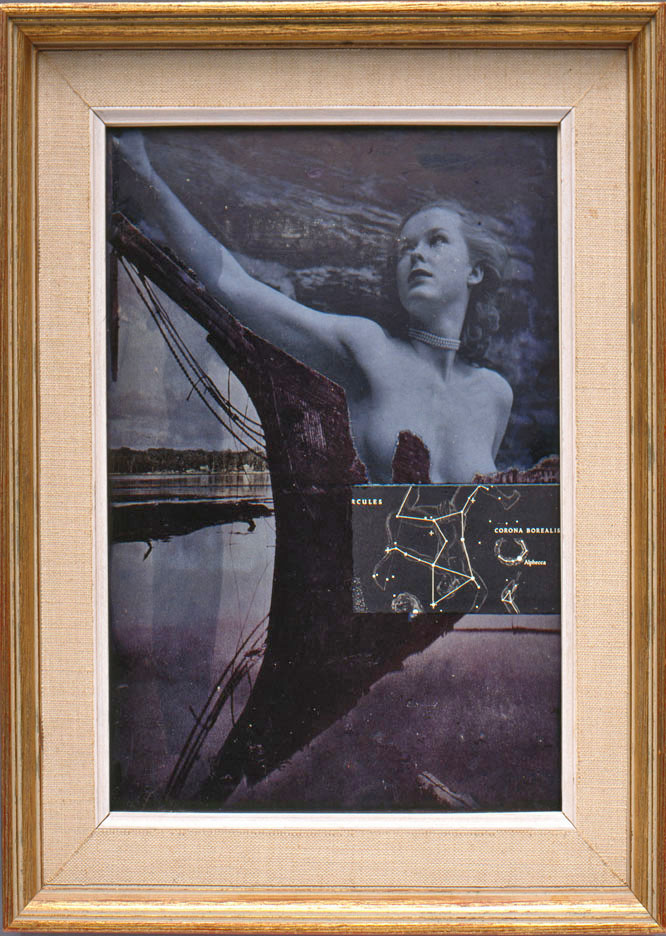
Another recurring theme is idealized images of women.

Ship With Nude

Although he professed devotion to unattainable women like Lauren Bacall and Marylin Monroe, his reserve kept him out of romantic relationships as far as anyone knows.   At the same time he was friends with numerous ballerinas, including Tamara Toumanova, a “superstar” in the world of ballet at a time when Cornell had gained some prominence in the world of art.  Several of his pieces are homages to Tourmanova.

The final exhibition Cornell worked on during 1972, the last year of his life, was for “children only.”  Everything was placed at their eye level, about three feet above the floor.  Denise Hare writes:  “Joseph Cornell often said children were his most receptive and enthusiastic audience.  They were filled with innocence and needed to see.”  Brownies and cherry coke were served as refreshments.

Cornell at an exhibition of his work for children at Cooper Union, 1972

In his 2003 article, Adam Gopnik says:

He is an artist of longings, but his longings are for things known and seen and hard to keep. He didn’t long to go to France; he longed to build memorials to the feeling of wanting to go to France while riding the Third Avenue El. He preferred the ticket to the trip, the postcard to the place, the fragment to the whole. Cornell’s boxes look like dreams to us, but the mind that made them was always wide awake.
***
Joseph Cornell showed us again and again that just a little shift in context, an altered point of view on the things of our lives will make them come alive, seem full of meaning, or appear as downright spooky.
The core importance of context in art was demonstrated forcefully in 1917 by Marcel Duchamp’s whose “ready-made” sculpture, Fountain, was named “the most influential piece of modern art” by 500 artists and critics.  Duchamp hung a urinal upside down in a gallery, signed it, “R. Mutt,” and to my mind, truly initiated the twentieth century in art.  Duchamps and Cornell were in regular contact in New York from 1942 to 1953.

Fountain, by Marcel Duchamp

Cornell never sought to shock as Duchamp did, or ask huge questions, like “what is art after all?”  But he regularily explored what happened when the faded postcard or torn photograph was removed from the shoebox or dusty album and given new life in a box on a wall.  And there, some of his birds and ballerinas still live mysterious lives and whisper to us messages which we have to become very quiet to hear, for as T.S. Eliot put it, Human kind cannot bear very much reality.
 
***
 

Click here for an interesting online Presentation of Cornell’s Work: http://www.pem.org/exhibitions/62-joseph_cornell_navigating_the_imagination

Good Grief – A Visit to the Charles Schulz Museum

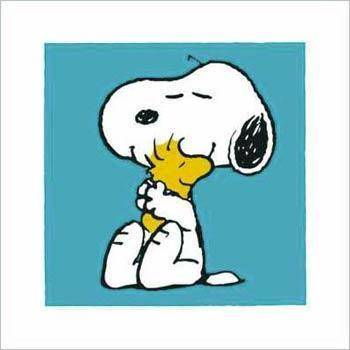
Eleven years ago, in December, 1999, we managed to round up everyone and get to the mountains for Christmas. There was good health and good cheer in abundance, and we had an exceptionally nice holiday. One of my gifts was a watch with this picture of Snoopy and Woodstock, which I still have, and which still evokes the memory of family and dogs, together, warm, and happy.

Snoopy and Woodstock

The man who gave us Snoopy and Woodstock died six weeks after that Christmas, in February, 2000. When a long-planned museum opened in his home town of Santa Rosa, it instantly became a desired destination, one of those spots I “definately had to visit someday.” Funny how many trips of thousands of miles we took, perhaps because they seemed like real vacations, before getting to this gem in our own backyard.

Snoopy, Woodstock, and Me

The displays do a fantastic job of illuminating Schulz’s creative process. Anyone who has flipped through a Peanuts picture book has seen the evolution of drawing styles for Lucy, Charley Brown, and Snoopy, but this exhibit goes a lot farther. Schulz worked out ideas using doodles and notes, often on yellow legal paper, which he tossed. One secretary recovered these crumpled drafts from the wastebasket, took them home and ironed thm flat, and now several of them are displayed beside the published comic strips they inspired. We get to see themes, characters, and narrative styles that were tried and discarded, along with some of Schulz’s comments, like:  “That was a bust,” or, “If I’d known then…”  We really get to see how the Peanuts we know and love resulted from the fifty year struggle of a man with a lot to say in a very strict medium, who developed his own unique form of visual-verbal haiku.

Charley Brown outside the skating rink

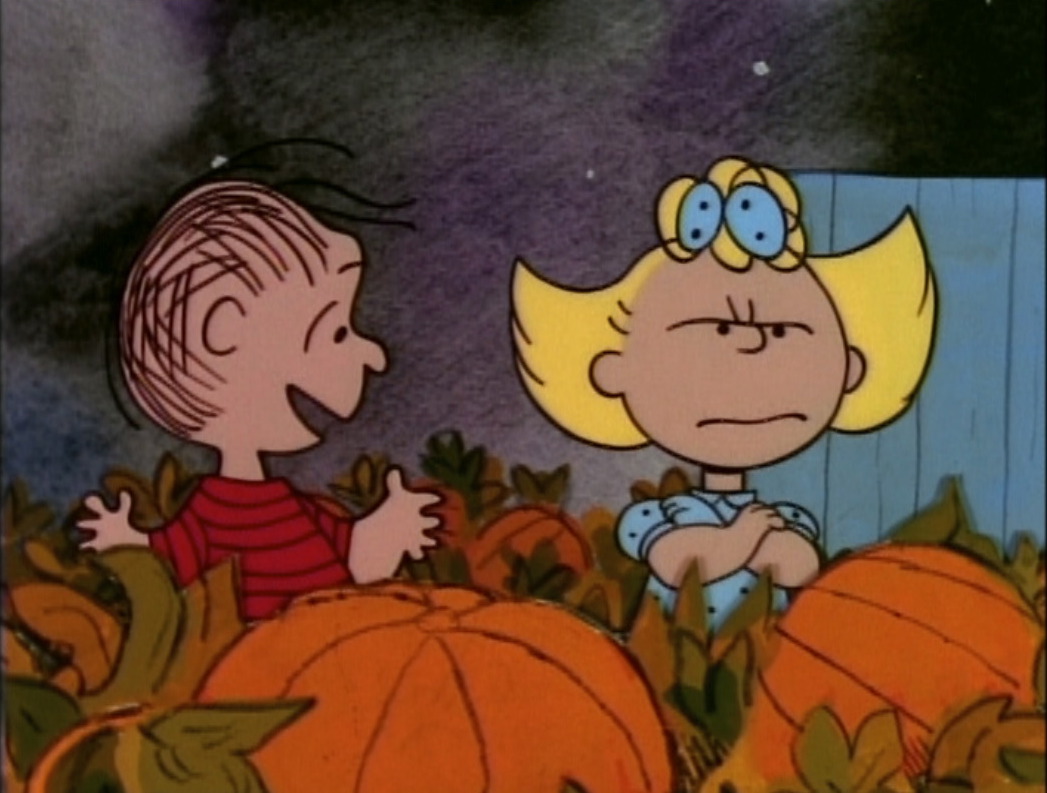
I just got up to fill my coffee cup and glanced out the kitchen window. How many rites of autumn have been forever shapped by Charles Schulz? Leaves. Football kickoffs. Hot chocolate. World series pitchers (GIANTS ROCK!!!!!!!). The eternal longing for the Great Pumpkin. And soon, our attention to the little orphan Christmas tree at the back of the lot, that nobody wants.

Waiting for the Great Pumpkin

One more hint if you visit:  the burgers at the Warm Puppy Cafe are exceptional, better than any fast food I can think of.  For those who can do it without breaking their necks, the attached ice skating rink is as fine as the rest of the facilities. 

Over by the door at the Warm Puppy is an empty table with a flower and a sign that says, “Reserved.” That is where Charles Schulz sat for lunch, where he watched the skaters and people passing outside. Where he dreamed and dreamed up a humble little comic strip that did things the medium hadn’t done before, and is still as much a part of starting the day as coffee.
http://www.schulzmuseum.org/