An Author’s Guide to Publishing in 2012, by Amy Rogers.

Those who have followed thefirstgates for a while will be familiar with Dr. Amy Rogers.

Amy Rogers

I reviewed her excellent first novel, Petroplague, in September, 2011 http://wp.me/pYql4-1ep.  In March of this year, she contributed a two part guest post detailing some of the rapid changes in today’s publishing landscape, an issue she follows in depth http://wp.me/pYql4-1MR.  Last Friday, Amy gave an updated presentation on  publishing options to the Sacramento branch of the California Writer’s Club during our monthly breakfast meeting.

Not long ago, there were only two publishing choices:  traditional publishing and the so called vanity press.  Now we have a spectrum of possibilities which keep getting harder to navigate.  Hybrid arrangements are multiplying:  traditional agencies offering ebook options, and agented independent publishing companies.

Rogers began her presentation by stressing the importance of every writer evaluating their individual goals.  Why do we want to publish this particular book?  How will we measure success?

Do we seek the implied approval that selection by a traditional publisher confers?  If so, do we have the time to invest in the process, knowing there is no guarantee of ultimate success?

If we choose to go the independent route, are we ready and willing to spend the time and/or money on five key tasks required for any book to be successful:  editing, cover design, layout, getting an isbn number, and marketing/distribution?

With a sense of our goals, Amy Rogers presentation, posted in full on her blog, will prove especially valuable.  A downloadable pdf version, is available too http://tinyurl.com/739ga5s.

After reviewing the presentation, take the time to explore Ms Rogers’ website, ScienceThrillers.com.  With a Ph.D in immunology, teaching experience in microbiology, and a writing career that began in grade school, Amy is uniquely qualified to write and review thrillers involving the depredations of “wee beasties.”  ScienceThrillers has grown to include reviews of books in multiple genres, publishing news, book giveaways, notices of writing contests, and her own quarterly newsletter.  It’s a site I’m very happy to recommend.

The Wind Through the Keyhole, by Stephen King: A Book Review

I recently said I look for “imaginative escapism” in summer reading, and Stephen King’s, The Wind Through the Keyhole, 2012, qualifies on both scores.

This book is a celebration of stories by a consummate storyteller.  It is structured as a frame tale, three levels deep – a story within a story within a story, something you find in some our oldest epics and story collections like The Odyssey and The Arabian Nights.

In case we we miss that connection, King says it another way through his main character, Roland Deschain, who tells his traveling companions, “There’s nothing like stories on a windy night when folks have found a warm place in a cold world.”  Later, during a story concerning his younger self, Roland says, “A person’s never too old for stories…Man and boy, girl and woman, never too old.  We live for them.”

This is the eighth of King’s Dark Tower Novels, and the first I have read, but the introduction caught me up well enough to proceed.  Roland Deschain is a gunslinger in Mid-World.  A gunslinger is a cross between a knight errant and an old west marshall.  Many gunslingers are descendants of “the old White King, Arthur Eld.”

Mid World borders our own and is “filled with monsters and decaying magic.”  In places, there are gates between the worlds, or places where “the veils are thin.”  Three of Roland’s companions come from New York.  The fourth is a billy bumbler, a talking, dog-like creature.

Roland and his companions – his ka-tet – barely have time to find shelter from a starkblast, a devastating storm, with winds like a hurricane, the sudden onset of a tsunami, and temperatures so cold that trees snap and explode.  While the friends shelter by the fire in the only stone building in a deserted town, Roland tells of one of his first assignments as a gunslinger.

In the first story, “The Skin-Man,” Roland rides with his partner, Jamie Red-Hand, to the desolate mining town of Debaria, where a shapeshifter has slaughtered dozens of people.  This a gritty western world, like the bleakest of early Clint Eastwood’s westerns, and the monster is more deadly than the bad and the ugly Clint faced down.

While talking to an 11 year old survivor of an attack, a boy whose father and a dozen others were slaughtered, young Roland tells the second tale, “The Wind Through the Keyhole,” about another 11 year old, Tim Ross, who goes on a dangerous quest to save his mother who has been injured by a treacherous step-father.  Tim sets off to find Maerlyn, aka Merlin, at the heart of The Endless Forest.

Picture an 11 year old on an Arthurian quest, who stumbles into a swamp filled with gators and is saved by a group of plant people who communicate telepathically and give him a strange disk with buttons and lights that speaks and answers his questions in a female voice.  Her name is Daria.  Once she tells him she’ll be “offline” for half an hour, “searching for a satellite link.”

Just when he’d begun to believe she really had died, the green light came back on, the little stick reappeared, and Daria announced, “I have reestablished satellite link.”

“Wish you joy of it,” Tim replied.

Well, why not?  Is a magical iPhone so different from an enchanted sword or magical ring?  A master storyteller like Stephen King can pull of escapades like this because he always has me asking the one question that really matters in storytelling.  To quote Neil Gaiman, that question is, “What happened next?”

There’s adventure, courage, cruelty, humor, horror and much more as Roland Deschain takes us in and leads us back out of three levels of story.  One constant throughout all the tales is the wind, and I think Roland speaks for King when he says:

In the end, the wind takes everything, doesn’t it?  And why not?  Why other?  If the sweetness of our lives did not depart, there would be no sweetness at all.

The Wind Through the Keyhole is a very satisfying summer read – and quite a bit more.

Imagine by Jonah Lehrer: A Book Review

Update, July 31, 2012.

On July 30, author Jonah Lehrer admitted fabricating quotes in Imagine. He resigned his position as staff writer for The New Yorker, and Houghton Mifflin suspended sales of the book. You can read my full post on the topic here, which contains a link to the newspaper story. http://wp.me/pYql4-2hg

It is with much sadness that I’ve decided to remove the text of my review. Some of Lehrer’s observations on creativity remain insightful. At the same time, I think it is vital to stand up for ethics wherever we can find it in public life.

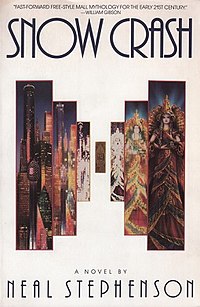
Snowcrash by Neal Stephenson – An Appreciation

Twenty years ago, Mary and I got our first real home computer (the Commodore 64 didn’t quite count).  With an Intel 486 processor, 500k of ram, an 8k external modem, and AOL memberships, we were wired!  Full-fleged members of the information age, at least by the standards of the day.

The same year, 1992, Neal Stephenson published a visionary novel called, Snowcrash. In retrospect, it merits the word, “prophetic,” for its sketch of life in the metaverse – a word Stephenson coined – and in the inconvenient world we call “reality.”

Consider:

In Snowcrash, Stepenson posits a world where nation states have transferred most of their power to corporations. Most people are corporate citizens and live in corporate enclaves, or less prestigious burbclaves.  The hero of Snowcrash, Hiro Protagonist, is a citizen of “Mr. Lee’s Greater Hong Kong.”  Military power belongs to private contractors, as do the roadways, which vie for driver/customers.  The post office is gone; private couriers deliver snail-mail.  The United States occupies a smallish territory centered in the Mohave Desert, and keeps it’s employees busy with make-work projects.  The former United States economy hinges on two industries – computer microcode and high speed pizza delivery, which has been revolutionized since the Mafia took control.

Though Hiro is a citizen of Hong Kong, as a pizza driver, he can’t afford to live in their enclaveclave.  Home is a self-storage unit under the flight path at LAX.  Like most of his hip and cyber-savvy generation, he spends most of his time online in the guise of his avatar, navigating virtual worlds.  But something is happening in the online world.  A strange new computer virus, when opened, generates a graphic pattern that scrambles the brains of the user.  They are dazed and speak in tongues.  With a young woman named YT, for Yours Truly, Hiro sets out to unravel the mystery.

The villain turns out to be a charismatic preacher.  In his attempt to secure both temporal and spiritual power, he has tapped into the ancient Sumerian glyphs that first scrambled human speech patterns in the event known as the Tower of Babel.

It’s been 20 years since I’ve read Snow Crash, so I’m writing this from memory.  I’m not necessarily recommending the whole novel.  The first jaw-dropping 100 pages, where Stephenson built his world, flew by and still leave me in awe.  I remember the rest of the book dragging in parts, but I still think of the story all the time.  Most futuristic fantasies prove as silly as the 1930’s movie shorts that show humans zipping along in their air cars between high rise buildings, happy and without any accidents.  This book is different.

In 1992 there were no virtual worlds.  Now there are, and you have to create an avatar to negotiate them.  These days, it isn’t so hard now to imagine a bright young man living in a self-storage shed.  But above all, Snow Crash comes to mind because in the wake of “citizens united,” it’s so easy to see corporate power growing while government power wanes.  With Super Pac money rolling the election year dice, does the government control corporations or do corporations control government?  Neal Stephenson saw this and other aspects of our world coming 20 years ago.

Snow Crash, is a visionary novel that all lovers of fantasy should know.

Life: The Movie by Neal Gabler – A Book Review

In his final movie, Being There, 1979, Peter Sellers plays Chance, a gardener with a low IQ, who becomes an advisor to the president and business tycoons. In one iconic scene, Chance is accosted by a knife wielding youth in Washington, DC.  He pulls out his TV remote control and clicks it to change the channel.  He is puzzled when the assailant doesn’t vanish.

Peter Sellers as Chance in “Being There”

This might be the perfect illustration for Neal Gabler’s, Life, The Movie:  How Entertainment Conquered Reality, (2000).  Gabler quotes historian, Daniel Boorstin, who wrote in the early 60’s that, “We risk being the first people in history to have been able to make their illusions so vivid, so persuasive, so ‘realistic’ that they can live in them.”  Done deal, according to Gabler, who calls us, not just a “post-modern culture,” but a “post-reality culture.”

At times I had to keep my own assumptions in check:  subjects like reality and imagination open onto psychological and spiritual vistas beyond the scope of this or any other single book.  But when Gabler cited concrete examples, I found myself nodding my head on almost every page.

“You know how to brood because you have seen Rebel Without a Cause,” Gabler says, quoting cultural analyst, Louis Menand.  “What better model does the world offer?”

Gabler charts the ascendency of entertainment in America from the early 19th century, where the split between high and low culture was fueled by our democratic suspicion of all elites.  Calling someone “aristocratic” was a serious insult.  During the 1840 presidential campaign, when a man called Daniel Webster an aristocrat, he thundered back that he’d grown up in a log cabin, and anyone calling him an aristocrat was “a coward and a liar.”  ( Sound familiar? )

Nathaniel Hawthorn despaired of the fate of serious writers amid the flood of “trash” being published.  One publisher sold four million dime novels in five years, at a time when the US population was only 25 million.

In 1850, 1% of the population owned 50% of the nation’s wealth and held almost all public offices.  Upward mobility was a myth, since 98% of that wealth had been inherited.  While the one-percent held the power, then as now, culture wars raged, sometimes with a violence that we (thankfully) haven’t seen yet.  One night in New York, rival Shakespearean actors, one British and one American, were both scheduled to perform, the former in an uptown theater, the latter downtown.  Police ejected the rabble who had bought tickets solely to heckle the British actor.  A much larger crowd gathered across the street to throw rocks as the “aristocratic” crowd tried to leave.  The militia was called, a riot ensued, and before the night was over, 22 lay dead and more than a hundred wounded.

In the end, it was movies that won the day for popular culture.  The 1% stayed away from the early nickelodeons, which tended to be crowded and crass.  Later, with middle-class patronage, refined behavior became the norm, but the elite have never fared well in the movies, from the Marx Brothers  Night at the Opera, to the present, where a too-expensive suit is always the mark of a villain.
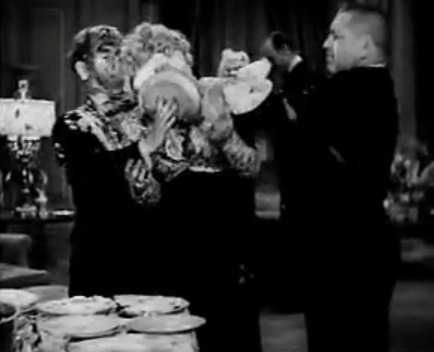
Three Stooges + high society + pies = disaster

As he charts the history of high vs. popular culture, Gabler makes a telling point.  It isn’t just about high brow and low brow – it’s about the ascendency of entertainment.  Being entertained is easy, and the corollary is that when the goal is entertainment, grabbing and holding audience attention is the supreme value, and “things that do not conform – for example, serious literature, serious political debate, serious ideas, serious anything – are more likely to be compromised or marginalized than ever before.”

Life: the Movie is a complex and disturbing book.  Gabler says in the introduction, it is diagnostic and not prescriptive.  To offer easy answers, he says, would be like the movie illusion where we meet the monster in act one and see it vanquished in act three.  Writing 12 years ago, Gabler said:

“One is almost compelled to admit that turning life into escapist entertainment is a perversely ingenious adaptation to the turbulence and tumult of modern existence.  Why worry about the seemingly intractable problems of society when you can simply declare ‘It’s morning in America,” as President Reagan did in his 1984 reelection campaign, and have yourself a long-running Frank Capra movie right down to the aw-shucks hero?”

I read this book after watching Neal Gabler speak on the fictions that lace the current election campaign on Moyers & Company, as I described in the preceding post. Because of it’s scope, I would recommend Life: the Movie only to those who want to delve into this issue in some depth.

But  I would recommend that everyone watch the ongoing conversation this year between Gabler and Moyers.  The confusions and illusions surrounding the political process are more convoluted than when the book was written, but Neal Gabler remains a reliable guide to pulling back the curtains and helping us draw closer to the truth.
The Shape-Changer’s Wife by Sharon Shinn: A Book Review

I’ve enjoyed several young adult fantasies by Sharon Shinn and reviewed one of them here http://wp.me/pYql4-iQ.  Before she published her first YA book, Summers at Castle Auburn, in 2001, Shinn had a solid reputation as an adult fantasy writer.  I recently finished her first novel, The Shape-Changer’s Wife, which won the Locus award for Best First Fantasy Novel in 1995. Shinn was nominated for the John W. Campbell Award for Best New Writer that year.  On top of these honors – all well deserved – long time readers of this blog will know I am fascinated by stories of shape shifters (check out three posts I wrote on the theme in Feb., 2011).

At the start of The Shape-Changer’s Wife we meet Aubrey, a young man with a sunny disposition who is already on his way to becoming a skilled magician. His master sends him to study with Glyrenden, highly skilled in the art of shape-changing:

“Learn everything he teaches you so well you can cast his own spells back at him,” the old wizard had said. “Glyrenden respects only those stronger than he is, and those he hates. If you cannot beat him, he will destroy you.”

With the optimism of youth, Aubrey brushes the warning aside and sets out. Even when local villagers react to Aubrey’s request for directions with narrowed eyes and cold responses, his hunger to learn drives him on.

Shinn is masterful in building a sense of menace, which begins the moment Aubrey steps into the 3″ of dust that cake the entry way of the shape-changer’s house.  It builds when he meet the uncanny servants – Orion, covered with hair except for his eyes and nose, and Arachne, a woman who fights a loosing battle against the dust, while muttering curses and shooting everyone hostile glances.  Above all, Aubrey is fascinated by Lilith, the shape-changer’s wife, whose emerald eyes seem to see right through him, who is silent and self-contained, and doesn’t react to anything like any other woman he’s ever met.

Shinn’s presents magic as matter-of-fact.  Shape-changing sounds dramatic to Aubrey, so he is dismayed when Glyrenden hands him piles of books on anatomy and science and makes him practice hours of concentration exercises.  “How can you change into something you don’t understand in all of it’s details,” the shape-changer asks.  In Shinn’s books, magic is seldom dramatic.  More often, it forms an atmosphere like the felt danger offstage in a Hitchcock movie.

By the middle of the tale, Aubrey is hopelessly in love with Lilith, even as he perceives that “She seemed to be fashioned from the idea of a woman, and not to be a woman at all.”  This and other related perceptions lead him to pierce the secret of Glyrenden’s house – why the townspeople fear him, and why no bird or animal will come anywhere near the wizard’s dwelling.  Aubrey learns that the only way to undo Glyrenden’s “barbaric spells” is to kill him or become a better wizard, and even if he succeeds, the spells may prove too strong to break.

“I came to magic with joy.” Aubrey says.  “I thought it was a splendid thing to take the well of power that I found within me and shape it to marvelous uses…But magic, I have discovered…is not inherently good in itself.  And some of it – yes, some of it is inherently evil.  There are wicked spells, savage spells, enchantments that are so black that even to know them withers the heart just a little, taints the soul.  And yet to be a great magician, to be a sorcerer of any ability or renown, those spells must be learned as well.  For if a magician does not know them, they can be used against him.”

With measured pace, Shinn has brings us through her imagined world to one of our oldest stories, that of tasting the fruit of the Tree of Knowledge.  The Shape-Changer’s Wife is also a love story, but told with a kind of restraint that is rare in the fantasy genre.

You seldom see titles by Sharon Shinn on the shelves of Barnes&Noble, and never her YA titles.  At first glance, her books are not the stuff of blockbuster series and lucrative movie deals, though I can see them as moody, gothic dramas.

Shinn is a wizard in her own right.  Beyond the pleasure I’ve gained from six of her novels, I return to them often to study the masterful way she can weave character and atmosphere into stories I cannot forget.

Sharon Shinn

King of Morning, Queen of Day by Ian McDonald: An Appreciation

My recent discussion of unlikely mentors and guardians http://wp.me/pYql4-1J8 reminded me of Tireseas and Gonzaga, two “mystical vagabonds” (book jacket description) in one of the best fantasy novels I’ve ever read.

Ian McDonald, a visionary author who lives in Belfast, published  King of Morning, Queen of Day in 1991.  I still pick it up to read certain passages or a random chapter, to study and enjoy the ideas, the writing, and characters.

The narrative follows three women of three generations who are alternately attracted and attacked by creatures of the Mygmus, a technical name for the infinitely overlapping worlds of Faerie.

“The Mygmus may be viewed not so much as a place, a spatio-temporal relationship, a quasi-Euclidean geometrical domain, but as a state.  The concept is a familiar one in modern quantum physics, in which time is not considered a dynamic process, but a succession of recurring states eternally coexistent.  Such thinking liberates us from our essentially linear concepts of time, with past, present, and future.”  So reads a manuscript given to one of the women by a strange group of deformed, “Midnight Children.”

The first of the women, romantic, Edwardian Emily, dreams of a faerie lover and seeks him out.  First her rapes her, and then she disappears.

Gonzaga and Tireseas help Emily’s daughter, Jessica, battle free of the otherworld threat, which is personified by her mother, who has become a demonic force.

Jessica’s daughter, Enye, modern young woman in Dublin, battles Otherworld manifestations at night with martial arts swords.  Gonzaga and Tireseas charge her blades with high tech wizardry as well as ancient charms that allows her to win her way into Faerie, redeem her grandmother, Emily, and return to modern day Dublin.  The author gives the ending a contemporary twist that I won’t reveal here.

McDonald’s characters are among the most vivid in any novel I can remember, painted with a sure touch both in broad stroke and detail.  Every December, for instance, I reread “Enye’s soliloquy” – my name for it, with a nod to Molly Bloom.  It’s her internal monologue, in response to the question, “Wouldn’t it be nice if we could have Christmas all year long?”  It’s a long single sentence paragraph – not quite as long as the one that ends Joyce’s Ulysses, but then Joyce doesn’t make me laugh out loud.  I’ll quote the whole thing next December.

With his first book, Desolation Road, 1988, Ian McDonald won critical acclaim, and an Arthur C. Clarke award nomination.  Like other cyberpunk authors at the time, his vision of the impact of  technology at the birth of the internet age continues to amaze.  As a quick aside in King of Morning, Queen of Day, McDonald throws out a challenge to fantasy writers that has largely remained unanswered in the 21 years since it was written.  In the same manuscript that defined the Mygmus, Enye reads:

“I have this dread that…somehow we have lost the power to generate new mythologies for a technological age.  We are withdrawing into another age’s mythotypes, an age when the issues were so much simpler…and could be solved with one stroke of a sword called something like Durththane.  We have created a comfortable, sanitized pseudo feudal world of trolls and orcs and mages and swords and sorcery, big-breasted women in scanty armor and dungeon masters; a world where evil is a host of angry goblins threatening to take over Hobbitland and not starvation in the Horn of Africa, child slavery in Filipino sweatshops, Colombian drug squirarchs, unbridled free market forces, secret police, the destruction of the ozone layer, child pornography, snuff videos, the death of whales, and the desecration of the rain forests.

Where is the mythic archetype who will save us from ecological catastrophe, or credit card debt…where are the Translators who can shape our dreams and dreads, our hopes and fears, into the heroes and villains of the Oil Age?”

Ian McDonald

I haven’t kept up with the work of Ian McDonald in the two decades since I first read King of Morning but returning to the book via the characters of Tireseas and Gonzaga reminded me to do so. McDonald published Planesrunner, his first YA fantasy, in December, 2011. Here’s the blurb:

“When Everett Singh’s scientist father is kidnapped from the streets of London, he leaves young Everett a mysterious app on his computer. Suddenly, this teenager has become the owner of the most valuable object in the multiverse—the Infundibulum—the map of all the parallel earths, and there are dark forces in the Ten Known Worlds who will stop at nothing to get it.”

I don’t know about anyone else, but this is my very next read.

Gaia’s Secret by Barbara Kloss: A Book Review

I met Barbara Kloss a year ago at a California Writer’s Club workshop. We talked during the breaks, and later traded a few emails, based on a shared interest in young adult fantasy, but we lost touch when she and her husband moved to Phoenix.

Last fall, when Barbara emailed that she had published her first novel to Smashwords, I offered to review it here.  Due to the holidays and a penchant for multi-tasking, I am only getting to it now.

Daria Jones lives on a ranch outside of Fresno.  Her biggest worry is talking her overprotective father into letting her go away to college – that is, until her father disappears, and two non-human creatures show up at the ranch to kill her.  Family friends she has known all her life hustle her through a portal into Gaia, a world where magic not only works but can easily get you killed.

Gaia’s Secret introduces an appealing heroine whose 21st century sensibilities do not mesh well with the her destiny as a “special” child who was hidden away for her own safety.  Daria reacts as we might, with anger and fear, as all of her certainties crumble.  She doubts herself, her sanity, and her friends in turn.  It is her human failings, her pouts and impetuous actions, that make her so appealing, and save her from the “secret princess” cliche of so much YA fiction.

Early in the story, an ally of Daria’s father plays chess with her as her party hides from pursuit.  “You learn a lot about a person by their strategy,” he says.

“What about a person who has none?” Daria asks.

“Having no strategy is still a reflection of character,” her father’s friend replies.  “You’re impetuous and you don’t understand the consequences of your actions.  And you don’t have the patience to learn, which prevents you from making good decisions.”

Daria fumes but later admits that he’s right as her party ventures farther into a magical world where bad decisions become increasingly dangerous.

Structured along the lines of Joseph Campbell’s hero story, Gaia’s Secret also appeals as a quest tale and a romance, thought Daria’s temper and “bad decisions” lead to muddles on all fronts.  They ultimately deliver her into the hands of the traitor who started by sending assassins to kill her on earth.

Can Daria harness her newly emerging and uncontrolled magical powers in time to save herself, her father, and friends?  Since Ms. Kloss has said on her website that she is working on the sequel, I don’t think it’s a huge spoiler to say the answer is yes. http://scribblesnjots.blogspot.com/

Author, Barbara Kloss

Daria attains her quest in the end.  She and her father are reunited in safety.  She and her heart throb finally admit their love for each other, but that doesn’t mean things end happily ever after.

The world of Gaia is ruled by a king, and though it’s a magical world, as a young woman at court, Daria has far less freedom than she did in Fresno.  When temper overrules caution, and she mouths off to the king, she winds up with guards outside her door – for her “protection,” and no chance to marry the man she loves.  Good thing a sequel is coming.

A click on the book at the top of this post will take you to Smashwords where you can read the opening pages.  Those who enjoy  YA fantasy will probably choose to download the rest of this lively story with its feisty and endearing heroine.