
Up to each one of us

Last weekend, I attend a teaching by Lama Pema Wangdak, a Tibetan Buddhist who was sent by the head of his order to teach in this country in 1982.  I invite you to read about his many humanitarian activities, which include founding schools in three countries and inventing a Tibetan brail alphabet. http://www.ewamchoden.org/?p=2093

Lama Pema

Lama Pema represents the next generation of the Tibetan diaspora, educated by traditional Tibetan masters, but fully acclimated to western culture.  He illustrates points of philosophy with current movies or ancient stories with equal ease.  He has a great sense of humor too.

Many traditional teachings are presented in simple phrases, called “pith instructions,” that are easy grasp with the intellect, but not so easy to grasp in depth.  For instance, we all understand the truth that “everything changes,” but it takes reflection to real-ize in the gut what that means in personal terms.

Because of this election season, some of Lama Pema’s comments ventured into the realm of politics.  He threw out some of his own deceptively simple concepts, which I’m still pondering and want to pass on.

One of his constant themes is individual responsibility, moment by moment, in trying to create the kind of world we want to live in.  “The peace of the world hinges on you and me,” he said.  I jotted down some of his other comments.

“We expect the world to be ‘right’ and to make us feel good.  In fact, we are in the midst of chaos and it’s up to us to make it right.”

“There are some people who can improve situations by their very presence, by their inner nature.  There are others for whom it’s not quite right, and when they are done, it’s much worse.  Both capacities live within each of us.” 

“We have to stand up for what we believe in, be decisive about what we are aiming for…To belittle oneself, undermine oneself is a real sin…To take risks, even at the risk of being wrong, is far better than not taking risks.”

“A great part of our humanity is sustained by legends, imagination, and hope.  It’s all imagination.  To take life as a dream helps lower our blood pressure.”

Deceptively simple ideas.  The kind it’s easy to jot down in a notebook and forget about a day or two later.

One classic exercise with this kind of teaching is to take one of these points and focus on it for a day or a week or longer.  Mull it over, bring it to mind when we wake, while walking in from the parking lot, while waiting at red lights.  “What do I believe in, what do I need to stand up for?” for instance.

As if to underscore the idea, Lama Pema gave the example of Gandhi.  Even though we know it happened, it’s hard to believe one skinny little man could push the British out of India.  The core of all his action was knowing what he believed in, what he stood for, with unswerving certainty.

There was no suggestion that we are called to change the world in such a dramatic manner.  The suggestion was that at every moment, our thoughts and actions always change the world, either for good or ill.  The suggestion was to bring mindfulness to bear on our “simple” actions and see what kind of difference they can make.
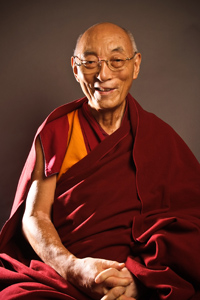
This summer I met a hero

It’s so easy to get caught up in negativity.  Sometimes all it takes is a quick scan of the paper or a click on a topical websites to make the world seem full of scallawags and scoundrels.  This summer, however, I was privileged to meet a towering figure of moral courage.

His Eminence Choden Rinpoche was born in eastern Tibet in 1933.  At the age of three, he was recognized as the reincarnation of a previous master, and he took novice ordination vows at seven.  He chose not to flee Tibet after the Chinese takeover, and beginning in 1965, during the cultural revolution, Rinpoche spent 19 years in seclusion, living in a windowless basement room at a cousin’s house in Lhasa.

During the cultural revolution, thousands of monasteries were destroyed and more than a million people, especially lamas, monks, and nuns were imprisoned.  When the Chinese burst into his room unannounced at various times of the day or night, they never found any incriminating evidence of religious activity – no texts or even prayer beads.  He was able to hide in plain sight because they thought him an invalid.

Like other spiritual giants – Gandhi, Nelson Mandela, and Martin Luther King – Choden Rinpoche used his time in what amounted to a cell to deepen his practice.  From memory and imagination, he recited texts and performed rituals he had learned, internalizing Buddhist philosophy.

“From the point of view of spiritual practice, there was great accomplishment in living as I did…If I had gone with the Chinese, I would have received a house, a car and high rank, but I would have had to harm people and cause much suffering…I didn’t have to experience any of this.  These were the advantages of living as I did.”  – from a pamphlet published by Ananda Dharma Center, San Jose, CA, 2012. 

In 1985, Rinpoche was able to leave for India, and he has been teaching around the world since then.  I was a beneficiary this summer and attended a very special series of teachings he gave at his US home, the Ananda Dharma Center in San Jose.  http://anandadharma.org

On July 28, I went to the final event of the summer, a long-life puja for Rinpoche.  It’s a beautiful ceremony in which students, friends, and other lamas essentially ask him to stick around in his present incarnation as long as possible.  Choden Rinpoche is a Tulku, a word for those believed to be able to chose the time and place of their next birth.  For the rest of us, the puja is a way of saying, “Hang on – don’t leave yet!”

Rinpoche has had trouble with his knee.  On Thursday, he flew to Taiwan where some of his students are doctors.  Today he undergoes knee replacement surgery.  Friends and students around the world are sending prayers and good wishes in his direction.  With that in mind, I decided to write that post, knowing even as I did so, that I am really the one it benefits.

Like his friend, the Dalai Lama, Choden Rinpoche’s mind is always fixed on what’s beneficial.  Some of the rest of us (meaning me) have to rely on the inspiration of people like this to bring unruly thoughts back to what really matters.

We have met the enemy…

The Colorado shootings will forever cast a pall over the opening day of the latest Batman movie, the kind of action-adventure fantasy many of us were looking forward to as an escape from all the other bad news that fills the papers these days.

I cannot add anything to the expressions of grief and outrage that the people of Colorado have and will make, but I heard one thing this morning that gave me pause.

The governor of Colorado said, “This is the act of a very deranged mind.”  It’s a natural thing to say, and we hear the same words after every similar tragedy.  The Texas Tower.  Oklahoma City.  Columbine.  The first thing we try to do is assure ourself that the crime was the work of a nut or monster.  The last thing we want to hear are comments now emerging from people who knew the suspect and say he seemed “really smart,” and “a nice guy.”  It’s terrifying to think that an “ordinary person” or a neighbor could do something like this.

Thich Nhat Hahn, the Vietnamese Buddhist monk who Martin Luther King nominated for a Nobel Peace Prize, was versed both in Buddhist and western psychology.  His teachings gave me the concept of “store consciousness.”

Thich Nhat Hahn

This is the part of our unconscious psyche where all possible tendencies reside, like seeds, waiting to germinate.  The ones we water with our attention, thought, and action are the ones that grow.  Like all Buddhists, Thich Nhat Hahn believes that we cannot know for sure which seeds we have watered in previous lives, but our proclivities in this life, for good or ill, give a strong hint.

Metaphysics aside, we can recognize the truth of the core concept – the seed tendencies we water are the ones that grow.  The only memorial we can make to the people who died in that theater is to stand beside those like Thich Nhat Hahn, Martin Luther King, and all men and women of goodwill of the present and past.  We can join with them in trying to give the water of attention to qualities like compassion, patience, and non-violence – the seeds we want to grow.

Those who follow this blog know how often I quote Walt Kelley’s comic strip character, Pogo, who said, “We has met the enemy and he is us.”  It doesn’t have to be that way.

Everything Changes

Lewis Richmond, an ordained Zen priest and author of Aging as a Spiritual Practice, began his studies 40 years ago with the renowned teacher, Shunryu Suzuki Roshi.  Richmond relates that one day, after a talk, a student said, “Suzuki Roshi – you’ve talked for an hour, and I haven’t understood a word you’ve said.  Could you please tell me one thing about Buddhism I can understand?”

The master waited for the laughter to die down and said, “Everything changes.”

“Everything changes” is a truth we often would rather forget, but sometimes events make that impossible.  Our oldest dog, Holly, has serious medical issues.  She has come to the end of her life.  This month has been a daily exercise in letting go, in watching her, in trying to gauge the quality of her life and which interventions make sense.

The vet confirms that she’s not in any pain.  She is still feisty and cuddlesome in turn.  She turns up her nose at dog food much of the time, but still likes buttered toast and hot dogs, so antibiotics make sense.  So does medication to increase the blood flow to her kidneys, which are failing.  We take turns administering “subcutaneous fluid replacement therapy” each morning, which was scary at first, but has become a very serene, if bitter-sweet, time to bond with her and reflect.  With quiet music and morning sun slanting into the room, we calm ourselves so Holly calms down and stroke her head while 150 ml of solution flow through the drip.

We brought her home as a puppy when she was eight weeks old.  She’ll be 16 at the end of the month if she lasts that long – we don’t know – it could be days or weeks or months.  It’s hard to believe how quickly sixteen years goes by.

Is there anything that doesn’t change?  All of the major religions say yes, there are the ways to unravel the knot.  A reminder of why there is nothing more important may be Holly’s final gift.

Happy Losar

Today, February, 22, is Ash Wednesday, the beginning of Lent on the Christian calendar.  It is also Losar, the beginning of 2139, the Year of the Water Dragon on the Tibetan calendar.  The dates of Lent and Losar both involve lunar calculations, so it’s just coincidence that they align this year.

Water Dragon

Tibetan astrology predates Buddhism but was adapted by that tradition.  There are 12 signs and five elements, for a total of 60 combinations. The astrological year begins not at Losar, but around the time of the Winter Solstice, so children born since December 22 are Water Dragons.  So are those celebrating their 60th birthday.

Here is a good introduction to Tibetan astrology. http://www.tactus.dk/tacom/.  It’s a complicated system, so this is a newspaper horoscope version.  One website predicts 2012 will be “an eventful, mixed blessing year” – what year isn’t?   Another says, “The year of the Dragon is full of energy and surprises.  The element of water symbolizes calm and receptivity.”

The Chinese government has closed the borders of Tibet to foreigners during the traditional 15 days of Losar celebration.  In recognition of recent unrest, some Tibetan leaders in exile are asking that traditional celebrations not go forward.  Prayers and ceremonies will still mark the event worldwide.  Tibetans believe that the power of both positive and negative actions during the first month of the new year are greatly multiplied in their effect on the year to come.

In any event, Losar is a time when the traditional greeting, Tashi Delek, is given, a phrase that is sometimes translated as, “Blessings and good luck.”

A Day With Anam Thubten

Last summer I wrote about a retreat I attended with Anam Thubten. http://wp.me/pYql4-Wp .  Another time I posted about his first book, No Self, No Problem. http://wp.me/pYql4-gg.  Just over a week ago, I join a large group to attend another retreat with this Tibetan master.  The event coincided with the publication of his new book, The Magic of Awareness.

The magic of awareness cover

At first I was not going to write about the day because, in Anam Thubten’s own words, “I don’t have so much to say today.”  After a pause, he added, “I think you already know these things.”  A lot “happened,” that day, but not the sort of things you  can write about.

I thought of the Buddha’s flower sermon.  One day when a group of monks assembled to hear Sakyamuni Buddha, he simply held up a white flower someone had given him as he climbed onto the teaching dais.  One monk, Mahākāśyapa, smiled in understanding, and we date the practice of Zen from that moment.  A lot happened that day too – we remember it 2600 years later – but there is also not much to write about.  What are you going to “say” about holding up a flower?

That’s sort of the point.  And the point of this post.

For some reason, I was wide awake at 5:00am this morning.  I got up, made coffee, and dug into the Sunday paper – for some other unfathomable reason, I was really looking forward to catching up on all the news (what are they putting in the water these days?).  It only took one article on the presidential campaign to cure that delusion and cause me to trash a political post I almost had ready for Monday.  No way I wanted to add my $0.02 to the chatter.  There in the pre-dawn quiet, I thought again of Anam Thubten, the wisdom of silence, and the Buddha’s flower.

At the retreat, Anam Thubten gave few instructions on meditation beyond this: “The essence of meditation is doing nothing.” He elaborates in his first book:

“to rest means to pause, to pause from working very hard, to pause from continuously constructing this world of illusions, the dualistic world, the world that is based on the separation between self and other, you and me, good and bad.  When you completely take away the egoic mind, the creator of this illusory world, then realization is already there and truth is automatically realized.  Therefore, the heart of Buddhist meditation practice is to relax and to rest.”

When you think about it, those are really quite enough words for a lifetime…

“Be a Lamp Unto Yourself”

Happy New Year!!!!  

I thought I would begin the 2012 blogging year with words that have long been an inspiration to me.  They come from advice the Buddha gave his disciple, Ananda:

“Therefore, Ananda, be a lamp unto yourself, be a refuge to yourself. Take yourself to no external refuge. Hold fast to the Truth as a lamp; hold fast to the Truth as a refuge.”  – Mahaparinibbana Sutta

Part of the problem, then as now, was knowing the truth when you found it.  The Buddha’s India of 2600 years ago was similar to ours in this respect – it was awash in competing and often conflicting philosophies, teachers, and religions, each claiming special access to the truth.

Gandhara Buddha (4th-5th c.)

Once, as the Buddha passed through a village called Keshaputta, the inhabitants, members of a clan called the Kalamas, approached him for advice.  The Kalamas were seekers of truth.  They were happy to welcome traveling yogis, holy men, and teachers of all sorts, but by the time Buddha arrived, they were thoroughly confused by contradictory teachings from too many “experts.”

In response, the Buddha gave the teaching known as the Kalama Sutta, a fuller version of the advice he later gave Ananda.  In his discourse, the Buddha listed ten ways of knowing that are not sufficient to indicate the truth:  oral history, tradition, scripture, news, ordinary reasoning, dogmatism, common sense, one’s own opinions, expert opinions, opinions of authorities.  Instead, the Buddha asserts our need to test such sources experientially, and trust our own conclusions:

“O Kalamas, do not be satisfied with hearsay or tradition, or any teachings, however they may come to you.  Only when you know in yourself when things are wholesome, blameless, commended by the wise, and when adopted and practiced lead to welfare and happiness, should you practice them.  When they lead to virtue, honesty, loving-kindness, clarity, and freedom, then you must follow these.” (as quoted in A Path With Heart by Jack Kornfield)

A teaching like this can be difficult with its demand for our own freedom and responsibility.  The teaching seems to throw us back on our own moment by moment awareness.  If we lose our way in the maze of conceptual thought, our own direct experience is one of the few things left to trust.

Most traditions and most of the world’s folklore suggest that we each have a deep way of knowing within us.  It goes by many names:  Higher Power, Buddha Nature, Christ Consciousness, Holy Spirit, Inner Guru.  How and when do we contact this wisdom?

This seems like a very good question to ask at the start of a brand new year.

What Is Your Innermost Request?

On Saturday, Zen teacher, Edward Espe Brown, gave his second all-day retreat of the year for the Sacramento Buddhist Meditation Group.  Zen is not exactly “my thing,” but like the SBMG as a whole, I’m ecumenical, ready to look for insight wherever I can find it, and I really enjoy Ed Brown.  Zen is actually so free of doctrine that Catholic priests have become advanced practitioners, and Edward Brown is un-doctrinaire even for Zen.  At the start of the retreat, after the hostess introduced him and  listed his “credentials,” Brown said, “Yep, I’m certifiable.”

Edward Espe Brown

Edward Espe Brown

“I’m not going to give you very many instructions,” he said.  “If I do, there’s the danger of wondering, ‘Am I doing it right?'”  This is one of Brown’s constant themes:  no one else can tell you the right way to do Zen or life.  One statement framed both of Brown’s visits this year, a quote from his teacher, Shunryu Suzuki Roshi:  “When you become you, Zen becomes Zen.”  Zen is about “becoming authentically you,” Brown said.

Brown is an accomplished chef and uses lots of cooking metaphors.  One time a group of his students was tasting a dish and one of them asked, “What am I supposed to be tasting?”  To Edward Brown, that a question all of us ask in one form or another:  “What am I supposed to be doing?”  “What am I supposed to be feeling – or experiencing – or thinking?”  “What am I supposed to be writing?”

Understanding the point takes a bit of subtlety; it does not deny that we have an “ordinary” self that must operate in “relative” reality and know how to balance a checkbook, check the oil, boil an egg, or get a job.  Brown was directing remarks to that “unmanifest self,” the “big mind” within us, our Buddha nature.  “It’s the sky not the weather,” he says.  It’s the larger “us,” that can only say, “I am,” not “I am this or I am that.”

Because this silent knowing is so often drowned out by day to day concerns, it often requires a strategy to hear it.  Meditation is one strategy.  Another is learning to ask the right kind of question.  Brown posed one such question:  “What is your inmost request?”  What do we want in our depths?

He did not mean our ordinary wants and needs, however pressing.  He gave an example, saying that for many years, his inmost request was, “I want it to be ok for me to be here.”  Questions like this do not come with fast or easy answers.  There is nothing fast or easy about becoming authentic, especially in a culture that fears real individuals.  If we’re looking for others to tell us what to do, they will be glad to oblige.

Yet failing to ask what we really are and what we truly long for carries a greater risk.  William Stafford, the poet, put it this way:  “a pattern that others made may prevail in the world and following the wrong god home we may miss our star.”