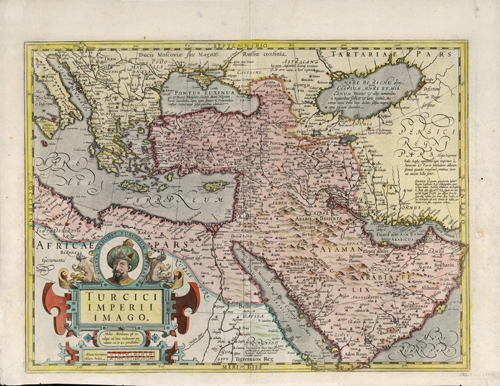
Ottoman Empire, early 17th century. Library of Congress
At its height, the Ottoman Empire (1299-1922), controlled North Africa, much of the Mediterranean, and portions of the Balkans, Italy, Austria, Hungary, and Russia. Innovations in medicine, mathematics, astronomy, architecture, philosophy, chemistry, physics, calligraphy, weaving, music, and literature are part of their cultural legacy. They gave us scalpels, alarm clocks, and coffee.
The following notes on the decline of the Empire come from A World Undone, 2007, by G.J. Meyer, an excellent history of World War I that I have quoted before.
The high point of the Empire occurred during the reign of Sultan Suleiman the Magnificent, from 1520-1566. The Sultans did not have wives, but large numbers of concubines, who gave them large numbers of sons. Suleiman had 300 women in his harem, but became enamored of a red-haired Russian woman, who later became known as “the witch,” She convinced Suleiman that his favorite son was plotting against him. Suleiman had this son killed and the witch’s son, Selim, installed as his heir. Meyer says:
“Selim the Sot was short and fat and a drunk. He never saw a battlefield and died after eight years on the throne by falling down and fracturing his skull in his marble bath.” Meyer describes the Sultans that followed him as “craven.” This started the Empire’s decline.
*****
Let me put this in bold type:
It only took eight years for a craven leader to begin the ruin of what, for 300 years, had been the most powerful and innovative Empire in the known western world.
Happy New Year, friends! During a lunchtime conversation with Mary, the name of Ray Bradbury came up, which reminded me of the first book I was told not to read and the pleasure I had in reading it.
My parents loved books and passed their love of reading on to me. One night when I was in the sixth grade, we went to the Burger Pit in Los Gatos, California. Someone had left a Sci-Fi paperback in the booth where they seated us. The cover featured a fetching space maiden in skimpy garb, in the clutches of an ugly alien with tentacles.
“You don’t want to read that trash,” my mother said. Of course I did! I left the restaurant with the book tucked in my waistband. I found a flashlight in a kitchen drawer to read it when I was supposed to be sleeping. It probably was trash, since I can’t remember the plot, if it had one, and I soon was back to reading my favorite author at the time, Jack London. His best known book, Call of the Wild, was burned in Nazi Germany, but has not yet been banned in Florida. Be sure not to tell DeSantis that London was a socialist!
A list of 300 books banned in Florida contains some striking omissions. Nineteenth century books like Walden and Uncle Tom’s Cabin did not make the list, nor did Tess of the D’Ubervilles, which comes to mind because in high school, after I saw the movie version of Far From the Madding Crowd, with Julie Christie and Alan Bates, I went on a Thomas Hardy reading binge.
Here are some of the authors I read in high school, to whom I am deeply grateful for helping to shape my outlook on life:
Henry Miller. Sherwood Anderson. Theodore Dreiser. Sinclair Lewis (I devoured work by authors of the so-called “Chicago Renaissance”). Nathaniel West (see Day of the Locust if you don’t know where the name, Homer Simpson, came from). Edwin Arlington Robinson, after I learned that his poem, Richard Cory, inspired the Simon & Garfunkel song. Shunryu Suzuki – I purchased Zen Mind, Beginner’s Mind because I wanted to learn to meditate. Now, after decades of living and meditation practice, I have a decent grasp of what he was saying, but I suspect there are places that would burn this classic the way a church group in Alamogordo, New Mexico burned books by Tolkien in 2001 after determining they were the work of Satan. I’m sure there were more, but these are the authors that first came to mind.
The only thing I can think to pass along to students who are sickened by the notion of politicians dictating what they can read and think are these words posted on Twitter by Stephen King, who has 16 books banned in Douglas County, Florida:
“Hey, kids! It’s your old buddy Steve King telling you that if they ban a book in your school, haul your ass to the nearest bookstore or library ASAP and find out what they don’t want you to read.”
One morning in the fall of 2021, as Mary and I walked the dogs in a nearby park, we turned a corner, and at the other end of a parking lot, saw several police cruisers pulled up next to a pickup truck with a camper shell. The area was cordoned off with caution tape. The pickup was there almost every morning, so although we had never seen or spoken to the owner, we assumed it was one of the homeless men who spend their nights in the park. We chose another path to continue our walk, and I remember thinking that it seemed like a lot of police to bust a guy for sleeping in his car.
The next day we learned the man had hanged himself from the tree next to his truck.
It’s impossible to grasp the full extent of suffering and the death toll of the pandemic years, and just as the world did after the 1918-19 pandemic, we seem hell bent on trying to act like things are back to normal, but out of all the statistical and personal losses, this man’s death continues to haunt me. Potentially, there was help nearby if he had been able to reach out. There’s a megachurch, with various outreach programs, visible from the place where he died. A twelve-step group met several days a week that year in the park near the spot where he parked. Other homeless people sometimes gathered in the evenings for company or to share a pizza, but this man he never seemed to have joined them.
Most of us know what it’s like to get stuck in a dark place, where there doesn’t seem to be any way out. Most of us might also agree that the culture, the nation, the world are in a parallel state. In earlier times, in shamanic cultures, “soul loss” was the diagnosis for conditions we now call Anxiety Disorders, Dissociative Disorders, PTSD, and in general, the feeling of being “outside oneself,” “beside oneself,” or “not all there.”
But what kind of soul is it that can be lost and found? This has been a world-wide concern of shamans, spiritual seekers, and poets for millennia and has resurfaced for modern psychotherapists like Carl Jung and James Hillman.
Soul eludes precise definition, though I suspect everyone has a sense of it. Somehow it relates to depth, to intensity, to vibrant experience. Contact with soul, for an individual or a group, involves a sense of connection to an inner wisdom, an inner compass, like touching “the still point in the turning world,” to borrow Eliot’s phrase. To be out of contact with soul was reflected in a line from Yeats, “Things fall apart; the centre cannot hold.”
At the end of 2016, a lot of people in the Bay Area were upset by the election of Donald Trump. I was invited to a two day soul-retrieval ceremony in the Bon Tradition of Tibet, which dates back thousands of years and has shamanic roots. Tenzin Wangyal Rinpoche, a contemporary Bon meditation master, wrote that “In the context of the Bon soul-retrieval practice, the soul…is understood as the balance of the subtle energies and related qualities of the five elements: earth, water, fire, air, and space.”
At the end of the second day, the presiding lama performed a traditional test of this ceremony’s success. The result was about 50% effective, and that’s what it felt like subjectively – nothing had really changed. I found the result disappointing though not surprising. The ceremony grew from indigenous roots, among a people who shared the same consensus reality, a condition that no longer exists in America, where it feels like our 20th worldview is gone and the future is not yet in sight. Also, regardless of our conscious beliefs, at deeper levels, we are steeped in the imagery of our native culture, and other iconography, no matter how attractive, remains more distant. As Garrison Keeler once quipped, “In Minnesota, even the atheists are Lutherans because it’s a Lutheran God they don’t believe in.”
Joseph Campbell wrote extensively of the Grail Legends, which became popular in Europe during the liminal time between the dissolution of the medieval world and the emergence of the Renaissance. The mysterious Grail, which could heal individuals, the kingdom, and the land, was something mystical, sometimes imagined as the cup of the last supper, and at other times, as a stone, like the philosopher’s stone of alchemy. A key feature for Campbell was that every seeker of the Grail had to enter the wildernessalone.
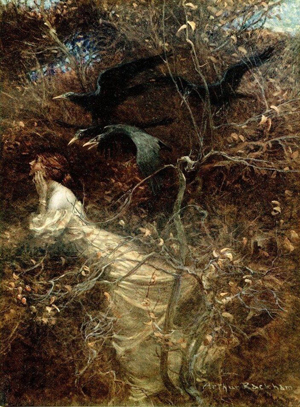
“Haunted Wood” by Arthur Rackham. Public Domain
In the Grail stories, a single hero (in some versions, Galahad, in others, Parsifal) finds the sacred object which redeems the kingdom and the king. No single hero or culture or nation can solve the issues as complex as those which confront the entire planet during our time of cultural dissolution. Solutions that seemed to work in the past are the very source of the problems that face us now.
Like it or not, every individual now living has the choice of clinging to nostalgic fantasies of an imagined idillic past, or of looking within to see what our individual soul and the soul of the world need from us now. The time of the winter solstice and the New Year is conducive to such reflections. “Peace and an hour’s time” are needed for creativity, according to photographer, Edward Weston, though he admitted that neither are easy to attain. How to get there is worth reflection as the new year dawns, and worth considering in the new year at greater length here.
Meanwhile I wish you all Happy New Year, with peace and time to enjoy it.
On Sunday, a 39 year old man drove an SUV through the annual Christmas parade in Waukesha, Wisconsin. Five people are dead and many more injured, including 18 children between the ages of 3 and 16, who suffered abrasions, broken bones, and serious head injuries. I remember the joy of a Christmas event like that when I was about 4, that climaxed with Santa arriving by helicopter. Will Advent and Christmas ever be joyful again for the people of Waukesha?
The media mostly glossed over the event. If the killer had used a gun or had a political motive, it would have been front page news, but apparently regurgitated opinions on the Rittenhouse trial got more clicks than another massacre in America.
As of this morning, we know the accused man was on bail after allegedly running over the woman who claims to be the mother of his child at the start of the month. On Sunday, he was involved in a “domestic altercation” before plowing into the crowd. One of the few comments I saw the night of the attack came from Marianne Williamson, who said “an evil spirit” was loose in Wisconsin, and we needed to pray.
Williamson evoked some mockery during the 2019 Democratic primary debates for statements like that, but hers was the one comment I still remember from those events. She said “No amount of policy wonkiness can overcome all the hate in this country.” More recently she echoed words I’ve heard from other leaders in other spiritual traditions that, “There are no political solutions for what ails the nation.”
I’ve been thinking about belief in spirits, both good and bad. Some acts are so heinous it’s hard to believe that “mere” human malevolence lies at the root – the Manson murders and Jonestown come to mind. As far as I can tell, only western culture since “the Enlightenment,” has refused to acknowledge the possibility of non-material influence on our behavior. Belief in spirits was part of original Christianity, and “distinguishing between spirits” was listed as a gift of the Holy Spirit by St. Paul (1Co 12:10 NIV). When you’re hearing voices, it’s good to know if they’re trustworthy!
We can call them spirits or call them neuroses, but at times like this, it’s dangerous to call ourselves invincible. In a more peaceful time, when the Star Wars movies first came out, everyone knew the Force was good and wanted it, without taking it literally. It’s worth remembering now that all it takes to turn us to the Dark Side is anger and hatred.
One of my favorite photos of our nearest shining sea. Sunset, Bandon, OR, 2013.
A story that Tibetan meditation master, Orgyen Chowang Rinpoche told during a Zoom teaching last year came to mind this Independence Day.
Rinpoche said that when he was young, his passion was to learn ultimate truths. He said he eventually realized that ultimate truths are beyond the grasp of our ordinary, discursive minds, and the question he now asks is, “Is this beneficial?”
Historical truths are more accessible than metaphysical ones, but this July 4, the contention over even fundamental “facts” is central to our national malaise. I remain convinced that for a nation, just as for an individual, a fearless admission of wrongs is a pre-requisite to further efforts to manifest dreams and ideals.
Our national ideals of equality, freedom, and democracy, are now International dreams. So are the forces of fear and greed that feed the rising waves of world-wide authoritarian movements. The dream of democracy will survive, and now would be a good time to pray that nations that currently embody it do as well.
***
This seems related – Mary and I were out this morning, and when we got back, it was too hot for a vigorous walk with the dogs, but we took them to the park anyway, sticking as much as possible to the grassy and shady areas. Not many people were out, but at one picnic table, three guitarists with portable amps were playing a stunningly good instrumental version of Dear Mr. Fantasy! It seems like just the song for this Independence Day.
Here’s a nice version of Steve Winwood playing it at Crossroads, 2007.
These days, it’s impossible not to daydream of “getting back to normal,” though it gets complicated the moment you try to figure out what that means. Much of “normal American life” led to our current messes, and some of the least desirable normal things, like mass shootings, have been the first to return to our not-yet, post-pandemic world.
I am profoundly fortunate, with a reclusive temperament and a living situation that allowed me to weather 2020 safely, with a fair amount of residual sanity. Even so, yesterday, I discovered how much I miss some normal things. Mary and I left for an errand near downtown, with nothing more than a piece of toast, so by 10:30, when we were done, we were more than a little ravenous. An impulse led us to Lido’s, on Fair Oaks Boulevard, which has always had outdoor dining on the front porch. Several tables were open by then.
We hadn’t been to a restaurant since the second week of March, 2020, so scrambled eggs, country potatoes, a bowl of fruit, and coffee seemed like the finest breakfast I’d ever had. The good spirts of those dining on the porch were contagious. The downside became apparent after breakfast, when I masked up to go indoors to use the restroom – the place was jammed with maskless people, and I could only reflect that the end of the pandemic is in no way assured!
Stupidity is as normal as genius in this country, and I think we’ve become conditioned, especially after the last four years, to pay closer attention to the former. And yet…
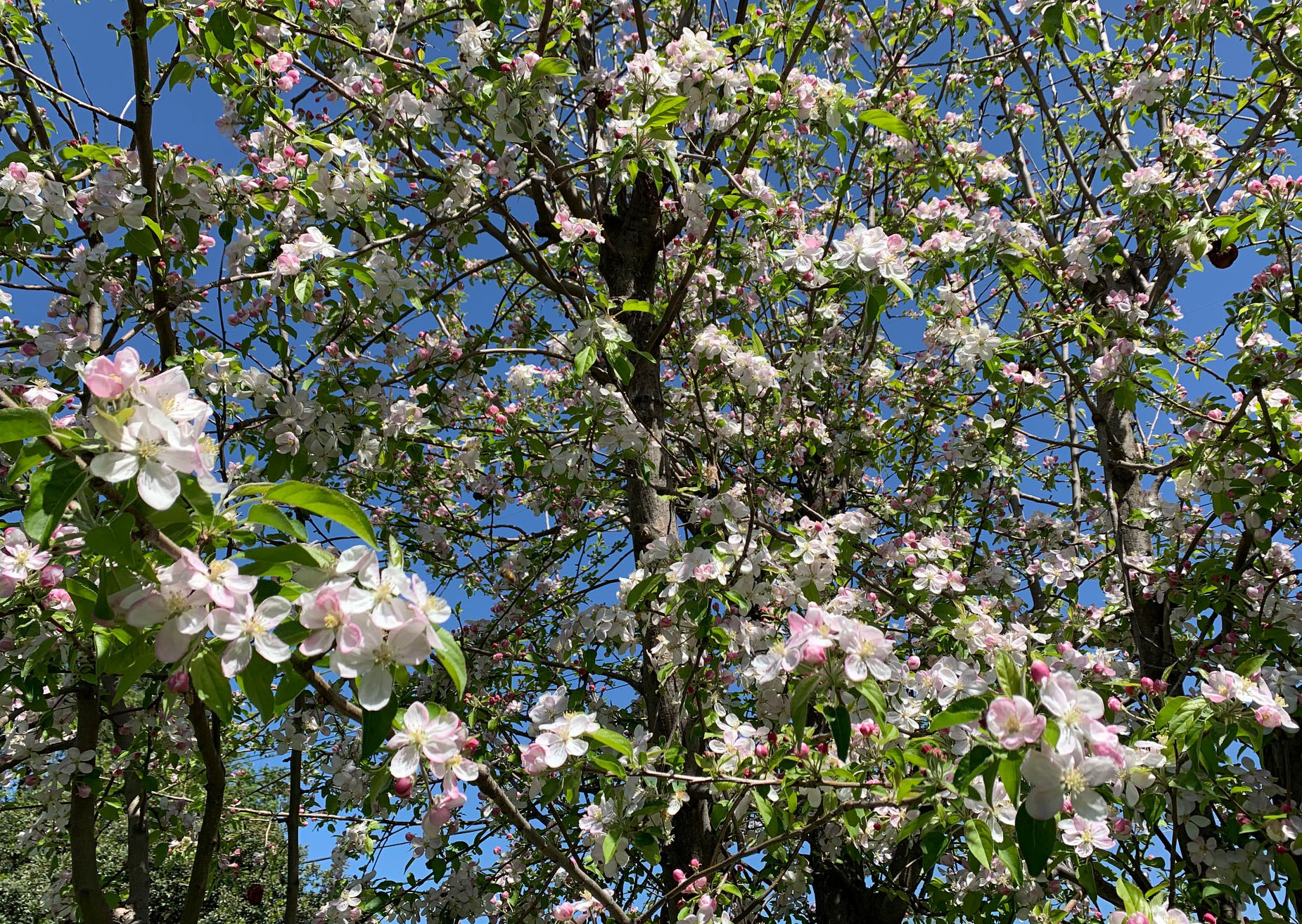
In the afternoon, as I sat on the back porch, two hummingbirds joined the bees in circling and darting through through the apple blossoms.
Cheri Huber, a Zen teacher I met years ago, had a favorite saying: “The quality of your life is determined by the focus of your attention.”
A week or so ago, at noon, I was sitting on the back porch, gazing at the sky. I was dressed warmly for it was 50 degrees and windy, which is cold if you live in a hot climate. Suddenly – and this made no sense – I heard the distinctive jingle of an ice cream truck. Stephen King came to mind, and I imagined a truck full of killer clowns. It has been that kind of year.
King himself has tweeted that nothing he’s written is as scary as 2020 has been. To be precise, he said nothing he’s written “is as frightening as the current administration,” which is to state more clearly what has made America the epicenter of many of the horrors the world has endured this year.
My father was born exactly 100 years ago, on December 31, 1920. As I sat on the porch this afternoon, on another chilly day, I was thankful that he didn’t live to see this year. Then a pleasant memory came to mind. Continue reading →
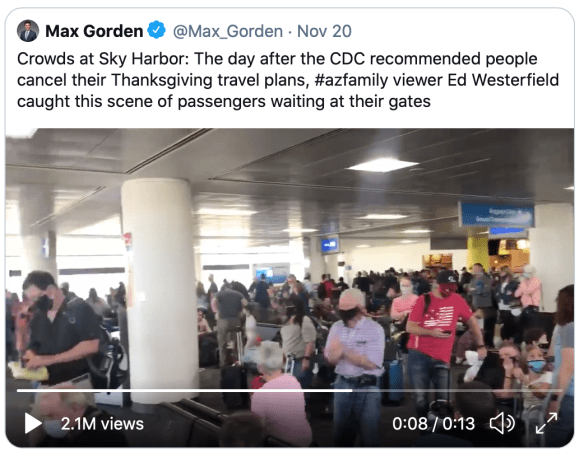
On Friday, a few days after the CDC recommended that people avoid Thanksgiving travel, someone tweeted a video clip of a crowded terminal at Sky Harbor Airport in Phoenix. Other tweets have confirmed that this is unfolding in many airports.
On the plus side, everyone was wearing a mask. The ceilings were high and there may well have been good ventilation. One man was using hand sanitizer. I’m sure some had purchased non-refundable tickets even before the current coronavirus spike. Most had probably done so before the CDC announcement. But the virus doesn’t care, and many of these travelers were going to be crowded together in terminals and airplanes for hours.
It struck me that this is truly in an evolutionary moment. As in, survival of the fittest. But what isfitness now, in this situation?
Surviving the first wave had much to do with luck – or karma if you wish. We did ok if we weren’t in a nursing home or on a cruise ship. If we weren’t a New York City bus driver. It helped if we were young and healthy, were not homeless, and didn’t have to work in a meat packing plant. It helped to be distant from the first epicenters while scientists worked out aerosol transmission and our current distance and mask protocols.
But now, a year after the first appearance of the virus, when everyone knows the guidelines, what attributes give us the greatest chance of survival? I’m thinking just of western nations for now, for I don’t know much about the cultural dynamics of places like China or Korea. What are the attributes that will keep us alive?
The first thing that comes to mind is compassion, a concern for others, born, at a minimum, of an understanding that we are all in this together – that no one survives by themselves. We wear a mask, not just for ourselves but for the grocery worker who stocks the shelves with toilet paper. It’s the opposite of the adolescent, “You’re not the boss of me,” concept of freedom which lies close to the core of the dismal failure of the US effort to contain the virus.
In addition to an open heart, it helps to have an open mind, open to evidence and not locked into concepts, blind beliefs, or dogma. A South Dakota nurse recently lamented that some of her patients have died proclaiming that covid is a hoax.
And finally, despite the teachings of “positive psychology,” there seem to be times when pessimism is an asset. A few years ago, I heard a discussion on NPR, of research, including a study by the American Psychological Association, that pessimists may live longer – if we are worried about our health, we may guard it more carefully. “Two of our hunter-gatherer ancestors are caught in a violent storm, but see a dry cave on a ledge above them,” said the narrator. “One of them says, ‘Oh look, a dry cave!’ The other hunter says, ‘I don’t know…there might be a bear inside.’ Which hunter is more likely to live long enough to pass on his genes?”
I find it interesting that two of the western nations that have best contained covid-19, New Zealand and Iceland, are islands, while Hawaii has consistently been at the top of American states in that regard. According to today’s (Nov. 22) New York Times update, they have again been at the lowest level, of 10 or fewer daily infections per 100,000 people over the last week. There’s no way to prove it, but my hunch is that residents of an island know that they’re all in this together more viscerally than we on the mainland can.
Meanwhile, on the mainland, as the pandemic rages out of control and even our best prepared hospitals are likely to be overwhelmed, our public response is irresponsible travel and hoarding toilet paper. Our mythic, “American Exceptionalism” has come to mean exceptionally stupid. I am reminded of the challenge back in the ’60’s as the Vietnam war raged: “America – love it, or leave it.”
It’s easy now to think that leaving, if and when other nations would even have us, is a reasonable survival strategy. And yet that part of me with roots deep in this land, that grew up feeling pride in this nation, can only offer the same response we gave in the ’60’s: “America – change it or lose it.”



 The First Gates