More good news on the food front

Last week, two posts on npr.org opened a startling window on the capacity of well tended small gardens. The first article, “Why Micro-Gardening Could Go Big,” discussed the UN’s Food and Agriculture Organization (FAO) as a large supporter of micro-gardens, defined as “intensely cultivated small spaces.”  They claim that an 11 square foot garden can produce “as much as 200 tomatoes a year, 36 heads of lettuce every 60 days, 10 cabbages every 90 days, and 100 onions every 120 days.”

Micro-garden by Nick Saltmarsh, 2009.  CC-by-3.0

Micro-garden by Nick Saltmarsh, 2009. CC-by-3.0

The post features a number of links to other sites with numerous links of their own, and it soon becomes clear that many groups and individuals are finding new ways of boosting yields.  As I discussed recently (Good news on the food front), unless agriculture finds ways of keeping pace with population growth, disaster is a mathematical certainty.

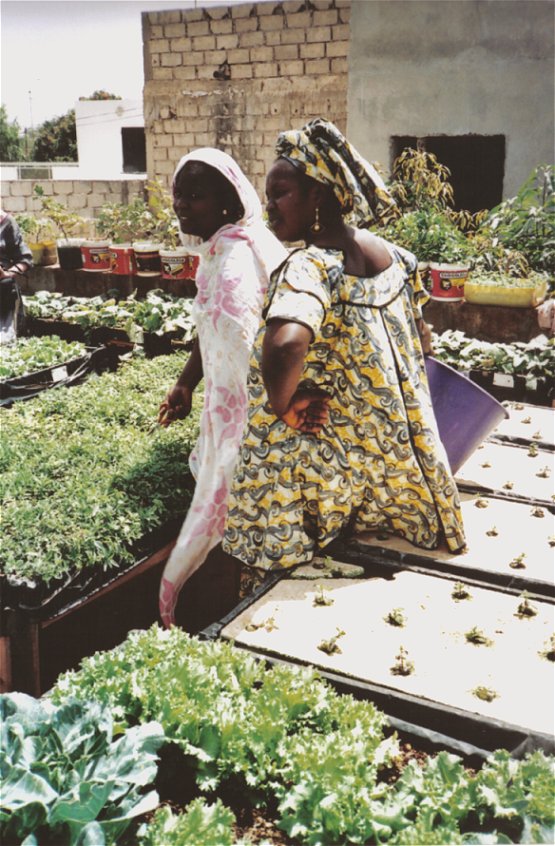
These articles show that there are far more efficient configurations than traditional, single row gardens. Raised beds and containers are common features of the gardens pictured online.

Rooftop garden, Senegal, CC-by-2.0

Rooftop garden, Senegal, CC-by-2.0

One nice thing about these photos is that they make you want to get your hands dirty! Maybe not this afternoon, with temps in the mid 90’s, but I’ve already got a spot in mind for the fall and spring.  We used to have a veggie garden when we lived north of here and had more time and far better soil.  With micro-gardens you don’t need large amounts of time or good soil to get started.

Photo by USDA.  CC-by-2.0

Photo by USDA. CC-by-2.0

NPR’s second post, Micro-Garden Madness, has additional photos of places where people are growing things.  Unlike the ambitious plots at the local community gardens, where you often see couples and families work long hours on weekends and evenings, the smaller gardens can work for people who spend their evenings and weekends in strange pursuits like blogging.

Phil Weiner co-founded a company that makes products aimed at micro-gardeners.  “Everyone in the world should have a victory garden,” he says.

Can we even begin to imagine what such a world would be like?  With these articles and photos, we can begin to envision such a transformation.

Tis the season?

First Christmas catalog arrival date for 2013 - July 5

First Christmas catalog arrival date for 2013 – July 5

At the risk of being accused of having an idle mind, let tell you that over the last few years, I have tracked the arrival date of the first Christmas catalogs.  It was the end of July in 2010, and over the next two years, the trend seemed to reverse – no Santa’s in the mail until August.  This year we’ve hit a new low.  The first one, inviting me to “Celebrate life’s special moments,” was delivered July 5, with two more arriving the next day.

Here I am, just beginning to mourn the beginning of shorter days as a new threat looms on the horizon – if “the most wonderful time of the year” can almost breach the Independence Day bulwark, can “holiday music” be far behind?  Are you ready for “Little Saint Nick” in the stores in September?  Note to self – carry earbuds everywhere!

Every year it seems I come to a greater appreciation of the pre-repentant, “Humbug” Ebenezer.

And when the days grow short and the weather turns cold, I’ll be singing along with Joni Mitchell – “Wish I had a river I could skate away on.”

Your Own Damn Life: an interview with Michael Meade in The Sun

Michael Meade is an author, storyteller, and a passionate advocate of soul values in a world that increasingly ignores them; I’ve written about Meade or mentioned him in half a dozen posts.

In The Water of Life (revised, 2006) he shares his discovery that stories can be a matter of life and death.  As a teen in New York, when confronted by gang members from a rival neighborhood, Meade didn’t just lie his way out of serious injury or worse – he storied his way out, with an elaborate made-up tale that won over the assailants long enough for him to make his escape.  Readers of my recent posts will recognize a thriving trickster in Meade when he was just a kid!

I recently found an interview between Michael Meade and John Malkin in the The Sun that is as timely today, or more so, than in November, 2011, when it was published.  In the interview, “Your Own Damn Life,” Meade quotes an African proverb, “When death finds you, may it find you alive.”  Alive, he goes on to say, “means living your own damn life, not the life that your parents wanted, or the life some cultural group or political party wanted, but the life that your own soul wants to live.”

In the past, meaningful stories could guide soul evolution, but now, with the culture and the natural world both in crisis, Meade points to our lack of coherent, guiding tales.  A culture falls apart, he says, when youthful imagination and energy are stunted and when the traditional wisdom of elders is forgotten.  At one extreme, “You’re not supposed to be worrying about the end of the world as a teenager; you’re supposed to be bringing your dream to it. The world seems old and troubled now, and the young are no longer allowed to be as young as they should be.”  At the other extreme, we have a lot of “olders” but not many wise “elders.”

When traditional stories collapse, Meade says, the guiding and healing stories must come from within.  “That means going to the core of your own life and finding the story seeded within.”  Meade has tried to facilitate such explorations through his writings and talks, which first became known in the 80’s when he, James Hillman, and Robert Bly hosted a series of men’s conferences.

Meade continues to teach, write, and offer a variety of community services through the non-profit Mosaic Foundation he founded in Seattle where he lives.  If you’ve read this far, you will find Meade’s interview in The Sun and the Mosaic page hightly rewarding and likely sources for new ideas.


Weekend Video: The Real Meaning of Life

For now, the heat has broken. It’s Sunday. Went for an early dog walk and had the park almost to ourselves. Now the dogs are dozing at my feet and there’s a cup of coffee nearby – a good frame of mind to watch a short but inspiring video I found posted on Life Out of the Box, a blog that always rewards the time I spend exploring it.

lifeoutofthebox's avatarLife Out of the Box

LOOTB Weekend Video: The Real Meaning of Life

Here’s a great video that we found by one of our favorite philosophers Alan Watts. We’ve shared another video of his in the past, What Do I Desire, because his philosophy on life is so in line with the mentality we have here with Life Out of the Box. In this video he explains what the real meaning of life is and that it’s not about the destination of success that we’re after, but rather the journey along the way. His words continue to inspire us to go after our dreams and live the life we desire and we hope they do the same for you all on this beautiful Saturday morning. Make it a weekend to remember friends!

View original post

July 6 is the Dalai Lama’s birthday

His Holiness with a participant at the Young Minds Conference in Sidney, Australia, June 17, 2013

His Holiness with a participant at the Young Minds Conference in Sidney, Australia, June 17, 2013

His Holiness the Dalai Lama is 78 today.  Regarded by many as an emanation of Avalokiteshvara, the Buddha of Compassion, here is a summary of the Dalai Lama’s mission in the world from the website of the Gyuto Vajrayana Center in San Jose.

Three Main Commitments of His Holiness

Firstly, on the level of a human being, His Holiness’ first commitment is the promotion of human values such as compassion, forgiveness, tolerance, contentment and self-discipline. All human beings are the same. We all want happiness and do not want suffering. Even people who do not believe in religion recognize the importance of these human values in making their life happier. His Holiness refers to these human values as secular ethics. He remains committed to talk about the importance of these human values and share them with everyone he meets.

Secondly, on the level of a religious practitioner, His Holiness’ second commitment is the promotion of religious harmony and understanding among the world’s major religious traditions. Despite philosophical differences, all major world religions have the same potential to create good human beings. It is therefore important for all religious traditions to respect one another and recognize the value of each other’s respective traditions. As far as one truth, one religion is concerned, this is relevant on an individual level. However, for the community at large, several truths, several religions are necessary.

Thirdly, His Holiness is a Tibetan and carries the name of the ‘Dalai Lama’. Therefore, his third commitment is to work to preserve Tibet’s Buddhist culture, a culture of peace and non-violence.

The Unwinding: An Inner History of the New America, by George Packer

In the first sentence of The Unwinding, George Packer tells us what his title means:  “No one can say when the unwinding began – when the coil that held Americans together in its secure and sometimes stifling grip first gave way.”

Packer is a staff writer for The New Yorker, the author of an award winning book on American involvement in Iraq, two novels, and a play.  You could almost guess it would take someone with Packer’s chops to weave together the disparate threads of change that have irreversibly altered the country we thought we lived in.

It began in 1973, when the mid-east oil embargo coincided with models showing American had reached peak oil production.  And in 1977 when the steel mills in Youngstown, Ohio, that once stretched side-by-side for 25 miles, shut down.  When an idealistic young man named Jeff Connaughton, got an MBA and then decided to go to Wall Street, because by the early 80’s, getting a business degree and going to work for a company “that actually made things,” was viewed as failure.  When, according to Packer, concern over exported jobs prompted Wal-Mart to hang “Made in the U.S.A” signs over racks of clothing from Bangladesh.  When Connaughton became a Washington lobbyist and one of his colleagues told him, “Four-hundred thousand a year just doesn’t go as far as it used to.”

Poets see things before the rest of us, and Packer quotes Bruce Springsteen, who put it like this in 1984:  “Don’t you feel like you’re a rider on a downbound train?”

Now, almost 30 years later, when we all know we’re on a downbound train, Packer turns a light on some of the hydra-headed influences that led us collectively down this road.  He also shows us where positive change is likely to come from.  And where it is not.  It won’t come from the power elites, though it may come from disaffected refugees from those elites.

Jeff Connaughton, who made it into the outer circles of the inner circle, as a legal council for the Clinton White House, left Washington after being “radicalized by a stunning realization that our government has been taken over by a financial elite that runs the government for the plutocracy.”  Connaughton is now writing a book called The Payoff:  Why Wall Street Always Wins.

Packer also profiles Peter Thiel, a Silicon Valley entrepreneur who co-founded Paypal and helped bankroll Facebook as a startup.  Thiel put it like this:  “…the deep secret is there’s nobody at the steering wheel at all…People pretend to be in control, but the deep secret is there is no one.”  Thiel now looks for unusual entrepreneurial projects to fund.  Claiming that education is “the latest U.S. economic bubble,” he compares university administrators to sub-prime mortgage lenders.  In response, he began awarding Thiel Fellowships, two year grants of $100,000 each, to 20 people a year under the age of 20, willing to leave school to work on projects that “could make the world a better place.”

Packer doesn’t just profile movers and shakers in the post-unwinding world.  He details the story of Dean Price, son of generations of tobacco farmers, who overcomes multiple obstacles, including personal bankruptcy, to establish a working and profitable biodiesel refinery after learning about peak oil and taking the message to heart.

George Packer

author George Packer

In writing the book, Packer spent a lot of time with Tammy Thomas, an African-American woman who was 11 when the mills closed in Youngstown.  A few years later, she found herself an unwed mother of three, with a fierce determination, which she attributed to her grandmother, to get off welfare, even as jobs evaporated and gangs took over the neighborhoods.  She succeeded in doing so, and is now a community organizer and advocate, but her story makes clear that the odds were stacked against her.  She survived for 19 years in a car parts factory but is scornful of politicians who attach the label of “good jobs” to such work.  “Mitt Romney would be dead in week,” she said.

Packer interweaves the individual stories in a way that keeps you turning pages, like a novel with a large cast of characters that you care about.  Not all the stories have happy endings, and the suffering of individuals, cities, and regions is palpable.  By giving so many seemingly separate events the name, Unwinding, Packer helps clarify connections I had been sensing but unable to articulate.

“Alone on a landscape without solid structures, Americans have to improvise their own destinies, plot their own stories of success and salvation.”

A problem has to be named and described before we can begin to imagine solutions, and for this reason The Unwinding is a profoundly important book.

Paranoia stikes deep

My title comes from a phrase Stephen Stills used 46 years ago in the lyrics of, “For What it’s Worth,” a song The Buffalo Springfield released in January, 1967.

Paranoia strikes deep
Into your life it will creep
It starts when you’re always afraid
You step out of line, the man come and take you away

Those lyrics came to mind today around noon, when the dogs started barking. I found a UPS package on the doorstep, lightweight, about 10x8x8, from a local address I didn’t recognize.

“Expecting a package from a place called ‘Copperfield?'” I called to Mary, who was in the other room.

“No,” she yelled back. “Be careful opening it.”

“Honey, if it’s a bomb, being careful won’t help.”

“No,” she said. “I mean that poison.”

“OK,” I called. “I’ll start with the packing slip. That’s probably where they put the ricin.”

It turned out to be the can of black touch-up paint I’d ordered for our wood-burning stove. As you might have guessed, I wasn’t really scared of being blown up, but it was the first thing that came to mind. And why not? “They” consider my phone calls worth logging, and my internet hits, and my credit card use. Those of you with newer high-definition TV’s should realize there is a built-in feature that allows a 3d party to peer into your living room. That’s old news, as in posted at least a year ago, to a collective yawn.

There’s something happening here
What it is ain’t exactly clear

That’s the heart of our problem: what’s happening ain’t exactly or even a little clear, except maybe, “step out of line, the man come and take you away.”

One of the few people in Washington I admire, Sen. Bernie Sanders, Independent from Vermont, posted a survey on his website. Here are the four questions:

  1. Do you favor or oppose the National Security Agency’s program to monitor online communications in order to protect the nation from terrorist threats?
  2. Is it appropriate for the federal government to collect millions of phone records from American citizens, if doing so could potentially disrupt a terror plot?
  3. Do you think the president should or should not have the power to authorize the National Security Agency to monitor the electronic communications of American citizens without getting warrants?
  4. Do you favor or oppose changing the PATRIOT Act, which allows the government to collect the phone records of American citizens without a warrant?

I haven’t taken the survey yet, because I’m still “Unsure” on two of the questions. I find that upsetting, given that Sanders also posted the text of Amendment IV to the Constitution:

The right of the people to be secure in their persons, houses, papers, and effects, against unreasonable searches and seizures, shall not be violated, and no Warrants shall issue, but upon probable cause, supported by Oath or affirmation, and particularly describing the place to be searched, and the persons or things to be seized.

Decades ago, H.L. Mencken wrote, “The whole aim of practical politics is to keep the public alarmed (and hence clamorous to be led to safety) by menacing it with an endless series of hobgoblins, all of them imaginary.”

Right now, I think we are all numb. More precisely, I think this is what psychologists call “learned helplessness.” When a creature perceives that it’s powerless to prevent harmful events, it becomes listless and depressed. Or disgusted with politics. One of these days I expect that listlessness and disgust to erupt as outrage. When and if it does, I don’t think it’s going to be pretty or the stuff of songs – there is too much we have collectively stuffed, and for too long a time.

Hometowns

Do you have a hometown?  When someone asks where you’re from, are you able to tell them?  Or do you mumble something like, “I’ve lived in a lot of places?”  I do that.

According to the census bureau, less than 1/3 of the people in western states live where they were born.  My wife comes from Rochester, NY.  I was born in Poughkeepsie.  We met in San Francisco.  That seems to be the norm out here.  I had lived in five cities and gone to six schools by the time I finished high school, so I can answer,”Where are you from?” in a lot of ways.

Childhood memories are layered in ways that reminds me of geographical strata.  Each place, school, and time had its own feeling tone.  Recalling those times sometimes seems like gazing at ancient pictographs on differing layers of rock.

Near Tucson, Jan. 2008

Near Tucson, Jan. 2008

A visit to Mary’s family in Rochester last week was like visiting earlier layers.  The sense of place in western New York is much like where I grew up.  The feel of the air, the look of the sky, the wind through the trees, the trees themselves, are now foreign but deeply known at the same time.  Maybe the answer to my question is,”I am from all the places I’ve ever lived.”

Rochester postcard

Old factory towns like Rochester have a strong sense of communal past.  There is more “home” in some towns than in others.  In the local paper, I came upon the smiling face of a handsome young man in the obituary section.  Charles “Dutch” Lydon died on June 1st at the age of 89.  He won five bronze stars in combat in the Pacific in WWII, was an “avid” bowler and golfer, and “a proud Kodak employee for 30 years.”  He is survived by children, grandchildren, and great-grandchildren.  Tom Brokaw must have been thinking of people like Dutch when he coined the name, “greatest generation.”

I don’t think my parents generation was great just because they were superior beings.  I believe the times demanded and fostered their greatness.  Men like Dutch Lydon knew where they were from, knew what that meant, and believed in it.  Now there is no more Kodak to be proud of.  Silent factory chimneys stand like tombstones for that way of life.

Not that smoke and soot were good for you, or that Kodak didn’t screw up in the end and screw its workers.  Not that things were so good if you weren’t a white hetrosexual male.  Not that my generation didn’t rebel against all that.  It’s just that from our current perspective, we can see things of value we lost when this way of life came to an end.

A sense of belonging and community, for one thing.  Friends and family you can count on were cited as key factors in a recent survey that named the ten happiest countries in the world.  Do I even need to say that the United States failed to make the cut?

Sense of community is an impression, an imagining, a gut feeling, but it makes a profound difference.  Walking along the Lake Ontario shore, we stopped to admire a fine old brick building, a public bathhouse, with half a dozen tennis courts sheltered from the wind in an enclosed courtyard.  The bandstand in the park was under renovation, as was the carousel with its hand-painted animals.  This is a city that doesn’t just pay lip service to words like “community.”  A cop on patrol passed us with a smile and a “Good morning,” because, though the park was filled with people, he had nothing more pressing to do.

Many in my generation grew up on Easy Rider and On the Road, filled with wanderlust and a longing for the horizon.  Others married their high school sweethearts, anxious to settle down.  People I know played it both ways, with differing results.  There aren’t any rules of thumb.  From the time of the pioneers, California has attracted people looking to reinvent themselves.  This is where Norma Jean Mortenson became Marilyn Monroe.  Sometimes it works out and sometimes it doesn’t.

It has taken me longer than usual to write this post.  I kept putting off hitting the “Publish” button in hopes of reaching some kind of conclusion.  Doesn’t seem likely at this point.  Just a number of questions without any clear cut answers.

What does it mean to have a hometown, or maybe the question is really, how does a “town” become “home?”  What does it mean to have a home, to “feel at home?”  What does it mean to be from someplace?  “You can’t go home again,” Thomas Wolfe famously said.  Nobody asks the flip-side question, which is whether we ever really leave?

I’d love to hear any thoughts you have along these lines.