Books for Brainiacs (literally)

I was browsing the NPR list of recommended Sci-Fi titles today, and could barely manage a ho-hum.  I’ve slipped into one of my periodic non-fiction moods, and I’ve learned to follow such whims to see where they take me.  I fear that my book queue may get even more unmanageable after stumbling upon these NPR recommendations:  Insane Science:  Five New Books that Explain the Brain.  http://www.npr.org/2011/06/08/136896426/insane-science-5-new-books-that-explain-the-brain  Here is a quick summary of the article:

The Compass Of Pleasure: How Our Brains Make Fatty Foods, Orgasm, Exercise, Marijuana, Generosity, Vodka, Learning, And Gambling Feel So Good  by David J. Linden.  Everyone probably guessed Fatty Foods, Orgasm, Vodka, and perhaps Generosity, but the author claims that Paying your taxes belongs in that category too.

The Believing Brain: From Ghosts To Gods To Politics And Conspiracies — How We Construct Beliefs And Reinforce Them As Truths by Michael Shermer.  Shermer, a former Evangelical Christian who became an agnostic in college claims that belief precedes the explanations we invent for them.  However, Shermer acknowledges that, “we could be wrong.”

The Psychopath Test: A Journey Through The Madness Industry by Jon Ronson.  The bad news:  an estimated 1% of the population is psychopathic.  The good news:  if you wonder if you are, you almost certainly are not.

The Optimism Bias: A Tour Of The Irrationally Positive Brain by Tali Sharot.  Even if you are a cynic, your brain is probably hardwired for optimism.  “Most people are programmed to predict happy endings in all facets of our lives.”  As you might have guessed, there is measurable survival value in thes.

A Billion Wicked Thoughts: What The Worlds Largest Experiment Reveals About Human Desire by Ogi Ogas and Sai Gaddam.  If you want to know what people really think about sex, look online, claim the authors, and that is what they did.  Their conclusion, after sifting through “reams” of data?  Men’s sexual brains “are more like Elmer Fudd,” and women’s, “like Miss Marple.”  That hook I think, is enough to get me to download this one.  Not that I would be crass enough to ever make a joke about Elmer Fudd and Congressman Wiener – nope, no way.

Happy reading, everyone, and I categorically deny all rumors that I have too much time on my hands!
High School Confidential

The day after our local graduation made me pause and consider high school for the first time in a long while, an interesting article arrived in the June 20 issue of Time.  In “Life After High School,” Annie Murphy Paul says, “We’re obsessed with those four years.  But new research shows we’re not defined by them.”

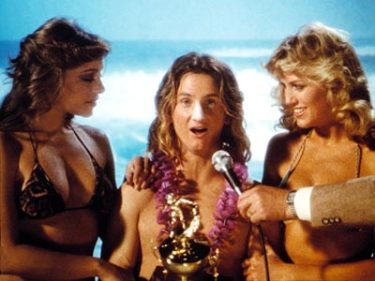
“Obsessed” will seem an appropriate word if you follow and enjoy popular media as I do.  Think of Rebel Without a Cause, Grease, Fast Times at Ridgemont High, The Breakfast Club, and any number of recent TV shows, some of which I really enjoyed, like Buffy and Joan of Arcadia.  Think of all the new authors piling into young adult fiction.  Think of Springsteen’s “Glory Days,” or “Married With Children’s” Al Bundy, whose life has been downhill since the day when he caught three touchdown passes (or was it four?).

At the core of Annie Paul’s article are a number of studies, now yielding results, on high school experience as a predictor of futures.  The longest running study, sponsored by the National Institute of Aging, followed 10,000 members of the class of 1957 in Wisconsin for 50 years.  There seem to be correlations, but they are not all that clear cut.  “Coveted as they are in high school, brains and popularity get you only so far in the real world,” says Paul.

Author Alexandra Robbins coined the term, “quirk theory,” to explain the fact that, “Many of the differences that cause a student to be excluded in school are the identical traits or real-world skills that others will value, love and respect…in adulthood and outside the school setting.”   In her recent book, The Geeks Shall Inherit the Earth, Robbins says, “I’m still a dork,” but believes that helps her connect with those she was interviewing and her readers.

Nothing is fixed, the various researchers seem to be saying, except the ideas we may hold of ourselves.  Such considerations may have motivated a University of Virginia psychologies to say, “Our work shows that popularity isn’t all that important.  The key is finding a group of people with whom you can feel at ease being yourself.”

In that respect, nothing much has changed.

A Change of Seasons

It may finally be summer.  Or spring.  Or whatever we’re calling it this year.  A week ago it was hailing, and today it’s in the mid-80’s.  By itself I would probably not notice since it’s gone back and forth from hot to cold so many times, but this week there were other changes as well

We cut down a huge liquid amber tree that was big when we moved in 25 years ago, and had grown huge over the last quarter century.  None of the neighbors could agree on how tall it was, but most guesses came in at 70′ – 80′.  The shade in the summer was enough of a bonus to make up for having to trim the limbs every few years, but this winter, which went on forever, it got to be too much.  The sap and the birds in the bare branches did a number on my car every night for weeks and weeks and weeks, and weeks and weeks.  Did I say it went on for weeks and weeks?  That plus the need to replace our roof this summer made up our mind, for we always eyed this behemoth tree warily during storm season.  Especially the last few years.

Now two small maple trees about 10′ high stand in the front yard, all staked and watered and fertilized.  They seem hopeful and sad at the same time.  Hopeful in the golden light of morning and evening, for they carry a promise for the future.  Sad in the flat light of noon which seems to emphasize the bare dirt where the stumps and roots of the old tree stood.  No amount of wisdom ever entirely gets your gut ready for change.

That’s nothing compared to what the guts of the graduates from the local high school are doing right now.  The school is just around the corner.  This morning, just after 7:00am they started to drift up the street with parents and grandparents and friends.  By 11:00 it was over and all the cars were gone from the curbs.  I found myself remembering my own graduation and the biker who led us into the ceremony with a psalm.

As we stood in our caps and gowns in alphabetical order, one of the “A’s” at the front of the line raised his voice and said, “Bretheren and Sisteren, I have a few words to share with you!”  Now this was a large biker guy who seldom spoke; he usually just sat around and glowered.   But just as they struck up Pomp and Circumstance, this guy pulled out a bible and read the 23d psalm.  When all the other memories of high school have faded, that may be the one I remember.  Well, maybe not, but it will be right up there.

This morning I found myself watching people returning from the ceremony.  A few were laughing and joking, but in general, no one seemed especially upbeat or inspired.  School officials mean well, but how can a bit of speechifying while you sit on folding chairs really commemorate what happened, or represent any useful guidance for what comes next?

Too bad the graduates cannot experience the vision quests the plains indians held for their young people.  Coming of age should be a time for discerning the themes of one’s life, and the nature of one’s guiding spirits, but that is very seldom what happens these days.  Or rather, we all still go on a vision quest, it just is not so well organized or safe.  If we are lucky, after a few decades, we begin to get a clue.  I found myself wishing the new graduates well, and wishing them a fruitful voyage into the wilderness.

My 100th Post

Trying to find something appropriate to say on the occasion of a fairly incredible milestone like this is about as hopeless as trying to really comprehend one of those big birthdays, like turning 30 or 50.  Experientially, it feels pretty much like the day before, just as this feels pretty much like post 99 or post 17 for that matter.

What I can very truthfully say is how much I appreciate all my readers, all the comments I have received, and all the links I have followed to find kindred spirits sharing their own ideas.  There is no longer any doubt that community can exist in cyberspace.  Earlier this morning, in regard to something else, Mary reminded me of a detail from Peter S. Beagle’s, The Last Unicorn: unicorns don’t have to be in each other’s immediate company – as long as they know there are other unicorns in the world, they do not feel lonely.  Thanks to all of you.

***

I started this post the way I started many others:  with an idea and the hope that it leads somewhere.  Very appropriately, I think, for such a significant milestone, the idea led me to Alfred E. Neuman.

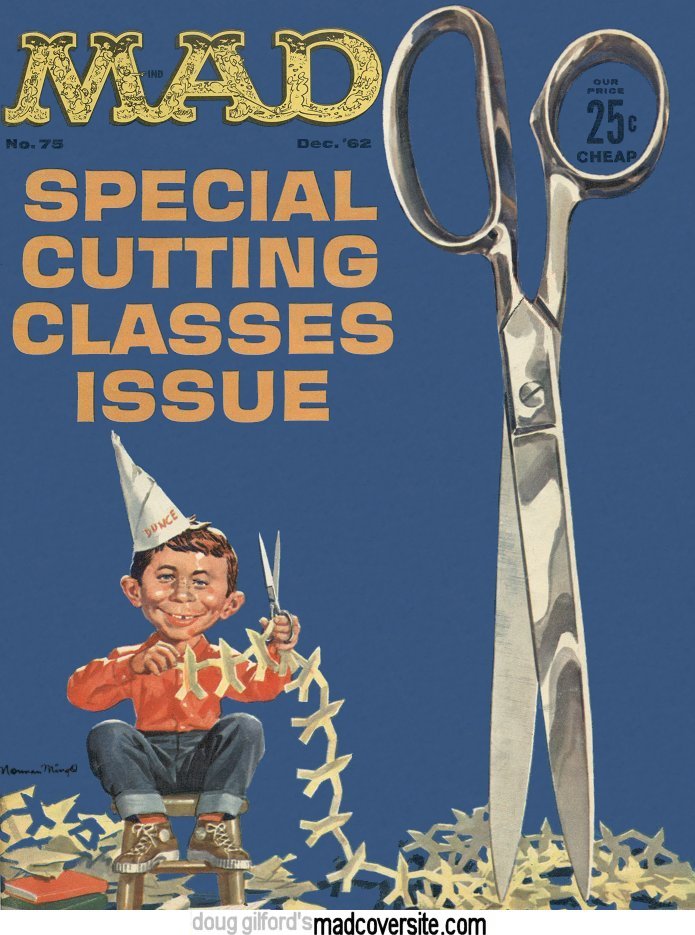
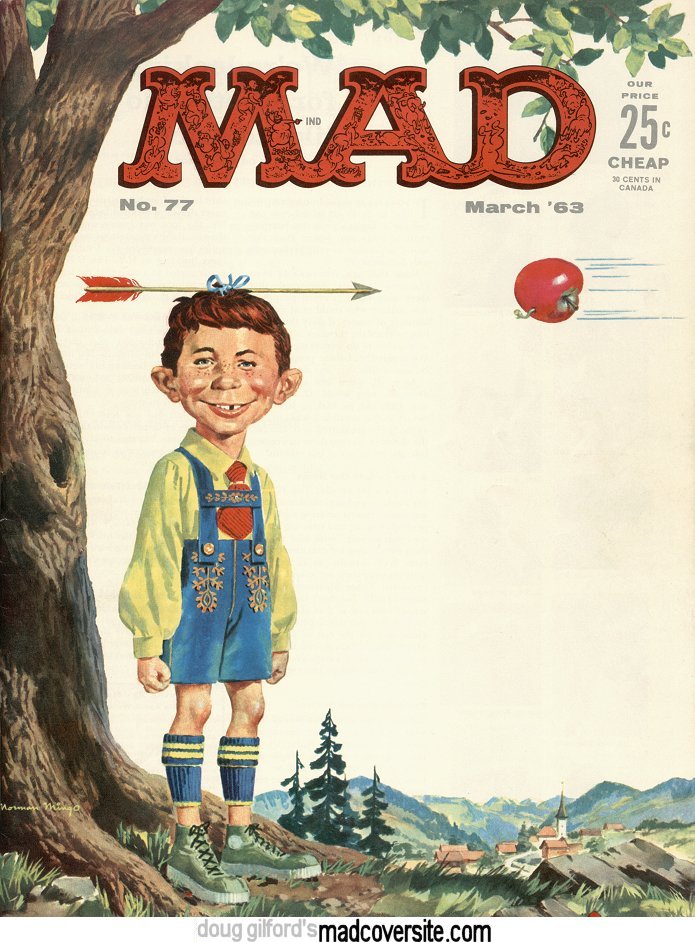
This is because Jen left a comment on my “Deja Vue All Over Again” post, regarding the school bomb drills.  “I couldn’t imagine how afraid they all must have been,” she said.  That triggered several vivid memories of photos and caricatures in Mad Magazine.  Mad parodied Kennedy and Kruschev.  The editors didn’t shy away from pictures of mushroom clouds.  In a way, they taught us the same technique that Harry Potter and his friends learned when faced with a boggart, those magical creatures that take the shape of your greatest fear.  When faced with a boggart, you have to look it in the eye and say the magic word, “Riddikulus!”

Mad taught members of my generation to say “Riddiculus” to much more than just the cold war.  Nothing was out of reach of the parodies.  Mad took special aim at Madison Avenue, popular culture, politics, education – in fact most all the artifacts of the “normal” world of adults.  Appropriately, I learned about beatniks from Mad. I seem to remember a picture of William Gaines, the founder, sporting a goatee.

One day my mother caught me coming home with a copy of Mad.  “Let me see that!” she said.  She snatched it out of my hand and flipped through it, thinking, I guess, that it was some new kind of Playboy. She chuckled once or twice and handed the magazine back.  “I guess this is all right,” she said.  Yes and no.  In many ways, Mad was far more more subversive for a grade school kid than Playboy could every have been.

More than once over the years, I have seen articles on Mad Magazine’s influence on the ’60’s counterculture, for it taught a whole generation to laugh at the world they were going to inherit.  Few sacred cows escaped Mad’s satire.  I assumed there would be lots of dissertations on that subject by now, but when I did I a search, I could not find any.  What I did find – and this would have made Gaines laugh out loud – was a term paper on Mad for sale, that had its basic facts wrong in the synopsis.

Mad has, however, made a significant contribution to the field of computer science through the work of Donald Knuth, Professor Emeritus of Computer Programming at Stanford.  Knuth is:

Author of the seminal multi-volume work The Art of Computer Programming, [and] has been called the “father” of the analysis of algorithms, contributing to the development of, and systematizing formal mathematical techniques for, the rigorous analysis of the computational complexity of algorithms. http://en.wikipedia.org/wiki/Donald_Knuth

Knuth’s first scientific article, “The Potrzebie System of Weights and Measures,” was published in a school magazine in 1957.  In it, he defined the basic unit of length as the thickness of Mad issue #26, and named the fundamental unit of force, the “whatmeworry.”  Mad bought the article and published it in issue #33, in June, 1957.

Remember that fun PBS show called, “Connections?”  The host, James Burke, loved to show how events, separated by centuries and thousands of miles, influenced each other.  So here, for this weighty and significant 100th post, is a brand new connection!   Think of it:  the influence of Mad Magazine on the man who taught us to analyze the sort of programming algorithms that make blogging possible.  Now if that’s not a happy thought, I don’t know what is!