The Neverending Story: A Movie Review

Several people had wonderful things to say in response to preceding birthday post, where I restated what has become the mission statement of this blog:  to look for the fantasy in all realities and the reality in all fantasy.  The comments were almost too kind – but not quite – and they prompted me to begin several posts on people and things that have shaped my thinking about imagination.  What jumps to mind first is movie released in 1984.

The Neverending Story, 1979, a fantasy novel by German author, Michael Ende, was translated into English in 1983.  A film was released the following year, which I saw in the early ’90’s, after one of my psych professors said, “It’s a story about our culture’s war on imagination.”

A lonely boy named Bastian loves to read.  One morning on the way to school, he ducks into a bookstore to escape pursuing bullies.  He asks the grumpy store owner about an intriguing book called, The Neverending Story.  “It isn’t safe,” the owner says.  At an opportune moment, Bastian “borrows” the book and carries it into the school attic to read.

The book relates how the kingdom of Fantasia is under attack by the Nothing, a dark void that consumes everything it touches.  The creatures of Fantasia appeal to their ruler, The Childlike Empress, but the Nothing has made her ill.  She summons Atreyu, a warrior of Bastian’s age, to conquer The Nothing, and gives him a magical talisman, the AURYN to guide him on the quest.  The force behind The Nothing summons Gmork, a wolf-like beast who craves power, to kill Atreyu.

The AURYN. Stephen Spielberg keeps the original prop in his office

Nowadays we’d call this a middle-grade book, but 33 years ago, when The Neverending Story was written, that label didn’t exist.  Most books written for young people, then and now, focus on personal issues.  Bastian is lonely and has trouble at school, but this is just the inciting action, not the real subject of the story.  The book and movie are unique in presenting a very adult theme – imagination and the forces arrayed against it – in fiction for this age group.

Atreyu finds no clues concerning the Nothing, so he risks the Swamps of Saddness to find the wisest being in Fantasia. Those who succumb to the sadness sink into the swamp and are lost. This is the fate of Atreyu’s beloved horse, Artax.

The wise being  cannot help, but directs Atreyu to the Southern Oracle, 10,000 miles away.  While trudging through the swamp with Gmork on his trail and little chance of success,Atreyu begins to sink into despair.  A Luckdragon named Falkor rescues him and carries him most of the way to the oracle.

Atreyu and Falkor

The oracle tells Atreyu that the only way to save Fantasia is for a human child, who lives beyond the borders of the realm, to give the Childlike Empress a new name. Then the oracle crumbles, a victim of the Nothing.

Falkor and Atreyu seek the border, and find the Nothing, which has become incredibly strong. Atreyu encounters Gmork who explains that Fantasia is “humanity’s hopes and dreams,” while the Nothing is “human apathy, cynicism, and the denial of childish dreams.”

Atreyu kills Gmork but is wounded and nearly falls victim to the Nothing. He is rescued once again by Falkor, but when he regains consciousness, only fragments of Fantasia remain, floating in the void.  The two make their way to the Ivory Tower, where Atreyu tells the Empress he has failed.

She says no, he has succeeded.  His quest was the only way to draw the attention of the human child, who is listening to them as they speak.  Bastian realizes she is talking of him.  As the Nothing begins to consume the Tower, the Empress begs him to say her name.  Bastian races to the attic window, and cries, “Moonchild!” into the face of an approaching storm.  He finds himself face to face with the Empress, who reveals that the Nothing has consumed all of Fantasia but a single grain of sand.

The Empress gives Bastian the last grain of sand of Fantasia

The Empress tells Bastian that his imagination and wishes have the power to restore the land to its former glory. In the final scene, we see Bastian soaring on Falkor through skies in Fantasia and his own world.  I wasn’t crazy about the ending.  There’s a Disney quality though out, since in the days before digital animation, films like this relied  on animated models and actors in costumes, but that was not necessarily a liability.  Jim Henson pulled it off without missing a beat in Dark Crystal, 1982.

In the last scene of The Neverending Story, I’m aware of watching a children’s movie, which disappoints, since most of the film was greater than any such category.  Even so, in the 20 years that have passed since I saw the movie, I’ve never forgotten the chords it struck concerning imagination.  Please take a look at this clip of Atreyu meeting Gmork to get a sense of the movie’s scope:

http://www.youtube.com/watch?v=iDHBZlSNO6w

In succeeding posts, we’ll look at some views of Depth Psychology and certain spiritual traditions.  For both of them, literalism is the enemy of living with soul and imagination.   The Neverending Story tells us this is a battle we each must fight in our own hearts and minds.  The world of practical affairs and the marketplace have never had much use for the world’s dreamers.  Can we still manage to hear the cries of the Otherworld beings who fade into nothing at our lack of attention?  “Rosebud” in Citizen Kane is the dying cry of someone who lost Fantasia.

The Neverending Story echoes world folklore in showing the need otherworld creatures have for humans.  Irish and Scottish fairies steal mortal children.  The fairy queen sought out Thomas the Rhymer to be his consort for seven years, the same length of time the sea nymph, Calypso, held onto Odysseus in ancient Greece.  Why do such beings need us for redemption?

These are just some of the questions this apparently simple “children’s movie” raises.  They are far to complex to answer here, but I plan to take some additional forays into imaginal realms in the next few posts, so please stay tuned.

Paracosms in Writing and Music

When I turned to the editorial page of the local paper this morning, I learned a new word and a wonderful concept.  http://www.sacbee.com/2012/06/27/4591277/springsteens-global-attraction.html.

David Brooks, a writer for The New York Times, and several friends “threw financial sanity to the winds” to follow Bruce Springsteen on tour through France and Spain , because supposedly the crowds are even more intense than their American counterparts. 

Young European fans know every word of songs The Boss recorded twenty years before they were born.  Their enthusiasm “sometimes overshadows what’s happening onstage,” says Brooks.  The moment that spawned his article was seeing “56,000 enraptured Spaniards, pumping their fists in the air…and bellowing at the top of their lungs, ‘I was born in the USA.‘”  

How could this be, especially since in Springsteen’s music, USA often means New Jersey?

Brooks asked himself the same question and borrowed a term from child psychology to help understand it.  The word is paracosm, meaning a world in imagination, “sometimes complete with with imaginary beasts, heroes and laws that help us orient ourselves in reality.  They are structured mental communities that help us understand the wider world.”

Children do it, says Brooks, and as adults we continue the habit.  Then he adds the observation that is the point of this post:

“It’s a paradox that the artists who have the widest global purchase are also the ones who have created the most local and distinctive story landscapes.”

Springsteen’s New Jersey.  J.K. Rowling’s English boarding school.  Tony Hillerman’s Navajo country.  221B Baker Street.  Downton Abbey.  Tolkein’s Edwardian rural England, aka, The Shire.

Hob Lane, near where Tolkien lived as a boy

I often think of the books I hate to see end, the kind that inspire fans to continue the story on their own, as I described in a recent post on fan fiction http://wp.me/pYql4-298.  Character remains the essential ingredient – we want to follow Harry, Ron, and Hermione wherever they may lead us – but in his article David Brooks points out the critical nature of the world where they more and act and love and fight.  We wouldn’t really want to see the Hogwarts gang on Sunset Boulevard anymore than we’d want Sam Spade in St. Mary Meade, working a case with Miss Marple.

“If you build a passionate and highly localized moral landscape, people will come,” says Brooks, echoing Field of Dreams, a movie that largely took place in a cornfield.  “If your identity is formed by hard boundaries, if you come from a specific place…if your concerns are expressed through a specific paracosm, you are going to have more depth and definition than if you grew up in the far-flung networks of pluralism and eclecticism…sampling one style then the next, your identity formed by soft boundaries, or none at all.”

I think this is an important thing to consider – one you seldom read about in books on writing but which instantly resonates when called to mind in the context of our favorite fiction.

But let’s end with The Boss

One of Springsteen’s best known songs, “My Hometown,” moves me the way “Born in the USA” moved a stadium full of Spaniards.  Hometown for me is part of a paracosm, a special kind of imaginary landscape.  I’ve said elsewhere that when I was young, we moved around too often for me to have any sense of a hometown, yet the moment I say the word I can see it vividly, with eyes opened or closed.

We’ll let the master paint the picture, since someone (I forget who) once observed that only a troubadour of Springsteen’s calibre could make you nostalgic for New Jersey.

Enjoy the paracosm.

American Literary Merit Short Story Contest

A friend on a writer’s mailing list sent this notice of the ALMA short story contest.  First prize is $1000 and inclusion in the ALMA Short Story Compilation for 2013.  Word limit is 3000.  Due date is Nov. 12, 2012.  The entry fee is $15 before Aug. 12 and $20 after that.  Here are the details:

http://americanliterarymeritaward.com/ALMA_Contest.html

Fan Fiction on the Radar

A year ago, I wrote a post on Harry Potter fan fiction,  http://wp.me/pYql4-14b.  My information came from an article in Time on the occasion of the release of the final Potter movie.  I had no idea how popular fan fiction had become, since my only prior experience was with its 20th century incarnation as cheaply printed fanzines on the magazine racks at Tower.  I sometimes skimmed but never bought.

All of that has changed.  The genre was featured last Friday in a Wall Street Journal article, “The Weird World of Fan Fiction.”  No wonder the Journal took notice.  E.L. james, author of the Fifty Shades of Gray erotic trilogy, which sold 15 million copies in three months, got her start writing fan fiction based on the Twilight Series (Edward as a powerful CEO and Bella as his sex slave).

The article mentions other well known writers whose first work was fan fiction. Meg Cabot, author of The Princess Diaries began writing Star Wars stories when she was 11.  Naomi Novik, author  of the Temeraire series, which has been optioned by Peter Jackson, continues to write fan fiction.  For her it is play, and she has more than 400 stories online, set in the worlds of Star Trek, Sherlock  Holmes, and The Avengers.

In addition to fan fiction writers who have broken into the mainstream, some have gathered huge numbers of online readers at sites like fanfiction.net or wattpad.net.  One story based on The Hunger Games has been read two million times.

Fan fiction isn’t new.  Conan Doyle fans in the late 19th century wrote their own Sherlock Holmes stores as authors continue to do.  The theme for an upcoming TV series with a female Watson appeared first on fanfiction.net.  One can argue that both Homer and Shakespeare in his histories, created stories akin to fan fiction; they used pre-existing worlds, situations, and characters.

The Journal gives a sense of the wild playfulness of fan fiction authors.  There is Pride and Prejudice in Space. We have Alice and the Mad Hatter battling zombies, and The Lord of the Whiskers, which populates Middle Earth with cats.  Male-male romance appears to be common, with Kirk and Spock, and Harry and Draco among readers’ favorite couples.  There are character cross-over stories too, like characters from the TV series, Glee, winding up in Middle Earth.

Published authors are mixed in their response.  Some, like J.K Rowling and Stephanie Meyer welcome the spinoff stories.  Others like George R.R. Martin and Anne Rice are dead set against fan fiction, and threaten lawsuits, though suits are seldom launched except when fans try to move borrowed worlds into mainstream publication.  Orson Scott Card was initially opposed to fan fiction but has come to embrace it.  This fall he will host a contest for Ender’s Game fan fiction.  Fans can submit works to his website, and the winning stories will be published in a anthology.  “Every piece of fan fiction is an add for my book,” Card said.  “What kind of idiot would I be to want that to disappear?”

I understand the draw of fan fiction.  My first real literary effort was a sequel to The Wind in the Willows that I wrote in the fifth grade because I didn’t want the story to end.  In college I was seized with great, “What am I going to do now?” angst when I finished Lord of the Rings.  One of the things I did was work with a group of independent filmmakers on a 20 minute epic entitled, Billy the Kid Meets the Wizard of Oz

The word, “amateur” comes from the Latin, amare, to love.  With that in mind, I look forward to checking out some of the web sites where these amateurs post their work.

The Wind Through the Keyhole, by Stephen King: A Book Review

I recently said I look for “imaginative escapism” in summer reading, and Stephen King’s, The Wind Through the Keyhole, 2012, qualifies on both scores.

This book is a celebration of stories by a consummate storyteller.  It is structured as a frame tale, three levels deep – a story within a story within a story, something you find in some our oldest epics and story collections like The Odyssey and The Arabian Nights.

In case we we miss that connection, King says it another way through his main character, Roland Deschain, who tells his traveling companions, “There’s nothing like stories on a windy night when folks have found a warm place in a cold world.”  Later, during a story concerning his younger self, Roland says, “A person’s never too old for stories…Man and boy, girl and woman, never too old.  We live for them.”

This is the eighth of King’s Dark Tower Novels, and the first I have read, but the introduction caught me up well enough to proceed.  Roland Deschain is a gunslinger in Mid-World.  A gunslinger is a cross between a knight errant and an old west marshall.  Many gunslingers are descendants of “the old White King, Arthur Eld.”

Mid World borders our own and is “filled with monsters and decaying magic.”  In places, there are gates between the worlds, or places where “the veils are thin.”  Three of Roland’s companions come from New York.  The fourth is a billy bumbler, a talking, dog-like creature.

Roland and his companions – his ka-tet – barely have time to find shelter from a starkblast, a devastating storm, with winds like a hurricane, the sudden onset of a tsunami, and temperatures so cold that trees snap and explode.  While the friends shelter by the fire in the only stone building in a deserted town, Roland tells of one of his first assignments as a gunslinger.

In the first story, “The Skin-Man,” Roland rides with his partner, Jamie Red-Hand, to the desolate mining town of Debaria, where a shapeshifter has slaughtered dozens of people.  This a gritty western world, like the bleakest of early Clint Eastwood’s westerns, and the monster is more deadly than the bad and the ugly Clint faced down.

While talking to an 11 year old survivor of an attack, a boy whose father and a dozen others were slaughtered, young Roland tells the second tale, “The Wind Through the Keyhole,” about another 11 year old, Tim Ross, who goes on a dangerous quest to save his mother who has been injured by a treacherous step-father.  Tim sets off to find Maerlyn, aka Merlin, at the heart of The Endless Forest.

Picture an 11 year old on an Arthurian quest, who stumbles into a swamp filled with gators and is saved by a group of plant people who communicate telepathically and give him a strange disk with buttons and lights that speaks and answers his questions in a female voice.  Her name is Daria.  Once she tells him she’ll be “offline” for half an hour, “searching for a satellite link.”

Just when he’d begun to believe she really had died, the green light came back on, the little stick reappeared, and Daria announced, “I have reestablished satellite link.”

“Wish you joy of it,” Tim replied.

Well, why not?  Is a magical iPhone so different from an enchanted sword or magical ring?  A master storyteller like Stephen King can pull of escapades like this because he always has me asking the one question that really matters in storytelling.  To quote Neil Gaiman, that question is, “What happened next?”

There’s adventure, courage, cruelty, humor, horror and much more as Roland Deschain takes us in and leads us back out of three levels of story.  One constant throughout all the tales is the wind, and I think Roland speaks for King when he says:

In the end, the wind takes everything, doesn’t it?  And why not?  Why other?  If the sweetness of our lives did not depart, there would be no sweetness at all.

The Wind Through the Keyhole is a very satisfying summer read – and quite a bit more.

RIP Maurice Sendak

If you haven’t heard, Maurice died today of a stroke, at age 83.  Here is a nice five minute interview he gave in 2002 that ran on the PBS Newshour tonight.  It’s illuminating to hear him say, “I don’t know how to write for children.  I don’t think anyone knows how to write for children, and those that say they do are frauds.”

He goes on to say, “I write for me,” and adds that it isn’t always easy to be driven by something internally that is “riotous and strange.” What a great gift he gave to riotous strangers!

http://www.pbs.org/newshour/bb/entertainment/jan-june12/wildthings_05-08.html

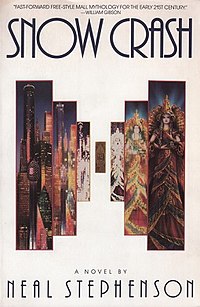
Snowcrash by Neal Stephenson – An Appreciation

Twenty years ago, Mary and I got our first real home computer (the Commodore 64 didn’t quite count).  With an Intel 486 processor, 500k of ram, an 8k external modem, and AOL memberships, we were wired!  Full-fleged members of the information age, at least by the standards of the day.

The same year, 1992, Neal Stephenson published a visionary novel called, Snowcrash. In retrospect, it merits the word, “prophetic,” for its sketch of life in the metaverse – a word Stephenson coined – and in the inconvenient world we call “reality.”

Consider:

In Snowcrash, Stepenson posits a world where nation states have transferred most of their power to corporations. Most people are corporate citizens and live in corporate enclaves, or less prestigious burbclaves.  The hero of Snowcrash, Hiro Protagonist, is a citizen of “Mr. Lee’s Greater Hong Kong.”  Military power belongs to private contractors, as do the roadways, which vie for driver/customers.  The post office is gone; private couriers deliver snail-mail.  The United States occupies a smallish territory centered in the Mohave Desert, and keeps it’s employees busy with make-work projects.  The former United States economy hinges on two industries – computer microcode and high speed pizza delivery, which has been revolutionized since the Mafia took control.

Though Hiro is a citizen of Hong Kong, as a pizza driver, he can’t afford to live in their enclaveclave.  Home is a self-storage unit under the flight path at LAX.  Like most of his hip and cyber-savvy generation, he spends most of his time online in the guise of his avatar, navigating virtual worlds.  But something is happening in the online world.  A strange new computer virus, when opened, generates a graphic pattern that scrambles the brains of the user.  They are dazed and speak in tongues.  With a young woman named YT, for Yours Truly, Hiro sets out to unravel the mystery.

The villain turns out to be a charismatic preacher.  In his attempt to secure both temporal and spiritual power, he has tapped into the ancient Sumerian glyphs that first scrambled human speech patterns in the event known as the Tower of Babel.

It’s been 20 years since I’ve read Snow Crash, so I’m writing this from memory.  I’m not necessarily recommending the whole novel.  The first jaw-dropping 100 pages, where Stephenson built his world, flew by and still leave me in awe.  I remember the rest of the book dragging in parts, but I still think of the story all the time.  Most futuristic fantasies prove as silly as the 1930’s movie shorts that show humans zipping along in their air cars between high rise buildings, happy and without any accidents.  This book is different.

In 1992 there were no virtual worlds.  Now there are, and you have to create an avatar to negotiate them.  These days, it isn’t so hard now to imagine a bright young man living in a self-storage shed.  But above all, Snow Crash comes to mind because in the wake of “citizens united,” it’s so easy to see corporate power growing while government power wanes.  With Super Pac money rolling the election year dice, does the government control corporations or do corporations control government?  Neal Stephenson saw this and other aspects of our world coming 20 years ago.

Snow Crash, is a visionary novel that all lovers of fantasy should know.

The Shape-Changer’s Wife by Sharon Shinn: A Book Review

I’ve enjoyed several young adult fantasies by Sharon Shinn and reviewed one of them here http://wp.me/pYql4-iQ.  Before she published her first YA book, Summers at Castle Auburn, in 2001, Shinn had a solid reputation as an adult fantasy writer.  I recently finished her first novel, The Shape-Changer’s Wife, which won the Locus award for Best First Fantasy Novel in 1995. Shinn was nominated for the John W. Campbell Award for Best New Writer that year.  On top of these honors – all well deserved – long time readers of this blog will know I am fascinated by stories of shape shifters (check out three posts I wrote on the theme in Feb., 2011).

At the start of The Shape-Changer’s Wife we meet Aubrey, a young man with a sunny disposition who is already on his way to becoming a skilled magician. His master sends him to study with Glyrenden, highly skilled in the art of shape-changing:

“Learn everything he teaches you so well you can cast his own spells back at him,” the old wizard had said. “Glyrenden respects only those stronger than he is, and those he hates. If you cannot beat him, he will destroy you.”

With the optimism of youth, Aubrey brushes the warning aside and sets out. Even when local villagers react to Aubrey’s request for directions with narrowed eyes and cold responses, his hunger to learn drives him on.

Shinn is masterful in building a sense of menace, which begins the moment Aubrey steps into the 3″ of dust that cake the entry way of the shape-changer’s house.  It builds when he meet the uncanny servants – Orion, covered with hair except for his eyes and nose, and Arachne, a woman who fights a loosing battle against the dust, while muttering curses and shooting everyone hostile glances.  Above all, Aubrey is fascinated by Lilith, the shape-changer’s wife, whose emerald eyes seem to see right through him, who is silent and self-contained, and doesn’t react to anything like any other woman he’s ever met.

Shinn’s presents magic as matter-of-fact.  Shape-changing sounds dramatic to Aubrey, so he is dismayed when Glyrenden hands him piles of books on anatomy and science and makes him practice hours of concentration exercises.  “How can you change into something you don’t understand in all of it’s details,” the shape-changer asks.  In Shinn’s books, magic is seldom dramatic.  More often, it forms an atmosphere like the felt danger offstage in a Hitchcock movie.

By the middle of the tale, Aubrey is hopelessly in love with Lilith, even as he perceives that “She seemed to be fashioned from the idea of a woman, and not to be a woman at all.”  This and other related perceptions lead him to pierce the secret of Glyrenden’s house – why the townspeople fear him, and why no bird or animal will come anywhere near the wizard’s dwelling.  Aubrey learns that the only way to undo Glyrenden’s “barbaric spells” is to kill him or become a better wizard, and even if he succeeds, the spells may prove too strong to break.

“I came to magic with joy.” Aubrey says.  “I thought it was a splendid thing to take the well of power that I found within me and shape it to marvelous uses…But magic, I have discovered…is not inherently good in itself.  And some of it – yes, some of it is inherently evil.  There are wicked spells, savage spells, enchantments that are so black that even to know them withers the heart just a little, taints the soul.  And yet to be a great magician, to be a sorcerer of any ability or renown, those spells must be learned as well.  For if a magician does not know them, they can be used against him.”

With measured pace, Shinn has brings us through her imagined world to one of our oldest stories, that of tasting the fruit of the Tree of Knowledge.  The Shape-Changer’s Wife is also a love story, but told with a kind of restraint that is rare in the fantasy genre.

You seldom see titles by Sharon Shinn on the shelves of Barnes&Noble, and never her YA titles.  At first glance, her books are not the stuff of blockbuster series and lucrative movie deals, though I can see them as moody, gothic dramas.

Shinn is a wizard in her own right.  Beyond the pleasure I’ve gained from six of her novels, I return to them often to study the masterful way she can weave character and atmosphere into stories I cannot forget.

Sharon Shinn