Three Requirements of a Book Review (?)

In a post entitled, “How Not to Write a Book Review,” Robert Pinsky, who has been writing reviews since typewriter days, discusses a famous and venomous book review a critic leveled at John Keats in 1818. http://www.slate.com/id/2299346/pagenum/all/#p2.  The review, by Irishman, John Wilson Croker, founder of modern political conservatism, became known as “the review that killed Keats.”  Croker really is nasty, but by himself,would not inspire me to write a blog post.

What I found noteworthy in the article are the basic principles Pinsky has used for decades to write his reviews.  In the 1970’s, when he wrote freelance for newspapers, one of them gave him a mimeographed style sheet with three rules  for every book review:

1. The review must tell what the book is about.
2. The review must tell what the book’s author says about that thing the book is about.
3. The review must tell what the reviewer thinks about what the book’s author says about that thing the book is about.

At first reading, the list seems to apply to non-fiction more than fiction.  Novelists don’t really say things about what their books are about except during interviews, but if we are less literal, do these criteria work?  As an experiment, let’s consider Harry Potter and the Sorcerer’s Stone, which I’m choosing because it’s pretty well known.

Criterion #1 is really the synopsis:  A lonely orphan discovers he is a wizard and finds allies as well as a deadly enemy at Hogwarts School of Witchcraft and Wizardry.  I like to set a story in context with (relatively) objective information.  For the first Potter, I might discuss characteristics of middle-grade fantasy – a magical world must be internally consistent, but does not require a detailed explanation:  some people are wizards and some are muggles, and that’s how it is.  This is common in middle grade, while adult fantasy needs more – a theory of mutant genes or something like that.  This first criterion, a summary of what the book is about, is essential for any review.

Criterion #2, is phrased in a strange manner.  An author writing a history of the Third Reich will have things to “say about that thing that the book is about,” but J.K. Rowling doesn’t.  For fiction, I interpret this as detailing what the author does to flesh out the plot and make it dynamic.  Rowling’s main characters, for instance, are so well drawn that they feel like people we’ve known.  You feel like you’ve met Hermione, Snape, and Hagrid, whether or not you have.  In addition, this is where I would speak of the richness of the world of Hogwarts, and maybe research a brief history of academies of magic in fiction and legend.

Criterion #3 is a tongue twister that boils down to my take on #1 and #2.  For Potter, I might talk about how it evokes the longing for connection; how sometimes we all feel like orphans longing for a virtual family  of kindred spirits like Ron, Harry, and Hermione.  How Hogwarts is an endless world our imaginations want to explore.  In other words, if I can find words for my deepest reactions, presumably – hopefully, others will know or echo what I am talking about.

I enjoy reading and writing book review as do a lot of bloggers I follow.  The exact phrasing of Pinsky’s rules seem a little too cutesy, but they got me thinking and I can come up with lots of ways to conceptualize the same thing. Here is one, off the top of my head:

1.  What is the story about?
2. How does the author make it uniquely their own?
3. Does it work for me?

Can you write an effective review with less than these basic criteria?  Are there others that will make it more effective?  Is it possible to do all of this and still wind up in left field?

Harry Potter Fan Fiction

Harry, Ron, and Hermione in The Sorcerer's Stone, 2001

Fan fiction did not begin with Harry Potter or the internet.  According to Lev Grossman’s article, “The Boy Who Lived Forever,” in the July 18, issue of Time, xeroxed fanzines appeared after the premier of “The Man from U.N.C.L.E.” in 1964, and really took off with “Star Trek.”

In the broader sense, telling original stories with borrowed settings and characters is nothing new at all.  Homer did not create the Trojan War, Achilles, or Odysseus.  Shakespeare did not make up either King Lear or Henry V.  But with the internet and Harry Potter, fan fiction has exploded.  There are more than 2 million pieces on fanfiction.net and more than a quarter of these are based on Potter – everything from short stories to full length novels.

The final movie will not be the end of original Potter creations

Grossman explodes most of the stereotypes of those who write and read these tales.  One 38 year old writer and actress says it’s like character improvisation.  A best selling fantasy writer whose novels have been optioned by Peter Jackson says, “Fanfic writing isn’t work, it’s joyful play.”  This raises the key question of why writer’s of fiction write.  Joyful play, a platform, and an appreciative audience are there – and it’s not like many creators of “original” stories get to leave their day-jobs.

Well known authors fall on both sides of the unanswered copyright issue.  J.K. Rowling and Stephanie Meyer encourage new fiction based on their characters and worlds.  Orson Scott Card, Anne Rice, and George R.R. Marin, author of A Game of Thrones do not, and threaten lawsuits.  It may or may not be coincidence that the authors Lev Grossman names as supporting fanfic are more recent and write for a younger audience than those who are in opposition and write for adults.  So far, all cease and desist requests have been honored, so there are no legal precedents in the world of fiction, though court cases involving music have been liberal in their interpretation of what constitutes “fair use.”

This begs the interesting question of who a character or world belongs to.  Groosman says that until recently:

Writers weren’t the originators of the stories they told; they were just the temporary curators of them.  Real creation was something the gods did…Today the way we think of creativity is dominated by Romantic notions of individual genius and originality and late-capitalist concepts of intellectual property, under which artists are businesspeople whose creations are commodities they have for sale.

Personally, I have always loved the poet’s invocation at the start of The Odyssey:  Sing in me, muse, and through me tell the story… 

In my experience, the “I” does not invent worlds or characters.  Whether you call it the muse, the gods, or the collective unconscious, fictional worlds and imaginal people come from somewhere else.  With a bit of luck and humility, the “I” may get to witness what happens, and may even get adept at finding new rabbit holes.  To me, the idea of “owning” a “product” of imagination smacks of hubris.

There is no real data on whether fanfic hurts an author economically.  Intuitively, I can only imagine it benefits Rowling and Meyer.  I hope so.  Creativity is creativity, regardless of what spark ignites it.  I’m thinking of dropping by some of the sites to see what these authors are up to.  For those who write for the joy of it, I wish them a lot more.

The Emerald Atlas by John Stephens: A Book Review

I have said before, I often read middle grade fantasy for the sheer fun of it, and I recently picked up The Emerald Atlas, published in April by John Stephens.   Stephens comes from the world of television production where he wrote for “The Gilmore Girls” and “The O.C..”  He also produced and sometimes directed and wrote for, “Gossip Girls.”  Most interestingly, he says what he really wanted to do all along was write novels, but when he finished grad school, “I was pretty bad at it.  I really kinda stunk.”  Stephens learned his craft in Hollywood:

“Writing for Hollywood turns out to be a great training ground. You learn how to work on a schedule, tell a satisfying story, build character, construct scenes, you develop a feel for dramatic momentum…and you get to tool around the Warner Bros lot on a golf cart, which is kind of awesome.” 

He says working for television was so much fun he forgot about writing until he read Phillip Pullman’s, The Golden Compass and realized that “all” he wanted to do was write fantasy novels for children.  (thought he still misses the golf carts).

The Emerald Atlas is the story of three very special children whose parents mysteriously vanish when they are young.  One night when she is four, Kate’s mother slips into her room and insists that she promise to care for her younger siblings, Michael, two, and Emma, one. The three children are hustled to a waiting car driven by an elderly man who barely eludes magical pursuers in a chase reminiscent of Harry Potter.  After ten year of ever more awful orphanages where they never seem to fit in, the children are sent to an apparent “last stop,” facility in Cambridge Falls, New York, run by the mysterious Dr. Pym.

Dr. Pym, it turns out, is the wizard who had taken the children for safekeeping ten years earlier, to keep them from the grasp of the beautiful but evil witch who calls herself, the Countess.  The forces of both good and evil are interested in Kate, Michael, and Emma for they each have a magical bond with one of the three Books of Beginning, where the great wizards of old in Alexandria encoded their lore when the worlds of magic and humans began to seperate.

Kate’s affinity lies with the first book, The Emerald Atlas, which enables one to travel in time and space.  When they stumble upon the volume in Dr. Pym’s basement, Kate, Michael, and Emma are whisked into the past before they understand the powers they have awakened.  They become separated and fall under the power of the Countess and her minions.

There’s a lot to like in The Emerald Atlas.  The characters are nicely fleshed out.  Fourteen-year-old Emma, clever, brave, with intuitive understanding of magic, suffers under the burden of keeping her brother and sister safe, as well as the other children of Cambridge Falls.  Twelve-year-old Michael, who sometimes drives his sisters nuts with his camera, notebook, and bent for scientific experiment, has the thrill of his life when he meets real dwarves, the people he admires more than any other.  Eleven-year-old Emma is the feisty one – part of the reason they’ve been shuffled from orphanage t0 orphanage is Emma’s habit of mouthing off to prospective adoptive parents.  The three are desperate to locate their real parents and and learn who they really are.  The value of loyalty and family runs like a constant thread through the book, even through Michael’s betrayal and forgiveness, which is reminiscent of Edmund in The Lion, the Witch and the Wardrobe.

Something else I liked in the story was the complexity of the time-travel plot.  Traveling into the past creates alternative pasts and futures and things can get very complicated, but there is no simplification or condescension for young readers.  Humor that will appeal to all ages pervades the story as well:  “How was [Emma] supposed to know how to defuse a mine?  No one had ever taught her that in school.  Her classes had always been about useless things, like math or geography.”

This is the sort of book, like the Narnia tales or Harry Potter, that will appeal to readers of all ages.  With the cinematic sense of its author, I won’t be the least bit surprised to see it made into a movie.  Stephens said, in his Amazon interview, that none of the studios have contacted him yet, but I suspect it is only a matter of time.  I will certainly buy a ticket, just as I expect to read and enjoy the next two books of the trilogy.

A Job From Hell by Jayde Scott: A Book Review

Several weeks ago, a young author from London, Jayde Scott, emailed and asked me to review her ebook, A Job From Hell.  She sent the link to her Smashwords page, which can serve as a model of how to present an ebook; the cover, description, and the montage of images and music in the trailer are very professional and lend a clear sense of what the book is about.  Have a look:  http://www.smashwords.com/books/view/56864

A Job From Hell is a paranormal romance featuring vampires, but what separates it from similar stories is the tongue in cheek tone set by the protagonist, seventeen-year-old, Amber, who takes a summer housekeeping job on a  remote estate in Scotland where the cab driver will not take her after dark – not a promising omen, but Amber needs the money for college.  Amber is a teenage Bridget Jones and a refreshing change from so many breathlessly serious YA heroines who are princess material and/or destined to save the world.

Amber stumbles all over herself when she meets her new boss, the hunky Aidan, who never appears by day, but before she can puzzle out what that means, she accidentally wins a competition for otherworld creatures, held only once every five-hundred years.  The prize, five hundred years of second sight and the ability to see the dead, is nothing she wants but also proves to be nothing she can give back, even when legions of other supernatural creatures take an unwanted interest in her.  It is shocking enough when Aidan, leader of the local vampire clan, informs Amber that she is destined to be his mate for eternity, and only gets worse when the Shadows, sworn enemies of vampires, spirit Amber away to their hidden lair and tell her she will have to stay there.

More than the various thrills and chills, it was the cast of characters who kept me turning the pages.  In addition to Amber, we have Kieran, who is Aidan’s snarky brother and drives his SUV like a maniac.  There is Angel, a lonely Shadow who wants to be Ambers BFF, and my favorite, the delightfully irreverent  Cassandra, who is Lucifer’s daughter and notorious for her hellishly bad fashion sense.

The one major character who didn’t quite fit the Buffy-like tone of the story was Aidan.  Although he was “turned” into a vampire at 18, he’s had five hundred years of living experience, and I found myself wanting a bit more reserve or wisdom from him, something to set him a little apart from “the gang.”  Even so, it was the gang that made A Job From Hell appealing, and now that I’m done, I find I miss them.  No fear on that score, however, as this is just the first title in Ms. Scott’s Ancient Legends, series.  A Smashwords reviewer says the next book is due out June 1, and at a cost of $0.99, you can hardly go wrong.

First Family by David Baldacci: A Book Review

Sometimes you luck out and find good reads just by browsing, and so it was with David Baldacci’s First Family, 2009, an action adventure novel featuring private detectives Sean King and Michelle Maxwell.  As ex-Secret Service agents, both know Washingon, and in this case, the first lady, who calls them when her 12 year old niece, Willa, is kidnapped.

At first, we know who the good guys and bad guys are, and the breakdown of that certainty as the story moves forward is the single most telling feature of this tale.  In fact, for me, Sam Quarry, the mastermind of the kidnapping plot is likely to be the most unforgettable character.  He is ruthless, even fanatical, in the pursuit of his brand of justice, but then we see him stop in a nursing home to read Jane Austin to his daughter who has been in a coma for 13 years.  As the story unfolds, we come to appreciate the ingenuity he brings to bear on his personal concepts of right and wrong.  Our gradual understanding of what drives him parallels the fall of our admiration for several other characters who at first appeared virtuous but are revealed as anything but.

This is Baldacci’s fourth novel featuring the team of Sean and Melissa.  If I’d started the series at the beginning I might know why they left the Secret Service under clouded circumstances.  They are a compelling team, and the plot is complicated when Melissa’s mother is murdered in a separate event that parallels the main action when it leads to the exposure of family secrets.

The rhythm of a book, its pacing, is something very mysterious.  James Patterson sets a hook or mini-crisis every four pages, which is the length of his chapters.  Other writers speed things up even more

Baldacci steps away from constant thrills and chills.  Yes, there is the obligatory shootout early on, but the author also keeps us reading as he details the minute preparations Sam Quarry has made on his land in rural Alabama.  The little shack he has planned and constructed by hand is lined with metal and surplus dental x-ray blankets.  Why?  The video camera mounted almost invisibly near the cabin has a hidden feed to a bunker up the hill.  Why?  Quarry spends hours in the basement of his falling-apart family home, with charts and notes, illustrating a web of connections he has spent years uncovering.  We know just enough to keep us reading.  Baldacci knows that mystery and nagging questions can keep us turning the pages as eagerly as drama and shoot-em-up action.

I cannot say much more without giving away the plot.  I can say this – I am definitely going to read the first of the Sean King and Michelle Maxwell mysteries, and if First Family is any indication, I have a whole new series to enjoy.

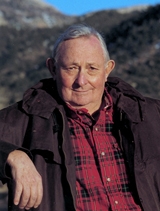
Tony Hillerman: An Appreciation

Tony Hillerman

Tony Hillerman

For many years during the nineties and the early part of the last decade, Tony Hillerman’s mysteries were a part of my annual celebration of spring.  In April or May his newest title would hit the bookstores – just in time for the beach or the pool at the gym.  “Beach read” is often synonymous with “guilty pleasure,” but I never feel guilty about enjoying good stories.

Hillerman is best known for the 18 mysteries set in northern Arizona and New Mexico and featuring Navajo tribal policemen Joe Leaphorn and Jim Chee, and later in the series, officer Bernadette Manuelito, who eventually marries Chee.  This series won Hillerman the 1974 Edgar Award, the 1991 Mystery Writers of America Grand Master Award, as well as the Navajo Tribe’s “Special Friend of the Dineh Award.”  Dineh is usually translated as “the People.”

The stories emphasize the Navajo ideal of living in harmony with the world and bring in themes from Navajo cosmology.  Many of Hillerman’s criminals are rumored to be witches – the worst thing you can become.  Leaphorn, the first detective in the series is skeptical, but…

Leaphorn didn’t believe in witchcraft.  He believed in evil, firmly believed in it, saw it practiced all around him in its various forms-greed, ambition, malice-and a variety of others.  But he didn’t believe in supernatural witches.  Or did he? (The Shape Shifter, 2006).

Chee, the younger officer, tries to walk in the worlds of both a modern policeman and a tribal shaman.  More than once, at the end of a case, Chee undergoes a traditional ritual to restore his balance and harmony.

Details of Navajo culture pervade all of Hillerman’s books and lend the restrained pacing of a people who think it rude to interrupt someone else who is talking.  In real time, the cops may have to drive a hundred miles to interview a suspect, but Hillerman keeps things moving by letting his detectives constantly mull over the compounding mysteries, and notice tiny details in the vein of Sherlock Holmes.

That said, the book I recently found, The Shape Shifter, the only one the Navajo mysteries I had not read read, is not where I would suggest a new reader start.  In places, it is a bit too slow, and it assumes we are familiar with the characters.

Skinwalkers (1990) would make a better first time Hillerman read.  This is the book where Leaphorn and Chee first team up, and the story is filled with supernatural menace.  Skinwalkers are especially nasty witches who change shape to harm others, like European werewolves.  Skinwalkers is one of three Hillerman titles featured on the PBS series, Mystery, with Wes Studi brilliantly cast as Leaphorn.

Skinwalkers movie

This is old-time detective fiction at its best, with the unique slant of a unique people, living in a remote and beautiful part of the country.  I only wish there were more of Hillerman’s books I hadn’t read.

Literary Comfort Food

In early March I was searching the shelves at a Barnes&Noble for a mystery for Mary’s birthday, when I spotted a treasure – one of Tony Hillerman’s Navajo Tribal Police mysteries neither of us had read.  The Shape Shifter (2006) is the last of the 18 titles in this series that won Hillerman (1925-2008) numerous awards both as a mystery writer and as a friend of Native Americans.  I will review The Shape Shifter when I finish, but starting it today reminded me of other stories that represent pure reading pleasure to me.  Books that carry me into another world.  Books that I read because I like to hang out with the characters, almost regardless of what they are doing.

I realized this morning as I sat down to coffee with Lieutenant Joe Leaphorn, and officers Jim Chee and his new wife, Bernadette Manuelito, that the greatest pleasures I’ve had in reading, bar none, are books in which I just want to be with the characters, almost regardless of whether they’re solving mysteries or buying groceries.  In addition to Hillerman’s tribal officers, other examples come to mind:

  • Frodo Baggins and friends.
  • Holmes and Watson.
  • Amelia Peabody and family in Elizabeth Peters’ Egyptian mysteries.
  • Rat and Mole and Toad in Wind in the Willows.
  • The sometimes annoying but always brilliant, Hercule Poirot.
  • Lirael and the disreputable dog in Garth Nix’s Abhorsen Trilogy.
  • Hamish Macbeth, the irrepressible Scottish detective in M.C. Beaton’s series.

I have also spent way too much money and time reading second rate fantasy series in the often vain hope of recapturing the Tolkien experience.

It’s important to realize that in stressing the importance of characters, I am not referring to the contemporary buzzword, “character driven.”  That has little or nothing to do with my list of comfort-food books, since with the possible exception of Wind in the Willows, these titles all belong in the “plot driven” category;  most mysteries begin, not with the detective’s quirks but with the discovery of a corpse, and problem of the Ring of Power was independent of Frodo.

As I said – these fictional people are friends, whether they are solving mysteries, dodging orcs, or sitting down to second breakfast.  This is a real clue for me, something to remember as I juggle plot elements.  Even though that is critical work, I find myself anxious to get back to the characters, both the heroine and the villain.  That, more than anything else, tells me I am heading in the right direction.

But now, before that or anything else, I have to get back to the The Shape Shifter, where storm clouds, both literal and metaphorical, are gathering over the reservation.

The Hunger Games by Suzanne Collins

What if there was a trend and I wasn’t paying attention?

I actually did notice The Hunger Games when it came out in 2008, but I did not read it then for two reasons.  First, though I love the genre, I am wary of reviews of fantasy literature, with words like “Breathtaking,” or “Original,” because I’ve been burned too many times.  In addition, when I read the synopsis, although The Hunger Games did sound original, but we had just had a round of serious layoffs at work, and I wasn’t in the mood for a story of hard times in the not-so-distant-future.

Last weekend, at the SCBWI conference, I heard repeated praise of The Hunger Games from sources I trust.  Later, one of the speakers cautioned the audience not to write a story just because it is trendy.  He cited a current mass of “dystopian fiction” as an example.

Looking again at reviews, and watching the the trailer of the movie that is “Coming Soon,” I realized The Hunger Games must have sparked the trend.  I downloaded the ebook and to my surprise and delight, could not put it down.  I devoured it this week.  It seems strange that in the fantasy genre, real originality is so rare, but this book has it.  It isn’t perfect.  I thought that at a key moment, Suzanne Collins held true greatness in her hand and let it slip away.  Still, The Hunger Games is one of the very best reads I recall in YA fantasy.

Katniss

I didn’t just read this book for pleasure.  It is one of a half-dozen new books I plan to read once for pleasure, and again with an eye to look under the hood and try to see how the author creates the magic.  Observation one – Suzanne Collins takes all the time she needs to introduce us to Katniss Everdeen, 16, and let us bond with her.  We rise with Katniss, learn that she loves her 12 year old sister Prim but despises her cat.  Very human stuff like that.  We learn that times are hard.  We learn that to get into the woods to hunt for squirrels to eat or trade on the black market, she has to pass through an electrified fence, which isn’t really that dangerous, because the power is seldom on.  We aren’t in Kansas anymore!  We meet Katniss’ best friend and hunting partner, Gale, who despises The Capitol, which runs things, and we learn he could be killed by the Peacekeepers if such talk is overheard.  We learn this is the day of “The Reaping” and that does not sound good.

Panem

Panem rose from the ruins of America.  Katniss’ District 12 used to be called Appalachia.  The Capitol is totalitarian, and attempts to flee result in death or slavery.  Earlier worlds of this sort, like 1984, reflected the cold war mentality, while Panem is firmly lodged in 21st century fears.  Large chunks of the coastline are gone.  There have been famines and other ecological disasters.  The Peacekeepers bring to mind Homeland Security, and the iffy electricity has an eerie resonance to what is happening right now in Japan.

But all that is nothing compared to the Hunger Games and what happens if you are selected as a “Tribute” at the “Reaping.”

As punishment and a warning to the 12 surviving Districts that unsuccessfully tried to revolt, the Capitol demands a boy and a girl between the ages of 12 and 18, to be chosen by lottery once a year.  The are trained and pitted against one another in a huge outdoor arena as gladiators.  One victor will be set up for life.  Twenty-three others will die for the amusement and “instruction” of the population, which is forced to watch – there is always enough electricity to televise the Hunger Games.

The Games

When her baby sister, Prim, is chosen, Katniss rushes forward to volunteer to take her place.  We had come to like her before, and now we love her.  Her chances do not seem very good.  Her fellow District 12 tribute, Peeta, is a baker’s boy, who doesn’t seem much of a warrior.  To make things worse, Peeta once saved her life with the gift of a loaf of bread, and both know they will eventually have to fight to the death to survive.

By now, of course, we are really into the story, and incredibly, as their training unfolds, we begin to think Katniss and Peeta may stand a chance.  As a strategy to deceive the others, they feign love for one another – except Peeta may not be pretending.  Katniss wins the affection of the crowds and the all-important sponsors.  The odds-makers give her good marks for her skill with a bow.  Their trainer, a past winner and a drunk goes on the wagon and dedicates himself to their survival.

Then the games begin and all hell breaks loose – literally.

Rue

Lets face it, we know Katniss will survive, but to her credit, Collins keeps up the nail-biting doubt.  The most poignant moment comes when Katniss teams up with Rue, a twelve year-old slip of a girl, who reminds Katniss of her sister.  They bond in a hurry, and Katniss briefly basks in the luxury of not feeling alone – never mind that they will have to fight each other later.  But after a daring raid on another team’s food supply, Rue is mortally wounded.  Katniss sings her a lullaby as she dies, for her greatest love had been music.  And then, as the greatest protest she dares, Katniss covers her friend’s body with wildflowers as the hidden camera’s broadcast the image all through the land.  Gladiators are not supposed to care for each other – it is the closest thing to open defiance Katniss can imagine.

At this moment, The Hunger Games transcends genre and reaches the level of tragedy – that which is grave and constant in human affairs.  In particular, it reminded me of that heartrending day, Dec. 25, 1914, that we now call the Christmas Truce.  Two armies of young men defied the old men who sent them to kill each other, by celebrating the birth of Christ with friendship.  The generals promised a firing squad to any who tried it again.

How It Ends

Things tapered off from there, perhaps inevitably so, for how could such a moment be sustained?  Still, the genetically mutated zombie-werewolves who end the contest were over the top – they seemed like an add-on, a patch to ramp up adrenalin by borrowing from the horror genre.  For me, it had the opposite effect.

The book also ends with romantic teasers.  Katniss went out of her way to save the badly injured Peeta, but until now, she had been a hard-luck tomboy, fond of him and grateful, but not in love.  Her last moment inner conflict does not seem to grow “organically” from her earlier thoughts about her friendship with two young men – maybe I am too cynical, but I took it as a carrot to get the masses of Twilight readers to buy the next book of the trilogy.  Club Peeta or Club Gale?

Still, I plan to read and enjoy the final two books of the trilogy.  Even if the series comes off as an “ordinary” romance and battle of good guys against an evil empire, if that’s the worst thing we can say of The Hunger Games, it is still in very good company.  Suzanne Collins has given us a vividly imagined and wonderfully crafted story.