The Devil’s Sooty Brothers

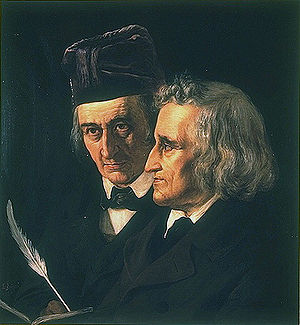
Wilhelm and Jacob Grimm, 1855. Painting by Elisabeth Jerichau-Baumann

Wilhelm and Jacob Grimm, 1855. Painting by Elisabeth Jerichau-Baumann

“People think stories are shaped by people. In fact, it’s the other way round.” – Terry Pratchett

“The Devil’s Sooty Brother” is the catchiest name among a group of tales from the Brothers Grimm about career soldiers who are discharged when they are wounded, or peace breaks out, or for no given reason. They find themselves on the road, with a loaf of bread and a few coins if they’re lucky, and no clear path to making their way in the world.

Most of the best known Grimm tales feature young people – a lad or a maiden, just starting out in the world. In contrast, we imagine these soldiers as middle aged career men, whose services are no longer needed. I thought of these stories when I heard that Oreo, “America’s favorite cookie,” will now be produced in Mexico, where Nabisco expects to save $130 million a year. Six hundred people join the hundreds of thousands before them whose working lives have been disrupted by technical, financial, and social changes that continue to accelerate in speed.

Do the old stories have anything practical to say to 21st century people when the world turns upside down?  Maybe…

These stories have elements in common:

  1. The protagonists are combat veterans. They’ve been around the block.
  2. They take up with shady, trickster-like characters, who take them underground, into the darkness, or other trials.
  3. They either are, or must learn to be, trickier than their tricky benefactors. In modern terms, they need to think outside the box, and there, if anywhere, is the relevance for us now. Circumstances may change, but the value of seeing the world afresh, free from habit and preconception, is probably even more vital now than in the “simpler” times when these tales emerged.

I will consider two of the tales of discharged soldiers that depend on wit. I’ll skip several others that hinge more on religious piety and luck. Piety and luck may pay off in real life, but they aren’t satisfying story elements.

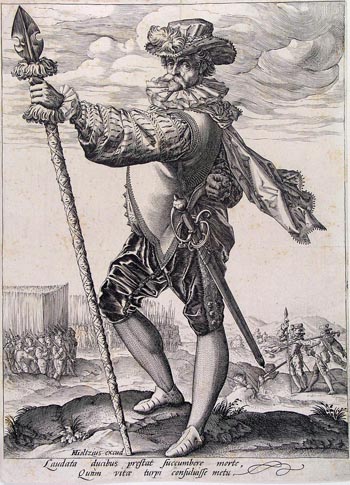
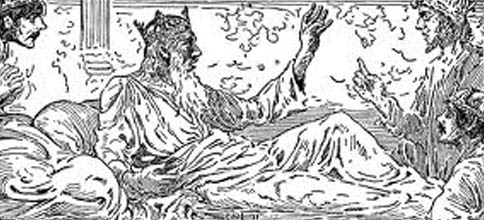
German mercenary pikeman. Wikimedia Commons

German mercenary pikeman. Wikimedia Commons

In our title story, The Devil’s Sooty Brother, (Grimm Tale #100), Hans, a hungry and penniless out of work soldier, meets the Devil in the woods. This Devil is a dark trickster and initiator rather than a personification of evil. If the soldier agrees to the terms of a seven-year contract, he’ll be set for life.  If he violates the terms, he will die, and presumably, be stuck in hell. Continue reading

Where did this come from?

notebook

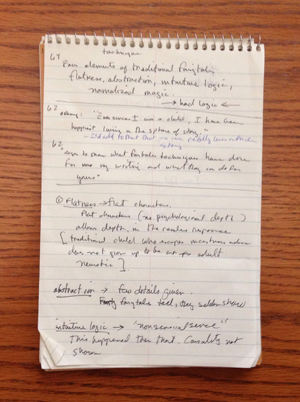
A few days ago, looking for a piece of scratch paper, I picked up a 5″ x 8″ spiral notebook from a desk in the back room. I flipped it open to some curious notes on fairytales – and I cannot remember where they came from. Not from any book I possess, nor from any lecture I remember. Did they come from a blog post? And if so, why did I take the time to jot down two pages of notes without bookmarking the post?

The words were those of a writer who said, “I am eager to show what fairytale techniques have done for my writing and what they can do for yours.”  This is curious, because most of what followed – the “four elements of traditional fairytales” that he or she discussed violate the usual advice given in writing books and seminars.  Here the four elements as I recorded them.

1) Flatness – flat characters (no psychological depth), which allows depth in the reader’s response. Eg., the child who escapes monsters does not grow up to be a neurotic adult. Also, few fairytale characters are named.

2) Abstract –  Few details given. Fairytales tell, they seldom show.

3) Intuitive logic –  “nonsensical sense”  This happened then that. Causality not shown. Events may not be connected except by narrative proximity. But inside that disconnect resides a story that enters and haunts you deeply. Details of fairytales exist apart from “plot” and are a “violation of the rule that things must make sense.” Dreamlike.

4) Normalized magic:  breaks the notion that the more realistic a story element, the more valuable.

All four of these points are accurate statements of fairytale characteristics. The idea that they hook the listener’s imagination to “fill in the blanks” may help explain why fairytales make far better oral narratives than literary fiction.

At the same time, I can’t think of any published fiction that follows such a structure, least of all modern fairytale retellings. For one thing, since the 19th century, psychologizing has been a favorite pastime for almost all lovers of folklore.

The unknown author of these notes made a few more statements I wrote down:

“Every since I was a child, I have been happiest living in the sphere of story.”  ( me too!!!)

“Trickery is the instinct to know when something is wrong.”

“I will end by saying that story is what makes us human.”

Whoever the unknown author is, you have my thanks (a second time) for your most stimulating thoughts on a genre I love!

Thoughts on Maleficent and retelling folktales

maleficent

Maleficent opens in a world of beauty, threatened by a greedy human king. The visual contrast between human actors and fantasy animation was great enough to take a few minutes for suspension of disbelief to kick in. After that, I was in for the ride, through an ambitiously re-crafted tale of the Disney arch villainess who gave kids of my generation nightmares in Sleeping Beauty (1959). As the poster implies, this movie belongs to Angelina Jolie, whose performance is gripping.

The Sleeping Beauty themes of love and betrayal remain but they manifest very differently in the two Disney versions of the story. Men betray and women love; implicit in Disney’s previous blockbuster, Frozen, the theme is explicit in Maleficent. For now at least, it’s Disney’s key to box office success.

Retelling fairytales with a modern twist is nothing new. Fantasy authors like Nancy Kress, Jane Yolen, Steven Brust, and Roger Zelazny, to say nothing of Neil Gaiman and George R.R. Martin have been doing this for decades. I’m currently reading a 1994 collection of short retold fairytales, Black Thorn, White Rose, edited by fantasy writers, Ellen Datlow and Terry Windling. There are two different versions of Sleeping Beauty. In both, it is the prince who needs to be rescued.

I take this as an inevitable pendulum swing from earlier Disney movies where princesses mostly sat around singing, “Someday my prince will come.” We have to remember that no Disney movie, then or now, is “real” folklore, nor is any work fantasy fiction. By “real” folklore, I mean stories shaped by the collective imagination of generations of members of a culture, region, or tribe. Strictly speaking, any talk of folktales now must be in the past tense. Nowadays the events that might spawn new fairytales, over a generation or two, become headlines or tweets, “details at 6:00,” to be forgotten in a day or an hour.

Among other things, the old fairytales were full of hints on wise living for those who knew how to listen. Here is one simple list of some of the lessons they taught:

  • Sorrow is real, and so is joy
  • Joy is freely available to all, just as sorrow comes freely to all, whether rich or poor, and without regard to changes in material fortune
  • The world is fraught with danger, including life-threatening danger, but by being clever (always), honest (as a rule, but with common-sense exceptions), courteous (especially to the elderly, no matter their apparent social station), and kind (to anyone who has obvious need), even a child can succeed where those who seem more qualified have failed.

Much as I love them, I don’t find that fantasy movies and novels teach lessons like these in a visceral or unforgettable manner, which leaves us sadly impoverished. Dragons have not gone away – any glance at the headlines makes that clear. What is gone is the wisdom to know how to deal with them.

Another note on tricksters

Groucho

I want to argue a paradox…that the origins, liveliness, and durability of cultures require that there be space for figures whose function is to uncover and disrupt the very things that cultures are based on. – Lewis Hyde

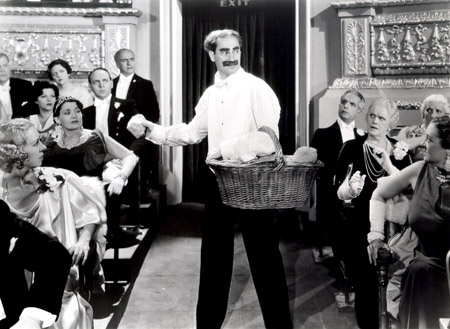
It has always made sense to me that the 1920s, 30s and 40s, when times were hard for so many, gave birth to our great movie tricksters: Charlie Chaplin, Laurel and Hardy, The Marx Brothers, and The Three Stooges. Their send ups of the 1%, among other things, are still hilarious. Where are their equivalents today?

My self-imposed moratorium on negative blog themes has passed. As I caught up on news I had kept at arms length, I found myself thinking often of trickster stories. In part because they are funny, and most of the news is not. And partly because the folly of tricksters has a sacred dimension while the folly of our headline makers is often just foolish.  If you invite the Three Stooges to lunch and serve pie, the outcome is fairly certain. I read that the Georgia legislature voted to allow patrons to carry guns into bars; the result is likely to be just as predictable, but without the catharsis of laughter.

stooges pies

In his introduction to Trickster Makes This World (1998), Lewis Hyde emphasized several key points:

1) Tricksters both make and violate boundaries and live in relationship to them. Where there are no boundaries, trickster creates them, as in several Native American creation myths where Coyote makes the land and separates it from the sea. Where there are cultural boundaries, tricksters blur or invert the distinctions: right and wrong, friend or foe, male or female, living or dead.

2) Tricksters are usually on the road, and this makes them outsiders.
Through most of human history, solitary travelers have been rare. Until the last century, most people lived and died close to the area where they were born. Nomadic people travelled as tribes or clans, but Hyde says trickster is “the spirit of the doorway leading out, and of the crossroad at the edge of town. He is the spirit of the road of dusk,” who may pass through city and town but only to “enliven it with his mischief.”

charlie chaplin and dog

Hyde points out that although there is an abundance of clever women who know how to be deceptive in world mythology, they are seldom full-time tricksters. Once the evil is vanquished, the curse lifted, they tend to settle down. Coyote and Loki do not domesticate, and the older cultures who gave us these stories would have had trouble imagining a woman who opted for a solo life on the road.

3) Tricksters are liars and thieves, but they are not petty criminals.
Tricksters steal things like fire and cattle, and according to Hyde, are often honored as creators of civilization. “They are imagined not only to have stolen certain essential goods from heaven and given them to the race but to have gone on and helped shape this world so as to make it a hospitable place for human life.”

We cannot be too doctrinaire about these things, for there is a distinction between “large” stories, like creation myths, and “small” folktales, where trickster sometimes steals cattle for himself. When he does so, however, in tales like “The Little Peasant” from Grimm, it is usually a case of swindling a swindler, or people who are dishonest and greedy to start with.

For obvious reasons, trickster isn’t welcome in corporate boardrooms. Like Robin Hood, he is into redistribution of wealth. He’s the patron of whistle blowers everywhere, and will gladly gum up the machine when it is no longer serving the greater good.

Perhaps that is why we need him now more than ever. We don’t even have to do anything. Hermes travels as fast as thought. For good and for ill, trickster is already here.

Chaplin modern times

The wishing tree revisited

I spent a lot of time this week staring at a blank screen while trying to sum up two recent posts (No discouraging words 1 and 2). The ways in which thought/stories create reality is a massive topic. Not only has it been central to eastern thought for thousands of years, but I wrote several chapters along those lines in a master’s thesis in psych. So that particular screen is going to stay blank.

I did, however re-read one of my early posts where I discussed an Indian story that centers on the creative power of mind. The story itself provides a nice summary. “The Wish Fulfilling Tree” is recorded in Hindu scripture as a story Shiva told Parvati. I quoted a version written by Paramahansa Yogananda which I like for its clarity:

Embed from Getty Images

In their kindness toward spiritual seekers, the gods placed certain “wish fulfilling trees” in remote Himalayan regions so pilgrims could refresh themselves. Once a young man with mixed aspirations climbed to the heights in search of one of these trees. At last, out of food and seemingly out of luck, he spied a solitary tree at the center of a small valley, and hurried toward it.

Under it’s branches he wished for a meal, and instantly, servants appeared and set out a feast before him. After his hunger was satisfied, he wished for wine and music, and then dancing girls, and all of his thoughts materialized. Enjoying himself immensely, he wished for a castle, with fruit trees, fountains, and soldiers to defend it.

By then he was tired and sought out the lush master bedroom for a rest. As he closed his eyes, he noticed a jungle not far away and felt a prickling of danger. “There are no bars on the window to keep jungle beasts out. A tiger could easily leap into this room.” Sadly, that was the last thought he ever had.

In his commentary, Yogananda said everyone spends their life beneath a wish fulfilling tree. Fortunately, ours don’t work as fast as the one in the story, but in the end, inexorably, they manifest what we hold steady in our minds. The name of this tree is imagination, and it is important to realize its power and be mindful of how we use it. it.

‘On the Supposed Unsuitability of Fairytales for Children” Guest Post by J. Aleksandr Wootton

This is, in essence, a double reblog, in which you will meet two interesting writers in the field of folklore. The first is Benton Dickieson of Prince Edward Island, Canada, who blogs at A Pilgrim in Narnia. The second is the author he presents, J. Aleksandr Wootton, self described “Author, Folklorist, Poet, Book-Worm, Faerie Historian, Cultural Critic, and Virginian.”

Writing on the “Supposed Unsuitability of Fairtales for Children,” Wootton has much to say including a fine summary of a subject I’ve circled about on several occasions, attributes of successful fairytale heroes and heroines:

“The world is fraught with danger, including life-threatening danger, but by being clever (always), honest (as a rule, but with common-sense exceptions), courteous (especially to the elderly, no matter their apparent social station), and kind (to anyone who has obvious need), even a child can succeed where those who seem more qualified have failed.”

Enjoy the websites of both of these folklore enthusiasts.

Brenton Dickieson's avatarA Pilgrim in Narnia

J. Aleksandr Wootton chairs the fictional Folklore Studies department at Lightfoot College, where his research focuses on post-war Faerie. He has authored Her Unwelcome Inheritance, an account of fairy refugees on earth, and has recently published a poetry collection titled Forgetting: Impressions from the Millennial Borderland

For more on his writing, or to contact him, visit www.jackwootton.com.

“On the Supposed Unsuitability of Fairytales for Children”

J. Aleksandr Wootton

Shortly after supporting a local library event promoting fairytale literature, the folklore department at Lightfoot College received an animated communication from a very concerned mother regarding, in short, the “unsuitability of fairytales for children.”As this seems to be a rather widespread idea (I might mention the Daily Telegraph article of February 12, 2012) as well as an oddly long-lived one, I take the liberty of public response.Dear Madame,

Though you may be unaware of it, your email represents sentiments that have…

View original post 1,656 more words

Final notes on the Grail and the Wasteland

An ailing king lives at the heart of the Wasteland. We often find this figure in fairy tales, such as “The Water of Life,” where efforts to heal him launch the story.  Jungians interpret the king as the “dominant ruling attitude” of a culture or individual, which grows atrophied unless it is periodically renewed.

water of life king

In seeking a simple description of our own collective attitude, I thought of an often misquoted phrase spoken by President Calvin Coolidge in 1925: “The chief business of the American people is business.”  This attitude swept the world in the years since then and sheds much light on our current Wasteland with an ecosystem in crisis.  Sadly, few people know what else Coolidge said in that speech:  

“Of course, the accumulation of wealth cannot be justified as the chief end of existence…So long as wealth is made the means and not the end, we need not greatly fear it…But it calls for additional effort to avoid even the appearance of the evil of selfishness. In every worthy profession, of course, there will always be a minority who will appeal to the baser instinct. There always have been, probably always will be, some who will feel that their own temporary interest may be furthered by betraying the interest of others.” (1)

***

In the earliest versions of the legend, the king is healed when the hero asks this question:  “Who does the Grail serve?”  In these tellings, the Grail is a stone or a large platter that nourishes each person according to their heart’s desire.  This suggests a cornucopia, a potential earthly and spiritual abundance.  There have always been cycles of growth and cycles of famine, cultural florescence and decay.  In the legend, that question, “Who does the Grail serve?” appears to lie near the heart of these cycles.  Somehow we intuit that what Campbell termed “Greed for more  than one’s share” on a large scale is a formula for disaster.

***

In my two previous posts, I mentioned hearing many accounts of people seeking new ways of doing most everything.  I’ve collected so many stories it took several days figure out how to present them.  Simplicity won out in the end; here is one brief account, with more to follow in the future.

I’ve listened to Jill Stein on several occasions, most recently on BillMoyers.com in November, 2013.  Stein, a Harvard Medical School graduate, “became so outraged by how politics adversely affected her patients” that she ran as the Green Party candidate for president in 2012.

Naturally, she was not allowed to participate in the presidential “debates,” which don’t really deserve the name, but in 2012 she and Green vice-presidential candidate, Cheri Honkala, were arrested for simply trying to enter the debate hall.  “We were arrested, taken to a secret detention facility, and handcuffed to metal chairs for eight or nine hours until the debate was long over.”  

Jill Stein, 2012 Green Party candidate for president

Jill Stein, 2012 Green Party candidate for president

You’d expect her to be discouraged after this blatant violation of civil liberties, as well as a host of other abuses she cited during the interview, but she was not, saying instead that,

“America is ready to move. And when we start moving together…all we have to do is realize how numerous, strong and inspired we are. And then we are unstoppable. You know, in the words of Alice Walker, the biggest way people give up power is by not knowing we have it to start with. It’s by flicking that switch and rejecting the disempowerment that’s beaten into us every waking moment by every media source that surrounds us.”

I encourage everyone to watch the interview or read the transcript.  There much that was frightening but even more that was hopeful in this discussion of our current situation.  As time goes on, I’ll feature other optimistic stories I have collected, featuring “ordinary” people searching for those Grails that can transform and renew the world and the lives we are living.

More notes from the Wasteland

Joseph Campbell considered the Wasteland and the quest for the Grail that heals it to be a core myth for our time.  During “The Power of Myth” series at the end of his life,  Campbell said the Wasteland results from a worldview that divides matter and spirit.  Referring to the Fisher King’s wound he said:

“the Christian separation of matter and spirit…has really castrated nature. And the European mind, the European life, has been, as it were, emasculated by this separation. The true spirituality, which would have come from the union of matter and spirit, has been killed.” (1)

Generations of western thinkers, culminating in Descartes, built upon the split Campbell cites to elaborate a mechanistic view of nature that made the world ripe for human exploitation.  Results of this world view are visible everywhere, both in the headlines and in the landscape around us.  This part of California, for instance, still bears the scars of hydraulic mining 150 years after the gold rush.
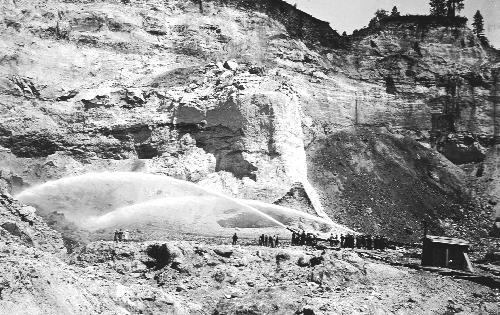
Hydraulic mining along the Yuba river.  Malakofdigginsstatepark.org

Hydraulic mining along the Yuba river. Malakofdigginsstatepark.org

Deliberate exploitation isn’t always the culprit.  We think of Native Americans as attuned with nature, but even they made mistakes.  From AD 900-1150, such a large concentration of Pueblo people lived in Chaco Canyon, NM that they cut an estimated million trees from the surrounding Colorado Plateau.  The resulting erosion, loss of game habitat, and flooding is thought to be one reason why they abandoned the site.  The surrounding landscape, once forest, has been desert ever since.
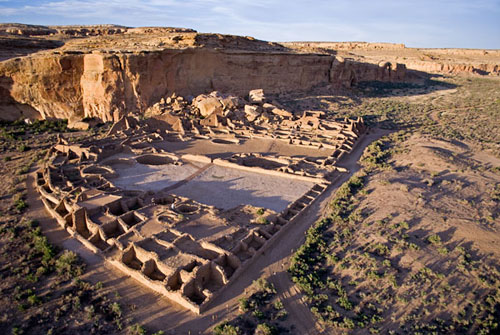
Pueblo Bonito ruins, Chaco Canyon.  Photo courtesy of Scott Haefner, scotthaefner.com

Pueblo Bonito ruins, Chaco Canyon. Photo courtesy of Scott Haefner, scotthaefner.com

Now that humans have the power to disrupt the environment on a global scale, the question of whether the harm is deliberate or inadvertent may be moot, but serious differences still lie at the heart of competing world views.  Campbell touched on this issue in Creative Mythology, the last book of The Masks of God, a four volume study of world mythology that he wrote between 1962 and 1968.  In this series, he ascribed four functions to myth (2)

  1. The Metaphysical Function: Awakening a sense of awe before the mystery of being
  2. The Cosmological Function: Explaining the shape of the universe
  3. The Sociological Function: Validate and support the existing social order
  4. The Pedagogical Function: Guide the individual through the stages of life

The Grail story resonates on all of these levels, but since I want to consider the Wasteland myth in light of our current environmental crisis, the third and fourth functions have the greatest relevance here.

Campbell points out that humans are born too soon, “absolutely helpless,” and unlike most other animals, learn how to survive from a social group.  Our earliest myths derive from the hunter/gatherer era, “hardly greater than large families, of which every adult member was in possession of the entire cultural heritage.”  

These earliest myths “served a fostering, educative function, bearing the unfinished nature product to full, harmonious unfoldment as an adult specifically adapted for survival in a certain specific environment, as a fully participating member of a specific social group; and apart from that group he would neither have come to maturity nor have been able to survive.”  There was room for diversity, but no one who threatened the group was tolerated.

The next strata of myth emerged when humans settled into agricultural communities, beginning around 7500 B.C..  Villages grew into towns and then into cities and “it was precisely at this point of space and time, in the Near East, and specifically Sumer, c. 3500-3000 B.C., that the evidence first appears among the ruins…first, of a disciplined social order imposed from above by force, and next, of deliberate expeditions of military conquest against neighbors…campaigns of systematic conquest and subjugation.”  The principle here, said Campbell, was “greed for more than one’s share.”

Imposed social orders are not inherently bad, says Campbell.  Despite romantic fantasies of the noble savage, few people really want to live in caves or give up such boons as advanced medicine, arts, spirituality, and transportation, to say nothing of indoor plumbing.  Like conventions in writing, music, or painting, cultural conventions may spark creativity when they are new and later stifle it as they atrophy.

“The Waste Land, let us say then, is any world in which…force and not love, indoctrination not education, authority not experience, prevail in the ordering of lives, and where the myths and rites enforced and received are consequently unrelated to the actual inward realizations, needs, and potentialities of those upon whom they are impressed.”

This was the situation when the European Grail myth emerged; the first written version was composed in the 12th century by Cretien de Troyes at the very time the inquisition began.  The Grail legend served as a counterpoint to the institutional church; the tale can be read as the map of a quest for personal realization, safely couched in a story of ladies and knights.  In the earliest versions, the Grail was not the cup of the last supper but a stone or a large stone dish, which like the philosopher’s stone of alchemy, granted the heart’s deepest desire.

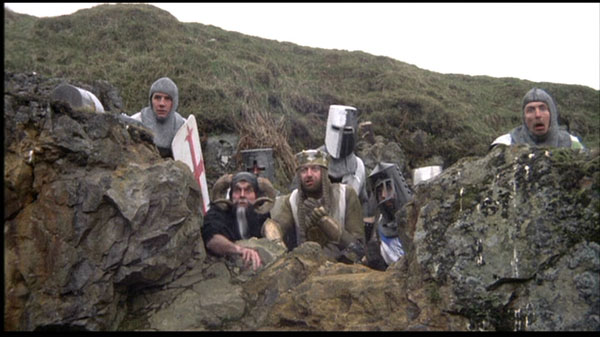
Even at our remove from the middle ages when the stories emerged, the Grail remains one of our living myths, at least if you pay attention to popular fiction and movies.  Think of The Da Vinci Code, Indiana Jones and the Last Crusade, and even Monty Python and the Holy Grail.
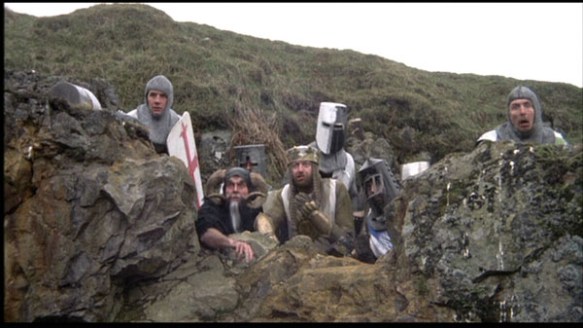
Pythons on the quest: at the lair of the Killer Bunny

Pythons on the quest: at the lair of the Killer Bunny

As much as the population of the middle ages, we are, in the words of 19th century poet, Matthew Arnold, “Wandering between two worlds, one dead, the other powerless to be born.”  The Grail continues to speak to such eras, especially one in which the Wasteland is not just the metaphor of an inner desert, but a world in which that desert is visible around us.

The Grail remains a shining image, never quite clear, but unforgettable, of the kind of life and world we seek among the confusion of possible futures.  At the end of “The Power of Myth” series, Bill Moyers asked Joseph Campbell what the myth of the future might be.

“You can’t predict a myth anymore than you can predict what you’re going to dream tonight,” Campbell replied (3).  “Dreams and myths come from the same place.”  Then he went on to say, “The only myth that’s going to be worth thinking about in the immediate future is going to be one that is talking about the entire planet.”

Earth from space

“You don’t see any divisions there of nations or states. This may be the symbol of the mythology to come. That’s going to be the country we are celebrating.” – Joseph Campbell, 1987″

Next:  Some people who are already question for the Grail.