A kinder, gentler, Jurassic World

psittacosaurus, at the Prehistoric Gardens, Port Orford, Oregon

psittacosaurus, at the Prehistoric Gardens, Port Orford, Oregon

Dinosaurs continue to fascinate. My first ambition in life, after a trip to the New York Museum of Natural History, was to become a paleontologist. Eventually, my life goals changed, and the T-Rex envy faded.

calvin-hobbes-dinosaur-005

Yet decades before Jurassic Park was a gleam in some screenwriter’s eye, Ernie Nelson, of Eugene, Oregon, did not outgrow his fascination with dinosaurs. He made them his life’s work in a most unusual way.

In 1953, Nelson gathered his family and left Eugene, where he worked as a CPA and owned a Mill supply company, to relocate to a valley near Port Orford, where rainfall averaged seven feet per year – he needed a rain forest.

In 1955, he opened the Prehistoric Gardens, and over 30 years, built 23 full size and anatomically correct dinosaurs. This unique roadside attraction is still in the family. Ernie’s granddaughter welcomed Mary and me in August, after we’d driven down from Bandon to see the dinos.

Not what you expect to see when you round the bend on the coast highway, but then, to paraphrase Monty Python, no one EVER expects a Tyrannosaurus!

Not what you expect to see when you round the bend on the coast highway, but then, to paraphrase Monty Python, no one EVER expects a Tyrannosaurus!

Nelson’s process was painstaking. His research was constant and thorough, and included a  trip back east to visit the Smithsonian. Each dinosaur began with a steel frame, which was then covered with a metal lath. A layer of concrete followed, and then another layer to define the visual features.  The Brachiosaurus, 86′ long snd 46′ high, took four years to complete and was his pride and joy.

Ernie working on the peterandon

Ernie working on the peterandon

The Prehistoric Garden’s website says the 23 sculptures were painted according to available scientific research. We normally don’t think of dinosaurs as colorful, though plenty of lizards, chameleons, and snakes in our world are.

I’m willing to trust Ernie on his color choices, but what I liked best was the aspect where I think imagination overrode research. Some of these critters are just so darn cute in, a wide-eyed sort of way.  I don’t want make Ernie turn over in his grave by calling his critters “cute,” but there’s just no other word for this triceratops, which has the same expression as one of my dogs!

triceratops small_edited-1

Some of us can remember the days of wacky roadside attractions on Route 66 or Hwy. 99 – giant oranges, strange animals, and gas stations designed to look like flying saucers.  There were animal parks, fairytale towns, and north pole villages in the days when Ernie Nelson moved his family to southern Oregon to shape his dream in concrete and steel.

The ichthyosaurus is suffering from the drought this year just like we are.

The ichthyosaurus is suffering from the drought this year just like we are.

Nowadays the most frequent sights, as we blow past towns on the interstate, are fast food joints and the same old big-box stores. Santa’s Village has long been shuttered, and the kids have video games and DVD’s to mitigate the boring view out the windows.

Like the dinosaurs, the Prehistoric Gardens speaks of a different era, one in which peace had come, America was unrivaled, and more people than ever before had jobs, cars, money, cheap gas, kids, health care, and paid vacations.

All those attributes can ebb and flow, but there is one precious thing we can always borrow from Ernie Nelson – the example of what an individual can do when he rolls up his sleeves, opens his mind and heart, and lets his creativity flow.

The medium is…

Republican debate

“The medium is the message”, said Marshall McLuhan in Understanding Media, 1964. Fifty-one years later, I’m still not certain we understand media, but a light bulb went on for me Thursday night regarding McLuhan’s iconic phrase. While watching the Republican presidential debate, I had a minor epiphany; that television cannot help transforming politics into entertainment.  

I am not suggesting that either party has a monopoly on show business.  Yes, the Republicans are likely to be funnier this year, with their Jerry Springer moments, and The Donald, who’s public persona is a weird combination of Rodney Dangerfield and Don Rickles.  I expect the Democrats to be far less interesting, more like infomercials on the home shopping channel.

There’s nothing new about politics as entertainment. If we believe television and movie depictions of pre-television and movie campaigns, there was plenty of bunting, and bluster, and brass bands in “the good old days.” But every now and then, wouldn’t it be refreshing to see something real happen on political TV?

The last time I saw reality break through was during the 2004 Democratic convention in Boston.  The Democrats had barred one of my heroes, the late Senator Robert Byrd, from the podium. Byrd could not be trusted to stay on script. Massachusetts Senator Kennedy invited Byrd to speak at the Old North Church, where Paul Revere worshipped, and his address was broadcast on Democracy Now. Byrd held up his well-worn pocket copy of the US Constitution and warned us that it was under attack…

Politics, of course, is not the only thing that TV flattens out. I recall several surreal moments with TV news. One early evening in college days, when I was living in an off-campus house, my roomies and I were watching a shoot out on Mod Squad on an old black and white TV. I went to the kitchen to fix a sandwich, and when I returned, the shootout had grown more intense; the house where the bad guys were hiding was on fire. But it looked different.  “Did somebody change the channel?” I asked.

“Nah, man,” said a house mate. “The news cut in. The cops are having a shootout with those guys who kidnapped Patty Hearst.” The visceral difference between watching a fictional versus a non-fiction firefight on TV was nonexistent without the dialog or voice over!

In a very real sense, that’s simply the nature of things according to both western depth psychology and Buddhist psychology. Every experience we have, noted James Hillman, begins as an event in the psyche. And Buddhist thinkers will tell you that our so-called realities are far more like the dreams we have at night than most of us dare to believe. Yet, as a practical matter, in order to make the right decisions, we have to be able to tell them apart, and that means turning a critical eye on the stuff we see on television.

I have recommended it before, but as we begin another presidential election mini-series, I can think of no better guidebook than Neal Gabler’s Life the Movie: How Entertainment Conquered Reality, 2000.  In it, he says:

“the deliberate application of the techniques of theater to politics, religion, education, literature, commerce, warfare, crime, everything, has converted them into branches of show business, where the overriding objective is getting and satisfying an audience.”

Unless we choose to live with the wolves, we’re going to be part of that audience, but at least we can remember that wonderful Buddhist bumper sticker:  “You don’t have to believe everything you think.”

Where did this come from?

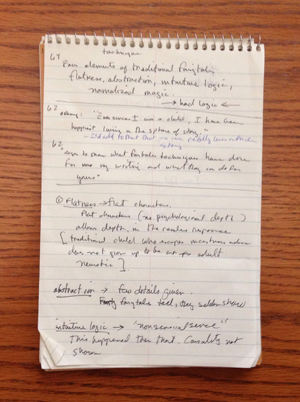
notebook

A few days ago, looking for a piece of scratch paper, I picked up a 5″ x 8″ spiral notebook from a desk in the back room. I flipped it open to some curious notes on fairytales – and I cannot remember where they came from. Not from any book I possess, nor from any lecture I remember. Did they come from a blog post? And if so, why did I take the time to jot down two pages of notes without bookmarking the post?

The words were those of a writer who said, “I am eager to show what fairytale techniques have done for my writing and what they can do for yours.”  This is curious, because most of what followed – the “four elements of traditional fairytales” that he or she discussed violate the usual advice given in writing books and seminars.  Here the four elements as I recorded them.

1) Flatness – flat characters (no psychological depth), which allows depth in the reader’s response. Eg., the child who escapes monsters does not grow up to be a neurotic adult. Also, few fairytale characters are named.

2) Abstract –  Few details given. Fairytales tell, they seldom show.

3) Intuitive logic –  “nonsensical sense”  This happened then that. Causality not shown. Events may not be connected except by narrative proximity. But inside that disconnect resides a story that enters and haunts you deeply. Details of fairytales exist apart from “plot” and are a “violation of the rule that things must make sense.” Dreamlike.

4) Normalized magic:  breaks the notion that the more realistic a story element, the more valuable.

All four of these points are accurate statements of fairytale characteristics. The idea that they hook the listener’s imagination to “fill in the blanks” may help explain why fairytales make far better oral narratives than literary fiction.

At the same time, I can’t think of any published fiction that follows such a structure, least of all modern fairytale retellings. For one thing, since the 19th century, psychologizing has been a favorite pastime for almost all lovers of folklore.

The unknown author of these notes made a few more statements I wrote down:

“Every since I was a child, I have been happiest living in the sphere of story.”  ( me too!!!)

“Trickery is the instinct to know when something is wrong.”

“I will end by saying that story is what makes us human.”

Whoever the unknown author is, you have my thanks (a second time) for your most stimulating thoughts on a genre I love!

Character

Here is a wonderful meditation on character, both general and personal, from Debra, who shares with me a keen interest in the writings and world view of James Hillman. It makes a great companion piece to my previous post on Hillman. Thanks Debra!

ptero9's avatarTheoria

“A man’s character is his fate.” Heraclitus (540 BC – 480 BC), On the Universe

“If the final purpose of aging is character, then character finishes life, polishes it into a more lasting image.” James Hillman

Anna Rebecca Smith

If I have felt compelled towards living life closer to the margins, seeking out what is obscure, liminal, or for understanding more deeply the nature of life, I might trace these loose threads back to childhood and the memory of my dear Great, Great Aunt Bunny. The family myth taking root early in my life often compared my oddness to hers. Maybe another child would not have taken the myth to heart and some may say a child should be left without a myth or vision handed down by an ancestor, but I remain grateful.

Although long since passed on, her presence fosters in me a love of life’s oddness. Through the legacy…

View original post 791 more words

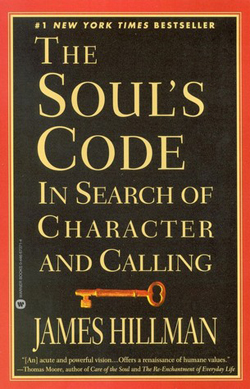
The Soul’s Code by James Hillman

the soul's code

James Hillman (1926-2011), a prolific post-Jungian psychologist, thinker, and cultural critic, wrote more than 20 books, but The Soul’s Code: In Search of Character and Calling (1997) is probably his best known work.

In a head-on attack upon the reductionist nature of both the nature and nurture camps of western developmental psychology, Hillman proposes a view of individual destiny based on Plato’s Myth of Er. Are we nothing but helpless products of our mothers in the first year of life or our luck-of-the-draw genetics? Or is there a deeper meaning to how we grow and unfold?

Hillman proposes an “acorn theory,” arguing that each acorn holds the pattern of the oak it may become, just as each soul that enters the world may bear a destiny shaped by intelligence rather than random chance: “what is lost in so many lives and what must be recovered [is] a sense of personal calling, that there is a reason I am alive.”

Hillman expounds his theory in a number of biographical sketches. He writes of Manolete, the most famous bullfighter of 20th century Spain. As a child, he was sickly and frail. “He stayed so much indoors and clung so tightly to his mother’s apron strings that his sisters and other children used to tease him.” Then, at the age of 11, he became fascinated with bulls.

Current psychology theory would hold that Manolete chose a macho vocation to compensate for his mama’s-boy childhood. Hillman wonders if somewhere deep inside, was “the acorn” that realized his destiny was to face down charging, thousand pound bulls, including the one that gored him to death at age 30. Of course that was too frightening a vision for a boy of 8 or 9 to hold!  Of course he held tight to his mother!

Hillman also discusses the childhood of Eleanor Roosevelt, one of the 20th century’s most influential women. As a child, Eleanor was “funny,” as well as “sullen, stubborn, spiteful, [and] sour…She lied; she stole, she threw antisocial tantrums in company.”

She lost her mother, a brother, and her “playboy father” before she was nine, but all the while carried on a vivid fantasy, “the realest thing in my life,” in which she lived with her father in a large household and traveled the world with him.

Psychotherapy would have regarded her fantasies as delusions and prescribed psychotropic medications to try to return her to normal. But what of the possibility that her visions meant something? What if her fantasies were “invented by her calling,” Hillman asks, and “were indeed more realistic in their orientation than her daily reality.”

“Imagination acted as a teacher, giving instruction for the large ministering tasks of caring for the welfare of a complex family, of a crippled husband, of the state of New York as the governor’s wife, the United States as its first lady, and even of the United Nations. Her fantasies of attending to “Father” were a preliminary praxis into which she could put her call, her huge devotion to the welfare of others.

Hillman is always provocative, inviting us to look deeper into, or “see through” the ideas that limit soul and it’s individual expression. Psychological literalism is often in his crosshairs, as when he says, “Our lives may be determined less by our childhood than by the way we have learned to imagine our childhoods.”

James Hillman, 1926-2011

James Hillman, 1926-2011

The Soul’s Code is a challenging book, but valuable as it sheds new light on many unquestioned assumptions about development, the individual, and destiny that need to be questioned.

Lend a hand—49 things you can do to make a difference

Russel so often brings us magnificent photos, but here he gives something else – suggestions that are in reach, things we can do in the face of the glut negativity that greets us each morning in the papers and the news.

Russel Ray Photos's avatarRussel Ray Photos

Inspiration

For those who continue to rant about things over which you have no control, I would suggest getting out in your community and volunteering.

Scott #2039 VoluntarismMy life has been full of volunteerism, so much so that too often I let the unpaid volunteer job interfere with the paid professional job. I started with Key Club in high school, then Alpha Phi Omega National Co-ed Service Fraternity at Texas A&M University, and then to Red Cross, American Heart Association, Special Olympics, Muscular Dystrophy Association, and many, many others.

Following are 50 things you can do to help the world. I have done them all at some point in my life. Don’t let your ego get in the way of contributing to your neighborhood and city. Keep in mind that businesses have liability concerns, so the type of services that you’re allowed to volunteer for might be limited in some circumstances.

  1. Scott #1788 Special OlympicsPick a…

View original post 900 more words

About Affirmations

“Affirmations are simply the practice of repeating to yourself what you want to achieve while imagining the outcome you want.” – Scott Adams

For a long time, the word “affirmation” brought to mind, “Every day in every way, I am getting better and better.” When you see it in print like that, it’s hard to believe and easy to dismiss. The phrase was created by Emile Coué (1857-1926), a French psychologist and pharmacist who developed a method of psychotherapy based on autosuggestion.

Later, when I studied the teachings of Paramahansa Yogananda, I found a broader concept of affirmations and why certain types of suggestions work for certain types of people.  In Scientific Healing Affirmations, (1925), Yogananda wrote:

“Imagination, reason, faith, emotion, will, or exertion may be used according to the specific nature of he individual – whether imaginative, intellectual, aspiring, emotional, volitional, or striving. Few people know this. Coué stressed the value of autosuggestion, but an intellectual type of person is not susceptible to suggestion, and is influenced only by a metaphysical discussion of the power of consciousness over the body. He needs to understand the whys and wherefores of mental powers. If he can realize, for instance, that blisters may be produced by hypnosis…he can understand the power of the mind to cure disease. If the mind can produce ill health, it can also produce good health.”

Recently, I found an even simpler testimonial to the power of affirmations in Scott Adam’s book, How to Fail at Almost Everything and Still Win Big. Discussing affirmations in an earlier book, Adams drew negative email from people who claimed he believed in magic. In two chapters of his latest work, Adams lays out the principles of affirmations without venturing any guesses on why they have worked for him, with the exception of one simple principle:

“The pattern I have noticed is that the affirmations only worked when I had a 100 percent unambiguous desire for success.”

He then summarizes his experience with affirmations, leading up to the big one in his life: “I, Scott Adams, will be a famous cartoonist.”  As the book makes clear, he was already working in the field and committed when he practiced this suggestion.

I recommended How to Fail when I reviewed it, and the chapters on affirmation alone are worthy of another recommendation.

Thoughts on Maleficent and retelling folktales

maleficent

Maleficent opens in a world of beauty, threatened by a greedy human king. The visual contrast between human actors and fantasy animation was great enough to take a few minutes for suspension of disbelief to kick in. After that, I was in for the ride, through an ambitiously re-crafted tale of the Disney arch villainess who gave kids of my generation nightmares in Sleeping Beauty (1959). As the poster implies, this movie belongs to Angelina Jolie, whose performance is gripping.

The Sleeping Beauty themes of love and betrayal remain but they manifest very differently in the two Disney versions of the story. Men betray and women love; implicit in Disney’s previous blockbuster, Frozen, the theme is explicit in Maleficent. For now at least, it’s Disney’s key to box office success.

Retelling fairytales with a modern twist is nothing new. Fantasy authors like Nancy Kress, Jane Yolen, Steven Brust, and Roger Zelazny, to say nothing of Neil Gaiman and George R.R. Martin have been doing this for decades. I’m currently reading a 1994 collection of short retold fairytales, Black Thorn, White Rose, edited by fantasy writers, Ellen Datlow and Terry Windling. There are two different versions of Sleeping Beauty. In both, it is the prince who needs to be rescued.

I take this as an inevitable pendulum swing from earlier Disney movies where princesses mostly sat around singing, “Someday my prince will come.” We have to remember that no Disney movie, then or now, is “real” folklore, nor is any work fantasy fiction. By “real” folklore, I mean stories shaped by the collective imagination of generations of members of a culture, region, or tribe. Strictly speaking, any talk of folktales now must be in the past tense. Nowadays the events that might spawn new fairytales, over a generation or two, become headlines or tweets, “details at 6:00,” to be forgotten in a day or an hour.

Among other things, the old fairytales were full of hints on wise living for those who knew how to listen. Here is one simple list of some of the lessons they taught:

  • Sorrow is real, and so is joy
  • Joy is freely available to all, just as sorrow comes freely to all, whether rich or poor, and without regard to changes in material fortune
  • The world is fraught with danger, including life-threatening danger, but by being clever (always), honest (as a rule, but with common-sense exceptions), courteous (especially to the elderly, no matter their apparent social station), and kind (to anyone who has obvious need), even a child can succeed where those who seem more qualified have failed.

Much as I love them, I don’t find that fantasy movies and novels teach lessons like these in a visceral or unforgettable manner, which leaves us sadly impoverished. Dragons have not gone away – any glance at the headlines makes that clear. What is gone is the wisdom to know how to deal with them.