The wishing tree revisited

I spent a lot of time this week staring at a blank screen while trying to sum up two recent posts (No discouraging words 1 and 2). The ways in which thought/stories create reality is a massive topic. Not only has it been central to eastern thought for thousands of years, but I wrote several chapters along those lines in a master’s thesis in psych. So that particular screen is going to stay blank.

I did, however re-read one of my early posts where I discussed an Indian story that centers on the creative power of mind. The story itself provides a nice summary. “The Wish Fulfilling Tree” is recorded in Hindu scripture as a story Shiva told Parvati. I quoted a version written by Paramahansa Yogananda which I like for its clarity:

Embed from Getty Images

In their kindness toward spiritual seekers, the gods placed certain “wish fulfilling trees” in remote Himalayan regions so pilgrims could refresh themselves. Once a young man with mixed aspirations climbed to the heights in search of one of these trees. At last, out of food and seemingly out of luck, he spied a solitary tree at the center of a small valley, and hurried toward it.

Under it’s branches he wished for a meal, and instantly, servants appeared and set out a feast before him. After his hunger was satisfied, he wished for wine and music, and then dancing girls, and all of his thoughts materialized. Enjoying himself immensely, he wished for a castle, with fruit trees, fountains, and soldiers to defend it.

By then he was tired and sought out the lush master bedroom for a rest. As he closed his eyes, he noticed a jungle not far away and felt a prickling of danger. “There are no bars on the window to keep jungle beasts out. A tiger could easily leap into this room.” Sadly, that was the last thought he ever had.

In his commentary, Yogananda said everyone spends their life beneath a wish fulfilling tree. Fortunately, ours don’t work as fast as the one in the story, but in the end, inexorably, they manifest what we hold steady in our minds. The name of this tree is imagination, and it is important to realize its power and be mindful of how we use it. it.

How to Fail at Almost Everything and Still Win Big by Scott Adams

How to Fail

“Don’t let reality control your imagination. Let your imagination be the user interface to steer your reality.” – Scott Adams.

How to Fail at Almost Everything is a quirky, funny, irreverent, and often inspiring “sort of autobiography” from the creator of Dilbert, that quirky, funny, irreverent, and often inspiring comic strip that lays out the truth of working in the trenches cubicles of corporate America.

This is not another collection of Dilbert cartoons or Dilbert philosophy.  It’s more of a Dilbert origin story.  We know we’re in for a different kind of kind of how-to-book when Adams begins by advising us to make sure our bullshit detectors are working before we take advice from a cartoonist.

He dismantles many self-help cliches in order to clear the way for fresh perspectives.  “Goals are for losers,” he says, and recommends strategy instead.  “I will finish my first novel,” is a goal. “I will write for an hour a day,” is a strategy.  Every day we don’t attain a goal is slightly depressing, he says, and soon after we reach it, the “what next?” question arises.  A strategy, on the other hand, brings a daily sense of satisfaction as we move in the right direction.

“I tried a lot of different ventures, stayed optimistic, put in the energy, prepared myself by learning as much as I could, and stayed in the game long enough for luck to find me…with Dilbert it did.” – Scott Adams

Adams gives a chronology of his many failed careers and entrepreneurial ventures. Shining through the story is a positive attitude that allowed him to find key lessons and life experience in every failure.  His optimism is gold, and he spends a lot of time writing of health, especially, diet and exercise, although he cautions that there is a “non-zero chance” that health advice from a cartoonist could be fatal.

“I’m here to tell you that the primary culprit in your bad moods is a deficit in one of the big five: flexible schedule, imagination, sleep, diet and exercise.”  The “big five” benefit mood, which builds personal energy, which is the driver of aspiration and effort.

Scott Adams shares his ideas at IBM Connect 2014.  Photo by Greyhawk68, CC BY-NC-ND 2.0

Scott Adams shares his ideas at IBM Connect 2014. Photo by Greyhawk68, CC BY-NC-ND 2.0

Adams packs an abundance of topics into his book. Not every one resonated, and several dragged for me, but much of my copy is highlighted and underlined, and I’ve reread several chapters already.  If you like Dilbert, you will value this story of the life twists and turns of his creator, and you will benefit from the lessons he learned along the way.

More notes from the Wasteland

Joseph Campbell considered the Wasteland and the quest for the Grail that heals it to be a core myth for our time.  During “The Power of Myth” series at the end of his life,  Campbell said the Wasteland results from a worldview that divides matter and spirit.  Referring to the Fisher King’s wound he said:

“the Christian separation of matter and spirit…has really castrated nature. And the European mind, the European life, has been, as it were, emasculated by this separation. The true spirituality, which would have come from the union of matter and spirit, has been killed.” (1)

Generations of western thinkers, culminating in Descartes, built upon the split Campbell cites to elaborate a mechanistic view of nature that made the world ripe for human exploitation.  Results of this world view are visible everywhere, both in the headlines and in the landscape around us.  This part of California, for instance, still bears the scars of hydraulic mining 150 years after the gold rush.
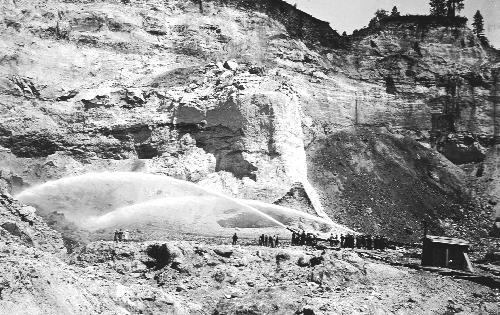
Hydraulic mining along the Yuba river.  Malakofdigginsstatepark.org

Hydraulic mining along the Yuba river. Malakofdigginsstatepark.org

Deliberate exploitation isn’t always the culprit.  We think of Native Americans as attuned with nature, but even they made mistakes.  From AD 900-1150, such a large concentration of Pueblo people lived in Chaco Canyon, NM that they cut an estimated million trees from the surrounding Colorado Plateau.  The resulting erosion, loss of game habitat, and flooding is thought to be one reason why they abandoned the site.  The surrounding landscape, once forest, has been desert ever since.
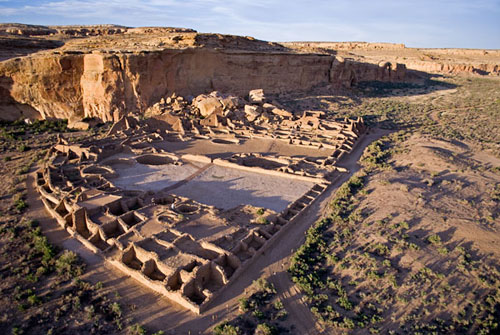
Pueblo Bonito ruins, Chaco Canyon.  Photo courtesy of Scott Haefner, scotthaefner.com

Pueblo Bonito ruins, Chaco Canyon. Photo courtesy of Scott Haefner, scotthaefner.com

Now that humans have the power to disrupt the environment on a global scale, the question of whether the harm is deliberate or inadvertent may be moot, but serious differences still lie at the heart of competing world views.  Campbell touched on this issue in Creative Mythology, the last book of The Masks of God, a four volume study of world mythology that he wrote between 1962 and 1968.  In this series, he ascribed four functions to myth (2)

  1. The Metaphysical Function: Awakening a sense of awe before the mystery of being
  2. The Cosmological Function: Explaining the shape of the universe
  3. The Sociological Function: Validate and support the existing social order
  4. The Pedagogical Function: Guide the individual through the stages of life

The Grail story resonates on all of these levels, but since I want to consider the Wasteland myth in light of our current environmental crisis, the third and fourth functions have the greatest relevance here.

Campbell points out that humans are born too soon, “absolutely helpless,” and unlike most other animals, learn how to survive from a social group.  Our earliest myths derive from the hunter/gatherer era, “hardly greater than large families, of which every adult member was in possession of the entire cultural heritage.”  

These earliest myths “served a fostering, educative function, bearing the unfinished nature product to full, harmonious unfoldment as an adult specifically adapted for survival in a certain specific environment, as a fully participating member of a specific social group; and apart from that group he would neither have come to maturity nor have been able to survive.”  There was room for diversity, but no one who threatened the group was tolerated.

The next strata of myth emerged when humans settled into agricultural communities, beginning around 7500 B.C..  Villages grew into towns and then into cities and “it was precisely at this point of space and time, in the Near East, and specifically Sumer, c. 3500-3000 B.C., that the evidence first appears among the ruins…first, of a disciplined social order imposed from above by force, and next, of deliberate expeditions of military conquest against neighbors…campaigns of systematic conquest and subjugation.”  The principle here, said Campbell, was “greed for more than one’s share.”

Imposed social orders are not inherently bad, says Campbell.  Despite romantic fantasies of the noble savage, few people really want to live in caves or give up such boons as advanced medicine, arts, spirituality, and transportation, to say nothing of indoor plumbing.  Like conventions in writing, music, or painting, cultural conventions may spark creativity when they are new and later stifle it as they atrophy.

“The Waste Land, let us say then, is any world in which…force and not love, indoctrination not education, authority not experience, prevail in the ordering of lives, and where the myths and rites enforced and received are consequently unrelated to the actual inward realizations, needs, and potentialities of those upon whom they are impressed.”

This was the situation when the European Grail myth emerged; the first written version was composed in the 12th century by Cretien de Troyes at the very time the inquisition began.  The Grail legend served as a counterpoint to the institutional church; the tale can be read as the map of a quest for personal realization, safely couched in a story of ladies and knights.  In the earliest versions, the Grail was not the cup of the last supper but a stone or a large stone dish, which like the philosopher’s stone of alchemy, granted the heart’s deepest desire.

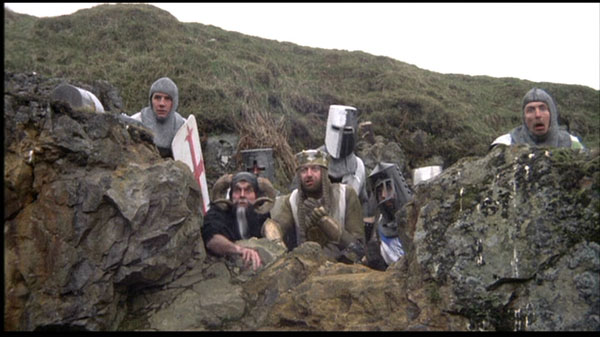
Even at our remove from the middle ages when the stories emerged, the Grail remains one of our living myths, at least if you pay attention to popular fiction and movies.  Think of The Da Vinci Code, Indiana Jones and the Last Crusade, and even Monty Python and the Holy Grail.
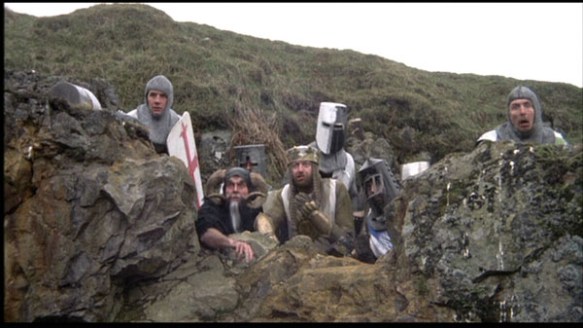
Pythons on the quest: at the lair of the Killer Bunny

Pythons on the quest: at the lair of the Killer Bunny

As much as the population of the middle ages, we are, in the words of 19th century poet, Matthew Arnold, “Wandering between two worlds, one dead, the other powerless to be born.”  The Grail continues to speak to such eras, especially one in which the Wasteland is not just the metaphor of an inner desert, but a world in which that desert is visible around us.

The Grail remains a shining image, never quite clear, but unforgettable, of the kind of life and world we seek among the confusion of possible futures.  At the end of “The Power of Myth” series, Bill Moyers asked Joseph Campbell what the myth of the future might be.

“You can’t predict a myth anymore than you can predict what you’re going to dream tonight,” Campbell replied (3).  “Dreams and myths come from the same place.”  Then he went on to say, “The only myth that’s going to be worth thinking about in the immediate future is going to be one that is talking about the entire planet.”

Earth from space

“You don’t see any divisions there of nations or states. This may be the symbol of the mythology to come. That’s going to be the country we are celebrating.” – Joseph Campbell, 1987″

Next:  Some people who are already question for the Grail.
Notes from the Wasteland

Photo by David Mark, public domain.

Photo by David Mark, public domain.

Talk of drought in California isn’t uncommon.  Normally it means lower levels in reservoirs and thinner snowpacks in the Sierras.  Bad news for skiers, and boaters, and farmers, perhaps, and an earlier start to the fire season, but’s it’s January, and for those who don’t ski, or boat, or farm, it’s easy to ignore until summer. But this time it’s different. This year it simply will not rain.

Even in “dry” winters, you see warnings that river currents are cold and swift.  This year the river’s so low there is no visible current.  Half of the local lawns are brown, and those that are green invite visits from the “water patrols” the districts threaten to form.  They say the reservoir from which we get our drinking water is at 17%; that image isn’t easy to forget.

A year ago, I posted a report from the National Intelligence Council.  Every four years, the NIC, representing every US intelligence agency, collaborates on a summary of the world situation to give the incoming president.  They post the report online for anyone to read.  After the last presidential election, the NIC gave the administration a report called Global Trends 2030: Alternative Worlds:

Click for the text of the whole report

I discussed the report in detail in a post in December, 2012, but it’s worth reviewing one of the four “Megatrends” the report identified.  The CIA, the NSA, the FBI, and the 13 other agencies that compiled the report do not waste time debating climate change; they accept it as a given and factor it into predictions, saying that by 2030:

Demand for food, water, and energy will grow by approximately 35, 40, and 50 percent respectively owing to an increase in the global population and the consumption patterns of an expanding middle-class. Climate change will worsen the outlook for the availability of these critical resources. Climate change analysis suggests that the severity of existing weather patterns will intensify, with wet areas getting wetter and dry and arid areas becoming more so.

What gives you pause is their conclusion:

We are not necessarily headed into a world of scarcities, but policymakers and their private sector partners will need to be proactive to avoid such a future.

At this time, if we have to depend on our “policymakers and their private sector partners” to be proactive, we’re screwed, but there are different ways to look at our situation.  As usual, I try to relate literal “truth” to archetypal patterns, and in this case, the obvious mythic story is that of the Wasteland.

The story relates how Camelot fell apart.  How the rift between Arthur and his queen threw the land into ruin.  How the ailing king sent his knights in search of the Holy Grail, the one thing that could restore the barren world.  Those who reached the Grail Castle found another mysterious king inside, wounded through the testicles, in constant pain but unable to die.  His only relief by day was to float in a boat on a lake near the castle.  For this reason, he was known as “The Fisher King.”  He could only be healed by the right knight arriving at the castle to ask the right question.

Antecedents to the story are ancient and predate the Arthurian tales, perhaps by thousands of years.  In writing his poem, The Waste Land (1922), T.S. Eliot relied on an anthropological study, From Ritual to Romance by Jessie Weston, who in turn, drew on The Golden Bough, Sir James Frazier’s study of sacred kingship.

In the mythic cycle Frazier explored, the earthly king was “married” to the Goddess of the Land.  His potency and the earth’s fertility were one.  When he became old and infirm or impotent, the health of the land suffered.  He was ritually killed and a new king selected.  We find echoes of this in Arthur’s estrangement from Guinevere, though of course by then, the era when monarchs submitted to sacrifice was past.

We aren’t ruled by kings anymore, but if we consider “governments” alongside the word, “impotent,” and if we ignore what Viagra can fix, we find these meanings: “weak; ineffective, powerless or helpless; having no self-control.”

Yet the news isn’t all bad, and that is a theme I plan to explore in a series of posts exploring the Wasteland.  For one thing, the Grail hides there and nowhere else.  For another, the old stories never suggest that rulers can save us.  Renewal comes from the outsider, the dummling, the fool, Parsifal the rustic youth, or a carpenter from Nazareth.  

There are literally thousands of people today, already in or ready to enter the metaphorical forest on a quest for better ways to live.  I plan to discuss a few of their stories here.

“Arming the Grail Knights” by Edward Burne-Jones, tapestry, 1890’s, public domain

Help wanted, heroes and heroines: must be civil and adroit

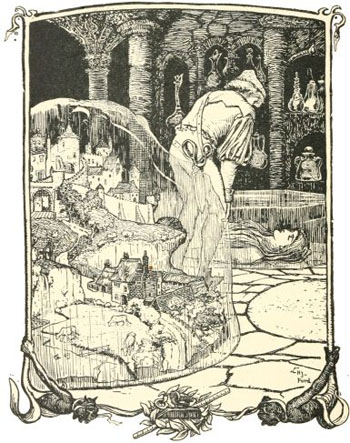
This unusual job description comes from the opening lines of a Grimm’s fairy tale I recently read for the first time.  Fairy tale characters never get more than a word or two of description, and most of the time, tags like “clever fox” and “evil stepmother” are so familiar they don’t make us stop and think.  The opening of “The Glass Coffin,” was different enough to catch my attention:

“A civil, adroit tailor’s apprentice once went out traveling, and came into a great forest, and as he did not know the way, he lost himself.”

Civil and adroit are good terms for key attributes of successful folklore protagonists.  Though the words may sound quaint to us now, the traits they describe are as relevant to our own world as they are to travelers in Faerie.

The Glass Coffin

The Glass Coffin

The virtue of civility:

Some of the Grimm Brothers’ stories seem to locate these attributes along gender lines, implying a world of civil females and adroit males.  But if we review a number of tales, much of the time we find both characteristic needed by men and women alike.

Girls who are rude or mean may wind up dead or have their eyes pecked out like Cinderella’s step sisters.  Toads may jump from their mouths when they try to speak.  Feminists point to such story features as efforts to domesticate young women and make them docile.  Yet for many youngest sons, success also hinges on civility, often to seemingly insignificant creatures.  It’s a dwarf who offers council in  The Water of Life.  When the worldly-wise older brothers mouth off to the little man, they end up imprisoned in stone.  The youngest brother, who is respectful and heeds (most of) the dwarf’s advice, wins his heart’s desire and more.

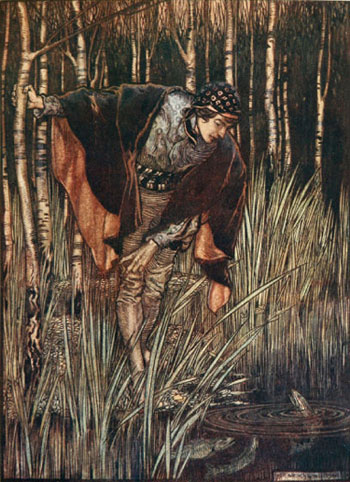
In many of these stories, motives are greater than simple expediency.  The hero of The White Snake shows genuine compassion.

The White Snake by Arthur Rackham

The White Snake by Arthur Rackham

Through a bit of (adroit) trickery, a king’s servant gains the power to understand the speech of animals. He goes traveling and saves three different kinds of “lowly” creatures – fish, ants, and baby ravens.  Kind heartedness rather than self-interest drives him, for though the creatures promise to help him, they only do so after he sets them free.  There were no strings attached to his generosity.

The story is not just a simple call to spare the lives of all creatures, for the servant kills his horse to feed the ravens.  It would take another post to explore this detail, but to the extent that these stories dwell on  compassion, their theme is both ancient and timely.  The Dalai Lama put it in simple terms:  “If you want others to be happy, practice compassion.  If you want to be happy, practice compassion.”

The virtue of being adroit:  

The dictionary defines adroit as “skillful in a physical or mental way; clever; expert.”  In fairy tales, this sometimes means knowing when to kill your horse to feed the ravens.  At other times, it means cunning, trickery, and lies.  In stories, we often imagine these as men’s attributes, perhaps because traditional full time tricksters, from Hermes to Coyote, are usually male.  Yet in Grimm’s stories, young women need to understand and master deceit as often as men.  In Bluebeard-type tales, and notably a frightening story called “Fitcher’s Bird,” it’s a matter of life and death.

Part of being adroit is the intuitive sense of when someone or something feels wrong; when civility is not in order.  In fairy tales, women often do this better than men.  Typically, in three-brother stories, the youngest prince will trust his older brothers, even after the dwarf has warned him not to.  Cinderella and girls like her know better than to be fooled by older siblings.

Instinctively knowing when something is off has new relevance in the 21st century.  Interviews with 9/11 survivors adds to research suggesting our brains are not very good at processing radical changes or threats.  People on the upper floors of the South Tower had just over 16 minutes before the second airplane hit; those who left survived and those who waited did not.  On average, people took 1o minutes to choose.  In times of radical change, we need that cunning, adroit part of our ourselves to cut through the illusion that things will right themselves and return to “normal.”  It can be a matter of life or death.

***

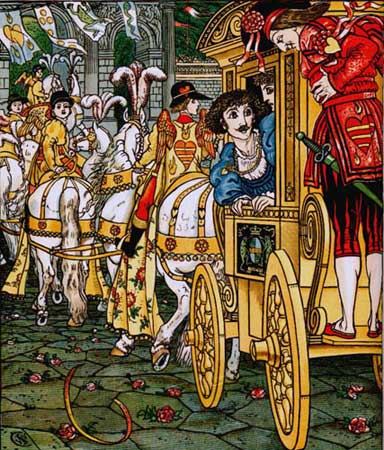
Few things in fairy tales are certain, and the first story in the Grimm’s collection, The Frog King, is an exception that proves the rule proposed by this post.  The princess is neither civil nor adroit.  She’s a petulant brat, who gets what she wants by hurling the frog against a wall (the kiss only comes in later versions).  To our sensibilities, she doesn’t deserve the prince who appears when her act of violence breaks the spell.

There’s an irony in the original “Frog King,” however.  When the transformed prince reunites with his faithful servant, Heinrich, he almost seems more delighted than he is with his new bride.  At least one illustrator, Walter Crane (1845-1915) implies that the princess won’t have everything to her liking.  Who does the prince have eyes for in the closing scene, and how does the princess appear to react?  Does this story end with a twist that the Brother’s Grimm shied away from?

The princess, the prince, and Heinrich in Walter Crane's 1874 illustration.

The princess, the prince, and Heinrich in Walter Crane’s 1874 illustration.

Experienced explorers warn us that the way through Faerie is perilous.  Trails may shift beneath our feet, and hard-and-fast rules don’t apply.  As Joseph Campbell observed, everyone must find their own way through the forest.

My latest exploration leads me to wonder if “adroit” is another word for “street smarts,” something we need in our own world as well as in dark imaginal forests and castles frozen in time.  And isn’t “civil” an attitude that understands that our own wellbeing, even in the most practical terms, must include the welfare of others?

The old stories may offer no certain answers, but with careful reading, they can always lead us to ask interesting questions.

A teller of sacred stories

Robert Béla Wilhelm, storyteller

Robert Béla Wilhelm, storyteller

In 1965, a young New Jersey college student, in need of money for rent and tuition, took a weekend job as a tour guide at $25 a day, for a charter company that specialized in high school class trips to Washington, DC.  The company gave him a binder of facts and statistics to learn, but the student, Robert Béla Wilhelm, quickly realized that only a story makes facts and statistics come alive.

Sixteen years later, Bob was a university professor and had written his PhD dissertation on the craft and philosophy of storytelling.  His wife, Kelly’s, PhD centered on travel and leisure.  Both had grown up in storytelling families, and in 1981, they founded Storyfest Journeys (see their Facebook page too) with an inaugural trip to Ireland.  After more than 50 storytelling oriented, small group tours to Europe, the Pacific, and destinations in the US, they are still at it.  It was thanks to the Wilhelms that Mary and I traveled to Iceland in 2012.

Over time, Bob and Kelly have focused their energy on mentoring storytellers and specializing in sacred stories.  I just received word that Bob has completed a 17 year labor of love that he calls, “Parables Today, A Weekly Lectionary Storybook.”  For every Sunday of the three year lectionary cycle of the Catholic church, he presents stories from around the world along with artwork, and reflections.  The tone is open and ecumenical; many of the tales will appeal to people of any faith or none at all.  They  are now freely available at sacredstorytelling.org.

I was thinking of Robert Wilhelm when I wrote my second post on this blog, which featured a poem called “Story Water” by Rumi.  I think it’s safe to say that Robert has carried on Rumi’s tradition, which centers on the understanding that our spiritual dreams and longings are woven of stories.  Abstract understanding may sometimes move the heart, but more often it is The Prodigal Son, or Arjuna at Kurukshetra, or Coyote coming along that opens our eyes of understanding.

If you love stories, take a look at the stories that Robert Wilhelm loves.

Jung’s Tower: simplicity and the inner life

Jung's Tower House, Bollingen, Switzerland, by Andrew Taylor, 2009.  CC BY-SA-2.0

Jung’s Tower House, Bollingen, Switzerland by Andrew Taylor, 2009. CC BY-SA-2.0

Recent news of technological incursions into consciousness itself (virtual reality and altered memories); almost daily revelations about NSA spying; suggestions that social media “isolates people from reality;” it’s enough to make you want to unplug all the gadgets – at least for a while!

Renowned psychologist, Carl Jung (1875-1961) did just that, for months at a time, in a tower-house complex he started building in 1923 and continued to work on for the rest of his life.  He often spent months each year living as simply as possible, without electricity or running water.  It’s easy to think he lived in a simpler time and couldn’t have imagined modern complexity, but consider these words he wrote in his autobiography, Memories, Dreams, Reflections, published in 1961, the year he died:

“We rush impetuously into novelty, driven by a mounting sense of insufficiency, dissatisfaction, and restlessness.  We no longer live on what we have, but on promises, no longer in the light of the present day, but in the darkness of the future, which, we expect, will at last bring the proper sunrise.  We refuse to recognize that everything better is purchased at the price of something worse; that, for example, the hope of greater freedom is canceled out by increased enslavement to the state, not to speak of the terrible perils to which the most brilliant discoveries of science expose us.
………………………
…new methods or gadgets, are of course impressive at first, but in the long run they are dubious and in any case dearly paid for.  They by no means increase the contentment or happiness of people on the whole.  Mostly they are deceptive sweetenings of existence, like speedier communications which unpleasantly accelerate the tempo of life and leave us with less time than ever before.”

The tower, phase 1, 1923.  Creative Commons

The tower, phase 1, 1923. Creative Commons

Ten years before starting the tower, Jung had a painful break with Freud that precipitated a period of disorientation and a huge uprush of the kind of unconscious contents he had witnessed in schizophrenic patients.  Feeling that his experience was purposeful, he chose to submit to the unconscious with writing, art, and the effort to understand.  Out of this phase of turmoil and uncertainty, his unique psychological insights were born.  Paper and ink, he said, did not seem “real” enough to represent his discoveries, so in 1922 he purchased land on Lake Zurich for a “representation in stone” of his “innermost thoughts.”

Phase II, 1927.  Creative Commons

Phase II, 1927. Creative Commons

Jung wrote at length of the parallel developments of his inner life and the tower, over more than three decades, saying things like:

“At Bollingen I am in the midst of my true life, I am most deeply myself”

“At times I feel as if I am spread out over the landscape and inside things, and am myself living in every tree, in the plashing of the waves, in the clouds and the animals that come and go, in the procession of the seasons.”

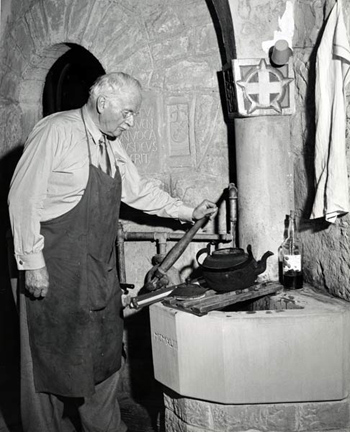
“I pump the water from the well.  I chop the wood and cook the food.  These simple acts make man simple; and how difficult it is to be simple!”

Jung pumping water at Bollingen ca. 1960.  Library of Congress

Jung pumping water at Bollingen ca. 1960. Library of Congress

While drawing inspiration from Jung, an obvious question becomes, how do I connect with this kind of depth in the midst of my own too-hectic life?  The good news is, we don’t need a tower to live in for months at a time.  The bad news is we need to unplug every day and tune into activities that nourish the soul; this is often hard arrange.  It takes focus, intention, and experimentation to find those things that center us and we are drawn to.  Any number possibilities come to mind:

  • “Spend an hour a day in a quiet room by yourself reading old stories that you find nourishing.”  That’s what Joseph Campbell said when Bill Moyers asked this question during the “Power of Myth” interviews.
  • Meditation, of almost any kind.  This my own core practice.  Zen teacher, Cheri Huber said, “If you start by watching your breath for as little as five minutes a day, it can change your life.”
  • Sports that allow one to get in “the zone,” especially walking, running, or bicycling.
  • Keeping a dream notebook.
  • Writing, though I suspect most bloggers will have the same difficulty I have in putting words at the service of psyche – how do I turn off the writing sophistication I’ve worked so hard to gain?  Can I ever truly use words in a “purposeless” manner, allowing them to go where the wish, without thinking, “Gee, this would make a good blog post?” For any chance of success, I need a definite strategy, like writing fast with a rollerball pen in cheap notebooks.
  • Visual arts or crafts.  Training or skill is not required for this kind of work, and in fact, can get in the way.  Those with artistic training may find it useful to paint or draw with the non-dominant hand.  Jung had no formal art training, but his private journal, The Red Book, only recently published, gives an idea of what may emerge if one is determined to honor the psyche.
Red Book, p. 131.  Courtesy Ox Aham, Creative Commons

Red Book, p. 131. Courtesy Ox Aham, Creative Commons

When I truly examine my own habits, it’s clear that I fritter away enough time with gadgets each day to find the space for this kind of exploration.  It doesn’t need to be with the kinds of activities I outlined above.  I find it’s ok to schedule “time for inner work” the way I schedule time at the gym, but the most powerful new discoveries seem to emerge from those quiet voices at the edge of consciousness, the tiny impulse it is so easy to overlook in our busy lives.

Such an impulse woke me one night at 1:00am one morning.  Instead of going back to sleep, I got up and wrote down a sentence.  That led to a paragraph, and then a page, and then another.  That was the start of the first (and so far only) novel I’ve finished.

Something similar happened to Jung at his tower.  He gave the stonemason at a quarry precise measurements for blocks he needed to build a new wall, but one of the stones arrived in error; it was square, about 20″ on each side.  When Jung saw it, he said, “That is my stone, I must have it!”  Over time, he carved a testament to his life and work on stone which “stands outside the Tower, and is like an explanation of it.  It is a manifestation of the occupant.”

Bollingen stone, main face, CC-BY-SA-3.0

Bollingen stone, main face, CC-BY-SA-3.0

In a seminar in 1939, Jung said:

“We have no symbolic life, and we are all badly in need of the symbolic life. Only the symbolic life can express the need of the soul – the daily need of the soul, mind you! And because people have no such thing, they can never step out of this mill – this awful, banal, grinding life in which they are “nothing but.”

The Bollingen Tower became a vital way for Jung to live the symbolic life, but he would have been the first to insist that we don’t need to carve stone or build houses to find it for ourselves.  All we need is the hunger.  And the will to begin.

Another great story rediscovered: Bamboo Charlie

Here is another inspiring tale that I bookmarked some time ago and then forgot.  Coincidentally, like the previous post, its subject is a uniquely creative folk artist.  I read about Bamboo Charlie in a memorial published in the L.A. Times in September, 2012.

Bamboo Charlie and his whimsical paradise

Bamboo Charlie and his whimsical paradise

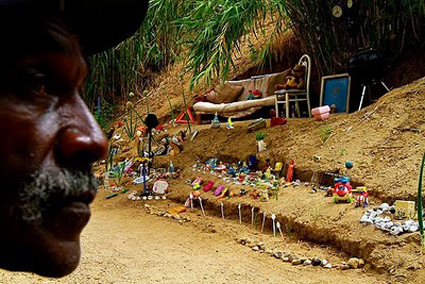
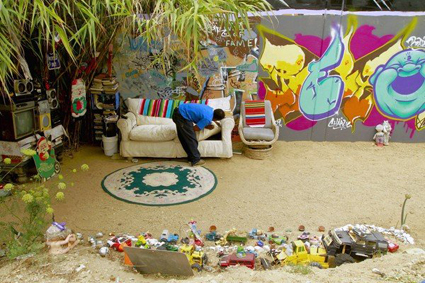
Twenty years ago, a homeless Texan named Charles Ray Walker noticed a bamboo grove along a narrow stretch of land by the Los Angeles River in Boyle Heights.  The property owner told Charlie he could stay there if he kept the place clean.

On the strip of land, about 40′ x 200′, squeezed between a parking lot and a warehouse, Walker grew fruits and vegetables.  He carved stairs into the bare slopes and decorated them with hundreds of discarded toys and signs.  He built a shack under a tree, with a TV, bed,and sofa, and then he invited guests to visit: graffiti artists, children and their parents, musicians, police officers, and homeless friends.  He assembled a library out of salvaged books, including best sellers and one called The Semi-Complete Guide to Sort of Being a Gentleman.  Bamboo Charlie was featured on the front page of the L.A. Times in 2010.

"Bamboo Charlie"

During the 20 years he spent on the parcel, he collected cans for money, sometimes working late into the night. Duruing occasional trips back to Texas to visit his family, he operated a crane at a steel company. “I’m not going to ask another grown man for money. I never have, and I never will,” he said. “People expect that from a homeless man.”  

That pride may have contributed to an early death.  He suffered greatly from ulcers during his final years, but insisted he was fine when friends suggested he see a doctor. On Aug. 26, 2012, a young friend named Teyuca found him dead in his shack, of what the coroner determined was heart disease.  He was 61.

“I really think what he did was folk art, built out of scraps and things found, things that people gave him,” Teyuca said.  “He was a mad genius.  He had such a wild imagination.”