Authenticity and folklore

In his comment on my review of Once Upon a Time, Calmgrove zeroed in on one of author Max Luthi’s key concepts, that fairytales show us “man’s deliverance from an inauthentic existence and his commencement of a true one.” Luthi gives us story examples: “a penniless wretch becomes wealthy, a maid becomes queen…or a toad, bear, ape, or dog is transformed into a beautiful maiden or handsome youth.”

What can we make of such a statement in terms of our own lives? Is there anything we can learn from stories of toads and bears transformed?

Rumpelstiltskin by Henry Justice Ford, 1889. Public domain.

In trying to answer the question, our first hurdle is trying to figure out what an “authentic existence” might look like, a philosophical exercise right up there with defining “the true,” “the good,” or “the beautiful.” When I try to imagine “authentic” in our world, one of the first things that comes to mind is Crazy People, 1990, a movie in which Dudley Moore, as an advertising executive, is checked into an insane asylum after he suffers a nervous breakdown and begins writing truthful adds.

Truth in advertising wins Dudley Moore a straight-jacket in “Crazy People,” 1990

Fairytales mirror philosophy and religion in their concern with lives well lived, but they are much less precise in prescribing what to aim for and how to proceed. When someone achieves their happy destiny, we see outer events representing that highest good, like a royal wedding or the discovery of buried treasure, but what works for one hero or heroine may not work for others.

This observation offers a segue into the first of several attribute that fairytale heroes and heroines seem to share – they chart their own course. In Luthi’s terms, they are “wanderers” who “set forth into the unknown in search of the highest, the most beautiful, or the most valuable thing.” Most often, but not always, it is male characters who cover the greatest outer distance, but in Faerie, the unknown waits outside your door. Cinderella’s journey begins with a solitary trip every day to weep at her mother’s grave. The smallest step into the forest is fraught with danger for one who goes their own way, whether the goal is the end of the world or the prince’s ballroom.

Arthur Rackham illustration from “The White Snake”

A second attribute of successful folklore characters is kindness, at least for those creatures who turn up with guidance for the quest. It is not the kind of universal compassion espoused by religion, but is more practical and down to earth. Cinderella is kind to birds, and they always assist her, but she makes no objection when they later peck out the stepsisters’ eyes. The hero of “The White Snake,” who learns the speech of animals, goes out of his way to help ants, fish, and ravens, who will later save his life, but he doesn’t hesitate to sacrifice his horse when events demand it.

According to Max Luthi, the fairy tale character’s estrangement from conventional social relations allows him or her to connect with help from unexpected quarters, with toads or foxes, crones or dwarves. Luthi often distances himself from Jungian interpretation, but not in the case of fairytale helpers. They can be viewed,not only as outer creatures, but “as forces within the soul of the individual which are at first in need of assistance but finally unfold and develop.”

A third attribute of folktale heroes and heroines is patience. Things take a long time to unfold. In the Grimm brothers version, Cinderella has no fairy godmother. Instead she plants a hazel twig on her mother’s grave and waters it with her tears every day until it is grown. Only then do the tree and the dove that lives in its branches grant her wishes. In “The Devil’s Sooty Brother,” a former soldier works in the devil’s kitchen for seven years, forbidden to bathe, cut his hair, his beard, or his fingernails, or wipe the tears from his eyes.

“Kitchen work,” as Robert Bly calls it, applies to both men and women in fairytales. In Iron John, he wrote, “The way down and out doesn’t require poverty, homelessness, physical deprivation, dishwasher work, necessarily, but it does seem to require a fall from status, from a human being to a spider, from a middle-class person to a derelict. The emphasis is on the consciousness of the fall.”

Fairy tale time, as both Luthi and Bly point out, is not literal time. Seven years in the kitchen might equate to several decades for the writer who has to make a living by some other means. Yet in all the stories, this tempering process is essential. Shortcuts don’t work. After seven years, even the devil is forced to keep his bargain.

Arthur Rackham, “The Goose Girl”

When I was young, I assumed the signs of an “authentic life” were visible – at a minimum, bohemian trappings were required. Now I know that such plumage is far too easy.

The courage to go one’s own way, to keep one’s own council. To be kind to the odd and despised parts of oneself and to give them a hearing. The poise and patience to allow events to unfold at their own pace rather than try to push the river. Fairy tale heroes and heroines champion themselves and their deepest desires. Their stories lead us to wonder what would happen if we follow their example. What do their footsteps look like in the 21st century?

Huh, what? Oh yeah, I remember

Until the 20th century, most people in the western world believed in objective memory, that what we remember is an accurate mirror of events that actually happened.

With the birth of psychoanalysis and concepts of the Id and unconscious mind, that began to change. Modern brain research confirms that not only do memory and imagination overlap, but that memories can be deliberately changed or altered.  Such manipulation is a core element of The Cloud by Matt Richtel, a page turning thriller I started to read after seeing this interview with the author on Sciencthrillers.com  http://www.sciencethrillers.com/2013/author-interview-matt-richtel-the-cloud/

The Persistence of Memory by Salvadore Dali, 1931

Freud was ambivalent about the accuracy of his patients’ memories. At the start of his career, he attributed several several cases of hysteria to real childhood sexual abuse that his methods uncovered.  Later he said that such episodes were patient “phantasies.”

The issue surfaced again at the end of the 20th century, with “recovered memory” therapy causing tremors in the field, to say nothing of lives disrupted by allegations of sexual abuse, in what is now widely viewed as abuse by helping professionals who implanted memories in the course of trying to treat patients.  “False memory syndrome” still evokes passionate disagreement in the field.  The AMA and the American Psychiatric Association, as well as the Royal College of Psychiatrists in Britain have condemned recovered memory therapy, and in the late 90’s, a number of patients who once believed they’d been victims of childhood abuse successfully sued the therapists who had led them to that belief.

Since the turn of the century, the “hard science” of biology has confirmed what most therapists since Freud have known – that memory is always mixed with imagination.  The area of the brain that perceives an object overlaps the part of the brain that imagines the same object.  In 2009, scientists implanted memories (involving smells) in flies by using light signals to trigger “genetically encoded switches.”

The day after I started reading The Cloud, I heard “Sure, I remember that,” on Marketplace, in which the work of Elizabeth Loftus was highlighted. Loftus, of UC Irvine, is one of the key researchers who have demonstrated how easy it is to implant memories, in this case using altered photographs. http://www.marketplace.org/topics/life/freakonomics-radio/sure-i-remember.  I invite you to listen to this timely piece, which is only five and a half minutes long.

Yep.  We now something new to worry about – hacking at the cellular level!  I’ll have to remember to worry about it later, though.  Right now I have to get back to my novel…

The Psychology of Superheroes

superheroes

Robin Rosenberg grew up with superhero comics. Later she shared them with her children, and after becoming a clinical psychologist, she studied them through the lens of psychology and discovered that “superhero stories are about morality and loyalty, about self-doubt and conviction of beliefs. I also saw that, like any good fiction, the sagas of superheroes bring us out of ourselves and connect us with something larger than ourselves, something more universal.”

Rosenberg published “We Need a Hero” in the current Smithsonian Magazine http://www.smithsonianmag.com/arts-culture/The-Psychology-Behind-Superhero-Origin-Stories-187938991.html#ixzz2IrHHrBBI.  The article inspired me to read The Psychology of Superheroes a collection of essays that Rosenberg edited in 2008 on what makes these caped crusaders tick.

Sometimes it seems that superheroes can’t get no satisfaction, but is that accurate?  Not according to the opening essay in the collection, “The Positive Psychology of Superheroes,” by Christopher Peterson and Nansook Park.  “One of the defining features of a superhero is an over-riding mission to serve the larger world and to defend it.  In this sense, superheroes have profoundly meaningful lives.”   

Peterson and Park assert that meaning is more important than pleasure in leading a satisfying life. That’s a good thing, because with a few exceptions, superheroes are challenged on the relationship front.  I’ve always thought it’s the flaws embodied in the secret identities of Clark Kent and Peter Parker that bonds us to these characters.  In one sense, they’re just like us, and their stories suggest that we too may choose the highroad.

Though superpowers isolate them from others, sometimes superheroes band together with superior results, according to the second essay in the collection, “The Benefits of a Group,” by Dr. Wind Goodfriend. This article may shed some light on why The Justice League of America functions more efficiently than your team at work or committees at church.

Another topic discussed in the book is the question of nurture vs. nature in the development of superhero psychology.  Superman may have his powers through genetics, how did he come to use them for altruistic rather than narrow and selfish ends?  Did he inherit those qualities too, or were they a result of his wholesome upbringing on a farm in America’s heartland?  What would have happened if his pod had landed in New York City?

Good and evil are usually clearly drawn in superhero stories, but not always. In “Anti-Heroism in the Continuum of Good and Evil,” Dr. Michael Spivey and Steve Knowlton discuss the ambiguous, gray-zone nature of super anti-heroes and sympathetic villains (think of Darth Vader and Gollum).  Each of the 18 essays in The Psychology of Superheroes addresses some facet of the super-psyche that you may or may not have wondered about.

Humans have relished hero tales for millennia.  Superman joined the ranks 75 years ago, and if you’ve been to the cineplex lately, you know that his saga is going to continue this summer.  The trailer for Man of Steel 2013 zeroes in on Clark’s inner struggles to understand who he is and why he is here.  Earlier incarnations of Superman did not live in a world of such moral ambiguity and mistrust of the government, themes which place this telling squarely in the 21st century.

As The Psychology of Superheroes makes clear, what we really admire is not the superpowers but the hero, the one who overcomes their doubts and demons and then acts to make the world a better place. This book is a fascinating read in its own right and will whet your appetite for the new movie.  It will give you some new perspectives on movies you’ve seen in the past as well as the comic books that once inspired some of us to run around wearing capes made out of bedsheets.

The Annotated Wind in the Willows

“The Mole had been working very hard all the morning, spring-cleaning his little home.” So begins one of the great literary adventures of my life, The Wind in the Willows, published in 1908 by Kenneth Grahame.

I’ve written about The Wind in the Willows before: http://wp.me/pYql4-19a.  My parents read it aloud when I was little, and since then, it has been part of my life.  Now the annotated edition, which I got this month, reveals details about the text and the author that I never knew before.

The opening paragraph details the Mole’s spring cleaning.  Soon he has dust in his throat and eyes and splotches of whitewash on his fur.  Then the text says something rather strange:  “Spring was moving in the air above and in the earth below and around him, penetrating even his dark and lowly little house with its spirit of divine discontent and longing.”

I’ve been known to put off spring cleaning for months, but from laziness not “divine discontent.”  As a younger reader, this phrase escaped me.  Only now do I realize how Mole’s spirit of longing belonged to the author.  I always imagined Kenneth Grahame as a country gentleman, strolling quietly by the river.  Notes in the annotated edition make clear that while this came later, for much of his life, Grahame lived with a frustrated dream of living like that.

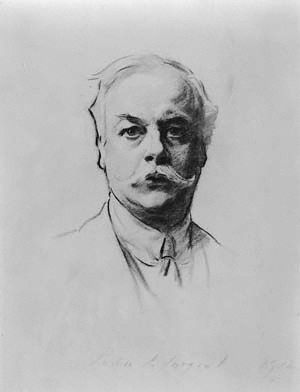
Kenneth Grahame by John Singer Sargent, 1912.  Public domain.

Kenneth Grahame by John Singer Sargent, 1912. Public domain.

He knew and loved the country life, but economic necessity tied him to London.  He abandoned his dream of going to Oxford and took a post at the Bank of England.  He married late in life, and both he and his wife had health problems.  Their only son, Alastair, was born with a congenital vision defect.  One day in November, 1903, a respectably dressed man came into Grahame’s office, pulled out a revolver, and began shooting.  The man didn’t hit anyone and was later sent to an asylum, but Grahame was shaken.  Already a private man, he kept even more to himself, his home, and vacations near the sea.

Grahame was already a popular author of several books of essays, but he stopped writing entirely between the years of 1903 and 1908.  Because of his wife’s health problems, Kenneth was Alastair’s primary care giver.  In the evenings, he made up stories about a mole, a toad, and various other animals, who lived beside a river.  A governess would later recall hearing Alastair ask questions and make suggestions; the two of them worked the stories together.

Alastair Grahame, 1907

Father and son spent the summer of 1907 apart.  Kenneth sent Alastair  a series of 15 letters which continued the tales and became the seeds of chapters for the book he would write the following year.  The letters are included in the annotated edition.  Also in this edition is an introduction by Brian Jacques, contemporary author of the Redwall series of animal stories.  Jacques lets us know what he thinks of the editors and agents who hesitated in printing The Wind in the Willows.  He has nothing good to say about people so short of imagination that they could not imagine a toad disguised as a washerwoman.

Arthur Rackham, 1940

An enthusiastic recommendation from President Theodore Roosevelt helped Grahame’s publishing efforts and the book has been in print ever since.

Some have suggested that Wind in the Willows is two books in one.  The madcap adventures of toad seem geared to please children – they were Alastair’s favorites – while other sections explore deeper emotions like homesickness, fear, wanderlust, and of course the theme of divine discontent.  This takes center stage in chapter 7, “The Piper at the Gates of Dawn,” in which the animals, searching for a lost baby otter, encounter the ancient god Pan.

The Piper at the Gates of Dawn. Frontispiece to a 1913 edition by Paul Bransom. Public domain.

Grahame first wrote about Pan in 1891 in an essay that appeared in his first book, The Pagan Papers 1893.  His longing for unspoiled nature on the eve of the 20th century was widespread in Victorian and Edwardian society.

As Mole and Rat approached the god, they were seized with the kind of awe and fear that scriptures around the world describe when people encounter angels.  When the vision ended, the animals “stared blankly, in dumb misery deepening as they slowly realized all they had seen and all they had lost.”

Then a little breeze “blew lightly and caressingly in their faces; and with its soft touch came instant oblivion.  For this is the last best gift that the kindly demigod is careful to bestow on those to whom he has revealed himself in their helping:  the gift of forgetfulness.  Lest the awful remembrance should remain and grow, and overshadow mirth and pleasure, and the great haunting memory should spoil all the afterlives of the little animals helped out of difficulties, in order that they should be happy and lighthearted as before.”

Life brought less solace for Grahame. His son, Alastair, who inspired the stories, was a budding artist and creator of his own literary magazine, but he was plagued with emotional problems. He enrolled at Eton but had to leave for this reason. He went up to Oxford in 1918, but didn’t do well with exams. On top of this, numbers of WWI veterans were returning to college, bringing the focus and maturity they had learned in the trenches.

In May, 1920, Alastair Grahame asked for a glass of wine after dinner, then walked to Port Meadow, outside Oxford, where a number of railroad lines merged. During the night, he was hit by a train and died. His father wrote that his vision problems might have led to disorientation.  The autopsy report suggested he lay on the tracks and waited for a train.

The Grahames were devastated. They spent the next four years in Italy. When they returned to England, they moved to a town beside the Thames where they lived for the rest of their lives. Kenneth was able to spend his days by the river, as he had always dreamed of doing, but the joy he once had making stories for his son must have been absent.

Arthur Rackham, 1940

Arthur Rackham, 1940

Some biographers have suggested that Grahame, good at everything he tried, must have been disappointed with his son. Annie Gauger, editor of the Annotated edition says no.  She includes letters and other material to demonstrate that The Wind in the Willows was a joint creation of father and son.  Since the stories were first told out loud, I have to agree – from experience I know that oral storytelling is a complex dance between teller and audience.  Out of their limitations, their longings, and divine discontent, Kenneth and Alastair Grahame  gave readers over the last hundred years a world of peace and friendship, far from “the wide world” trials, where if you listen, you can sometimes make out the music of the gods of nature on the wind.

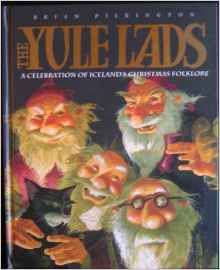
The Yule Lads: Icelandic Christmas folklore.

The Yule Lads

In most Christian countries, Christmas was slower to catch on than other major church holidays.  The clergy may have been wary of pagan solstice celebrations which happened at the same time of year and included serious revelry.  Some early Christmas festivities mimicked the custom.  They were banned in 17th century England, and American Puritans outlawed them too.

According to Brian Pilkington, author of The Yule Lads, Iceland was ahead of the curve. A 16th century law stated that “All disorderly and scandalous entertainment at Christmas and other times and Shrovetide revels are strongly forbidden on pain of serious punishment.”

Icelandic winters are long and dark, with fewer than five hours of daylight at this time of the year.  Imagination tends to fill the darkness with what we fear, and Pilkington’s book describes “the lads” that kept Icelandic children awake at night.  The gentlemen pictured on the cover are not our shopping mall Santas!

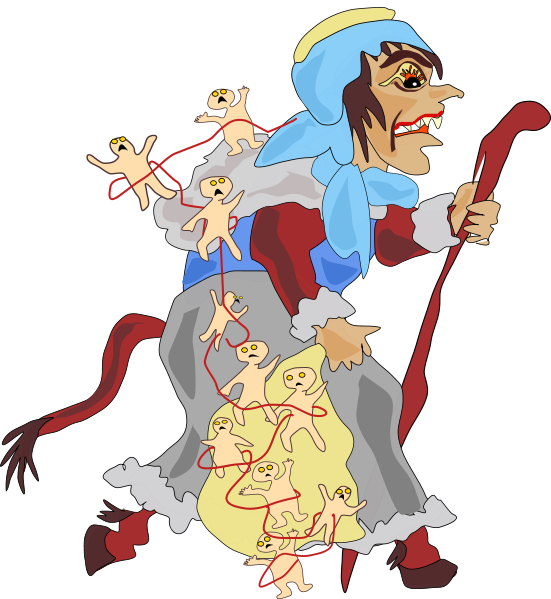
The matriarch of the clan was the ogress, Gryla, who loved to eat stewed children.  It couldn’t be just any kid though.  It had to be one who was “naughty, lazy, or rude.”  In one 13th century account, Gryla had 15 tails, and tied to each was a sack full of naughty children.  It was not “the most wonderful time of the year” if you were young!  The Icelandic word for icicle is “grylukerti” which means “Gryla’s candle.”

Gryla. CC-by-SA-2.5

Gryla had three husbands and 80 children, though legend now boils it down to 13 sons who visit the homes of children on successive nights from Dec. 12 – 25.  Time and the law have taken the edge off the Yule Lads, for a 1746 decree said “The foolish custom, which has been practiced here and there about the country, of scaring children with Yuletide lads or ghosts, shall be abolished.”  By the 19th century, the Lads had morphed from cannibals into rascals and petty thieves, who even began to leave gifts for good children who left their shoes on a window ledge.

The first to arrive was Stekkjarstaur, the “Sheep Worrier.”  He would visit the the sheep cot and try to suck milk from the ewes.  That doesn’t work in December and led author, Brian Pilkington to suggest that Sheep Worrier’s IQ is “somewhat less than three digits.”  These days  he heads for the fridge to get his milk.  If a child has been good, Stekkjarstaur leaves a sugary sweet.  Bad children get a potato.

Next comes Giljagaur, aka, “Gully Gawk” who travels through gullies and ravines, also in search of milk, but he looks for cow barns and inattentive milkmaids.  “Stubby” arrives the third night, as short as his name suggests.  He likes to raid the kitchen, as do the brothers that follow, “Spoon Licker,” “Pot Licker,” and “Bowl Licker.”  In their present forms all they do is mischief, but food thieves were no joke in earlier times.  For northern farming families, the time between Christmas and the spring thaw in April or May could be times of famine if food or fodder for livestock ran short.

The next lad to show up is Hurdaskellir, or “Door Slammer,” one of only two of Gryla’s sons who isn’t out to fill his belly.  Imagine loud bangs in the dead of night and you know how he gets his jollies.

And as if the sons of Gryla were not bad enough, children also had to contend with Jólakötturinn, the Yule Cat, a huge feral creature who hunts children on Christmas Eve instead of mice. Like the lads, the cat discriminates in choosing his victims, eating only those who have not received a new item of clothing for Christmas. Pilkington says that “Until fairly recently in Iceland, all clothing came directly from sheep. The wool had to be washed, combed, and spun before it was painstakingly crafted into a garment. It was a long, arduous process.”  Fear of the Cat induced lazy children to do their part!

This is a fun book and a fine counterbalance to the usual TV holiday movies.  You can picture families gathered around the fire as the wind howls outside, thinking as we do when hearing a good ghost story, “This can’t be true…can it?”  Something within the listeners then and within us now loves to be scared, to confront monsters and vanquish them in imagination.  On that score, Gryla & Sons and the Yule Cat satisfy!

A click on the book cover at the top of this post will take you a site where you can order The Yule Lads.

More on the Brothers Grimm bicentennial

Earlier this month, I posted a piece on the 200th anniversary of first edition of the Brothers Grimm’s collection of German fairytales: http://wp.me/pYql4-2sw.

Yesterday the Sacramento Bee printed an article on this treasure trove of folklore and some of the worldwide activities the bicentennial has inspired (“The Grimm brothers from many angles,” by Jan Ferris Heenan, http://www.sacbee.com/2012/10/28/4939548/the-grimm-brothers-from-many-anglesin.html).

Of particular interest is the publication of a new collection, The Annotated Brothers Grimm by Harvard professor, Maria Tatar. At $35, it’s not cheap, but since I don’t do Playstation and Christmas is coming up…

In the 45 years after 1812, Jacob and Wilhelm Grimm published six more editions which were eventually translated into more than 160 languages. In the Bee article, Jan Heenan explains that the Grimm brother’s motivation was partly political – Napoleon had conquered the German states and the Grimms sought to preserve something “authentically German.” They also understood the irreversible changes taking place because of industrialization. Farms, towns, and forests, the birthplace of traditional tales for millennia, were emptying out as economic change drove people into cities and factories.

“These stories were the television and pornography of an earlier age,” said author John Updike, and the summaries of earlier versions of the tales makes this clear. Rapunzel got pregnant, the stepmother wanted to eat Snow White’s liver and lungs, and in some versions, Red Riding Hood disrobes for the wolf. Not the stuff of Disney, but according to Maria Tartar, the originals offer something more important for adults:

“These are stories that show you no matter how bad it is…if you use your wit and have courage, you can get back home again. Even if we know in the real world that you don’t always survive, these are the stories that tell you…you do have a chance.”

Tartar’s book is the new number one on my wish list.

Reflecting on 400 posts

It’s taken me a while to write about reaching this milestone, partly because I’ve been busy, and partly because it’s hard to wrap my mind around a number this big.  The only wise thought that comes to mind is, “Wow, that’s a lot of posts.”

Writing has always been a mode of discovery for me, a way of digging below the surface noise of the mind and excavating what I am really thinking/feeling/imagining at any particular point in time.  I like the image of archeology – writing as inner spade work.

Fiction most often reveals where imagination wants to go, while blogging typically tells me what I really think about the topic at hand.  I don’t much care for this western way of categorizing awareness.  I prefer the Tibetan conception where  “mind” resides at the heart chakra and includes thought, feeling, perception, imagination, and intuition – all the shifting contents of consciousness.  That seems closer to our lived experience.  When I say, “This is me,” I point to my heart not my head.

But I digress.

I am grateful to every one of my readers – I wouldn’t be doing this without you!  The realization that others find something useful in what I write is as thrilling now as it was when I first wrote stories in grade school.  I was especially gratified with your interest and encouragement for my exploration of Njal’s Saga.  I invested a lot of time and effort, and I’ll remember your response the next time such a major project tugs at my attention.

I don’t have any clear roadmap for the next 100 posts – it wouldn’t be exploration if I knew where I was going.  I hope you’ll ride along and continue to post your wonderful reactions!

Two hundred years of The Brothers Grimm

Statue of The Brother’s Grimm, Hanau Germany, by Syrius Eberle, 1895-96. CC-by-SA-3.0

In honor of the bicentennial of Children’s Household Tales (1812) by the Brothers Grimm, the University of Florida presents Grimmfest this month and next.  The university is home to the Baldwin Collection of Historical Children’s Literature, which features 2500 digitized children’s texts and a virtual exhibition of 19th century children’s book covers.

The Grimmfest page, http://www.clas.ufl.edu/cclc/fairy-tales.html, has links to other fairytale resources, including related contemporary books and movies.

Grimm’s Fairy Tales, 1865 cover. Public domain.

“Traditional fairy tales have their roots in our oldest stories, in myths and legends, in those primal tales that were formed when human beings first began to speak…However we may wish to define fairy tales, they remain an inescapable part of our psyches and our cultures.  They are why we celebrate the underdog, and secretly acknowledge “The Ugly Duckling” as our own autobiography.  Through their flights of fantasy, fairy tales set us free to seek our happiness, to follow our bliss — if only for the few minutes we are enfolded in a particular tale.”

This is a marvelous resource for anyone wishing to delve into the roots of the stories we love.