What do these movies have in common: Alien, Fatal Attraction, and Godzilla? How about these: Star Wars, The Bad News Bears, and Lord of the Rings? The first trio belong to the genre that Blake Snyder called “Monster in the House.” The second set are “Golden Fleece” films in Snyder’s terminology.
He assigned distinctive genre names to help us think about films in a different manner and see connections we might miss with more familiar and less specific tags. Some of the names came from Snyder’s love of the roots of our story traditions. The Golden Fleece, for example, was the object of Jason’s quest in the myth of the Argonauts, while Theseus and the Minotaur is a “monster in the house” tale that is thousands of years old.
Snyder described his approach in Save the Cat, where he presented his top-down approach to writing a movie script, from idea to logline to pitch to outline to finished screenplay. He presented a model of 10 movie genres and 15 critical plot points. Save the Cat Goes to the Movies rounds out these concepts with detailed discussions of 50 well known and well respected movies – a valuable addition. Here’s an example:
“Monster in the House” stories have three three key elements, a monster, a house, and a sin. The monster often has seemingly “supernatural” powers: Jaws is an uber-shark, while insanity lends a lot of power to human monsters. The house may be a literal house, a spaceship, a town, or a planet, as long as escape from the monster is not an option. The sin is often greed (closing the beaches would hurt the tourist economy) or lust in a teenage slasher film. In the case of Victor Frankenstein and the atomic tests that spawned Godzilla, it is scientific hubris. Sometimes ignorance is the “sin.”
“Golden Fleece” movies are quest stories that span the millennia between Homer’s Odyssey and Bob Hope road movies. The elements Snyder identifies are a road, a team, and a prize. These movies run the gamut from comic (Planes, Trains, and Automobiles) to deadly serious (Saving Private Ryan), but in every case, winning the prize is less important to the story than the lessons the (surviving) team members learn.
In my previous post, I discussed Snyder’s “Fool Triumphant” genre. His remaining seven categories also reveal unexpected similarities between movies where we don’t expect to find them. It is also illuminating to look for his plot points in our favorite films. Some of them are familiar through the names he assigns – “The bad guys close in,” “All is lost,” “Dark night of the soul.” Others require explanation, which this second book in the Cat series provides.
A map is not a territory, as an outline is not the gripping story our hearts and minds crave. That doesn’t mean a map isn’t useful in helping us reach our destination. Blake Snyder’s Save the Cat Goes to the Movies is a useful and stimulating map to help us navigate the wilderness of a stack of blank paper.
In an earlier post, Tales of the Dummling, (January, 2013) I discussed a theme from folklore, and specifically from The Brothers Grimm, which has long intrigued me. In this story type, the youngest of three brothers, whom everyone else considers a fool, triumphs because of virtues like honesty, compassion, and attention to the present moment.
I mentioned Forrest Gump, 1994, as a recent movie version of the theme, and several readers were quick to point out that Being There, 1979, with Peter Sellers also fits the type. I’m currently reading an excellent book on screenplays, Save the Cat Goes to the Movies, by Blake Snyder (1957-2009) that widens the scope of this kind of movie by calling the genre, “The Fool Triumphant.” This shift allows us to see the connections between many other types of tales where innocence and virtue are rewarded.
I reviewed Snyder’s first book on screenwriting, Save The Cat, in January, 2012. I expect to write a review of this book after I finish, but first I want to focus on Snyder’s words about films with “fools” as heroes.
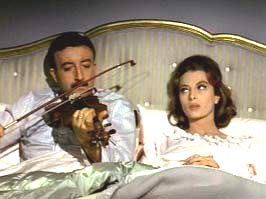
Inspector Clouseau in The Pink Panther, 1963
He lists three key elements:
The “fool” is someone with skills or powers that are overlooked or unnoticed by everyone except (sometimes) an antagonist who resents the fool’s success. Example: Inspector Dreyfus in the Pink Panther movies.
The fool is foolish to an establishment that opposes him or her. In Snyder’s words, “while he does not set out to do anything but live his life, it’s usually the establishment that’s exposed as the real fool in the equation. Have no fear, our unlikely hero won’t become a part of the system – or want to!”
Finally, Snyder says, a “transmutation” occurs for the fool. Sometimes this involves a change of name, as when Chance the gardener becomes Chauncey Gardner in Being There. It may be a change of life circumstance, like Goldie Hawn in Private Benjamin. It may involve gender swapping as in Tootsie and Mrs. Doubtfire. The fool’s mission may change as it does in Legally Blonde, whereReese Witherspoon first enrolls in Harvard law to win back her fiancé, but then discovers that law is her true calling.
Reese Witherspoon for the defense in “Legally Blonde”
Blake Snyder identifies sub-genres in stories about the wisdom of foolishness. “Political Fool” movies include Being There, Mr. Smith Goes to Washington, and The Princess Diaries. Films like Tootsie, Miss Congeniality, and Some Like it Hot are grouped together as “Undercover Fool” stories. Forest Gump and Zelig are “Society Fool” movies.
In addition to Legally Blonde, “Fool Out of Water” movies include Stripes, Beverly Hills Cop, and Crocodile Dundee.
Snyder is aware of the deep roots of these stories. The fool “has a bead on the truth,” he says, whether it’s Shakespeare’s Puck, saying, “Lord what fools these mortals be,” or Forrest Gump, who “can find a whole universe sitting on a bench waiting for a bus.” In discussing Gump, Snyder suggests that ultimately, the fool opens our minds and our hearts to spiritual wisdom.
I thought of an 11th century Buddhist master, Tilopa, who lived as an itinerant sesame seed grinder. A thousand years later, people still study his teachings, which are very complex in one sense, but can also be boiled down to these “six words of advice:”
Let go of what has passed.
Let go of what may come.
Let go of what is happening now.
Don’t try to figure anything out.
Don’t try to make anything happen.
Relax, right now, and rest.
Clearly such wisdom lies beyond the reach of anyone but a fool!
In literary gatherings, I usually introduce myself as part of the fantasy camp, but I’ve probably read and enjoyed just as many mysteries over the years. In my previous post, I gave a lukewarm review to James Patterson’s latest Alex Cross thriller. I think the real reason is that I’ve never bonded to Alex Cross the way I have to other favorite detectives.
Character is key to detective novels just as it is to other types of fiction, and this is separate from an issue that has surfaced over the last decade, the distinction between plot driven and character driven stories.
In character driven tales, some attribute of the protagonist begins and sustains the action, the way Katniss Everdeen’s sacrifice for her sister gets things moving in The Hunger Games. Mysteries are almost always plot driven – the story begins when the first body is found.
These days, agents and editors say they’re looking for character driven tales. Dan Brown wasn’t listening when he wrote TheDaVinci Code, now one of the five best selling books of all time, a distinction shared with The Bible and Harry Potter. Like much advice for writers, I think it misses the point. Regardless of what moves the action, we love novels with characters we love, in worlds we’d love to visit. Have you ever imagined yourself in Baker Street when Holmes jumps up and cries, “The game is afoot?”
If so, read on! I’ve listed a few of my favorite detectives, not necessarily in order, for that, like everything else, is subject to change.
Sherlock Holmes: This is obvious. How many popular books of today will still be read and loved 100 years from now, spawning a lively stream of new presentations in all the popular media of the future? I seldom reread mysteries – often there is no point when you know the criminal’s identity, but I still dive into Holmes for recreation. Has there ever been a more dastardly villain than Dr. Grimesby Roylott in “The Adventure of the Speckled Band?” And for chills up the spine, one sentence has never been beaten: “Mr. Holmes, they were the footprints of a gigantic hound!”
I enjoy all the presentations of Holmes in film, but my favorite movie Holmes is still Jeremy Brett for his perfect blend of genius and madness, without the slightest trace of modesty:
Cadfael: The Brother Cadfael mysteries were the creation of Edith Pargeter, under the pseudonym, Ellis Peters. In early 12th century England, during a period of contention for the crown known as The Anarchy, Cadfael, a middle aged and disillusioned veteran of the crusades, becomes a Benedictine monk. With keen powers of observation, a scientific turn of mind, and an in depth knowledge of herbalism, he solves the many murders that just happen to happen whenever he is near.
I enjoy the film versions more than the books, thanks to renowned Shakespearean actor, Derek Jacobi, who plays Cadfael.
Hercule Poirot and Miss Marple: Most writers are lucky if they can create a single unforgettable character. Agatha Christie gave us two. Sometime in the early 90’s, I went on an Agatha Christie binge, and over the next few years, read all the stories of both characters I could find, some 80 novels in all. Poirot and Miss Marple turn up often in films and on TV. I’ve enjoyed several versions of Murder on the Orient Express and Death on the Nile.
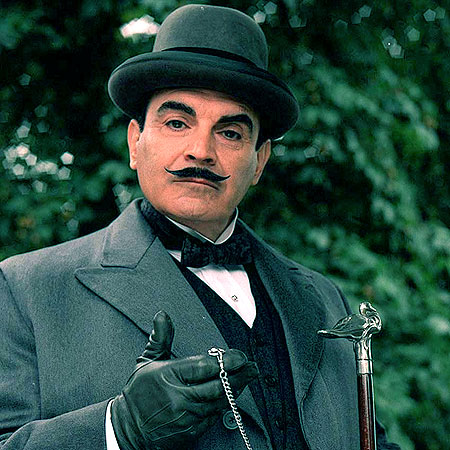
The bad news is that Miss Marple stories are usually classed as “cozy mysteries,” a sub-genre with a distinctly unmanly name. The good news is that I’m too old to care. There is no definitive movie Miss Marple, but British actor, David Suchet takes the honors for his portrayals of Hercule Poirot:
David Suchet as Hercule Poirot
Wallender: To re-establish my manly credentials, I add Kurt Wallender to the list. Wallender is sort of a Swedish, existentialist, high plains drifter, and the most angst-ridden detective in the history of the world. The creation of Swedish novelist, Henning Mankell, Wallendar was adapted for British TV, beginning in 2008. Episodes are show up here on PBS.
The series stars Kenneth Branagh, another great Shakespearean actor. Branagh says Wallender is “an existentialist who is questioning what life is about and why he does what he does every day, and for whom acts of violence never become normal. There is a level of empathy with the victims of crime that is almost impossible to contain, and one of the prices he pays for that sort of empathy is a personal life that is a kind of wasteland.”
Don’t watch this guy when you’re feeling blue!
Kenneth Branagh as Wallender
Jim Chee and Joe Leaphorn: These officers in the Navajo Tribal Police star in 18 mysteries Tony Hillerman wrote between 1970 and 2006. The grandeur of the American southwest and Navajo tribal beliefs are the background against which these unique detective stories unfold. Chee, the younger officer, struggles to hold on to tribal traditions in 20th century America. Leaphorn is more world weary and cynical, but he knows that where there is talk of witches and taboos, trouble erupts.
Hillerman, who died in 2008 loved the four corners and wrote about it so vividly that it’s really another character in the stories. His books won many awards, but he always said what pleased him most was being named a Special Friend of the Navajo Nation in 1987. Adam Beach and Wes Studi starred in three movie versions of Hillerman’s novels, including Skinwalkers, (the Navajo name for malevolent sorcerers), that is regarded as Hillerman’s breakout novel.
Amelia Peabody: Elizabeth Peters’ 19 book series centers on the adventures and detective skills of independently wealthy and independently minded Egyptologist, Amelia Peabody and her family, which at first includes her husband Radcliff Emerson (who hates his first name and refuses to use it), and their son Ramses, who was born as stubborn as his parents. Later Amelia and Emerson take in two wards, David, the son of a Muslim and a Christian whom they rescue from semi-slavery, and Nefret, a red headed former priestess of Isis who will eventually marry Ramses.
Set in the years between 1884 and 1923, there are rascals, rogues, adventurers, tomb robbers, mummy’s curses, and Sethos, aka, The Master Criminal. Historical Egyptologists and archeological events are woven into the series which ends with the 1922 discovery of the tomb of King Tut. The author has said that Amelia herself is based in part on Amelia Edwards, a Victorian novelist and Egyptologist, whose 1873 travel book, A Thousand Miles up the Nile was a best seller.
The middle east has changed since Peters began writing her novels, but they remain among my favorite beach reads of all time. For anyone who enjoys a good mummy movie or has ever fantasized lost tombs, pith helmets, and midnight at the oasis, these are great adventure stories, ever complicated by the corpses that turn up wherever Amelia goes.
I’ve only listed detective series here because I cannot remember every good singular mystery novel I’ve read. Please add any favorites of yours to the list. There’s always room for more, since the game is always afoot somewhere!
Fans of movies and fairytales will love this 1922 Cinderella (Aschenputtel), a 12 minute animated silhouette feature by Lotte Reiniger (1899-1981). Reiniger went on to create the first animated feature film in 1926. Those who appreciate the art of fantasy will want to know about Lily Wight’s blog, where so many finds like this appear.
The Vikings – a new, 9 part series on the History Channel
On Sunday night, I watched episode one of The Vikings, a new dramatic series on the History Channel that begins with the ambitions of an 8th century Scandinavian warrior and farmer, Ragnar Lothbrok, who has heard rumors of wealthy places to the west called England and Ireland.
I was especially interested in the series after visiting Iceland last fall and delving into Icelandic sagas which chronicle the same culture 200 years later, after they’ve mastered the art of navigation on the open sea. (search on “Iceland” on this blog to see the writings and photos that followed that trip). All the details on episode one fit what I learned in terms of historical accuracy. I’m looking forward to watching the next eight episodes in the series.
Episode one depicted a violent culture, but one with its own detailed code of honor. In that respect, it mirrored the Old Testament world presented in episode one of “The Bible,” which came on next on the History Channel. Plenty of smiting in both cultures.
I recommend the series. Anyone who is interested can check out episode one on Hulu: The Vikings on Hulu.
By now, everyone who cares has read accounts of the event – the winners and losers, the fashions, and the host. It’s tempting to add my own $0.02, but that’s not my purpose in writing this. It would be easy to get sidetracked if I tried.
With the glaring exception of failing to nominate Ben Affleck for Best Director, I thought the Academy had a number of worthy candidates to chose from and did a credible job in selecting winners.
This year, like most others, the major awards didn’t interest me as much as the “small” ones. Music, makeup, costumes. Screenplays, cinematography, film editing. The last three were tasks I learned while working on a student production in college – they are critical, difficult, and we hardly ever notice the names when the credits roll. These awards always remind me that movies are collective efforts. You see it especially in the memorials to those in the industry who died in the previous year – when they did their work well, it was seamless and we barely noticed.
In contrast to the production of movies, the myth of the solitary genius still lurks in our psyches. As far as I can tell, it’s an artifact of the 18th and 19th western romantic imagination. It has never appeared in the east at all, and the works of the Renaissance masters were mostly collective efforts. Leonardo, Michelangelo, and all the others had workshops where apprentices stretched the canvas or mixed the pigments, and journeymen painted the drapery. Then the master stepped in to finish the hands and the face of the virgin and child. Michelangelo painting the Sistine Chapel was an exception. I bet he would have advertised on TV it he’d had it available, like James Patterson, whose sometimes excellent novels are now collaborative efforts.
Old myths linger. In the early part of the 20th century, when movies were young, writers dreamed of the Great American Novel. Hollywood was a place where ill-starred authors like F. Scott Fitzgerald went to complete their fall from grace and die. Nowadays the fantasy is to write the next Twilight or Hunger Games and get the novel optioned.
Let me be explicit. Sometime during the last 50 or 60 years, movies became our most important artistic medium. Never mind that there’s lots of chaff in the wheat – across the globe, movies are where most of us go, most of the time, to find inspiration and learn about ourselves and the world we live in.
With this in mind, watching the Academy Awards made me sad when I thought of the future of the medium. During the past month, the local Board of Education announced 11 school closings. Parents and students showed up at several meetings to protest, and with its usual flair for drama, the paper published a photo of a girl with a sign saying, “Please don’t take our music department away.”
I thought about her on Oscar night. She probably won’t grow up to work on movie scores. How many other potential writers, musicians, artists, technicians, and designers who will do something else because our bureaucrats limit their options in the name of pragmatism?
Pragmatism is necessary but it doesn’t nourish the soul. I hope the next generation of dreamers continues to dream, against ever worsening odds. I hope we never look back on this year’s Oscars and think, “Ah, those were the days…”
Robin Rosenberg grew up with superhero comics. Later she shared them with her children, and after becoming a clinical psychologist, she studied them through the lens of psychology and discovered that “superhero stories are about morality and loyalty, about self-doubt and conviction of beliefs. I also saw that, like any good fiction, the sagas of superheroes bring us out of ourselves and connect us with something larger than ourselves, something more universal.”
Sometimes it seems that superheroes can’t get no satisfaction, but is that accurate? Not according to the opening essay in the collection, “The Positive Psychology of Superheroes,” by Christopher Peterson and Nansook Park. “One of the defining features of a superhero is an over-riding mission to serve the larger world and to defend it. In this sense, superheroes have profoundly meaningful lives.”
Peterson and Park assert that meaning is more important than pleasure in leading a satisfying life. That’s a good thing, because with a few exceptions, superheroes are challenged on the relationship front. I’ve always thought it’s the flaws embodied in the secret identities of Clark Kent and Peter Parker that bonds us to these characters. In one sense, they’re just like us, and their stories suggest that we too may choose the highroad.
Though superpowers isolate them from others, sometimes superheroes band together with superior results, according to the second essay in the collection, “The Benefits of a Group,” by Dr. Wind Goodfriend. This article may shed some light on why The Justice League of America functions more efficiently than your team at work or committees at church.
Another topic discussed in the book is the question of nurture vs. nature in the development of superhero psychology. Superman may have his powers through genetics, how did he come to use them for altruistic rather than narrow and selfish ends? Did he inherit those qualities too, or were they a result of his wholesome upbringing on a farm in America’s heartland? What would have happened if his pod had landed in New York City?
Good and evil are usually clearly drawn in superhero stories, but not always. In “Anti-Heroism in the Continuum of Good and Evil,” Dr. Michael Spivey and Steve Knowlton discuss the ambiguous, gray-zone nature of super anti-heroes and sympathetic villains (think of Darth Vader and Gollum). Each of the 18 essays in The Psychology of Superheroes addresses some facet of the super-psyche that you may or may not have wondered about.
Humans have relished hero tales for millennia. Superman joined the ranks 75 years ago, and if you’ve been to the cineplex lately, you know that his saga is going to continue this summer. The trailer for Man of Steel 2013 zeroes in on Clark’s inner struggles to understand who he is and why he is here. Earlier incarnations of Superman did not live in a world of such moral ambiguity and mistrust of the government, themes which place this telling squarely in the 21st century.
As The Psychology of Superheroes makes clear, what we really admire is not the superpowers but the hero, the one who overcomes their doubts and demons and then acts to make the world a better place. This book is a fascinating read in its own right and will whet your appetite for the new movie. It will give you some new perspectives on movies you’ve seen in the past as well as the comic books that once inspired some of us to run around wearing capes made out of bedsheets.
Biographies and history books seldom convey how messy our lives really are as we live them or how messy our politics are in the morning papers. We learn in grade school that Abraham Lincoln freed the slaves. Now Spielberg’s Lincoln brings us a movie portrait of just how uncertain, costly, and chaotic that effort was.
Lincoln spans the months between January and April 1865, as the president cajoled, sweet-talked, threatened, and offered political appointments to members of congress in order to pass the 13th amendment to the constitution which banned slavery forever. As a lawyer, Lincoln knew the Emancipation Proclamation, based on wartime powers he wasn’t even certain he possessed, could easily be struck down by the courts.
In tone, this is a post-heroic political movie that makes earlier visions, like Mr. Smith Goes to Washington, seem like hopeful adolescent illusions. Yet maybe there is even more to admire in someone portrayed as flesh and blood, who holds onto an ideal in the midst of political and personal chaos. We know the historical Lincoln agonized at the carnage of the last two years of the war and yet at the end, he allowed it to continue longer than necessary for the sake of an ideal that others considered madness.
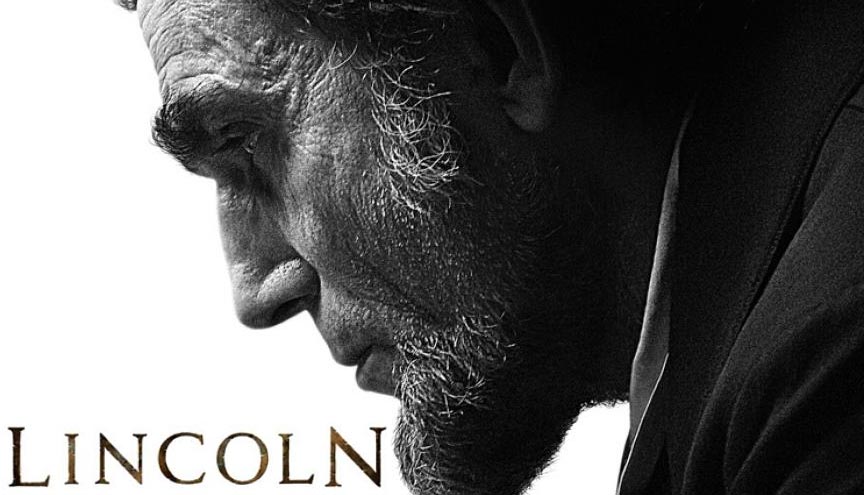
Daniel Day Lewis is an actor of definitive roles. For me, he became the definitive Hawkeye in The Last of the Mohicans 1992, and the archetypal 19th century criminal in his role as Bill the Butcher in Gangs of New York 2002. Now he will be the Abraham Lincoln for this movie going generation. With a fine supporting cast that includes Sally Field, Hal Holbrook, and Tommy Lee Jones, this movie will appeal to anyone with an interest in American History and fine drama.








 The First Gates