After Potter

Of course it is happening in your head, Harry, but why on earth should that mean it isn’t real?  –   Albus Dumbledore

The fact that everyone is weighing in on Harry Potter stands as a tribute to the impact the saga has had on us all.  There’s no doubt the release of the final movie is most poignant for those who grew up with the series; a span of 13 years for the books or 10 for the movies is huge when you are young.  Some of those who picked up The Sorcerer’s Stone in grade school have finished college.

Annie Ropeik, an intern at NPR suggests three adult fantasies for the “Hogwarts Grad.”  She calls one of them, The Magicians by Lev Grossman, a cathartic examination of the nature of magic and our relationship to the stories we wanted to live in as kids — required reading for anyone trying to recover from a lifelong love affair with a fictional world.  http://www.npr.org/2011/07/14/137802346/3-grown-up-books-for-the-hogwarts-grad

Note the language Ropeik uses, especially the word, “recover,” which suggests that a love affair with a fictional world is something we should fight the way someone “in recovery” uses the 12 steps to fight for freedom from an addiction.

I’ve been sensitive to this kind of nuance ever since one of my psychology professors, a colleague of James Hillman and Joseph Campbell, recommended The Neverending Story by Michael Ende with the comment that, “It’s about our culture’s war on imagination.”  Can we graduate from the fictional worlds we have loved and lived in?  Should we even want to?  According to Hillman, our greatest danger is literalism, the mind that is closed to fantasy, or rather, refuses to see the fantasy in all our realities and the reality of our fantasies.

Today may be a day to mourn the end of an era, but it is also a day to celebrate the gifts we have received from Rowling, the young actors, and everyone who worked on the movies.  They have given us an unforgettable world of imagination and dreams where courage and friendship matter, even when the odds are bad, in the struggle of good against evil.

Harry Potter Fan Fiction

Harry, Ron, and Hermione in The Sorcerer's Stone, 2001

Fan fiction did not begin with Harry Potter or the internet.  According to Lev Grossman’s article, “The Boy Who Lived Forever,” in the July 18, issue of Time, xeroxed fanzines appeared after the premier of “The Man from U.N.C.L.E.” in 1964, and really took off with “Star Trek.”

In the broader sense, telling original stories with borrowed settings and characters is nothing new at all.  Homer did not create the Trojan War, Achilles, or Odysseus.  Shakespeare did not make up either King Lear or Henry V.  But with the internet and Harry Potter, fan fiction has exploded.  There are more than 2 million pieces on fanfiction.net and more than a quarter of these are based on Potter – everything from short stories to full length novels.

The final movie will not be the end of original Potter creations

Grossman explodes most of the stereotypes of those who write and read these tales.  One 38 year old writer and actress says it’s like character improvisation.  A best selling fantasy writer whose novels have been optioned by Peter Jackson says, “Fanfic writing isn’t work, it’s joyful play.”  This raises the key question of why writer’s of fiction write.  Joyful play, a platform, and an appreciative audience are there – and it’s not like many creators of “original” stories get to leave their day-jobs.

Well known authors fall on both sides of the unanswered copyright issue.  J.K. Rowling and Stephanie Meyer encourage new fiction based on their characters and worlds.  Orson Scott Card, Anne Rice, and George R.R. Marin, author of A Game of Thrones do not, and threaten lawsuits.  It may or may not be coincidence that the authors Lev Grossman names as supporting fanfic are more recent and write for a younger audience than those who are in opposition and write for adults.  So far, all cease and desist requests have been honored, so there are no legal precedents in the world of fiction, though court cases involving music have been liberal in their interpretation of what constitutes “fair use.”

This begs the interesting question of who a character or world belongs to.  Groosman says that until recently:

Writers weren’t the originators of the stories they told; they were just the temporary curators of them.  Real creation was something the gods did…Today the way we think of creativity is dominated by Romantic notions of individual genius and originality and late-capitalist concepts of intellectual property, under which artists are businesspeople whose creations are commodities they have for sale.

Personally, I have always loved the poet’s invocation at the start of The Odyssey:  Sing in me, muse, and through me tell the story… 

In my experience, the “I” does not invent worlds or characters.  Whether you call it the muse, the gods, or the collective unconscious, fictional worlds and imaginal people come from somewhere else.  With a bit of luck and humility, the “I” may get to witness what happens, and may even get adept at finding new rabbit holes.  To me, the idea of “owning” a “product” of imagination smacks of hubris.

There is no real data on whether fanfic hurts an author economically.  Intuitively, I can only imagine it benefits Rowling and Meyer.  I hope so.  Creativity is creativity, regardless of what spark ignites it.  I’m thinking of dropping by some of the sites to see what these authors are up to.  For those who write for the joy of it, I wish them a lot more.

Victory to the Outsiders?

In 2009, 288,355 books were traditionally published in the US, and 764,448 were self-published.  The numbers for 2010 were similar, though I don’t have the exact figures handy.  A million new titles a year.  No wonder my book queue does not grow any shorter!

As the sheer quantity of books in print grows, the amount of advice for writers seems to grow too.  Four smiling faces stare at me from the cover of the new Writer’s Digest, next to titles of the following articles I will find inside (this is their “10” issue):

  • 10 Markets Open to New Writers
  • 10 Writing Myths Busted
  • 10 Ways to Start Scenes Strong
  • Bestselling Secrets for 10 Top Genres
  • 10 Ways to Stretch your Creativity
  • 10 Tips for Beating the Fear of Rejection
  • Take your Writing on the Road:  10 Inspiring Destinations.

Last week at the gym, I had a minor epiphany.  The talking-heads were doing their thing on CNN, and I realized the TV financial advisors and those who offer writing advice have a lot in common.  They can inspire; they can stimulate the flow of ideas; at the right moment, they can spark individual creativity, but no one who depends on them, who tries to practice their often contradictory advice is going to do better than average in either arena.

After my workout, I took a book out to the pool area for a read and a swim.  Summer poolside reading is a pleasure I jealously guard.  No reading to self-educate.  This is where I let stories carry me away.  Where I forget the million titles a year for the one I hold in my hand.

This time at the pool, I was rereading passages from the wonderful, Emerald Atlas, by John Stephens, that I reviewed here:  https://thefirstgates.com/2011/06/08/the-emerald-atlas-by-john-stephens-a-book-review/.  This time, because of my earlier thought train, I noticed all the rules Stephens broke in his novel.

Common “wisdom” says that not only is the omniscient viewpoint passe, but it confuses middle-grade readers – and yet here it was, masterfully executed and just right for the story.  Similarly, the consensus on the proper age for middle-grade protagonists is 12, yet  Kate is 14.

Fortunately for us, John Stephens had a successful career writing for television before he started his novel, so I’m guessing he hasn’t read how-to articles for writers in quite a while.  For here is a built in contradiction – if a million books are published each year, and the brass ring goes to those that step”out of the box,” we are not going to get there by heeding advice on how to get into the box!

I want to be very clear:  I am not disparaging learning one’s craft – badly handled omniscient viewpoints aren’t pretty.  What I am saying is that if we slow down and listen, won’t our stories tell us what they want?  If stories come from deep in the part of ourselves that dreams, isn’t it somewhat rude to meet them with an armful of rules?

I find myself wondering how many truly original novels were written by outsiders, people who bypassed the whole seductive promise of 10 Ways to Break Into Print.  Suzanne Collins, author of The Hunger Games was a TV writer like John Stephens before she wrote her novel.

Stephanie Meyer had not even written a short story before Twilight and had considered going to law school because she felt she had no talent for writing.  The idea for her vampire tale came to her in a dream, and she started writing because, after the birth of her first child, she wanted to stay at home and be a full time mom.  Echoes of the now-famous story of J.K. Rowling.

My cousin knew Jane Auel as a neighbor in a wooded Portland suburb, and never dreamed she was writing Clan of the Cave Bear at the kitchen table.  I doubt that the Inklings tried to tell Tolkien the proper age for Hobbits – 30 rather than 40.

What I am suggesting here – mulling over aloud, actually – is that all our lists of 10 Ways to do things are far less important than finding ways to remain Outsiders.  Outsiders who can dream without any fetters.  It isn’t easy, as anyone who even attempts it discovers, for the promise of an article or a friend’s advice on how to break into print can be as seductive as the lotus blossoms to the men of Odysseus’s crew.  Yet I am coming to believe it’s necessary to learn how to drop it all for extended periods of time.

For as the great Japanese teacher of Zen, Shunryu Suzuki said, “In the beginner’s mind there are many possibilities, but in the expert’s there are few.”

Gettysburg Day: The Third Day, July 3, 1863

On the afternoon of July 3, 1863, 15,000 men of General George Pickett’s division sheltered behind McPherson’s Wood during the fiercest artillery bombardment of the war.  Ninety minutes later, when the cannons fell silent, they passed through the wood and and marched over a mile of open ground to attack the Union center.

Numbers identify trees the War Dept. has identified as survivors of the battle

As you stand beneath the boughs of the trees, and gaze at the stone wall marking the Union position, it is almost beyond imagining what those men were feeling as they formed their ranks.  They were all veterans.  They probably knew what would happen as well as their commander, General James Longstreet, who did his best to talk Robert E. Lee out of the attack.  Lee would not budge.  His men had repeatedly done the impossible; maybe they would do it again at Gettysburg.

Where some of the generals wore plumes in their hats, talked of the bravery of southern manhood, and thought in terms of Napoleonic tactics, Longstreet was a pragmatist who knew that warfare had changed.  He had already invented a new kind of trench, anticipating the tactics of WWI.  He knew that bravery wouldn’t keep you alive when facing the fire of rifled muskets that were lethal at half a mile or when charging into cannons loaded with ball bearings.  He told Lee that no 15,000 men ever assembled could take the ridge, but he was overruled.  When Pickett asked, “Shall I go,” Longstreet could not even answer; all he could do was nod his head.

In one of the most tragic events of the Civil War, the men of Pickett’s division formed their ranks and moved over the fields in lines the northern men found stunningly beautiful, even as they fired their cannons and blew them apart.

Pickett’s 15,000 men suffered 60% casualties that afternoon.  As the survivors staggered back to the woods, Lee met them.  “It is all my fault,” he told the troops.  “All my fault.”  The south never had another chance to win the war.

The only brigade to reach the wall was led by General Lewis “Lo” Armistead.  His story illustrates the brother-against-brother tragedy of the Civil War.  Armistead and Union General John Hancock were close friends during the Mexican War and later in California.  On the night before they took separate trains to join opposing armies, they gathered with other officers to drink and sing and make tearful toasts to each other.  Armistead said, “May God strike me dead if I ever lift a hand against you.”  When he learned that he would have to march against Hancock, who commanded the Union center, Armistead did not think he would survive; he sent his family bible to Myra Hancock, his old friend’s wife.

Armistead was shot three times as he crossed the wall.  As union solders gathered around him, he said, “Tell General Hancock that General Armistead is so very sorry.”

This clip from Gettysburg is one of the most moving of the film and represents one of the saddest events in American history.  It is Armistead who gives the order to March.  It is worth noting that this scene, like most in the movie, was filmed on the Gettysburg battlefield, with the help of thousands of Civil War re-enactors who bring tremendous realism into all of the scenes involving the armies.

On the next day,  July 4, the Confederates reformed their lines as driving rain fell.  Lee hoped Meade would attack, mirroring his own mistake of the day before, but no attack came.  That night, the southern troops left the field and started their march back to Virginia.  Meade pursued the retreating Confederates, but half-heartedly, allowing the remnants of Lee’s army to escape.  WIth vigorous action, he might have ended the war – instead it dragged on for another two years.

What is YA and Who Reads It?

Recently someone suggested a novel to me, but cautioned that I might not like it because it was “women’s fiction.”  That sparked a mini-revelation.  I realized I read a lot of women’s fiction because I read a lot of young adult books, and the two have become synonymous.  As if to underscore the notion, an email from Amazon popped up in my inbox called, “New Releases in Young Adult.”  Of the ten recommendations, nine were by women, and the single title written by a man was a paranormal romance with a female protagonist.

That got me wondering about the history of YA, its origins, its audience, and its nature in the olden days, which I guess means before Twilight.  Wikepedia came to the rescue with a well done page on the history of YA fiction:  http://en.wikipedia.org/wiki/Young-adult_fiction.

The honors for coining the phrase, “young adulthood,” and distinguishing “books for children” from “books for young persons,” goes to Sarah Trimmer, in 1802.  Even so, 19th century publishers did not use any distinct classification for young readers, though some of the titles published remain classics to this day:  Swiss Family Robinson, Oliver Twist, Alice in Wonderland, The Adventures of Tom Sawyer, Kidnapped, and The Jungle Book to name a few.

The trend continued into the 20th century, and the roaring 20’s established young adults as a group apart, but it wasn’t until the 50’s and 60’s that “young adult” as a classification entered the publishing world.  The genre as we know it did not begin to emerge until the 70’s and 80’s, for books like The Catcher in the Rye (1951) and The Lord of the Flies (1954) bear little resemblance to what you find in the YA section today.  In case I’m being too subtle, I don’t really think that’s a good thing.

Neither did a thoughtful blogger named Annalee Newits, who posted a piece called, “Stop Writing Young Adult Science Fiction,” in 2008.  Though she writes in defense of her favorite  genre, her observations transcend such confines:

If we really want to open science fiction up to new readers, we won’t do it by dividing our audience up into smaller and smaller groups. Nor will we expand the minds of young people by telling them that they should only read specially-designated novels for young people. Why not admit that teens have a place in the world of adult imagination, and vice versa? Adults and teens are different in all kinds of ways, but surely they can meet in the world of fiction.  http://io9.com/5037686/stop-writing-young-adult-science-fiction

I posted earlier about my frustration one day when I cruised the blogs, in search of the “proper” age for protagonists in young adult vs. middle grade fiction.  It turned out that just as in real life, no one knew what to do with the 14 year olds.  The real question is why we are asking this question at all?  Who told us we have to, and why?

Ursula le Guin, Madeline L’Engle, C.S. Lewis, Tolkien of course, Mercedes Lackey, Robin McKinley, and Neil Gaiman – these are just a few of the names that pop right to mind when I think of writers who have played by their own rules, who have written stories for young adults that have weight, substance, and staying power, and defy our feeble attempts at classification.

The blurb for the young adult winner of the 2011 Amazon Breakout Novel Award begins, “In the increasingly crowded paranormal marketplace…”  Apparently that’s what it has all come down to in young adult – we introduce an award for excellence by noting how the book has positioned itself in the marketplace.

Life is way too short to play by this kind of rule.

The Emerald Atlas by John Stephens: A Book Review

I have said before, I often read middle grade fantasy for the sheer fun of it, and I recently picked up The Emerald Atlas, published in April by John Stephens.   Stephens comes from the world of television production where he wrote for “The Gilmore Girls” and “The O.C..”  He also produced and sometimes directed and wrote for, “Gossip Girls.”  Most interestingly, he says what he really wanted to do all along was write novels, but when he finished grad school, “I was pretty bad at it.  I really kinda stunk.”  Stephens learned his craft in Hollywood:

“Writing for Hollywood turns out to be a great training ground. You learn how to work on a schedule, tell a satisfying story, build character, construct scenes, you develop a feel for dramatic momentum…and you get to tool around the Warner Bros lot on a golf cart, which is kind of awesome.” 

He says working for television was so much fun he forgot about writing until he read Phillip Pullman’s, The Golden Compass and realized that “all” he wanted to do was write fantasy novels for children.  (thought he still misses the golf carts).

The Emerald Atlas is the story of three very special children whose parents mysteriously vanish when they are young.  One night when she is four, Kate’s mother slips into her room and insists that she promise to care for her younger siblings, Michael, two, and Emma, one. The three children are hustled to a waiting car driven by an elderly man who barely eludes magical pursuers in a chase reminiscent of Harry Potter.  After ten year of ever more awful orphanages where they never seem to fit in, the children are sent to an apparent “last stop,” facility in Cambridge Falls, New York, run by the mysterious Dr. Pym.

Dr. Pym, it turns out, is the wizard who had taken the children for safekeeping ten years earlier, to keep them from the grasp of the beautiful but evil witch who calls herself, the Countess.  The forces of both good and evil are interested in Kate, Michael, and Emma for they each have a magical bond with one of the three Books of Beginning, where the great wizards of old in Alexandria encoded their lore when the worlds of magic and humans began to seperate.

Kate’s affinity lies with the first book, The Emerald Atlas, which enables one to travel in time and space.  When they stumble upon the volume in Dr. Pym’s basement, Kate, Michael, and Emma are whisked into the past before they understand the powers they have awakened.  They become separated and fall under the power of the Countess and her minions.

There’s a lot to like in The Emerald Atlas.  The characters are nicely fleshed out.  Fourteen-year-old Emma, clever, brave, with intuitive understanding of magic, suffers under the burden of keeping her brother and sister safe, as well as the other children of Cambridge Falls.  Twelve-year-old Michael, who sometimes drives his sisters nuts with his camera, notebook, and bent for scientific experiment, has the thrill of his life when he meets real dwarves, the people he admires more than any other.  Eleven-year-old Emma is the feisty one – part of the reason they’ve been shuffled from orphanage t0 orphanage is Emma’s habit of mouthing off to prospective adoptive parents.  The three are desperate to locate their real parents and and learn who they really are.  The value of loyalty and family runs like a constant thread through the book, even through Michael’s betrayal and forgiveness, which is reminiscent of Edmund in The Lion, the Witch and the Wardrobe.

Something else I liked in the story was the complexity of the time-travel plot.  Traveling into the past creates alternative pasts and futures and things can get very complicated, but there is no simplification or condescension for young readers.  Humor that will appeal to all ages pervades the story as well:  “How was [Emma] supposed to know how to defuse a mine?  No one had ever taught her that in school.  Her classes had always been about useless things, like math or geography.”

This is the sort of book, like the Narnia tales or Harry Potter, that will appeal to readers of all ages.  With the cinematic sense of its author, I won’t be the least bit surprised to see it made into a movie.  Stephens said, in his Amazon interview, that none of the studios have contacted him yet, but I suspect it is only a matter of time.  I will certainly buy a ticket, just as I expect to read and enjoy the next two books of the trilogy.
First Family by David Baldacci: A Book Review

Sometimes you luck out and find good reads just by browsing, and so it was with David Baldacci’s First Family, 2009, an action adventure novel featuring private detectives Sean King and Michelle Maxwell.  As ex-Secret Service agents, both know Washingon, and in this case, the first lady, who calls them when her 12 year old niece, Willa, is kidnapped.

At first, we know who the good guys and bad guys are, and the breakdown of that certainty as the story moves forward is the single most telling feature of this tale.  In fact, for me, Sam Quarry, the mastermind of the kidnapping plot is likely to be the most unforgettable character.  He is ruthless, even fanatical, in the pursuit of his brand of justice, but then we see him stop in a nursing home to read Jane Austin to his daughter who has been in a coma for 13 years.  As the story unfolds, we come to appreciate the ingenuity he brings to bear on his personal concepts of right and wrong.  Our gradual understanding of what drives him parallels the fall of our admiration for several other characters who at first appeared virtuous but are revealed as anything but.

This is Baldacci’s fourth novel featuring the team of Sean and Melissa.  If I’d started the series at the beginning I might know why they left the Secret Service under clouded circumstances.  They are a compelling team, and the plot is complicated when Melissa’s mother is murdered in a separate event that parallels the main action when it leads to the exposure of family secrets.

The rhythm of a book, its pacing, is something very mysterious.  James Patterson sets a hook or mini-crisis every four pages, which is the length of his chapters.  Other writers speed things up even more

Baldacci steps away from constant thrills and chills.  Yes, there is the obligatory shootout early on, but the author also keeps us reading as he details the minute preparations Sam Quarry has made on his land in rural Alabama.  The little shack he has planned and constructed by hand is lined with metal and surplus dental x-ray blankets.  Why?  The video camera mounted almost invisibly near the cabin has a hidden feed to a bunker up the hill.  Why?  Quarry spends hours in the basement of his falling-apart family home, with charts and notes, illustrating a web of connections he has spent years uncovering.  We know just enough to keep us reading.  Baldacci knows that mystery and nagging questions can keep us turning the pages as eagerly as drama and shoot-em-up action.

I cannot say much more without giving away the plot.  I can say this – I am definitely going to read the first of the Sean King and Michelle Maxwell mysteries, and if First Family is any indication, I have a whole new series to enjoy.

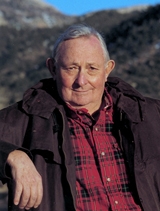
Tony Hillerman: An Appreciation

Tony Hillerman

Tony Hillerman

For many years during the nineties and the early part of the last decade, Tony Hillerman’s mysteries were a part of my annual celebration of spring.  In April or May his newest title would hit the bookstores – just in time for the beach or the pool at the gym.  “Beach read” is often synonymous with “guilty pleasure,” but I never feel guilty about enjoying good stories.

Hillerman is best known for the 18 mysteries set in northern Arizona and New Mexico and featuring Navajo tribal policemen Joe Leaphorn and Jim Chee, and later in the series, officer Bernadette Manuelito, who eventually marries Chee.  This series won Hillerman the 1974 Edgar Award, the 1991 Mystery Writers of America Grand Master Award, as well as the Navajo Tribe’s “Special Friend of the Dineh Award.”  Dineh is usually translated as “the People.”

The stories emphasize the Navajo ideal of living in harmony with the world and bring in themes from Navajo cosmology.  Many of Hillerman’s criminals are rumored to be witches – the worst thing you can become.  Leaphorn, the first detective in the series is skeptical, but…

Leaphorn didn’t believe in witchcraft.  He believed in evil, firmly believed in it, saw it practiced all around him in its various forms-greed, ambition, malice-and a variety of others.  But he didn’t believe in supernatural witches.  Or did he? (The Shape Shifter, 2006).

Chee, the younger officer, tries to walk in the worlds of both a modern policeman and a tribal shaman.  More than once, at the end of a case, Chee undergoes a traditional ritual to restore his balance and harmony.

Details of Navajo culture pervade all of Hillerman’s books and lend the restrained pacing of a people who think it rude to interrupt someone else who is talking.  In real time, the cops may have to drive a hundred miles to interview a suspect, but Hillerman keeps things moving by letting his detectives constantly mull over the compounding mysteries, and notice tiny details in the vein of Sherlock Holmes.

That said, the book I recently found, The Shape Shifter, the only one the Navajo mysteries I had not read read, is not where I would suggest a new reader start.  In places, it is a bit too slow, and it assumes we are familiar with the characters.

Skinwalkers (1990) would make a better first time Hillerman read.  This is the book where Leaphorn and Chee first team up, and the story is filled with supernatural menace.  Skinwalkers are especially nasty witches who change shape to harm others, like European werewolves.  Skinwalkers is one of three Hillerman titles featured on the PBS series, Mystery, with Wes Studi brilliantly cast as Leaphorn.

Skinwalkers movie

This is old-time detective fiction at its best, with the unique slant of a unique people, living in a remote and beautiful part of the country.  I only wish there were more of Hillerman’s books I hadn’t read.