Regulating Bloggers?

Disclaimer: I certify that I have received no financial renumeration, goods, or services for the content of this post.

I know you’re all shocked that the superPacs have yet to contact me, but under a proposal before the California Fair Political Practices Commission, bloggers expressing political opinions might have to insert such a disclaimer.  Last Thursday, FPPC chairwoman, Ann Ravel, announced plans to make such disclosure “suggested” for this November’s elections, and mandatory thereafter.  http://tinyurl.com/773olq2

This stirs up many questions, the first and foremost being, why?  Why focus on bloggers when we all know victory in this election will cost hundreds of millions of SuperPac dollars?  For attack adds on TV, not a few hundred blog posts.

The current FCC push to force TV stations to post the sponsors of political adds is news.  A district court decision to allow superPacs to solicit political add time on PBS stations is news.  The fact that bloggers post their opinions is not.

I believe some politicians cannot abide a medium that is beyond their control, and political blogging is a macguffin as defined in Neal Gabler’s marvelous book, Life, the Movie (look under Book Reviews here for more info). Gabler writes:

“It was with Kennedy in mind that Norman Mailer in 1960 prophesied that ‘America’s politics would now be also America’s favorite movie’…Candidates were the putative stars, the primaries open costing calls, the campaign was an audition, and the election itself the selection of the lead, while the handlers served as drama coaches, scriptwriters, and directors.  As for substantive issues, though they couldn’t be purged entirely, they largely became what film director Alfred Hitchcock…once called macguffins-that is, they were the excuse for setting the whole process in motion though they have virtually no intrinsic value.”

That helps me understand why Ms Ravel would float such a silly proposal.  How would the California FPPC try to regulate bloggers living out of state?  How much money would I have to rake in to be required to disclose?  Five dollars?  Fifty?  Five-hundred (I wish)?  Will twitter or Facebook users have to disclose as well?  What about book reviews?  Will I have to disclose which publishers are buying my pearls of wisdom?  What about lucrative Hollywood kickbacks for my movie reviews?

I think this proposal is a bluff intended to float the notion that bloggers need to be regulated, a move toward the slippery slope of controlling what we can and cannot say.  This being America, the pols still have to tie such actions to some concept of “fairness,” although here it’s pretty thin.  To go after bloggers who might somehow make a buck when Citizens United rules the day is like meeting a Martian invasion with mosquito spray.

But now it’s time for a quick commercial break:

Come on, SuperPacs, make me an offer!  Show me the money!  This space for sale!  Get it while you can!  Bargain prices!  Show me the money!  Will write for loot.  Everyone has their price.  Show me the money!  Did I say that already?  Try me out!

Call me….

What is Social Darwinism?

No, I am not playing Jeopardy, I’m considering the phrase Barack Obama used to characterize the recent House budget proposal.  I thought I had a good idea of what he meant:  survival of the fittest, applied to human endeavors.

I learned a lot more from an article in a New York Times opinionater blog post written by Philip Kitcher, John Dewey Professor of Philosophy at Columbia.  In his article, “The Taint of ‘Social Darwinism,'” Kitcher credits the birth of the concept to 19th century philosopher, Herbert Spencer, who first talked of “survival of the fittest.”  The phrase was never used to describe evolution but survival in the human jungle.  Kitcher characterizes the Social Darwinist view:

“Provided that policymakers do not take foolish steps to protect the weak, those people and those human achievements that are fittest — most beautiful, noble, wise, creative, virtuous, and so forth — will succeed in a fierce competition, so that, over time, humanity and its accomplishments will continually improve. Late 19th-century dynastic capitalists, especially the American “robber barons,” found this vision profoundly congenial. Their contemporary successors like it for much the same reasons.”  http://opinionator.blogs.nytimes.com/2012/04/08/the-taint-of-social-darwinism/?src=me&ref=genera

I can’t help thinking of Charles Dickens’ London, where “the fittest” is the pre-repentant Ebenezer Scrooge.

One not so grand irony is that many of our latter day Social Darwinists were born into wealth and opportunity, while truly self-made men and women, like Bill Gates and Oprah Winfrey, understand the value and necessity of supportive social structures.  In Kitcher’s words, “Horatio Alger needs lots of help, and a large thrust of contemporary Republican policy is dedicated to making sure he doesn’t get it.”

I urge everyone who has a stake in this debate – meaning all of us – to give Philip Kitcher’s article a read.

Bill Moyers Interviews Andrew Bacevich on the Middle East

On January 4, I published a post called, “Sabre Rattling Over Oil:  Better Get Used to It.”  http://wp.me/pYql4-1AT

I quoted from a 2008 interview between Bill Moyers and Col. Andrew Bacevich in which Moyers says, “Our finest warriors are often our most reluctant warmongers.”  Now we the privilege of hearing these two in a new discussion on Moyers & Company as we seem to drift helplessly toward our third war in a decade, and voices of reason and restraint are drowned out in the hysterical ranting of politicians.

Please be sure to look for the show on PBS this weekend, or watch it on billmoyers.com  http://billmoyers.com/episode/moving-beyond-war/

Andrew Bacevich on Moyers & Company

This week, on an all-new Moyers & Company, Bill Moyers and Bacevich explore the futility of “endless” wars, and provide a reality check on the rhetoric of American exceptionalism.

“Are we so unimaginative, so wedded to the reliance on military means that we cannot conceive of any way to reconcile our differences with groups and nations in the Islamic world, and therefore bring this conflict to an end?” Bacevich tells Moyers.

Bacevich also answers the question of whether Iran is a direct threat to America with a definitive no. “Whatever threat Iran poses is very, very limited,” he tells Moyers, “and certainly does not constitute any kind of justification for yet another experiment with preventive war.”

Andrew Bacevich is a West Point graduate and Vietnam veteran who retired as a colonel after 23 years in the military, to teach history and international relations at Boston University.

Doh! Now we (guys) are in for it!

NPR reports that in response to you know what, Democratic women legislators in six states have proposed new limits to male access to reproductive health care. http://www.npr.org/blogs/health/2012/03/15/148695307/in-protest-democrats-zero-in-on-mens-reproductive-health.   Consider:

House Bill 116 in Georgia states that:  “Thousands of children are deprived of birth in this state every year because of the lack of state regulation over vasectomies.”

An Oklahoma state senator proposed new legislation to regulate sexual acts:  “Any action in which a man ejaculates or otherwise deposits semen anywhere but in a woman’s vagina shall be interpreted and construed as an action against an unborn child.”

In Ohio, a female state senator sponsored a bill requiring men seeking drugs like viagra to:

  1. Have a cardiac stress test to ensure they are ready for sexual activity.
  2. Obtain written certification from a recent sexual partner that they are indeed experiencing erectile dysfunction.
  3. See a sexual therapist who would explain certain nonprescription lifestyle choices, such as celibacy, as alternate treatments for the problem.

***

It’s the very passion that people bring to these issues make them such effective smokescreens.  If “they” can get us asking the wrong questions…

We slide toward a third war in a decade with no hint of a national debate.  Recent news on Citigroup and Goldman Sachs reveal that the players who brought us the last financial meltdown are on track to do it again.  People know about Rush Limbaugh.  How many have heard of Greg Smith?

It used to be that “Nero fiddling while Rome burned” was the ultimate paradigm of irresponsible leadership.  Now it’s the 2012 presidential election.

And We Have A Winner!

That’s right, a winner in the: Caption the Condom Cartoon Contest  (announced here last week http://wp.me/pYql4-1MT).

There were at least a few positive outcomes after Rush Limbaugh’s slur of law student, Sandra Fluke, which inspired the contest.

1) One positive result:  I got to use some great alliteration in the contest name. 

2) Another bit of good news:  eleven sponsors bailed on Rush after his outburst.  Unfortunately, a Republican Super-Pac stepped in with bailout money.  Apparently some consider Limbaugh’s mouth too big to fail.

3) And best of all, at least for this blog, Camille w1ns a $10 Amazon gift card with her caption:

If only Rush’s parents had known how to use me properly… 

Please stop by Camilles blog and see what other clever things she is up to: http://poppycockandsomesuchnonsense.wordpress.com/

And thank you all for your entries and for stopping by to share a laugh!

Quiz: Who Said These Words on the Senate Floor?

No prize for the answer to this one, but in today’s climate, it is an eye-opener to realize these words were spoken by an earlier generation’s, “severe conservative.”  Unlike today’s crop, this man was always respected for his integrity and the strength of his convictions:

“I’m frankly sick and tired of the political preachers across this country telling me as a citizen that if I want to be a moral person, I must believe in ‘A,’ ‘B,’ ‘C’, and ‘D.’ Just who do they think they are? And from where do they presume to claim the right to dictate their moral beliefs to me? And I am even more angry as a legislator who must endure the threats of every religious group who thinks it has some God-granted right to control my vote on every roll call in the Senate. I am warning them today: I will fight them every step of the way if they try to dictate their moral convictions to all Americans in the name of ‘conservatism.’” – Sen. Barry Goldwater, Sept. 16. 1981.

From Richard Brenneman’s blog, eats shoots ‘n leaves: http://richardbrenneman.wordpress.com/

My First Ever, Caption the Cartoon Contest!

My recent resolution to stay more positive on this blog is challenged almost every time I pick up a newspaper or turn on the evening news.  Believing that laughter is better than tears, and in keeping with this week’s headlines, I’m announcing a little contest:

Thanks to istockphoto.com for this royalty-free cartoon

I’m guessing that everyone who isn’t living with wolves knows why poor little Mr. Happy is sad. I will award a $10 Amazon gift card to the best caption for this cartoon, submitted as a comment to this post by midnight PST, Saturday, March 10.  Multiple entries are encouraged.

***

If you have been on vacation, or on a media fast, or if you live in a country that still has real political debate, you may not have heard of the controversy over rules that require health-care providers to cover contraception even if it violates the conscience of certain faith-based employers.  Throwing gasoline on the fire, conservative talk show host, Rush Limbaugh, called Sandra Fluke, a third-year law student, a “slut” and “a prostitute” after she testified in favor of insurance coverage of birth control. http://www.sacbee.com/2012/03/03/4307985/contraception-fight-intensifies.html

So now that you know the story, what are you waiting for? Get busy writing your captions!

Life: The Movie by Neal Gabler – A Book Review

In his final movie, Being There, 1979, Peter Sellers plays Chance, a gardener with a low IQ, who becomes an advisor to the president and business tycoons. In one iconic scene, Chance is accosted by a knife wielding youth in Washington, DC.  He pulls out his TV remote control and clicks it to change the channel.  He is puzzled when the assailant doesn’t vanish.

Peter Sellers as Chance in “Being There”

This might be the perfect illustration for Neal Gabler’s, Life, The Movie:  How Entertainment Conquered Reality, (2000).  Gabler quotes historian, Daniel Boorstin, who wrote in the early 60’s that, “We risk being the first people in history to have been able to make their illusions so vivid, so persuasive, so ‘realistic’ that they can live in them.”  Done deal, according to Gabler, who calls us, not just a “post-modern culture,” but a “post-reality culture.”

At times I had to keep my own assumptions in check:  subjects like reality and imagination open onto psychological and spiritual vistas beyond the scope of this or any other single book.  But when Gabler cited concrete examples, I found myself nodding my head on almost every page.

“You know how to brood because you have seen Rebel Without a Cause,” Gabler says, quoting cultural analyst, Louis Menand.  “What better model does the world offer?”

Gabler charts the ascendency of entertainment in America from the early 19th century, where the split between high and low culture was fueled by our democratic suspicion of all elites.  Calling someone “aristocratic” was a serious insult.  During the 1840 presidential campaign, when a man called Daniel Webster an aristocrat, he thundered back that he’d grown up in a log cabin, and anyone calling him an aristocrat was “a coward and a liar.”  ( Sound familiar? )

Nathaniel Hawthorn despaired of the fate of serious writers amid the flood of “trash” being published.  One publisher sold four million dime novels in five years, at a time when the US population was only 25 million.

In 1850, 1% of the population owned 50% of the nation’s wealth and held almost all public offices.  Upward mobility was a myth, since 98% of that wealth had been inherited.  While the one-percent held the power, then as now, culture wars raged, sometimes with a violence that we (thankfully) haven’t seen yet.  One night in New York, rival Shakespearean actors, one British and one American, were both scheduled to perform, the former in an uptown theater, the latter downtown.  Police ejected the rabble who had bought tickets solely to heckle the British actor.  A much larger crowd gathered across the street to throw rocks as the “aristocratic” crowd tried to leave.  The militia was called, a riot ensued, and before the night was over, 22 lay dead and more than a hundred wounded.

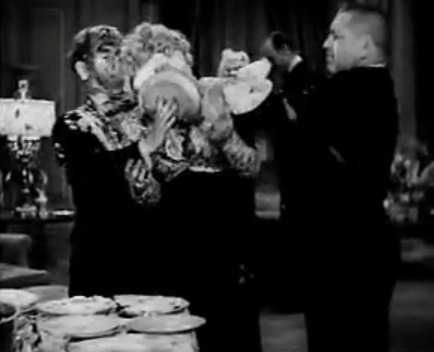
In the end, it was movies that won the day for popular culture.  The 1% stayed away from the early nickelodeons, which tended to be crowded and crass.  Later, with middle-class patronage, refined behavior became the norm, but the elite have never fared well in the movies, from the Marx Brothers  Night at the Opera, to the present, where a too-expensive suit is always the mark of a villain.

Three Stooges + high society + pies = disaster

As he charts the history of high vs. popular culture, Gabler makes a telling point.  It isn’t just about high brow and low brow – it’s about the ascendency of entertainment.  Being entertained is easy, and the corollary is that when the goal is entertainment, grabbing and holding audience attention is the supreme value, and “things that do not conform – for example, serious literature, serious political debate, serious ideas, serious anything – are more likely to be compromised or marginalized than ever before.”

Life: the Movie is a complex and disturbing book.  Gabler says in the introduction, it is diagnostic and not prescriptive.  To offer easy answers, he says, would be like the movie illusion where we meet the monster in act one and see it vanquished in act three.  Writing 12 years ago, Gabler said:

“One is almost compelled to admit that turning life into escapist entertainment is a perversely ingenious adaptation to the turbulence and tumult of modern existence.  Why worry about the seemingly intractable problems of society when you can simply declare ‘It’s morning in America,” as President Reagan did in his 1984 reelection campaign, and have yourself a long-running Frank Capra movie right down to the aw-shucks hero?”

I read this book after watching Neal Gabler speak on the fictions that lace the current election campaign on Moyers & Company, as I described in the preceding post. Because of it’s scope, I would recommend Life: the Movie only to those who want to delve into this issue in some depth.

But  I would recommend that everyone watch the ongoing conversation this year between Gabler and Moyers.  The confusions and illusions surrounding the political process are more convoluted than when the book was written, but Neal Gabler remains a reliable guide to pulling back the curtains and helping us draw closer to the truth.