A spring break medley

medley (med-lē) n., 1 a mixture of things not usually placed together; heterogeneous collection; hodgepodge.

A quiet week, with many ideas wandering through my mind without quite attaining blog post velocity. Sitting here, with a cup of coffee and the windows open to a fine spring morning, I decided to scoop up some of these notions, not necessarily in order of importance, and present them to you as a medley, or hodgepodge as the case may be.

On Mickey Rooney: I wish I had known that last Sunday, all day, Turner Classic Movies was  hosting a day of Mickey Rooney movies. I tuned in late, but did get to see Boy’s Town (1938) and The Human Comedy (1943), both notable for their idealistic and almost too sentimental presentation of American life. Boys Town tells the story of Father Edward Flanagan (Spencer Tracy), who founded a home for abused and delinquent boys in Nebraska. Rooney plays Henry Hull, the tough kid who tests Flanagan’s belief that there is “no such thing as a bad boy.”

Tracy and Rooney in "Boys Town," 1938

Tracy and Rooney in “Boys Town,” 1938

In addition to the real life humanity of Flanagan, whose Boys Town still exists in the Midwest, the film reflects 1930s progressive ideals, as well as an older, deeper, American romanticism, the belief that by nature, we are noble beings, corrupted only by cultural dysfunction. Watching Boys Town, I thought of the next great eruption of that ideal in the ’60s and remembered a line from Crosby, Stills & Nash that almost stands as an epitaph for that era: “It’s been a long time coming / it’s gonna be a long time gone.” The album came out in 1969, the year Charles Manson called optimism like Father Flanagan’s into serious question.   

Mother Nature on the run: Now that I’m thinking of Crosby, Stills & Nash, that phrase popped to mind as title for this subsection, though it’s really about animals on the run. An editorial in yesterday morning’s paper, The case for banning wildlife-killing contests by Camillia H. Fox, outlines the common practice of for profit, recreational predator hunting contests.
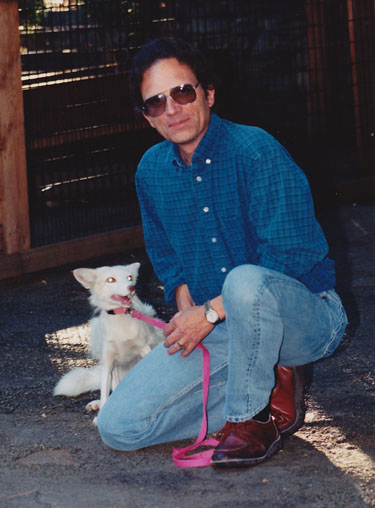
Exercising Vixen the fox while a volunteer at the Folsom City Zoo, ca. 1996. She was a sweetheart, though a bit of a drama queen. Is this the enemy?

Exercising Vixen the fox while a volunteer at the Folsom City Zoo, ca. 1996. She was a sweetheart, though a bit of a drama queen. Is this the enemy?

“The greatness of a nation and its moral progress can be judged by the way its animals are treated,” said Mahatma Gandhi. It is heartening to learn that pushback is growing, both from citizens and state Fish and Game Commissions. In California, commission president, Michael Sutton said:

“I’ve been concerned about these killing contests for some time. They seem inconsistent both with ethical standards of hunting and our current understanding of the important role predators play in ecosystems.”

The way we treat the animals seems increasingly to be like the way we treat each other. Witness the case cited in the article, of the organizer of one of these killing contests, who (allegedly) pushed a 73 year old man to the ground for trying to photograph the event. We have to say, “allegedly” because, although the older man’s spine was fractured, the perpetrator has yet to be charged. This is not what our founding fathers meant when they spoke of a “well ordered militia.”

Of Jungians and Tibetans: I’ve recently started, with keen interest, The Psychology of Buddhist Tantra (2012) by Rob Preece, an in depth practitioner of both Jungian psychology and Tibetan Buddhism. Tibetan iconography is striking and vivid, almost begging for Jungian analysis, but most western commentators, including Jung himself, have written about it as outsiders looking in.

Not Preece, who studied with Lama Thubten Yeshe, one of the greatest 20th century Tibetan teachers to come to America. Lama Yeshe understood Jung and understood that Buddhist practice has always undergone change when crossing geographic and cultural boundaries.

Preece writes of Col. Francis Younghusband, who visited Tibet in 1904. Seeing pictures of wrathful deities, Younghusband concluded that this was a culture that worshiped demons. Jungians may pounce on the concept of shadow, but that too, will often be wide of the mark. Although Tibetans and Jungians both understand such imagery as depicting internal qualities, in this case, it is wrathful energy in the service of compassion. It’s the energy of, “This shit’s gotta stop!” The energy that led Camilla Fox to start a foundation to stop the slaughter of animals.

Two large gatherings: Over the last two weekends, I took part in two separate events which drew hundreds of people. Both were immensely satisfying days of harmonious groups, drawn together by shared interest, working cooperatively and having a lot of fun doing so. It’s almost enough to make you believe in no such thing as a bad boy or girl, in Mickey Rooney’s America.

That fundamental goodness is precisely what the Tibetans and Buddhists in general believe, even with their finely honed awareness of both relative truth, here in the trenches, and ultimate truth. Our ultimate nature, they say, the ground of our being is pure, unstained by any event, the way the sky is unstained by pollution. The bad news is, it can take eons for us to figure this out; a weekend at Woodstock is clearly not enough.

Still, I always feel energized after such gatherings, even as that wrathful energy rises at the thought of all the artificial barriers that divide us in our day to day lives. That’s something everyone has to work out for themselves. Meanwhile, I felt like listening again to Crosby, Stills & Nash. I hope they’re right in this song: that it’s always darkest before the dawn.

https://www.youtube.com/watch?v=2DUqplxIcNk

The wishing tree revisited

I spent a lot of time this week staring at a blank screen while trying to sum up two recent posts (No discouraging words 1 and 2). The ways in which thought/stories create reality is a massive topic. Not only has it been central to eastern thought for thousands of years, but I wrote several chapters along those lines in a master’s thesis in psych. So that particular screen is going to stay blank.

I did, however re-read one of my early posts where I discussed an Indian story that centers on the creative power of mind. The story itself provides a nice summary. “The Wish Fulfilling Tree” is recorded in Hindu scripture as a story Shiva told Parvati. I quoted a version written by Paramahansa Yogananda which I like for its clarity:

Embed from Getty Images

In their kindness toward spiritual seekers, the gods placed certain “wish fulfilling trees” in remote Himalayan regions so pilgrims could refresh themselves. Once a young man with mixed aspirations climbed to the heights in search of one of these trees. At last, out of food and seemingly out of luck, he spied a solitary tree at the center of a small valley, and hurried toward it.

Under it’s branches he wished for a meal, and instantly, servants appeared and set out a feast before him. After his hunger was satisfied, he wished for wine and music, and then dancing girls, and all of his thoughts materialized. Enjoying himself immensely, he wished for a castle, with fruit trees, fountains, and soldiers to defend it.

By then he was tired and sought out the lush master bedroom for a rest. As he closed his eyes, he noticed a jungle not far away and felt a prickling of danger. “There are no bars on the window to keep jungle beasts out. A tiger could easily leap into this room.” Sadly, that was the last thought he ever had.

In his commentary, Yogananda said everyone spends their life beneath a wish fulfilling tree. Fortunately, ours don’t work as fast as the one in the story, but in the end, inexorably, they manifest what we hold steady in our minds. The name of this tree is imagination, and it is important to realize its power and be mindful of how we use it. it.

Thor: The Dark World

Thor-The-Dark-World-Poster

Sometimes the movies surprise you. On Friday, I saw The Muppets Most Wanted and wished I had waited for the DVD. Sunday I watched Thor: The Dark World on DVD, and was sorry I hadn’t caught it on the big screen.

As “the Convergence” approaches, a once every 5000 year alignment of the nine realms of the universe, portals between the worlds start to open at random.  Exploring one near London, Dr. Jane Foster, Thor’s mortal honey, is infected with the Aether, an ancient, indestructible weapon of evil that the gods of Asgard had hidden away.  The Dark Elf, Malekith, hopes to use the Aether to plunge the universe into darkness when the worlds align.

At the critical moment, Thor and his half-brother, Loki, the usual suspect in all things nefarious, team up to save the world and avenge the death of Frigga, their mother. Loki’s trickery fools Malekith into withdrawing the Aether from Jane and saving her life.  The movie has lots of explosions, and moments that echo both Lord of the Rings and Star Wars (though admittedly without the depth).  The forbidden love of immortal Thor and mortal Jane also parallels Superman and Lois, but for me, the character of Loki made the movie.

As I wrote in an earlier post, Loki the Trickster, has fascinated me since I read a book of Norse mythology as a kid.  Sometimes an ally and sometimes a nemesis of the gods, in the old stories, Loki was finally imprisoned under the earth for killing Baldr, the golden boy of Asgard, where he will remain until the final battle when this world will be destroyed.

Loki, from 18th c. Icelandic manuscript. Public domain.

Loki, from 18th c. Icelandic manuscript. Public domain.

The movie Loki is far more nuanced; he and Thor compliment each other.  Thor is ready to charge ahead, swinging his hammer against an invincible foe, while Loki embodies consummate strategy.

Loki and Thor plot their next move

Loki and Thor plot their next move

Loki, rejected by the Father of the gods and always subordinate to Thor, though he is older and smarter, is more the existential Outsider than any other movie superhero. Peter Parker may pine for Mary Jane, in a malt shop kind of way, and Clark gets tongue-tied near Lois, but Loki portrays the adult experience of not fitting in.

If you know what that’s like (and if not, why are you writing and reading blogs), you’ll enjoy this portrayal of Loki. The next time you’re in the mood for heroes, aided by Natalie Portman, saving the world, with help from a professor who runs around naked at Stonehenge, grab some popcorn and consider renting Thor.  It’s a fun ride.

A retreat with Edward Espe Brown

Edward Espe Brown

Edward Espe Brown

Saturday was the fourth time in as many years that I’ve attended a daylong retreat with Edward Espe Brown,  Zen abbot, author, cook, and altogether a charming and extremely funny man.  In 1965, Edward became a student of Shunryu Suzuki Roshi, author of Zen Mind, Beginner’s Mind.  When his teacher founded the Tassajara Zen Center near Big Sur, Ed became the head cook (as an author, he is best know for the Tassajara Cookbook and the Tassajara Bread Book).

Much of his learning took place in the kitchen, which gave him several unforgettable teaching stories. He relates his frustration in trying, without success, to produce a “perfect” muffin.  He tried numerous recipes and variations.  Everyone else thought they were great, but he was never satisfied.

One day he managed to taste a muffin without his usual preconceptions and found it delicious.  In that moment, he realized the source of his earlier discomfort – he’d been comparing his muffins to the “perfectly” shaped Pillsbury muffins he’d eaten as a kid.  This discovery led to one of the core ideas he tries to communicate as a teacher: we have the choice of living our lives according to someone else’s recipe or trying to discover our own.  “There is no by-the-book way for you to be you,” he says.

Given this background, it’s no surprise that he started the day by saying, “I’m not going to give you any meditation instructions, because then you might try to follow them – and be looking over your shoulder to ask, ‘How am I doing?”  The simplest instruction in Zen, “Just sit,” is the hardest to practice.  Similar things can be said for writing or painting (“Just write/paint what’s in your heart”) – and many other areas of life as well.

Such instructions (or lack thereof) assume the student knows the basics and some has experience.   This was true for the group that gathered on saturday.  It allows a generous teacher like Edward Brown to invite the student to seek what lies beyond a lifetime of learning how they are supposed to be.

Ed once said, “What is precious in us doesn’t come and it doesn’t go.  It is not dependent on performance.”  That’s a nice sounding aphorism, the kind of thing I jot down in notebooks.  Saturday’s retreat was a chance to test the waters, and as I hope I’ve made clear, at its best, Zen is about everything in our lives. I’d heard that Ed had written a new book, and it proved to be a fine example of finding our own way.

He has several traditional books in print on Zen and cooking, and he also edited a collection of Suzuki Roshi’s teachings.  When I’d read the title of his new book, By all Means A Zen Cautionary Tale, I assumed I’d be in for traditional reading.  Instead, I was surprised and delighted to find he’d written a semi-fictional, semi-autobiographical story of his adventures a little pig hand puppet.

When I asked him to sign a copy, I said, “This is great.  For my first 10 years, I had hand puppets.  They were my closest friends and confidents.”

“Ah, then you know,” he said.  “They’re powerful, aren’t they?”

In my next post, I’ll review By all Means, and after that, maybe the topic of conversing with inanimate things.  Please stay tuned!

——————————————————————————————–

PS:  When I posted this, I forgot to add a link to Edward’s home page, Peaceful Sea Sangha. In particular, I recommend the recordings of his talks, which give the flavor of his teaching style, his concerns, and his humor.

Media musings

I find most alliterative titles, like “Media musings,” to be about 40% cute and 60% annoying, but in this case, it’s a good match for the headline that inspired this post: “Ellen’s Oscar ‘selfie’ a landmark media moment.”

“A what moment?” I mused.  “A landmark media what?”

Because the media is falling over itself to celebrate Ellen’s tweet, and because nature abhors a vacuum, it has fallen to me to be the curmudgeonly voice of this “event.”  One of the first things a curmudgeon does is reach for the dictionary.  A “landmark event” is “an event, discovery, etc. considered as a high point or turning point in the history or development of something.” 

At first I thought it must be the high point of product placement.  The picture in question was taken with a Samsung phone, Samsung was a big Oscar sponsor, and the Academy Awards are the biggest post-Super Bowl marketing event.  But that’s not really new news.  Reading on, I realized the article referred to a landmark social media event. Since tweeting about TV isn’t new, an expert, in this case an Oscar co-producer, had to explain it to the likes of me:

“What it’s all about right now is creating a conversation, and social media allows for the conversation as it’s happening.”

Oh thanks, now I understand.

The dogs don’t like me being a curmudgeon, so while I was writing this post, Kit grabbed my (non-Samsung) phone and snapped a selfie, hoping to create a new conversation.

Kit snaps a selfie

Kit snaps a selfie

“It’s all about what’s happening now,” she says, explaining why she wants to establish a social media presence.

So the price I pay for being a curmudgeon is having to ask all you loyal readers to give my dog a tweet (she accepts treats as well).  After all, she is cuter than Ellen’s crew, and she hasn’t been real annoying since puppy days when she chewed up my wife’s phone.  That really happened, but it’s a story for another day, and right now I need to let you log onto your twitter accounts.  Don’t forget – it’s all about right now.

An unplanned television fast

CC BY-NC-ND 2.0

CC BY-NC-ND 2.0

We are a week into a major home reconstruction project that has about 2/3 of our living space sealed off against dust.  Bedroom, study, kitchen, and bath are available.  Internet too, since I carried the modem down to this end of the house.  A little cramped at times, but overall, just fine for a short period of time.

What surprises me is how little I miss TV.  More than that, it’s refreshing in many ways not to have it.  The sound was on at one of the TV’s at the gym and I found it so irritating I moved away.

It hasn’t been a completely video-less week.  One day we ventured out to the cineplex to watch Frozen.  Another evening we viewed an Agatha Christie mystery on youTube (the 13″ screen of my mac was ample).  On Friday, I watched a 20 minute Newshour segment on pbs.org.  And last night, we clambered through the dust curtains, out to the living room where the furniture is clumped, to watch the finale of Downton Abbey.

I’m not going to waste any time with polemics against television.  I enjoy several shows and of course, Turner Classic Movies.  I expect to watch those when the house is back to normal.  But a cautionary story came to mind as I looked for images for this post.

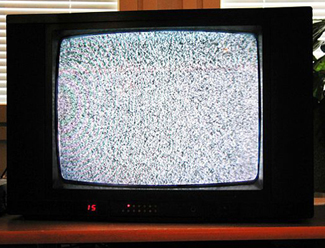
It’s possible some readers may not remember analog TV and the pre-404 no-signal pattern called “snow.”

Snow.  CC BY-NC-ND 2.0

Snow. CC BY-NC-ND 2.0

This always reminds me of Neal Stephenson’s visionary novel, Snow Crash.  Published in 1992, Stephenson envisioned a post-nation state world in which people lived as citizens of corporate territories.  The former United States still excelled at two things, computer micro-code and high speed pizza delivery, the latter because the mafia had taken over the business.

In 1992, the year I first got a windows computer, an 8K modem, and an AOL membership, Stephenson imagined virtual worlds where people created avatars to jack in and interact.  Then someone launched a virus that messed with people’s brains.  Anyone who opened this malware saw a pattern based on ancient glyphs that led to the Tower of Babel.  Viewing these symbols scrambled their neurons, in essence, turning their minds to snow.

What struck me this past week were the parallels to our current media world.  I can’t help thinking of all the ways that commercials, local news, political debates, and most of what passes for entertainment scramble our neurons, though much more slowly and in ways that leave us perfectly able to buy stuff.

I could say more, but this is enough – something to think about.

Posts I haven’t yet written

Quite a few of my posts begin with ideas that rattle around until research or mulling them over generates enough interest to get me writing.  Time for contemplation and research have been in short supply recently and are likely to be for the next week, so grabbing this moment, I decided to mention a few things I am working on that may or may not get posts of their own in the future.

Water

With the drought on everyone’s mind, I was tempted to write a piece on the symbolism of water.  The problem is, (1) the subject is huge, (2) it’s already been done, and (3) a Star Trek episode keeps me from starting.  Every time I remember the silicon creatures who called humans, “ugly bags of mostly water,” all my attempts to stay focused and serious fail.  According to Mr. Data, it’s an accurate description of our species.  Thanks, dude.

http://www.youtube.com/watch?v=paH97dYR6Lg

There’s another approach to discussing water in California that centers on economics and politics.  I could discuss the millions of gallons we pour into fracking wells.  Or I could mention the president’s three hour visit to Fresno, complete with a photo-op in a dry field before jetting off to Rancho Mirage, but I don’t think I will.  If I want to get depressed over water, it’s easier just to rent Chinatown.

I’m writing a letter

Not just any letter.  I’m writing a letter of condolence to someone whose dog recently died.  It’s one paragraph forward and two back.  Those who have lost a beloved pet will understand how this letter is siphoning off most of the emotional energy I’m willing to invest in writing at this time.

Too many choices

A chain of associations based on some of my own experiences led to a fascinating but huge subject, the difficulty of having too many choices.

photo by Alexander Acker, 2010, CC BY-ND-2.0

photo by Alexander Acker, 2010, CC BY-ND-2.0

In his 2004 book, The Paradox of Choice – Why More is Less, psychologist Barry Schwartz writes that seeking the “perfect” choice is “a recipe for misery.”  Other researchers say, “The current abundance of choice often leads to depression and feelings of loneliness,” and “Americans are paying for increased affluence and freedom with a substantial decrease in the quality and quantity of community.”

This kind of subject deserves elaboration, but if you don’t want to wait for me to get around to it, just Google on “too many choices” and see what you find.

I’m learning Spanish

Yup, I started last summer on Rosetta stone, for a variety of reasons, including (but not limited to, or necessarily in order of importance):

  1. It seemed like a good idea at the time.
  2. Languages are supposed to be good for the brain.
  3. One night, flipping through the TV listing, it seemed like it would be fun to watch El Codico DaVinci on the Spanish station.

One of my Facebook friends who knew me back when, reminded me that in 7th grade Spanish, I was a class clown.  The reason was simple.  I believed I was “no good at languages,” and it became a self-fulfilling prophecy.  There’s a lot of satisfaction in erasing that misperception.  I came upon the Spanish version of book I have in English yesterday and flipped through it before deciding I’d better start in the children’s section.  I wonder if they have cartoons on Saturday morning on the Spanish channels?

Meanwhile, I don’t know why mid-February should be so busy, but it is, and I have to move on to the next thing, so let me summarize this post.

  1. Water is good, though flooding is bad.
  2. Few things are harder than losing a dog.
  3. Choosing things can be iffy.
  4. Learning a language sometimes carries the kind of excitement that learning to read must have done when we were kids.

Feel free to quote me.  Until next time, when maybe I’ll manage to write a real post…

Part-time penury

Serfs

Between 1981 and 1984, I worked as a part time instructor at a community college in northern California.  Like most part-timers, I dreamed of the tenure track.  I was lucky.  At one point during a faculty meeting, I looked at all the other hopefuls, did the math, and realized I was on, if not a sinking ship, one that was dead in the water.  I started building a lifeboat and made my escape.

According to a recent NPR story, a million part-time, or adjunct professors, have not been so fortunate.  That’s 75% percent of U.S. college teachers who are stuck in part time positions; like workers at McDonalds, many rely on food stamps to get by.  Current pay for adjuncts is $2,000 – $3,000 a class with no benefits of any kind.  “Freeway fliers” is what we called ourselves when I was in the ranks, zipping between nearby schools to pick up any available classes.

One adjunct interviewed in a parallel story on the PBS Newshour teaches six English classes at three Ohio universities.  With a family to support, he couldn’t afford to stay home when he had pneumonia last fall.

At the time, I assumed the dismal prospects were my fault; I only had an M.A. and taught at a small town, two year school.  The articles make clear that although the trend began at two year schools in the 1970’s, it soon spread to all types of colleges and universities.

Peter Brown, professor emeritus of the State University of New York at New Paltz says the average salary of adjuncts there is $12,000 a year – less than the custodial staff.  “Between 1970 and 2008, the adjunct pay has gone down 49 percent,” says Brown.  “The salary of college presidents has gone up 35 percent.” 

In the 80’s we talked of organizing, and finally, three decades later, some colleges are granting part timers collective bargaining rights.  Twenty-two percent of adjuncts now belong to a union.  The death last fall of an 83 year old Duquesne University adjunct, who had taught for 20 years with good reviews, only to die impoverished, served as a wake-up call, as did a January congressional report that found adjuncts are treated like “cheap labor.”

In general, we get what we pay for, and as college students go ever deeper into debt, it’s worth asking what their education dollars are buying.  Well-to-do college administrations.  Top notch football teams.  A lot of professors too sick or stressed or busy commuting to hold decent office hours.  Ever fewer real-world prospects.  And…?

If we don’t want to end up singing “Glory Days” when we think of the long-gone time when American education was the best in the world, something will have to change.