What would James Hillman say about all this?

James Hillman (1926-2011)

James Hillman, a genius in the field of psychology, is largely unknown to the general public. Only one of his many books, The Soul’s Code (1997), is widely known, and only because Oprah featured it. Hillman’s long time friend and editor, Thomas Moore, wrote a tribute and summary of his life after his death in October, 2011. Moore said, “Jame’s books and essays, in my view, represent the best and most original thought of our times. I expect that it will take many decades before he is truly discovered and appreciated.”

Hillman, who was, for a time, director of the Jung Institute in Zurich, founded “Archetypal Psychology,” an extension of Jung’s thought, centered on the poetic, imaginal basis of psyche or soul: “Every notion in our minds, each perception of the world and sensation in ourselves must go through a psychic organization in order to ‘happen’ at all. Every single feeling or observation occurs as a psychic event by first forming a fantasy-image.”

He criticized most 20th century psychologies as materialistic and literal, giving no space to soul. With journalist, Michael Ventura, he co-authored We’ve Had a Hundred Years of Psychotherapy and the World Is Getting Worse (1992). He was vehement in his condemnation of the exclusive “inward” bent of most psychotherapies, which deprive the world of our outrage and our energy. He gave the example of a man who works eight or ten hours a day at a meaningless job, at an ugly, uncomfortable desk, under flickering florescent lights. When he goes to a therapist for relief from depression, he’s likely to be asked how he got along with his mother… Continue reading

The Summer of Love, Repression, and Stuff.

USA. Washington DC. Seventeen year old Jan Rose Kasmir, confronts the National Guard outside the Pentagon during the 1967 anti-Vietnam march. This march helped to turn public opinion against the war in Vietnam.

Dissatisfaction with the status quo gave birth to our nation, and has been part of our heritage every since. Fifty years ago this summer, this undercurrent burst into the loud and colorful limelight as 100,000 people gathered in San Francisco’s Haight Ashbury with mottos like Timothy Leary’s, “Tune in, turn on, drop out.”

I was a high school kid in San Jose, wearing torn jeans and love beads, reading the literature of discontent by authors such as Thoreau, Sinclair Lewis, and Nathanial West. After Saturday excursions to the head shops on Haight Street, with their incense and posters of Lakshmi and Ganesh, I bought a copy Zen Mind, Beginner’s Mind, a book I still have, and one which, fifty years later, I more or less understand, because doing so became one of the core priorities of my life.

“We are all outlaws in the eyes of America,” sang Grace Slick, and in the explosion of new music, art, literature, and the ideas of change embodied in The Whole Earth Catalog, there was a sense of expansion, a sense that we could stop the war, and we could leave the world of ticky-tacky houses, and create a nation where Peace and Freedom would reign as supreme values.

We didn’t understand our own shadows. We didn’t knew that Charles Manson was roaming the Haight during the summer of ’67, winning friends and influencing people with techniques he had learned from Dale Carnegie’s book, which he studied in prison. We didn’t know that “Do your own thing” was a double-edged sword, and that we would see bitter fruits of that motto fifty summers later.

*****

When I turned 40 in 1990, I was halfway through a Masters program in Psychology, which I’d entered in part because in the wake of the Summer of Love, I’d discovered Jung, Joseph Campbell, and Tolkien, and I couldn’t get enough of that stuff. And also because, the ethos of “Sex, drugs, and rock ‘n roll” doesn’t really work very well.

Yet when in that course of study, we came to look at the psyche’s defense mechanisms, most of us thought repression was a bad thing, inhibiting self-expression and individuation. I gotta do my own thing, man!

“Don’t be so fast to put down repression” said the instructor. “It’s one of the glues that holds a culture together.”

I’ve thought of this statement many times since then, never more so than when I read a woman’s letter to the editor in the local paper sometime in the mid-nineties, reporting on an incident she’d seen at a local multiplex. For whatever reason, no one was behind the concession counter, so some of the patrons clambered over the counter, help themselves to popcorn and drinks and then dash into the theaters.

That’s not quite what we meant by “Do Your Own Thing,” but it’s a pretty telling, canary-in-the-coal-mine kind of snapshot of the kind of societal breakdown parading through our streets this summer.

One of the four major functions of a living myth, according to Joseph Campbell, is “the sociological function,” which teaches us the norms of living together. “Thou shalt not kill,” for instance. Other roles are more dicey – gender and class roles for instance. These get rigid as times change, and are then modified by pioneers or movements, or in extreme cases, by revolutions if leaders are really stupid and tell their starving masses to eat cake.

Perhaps with enough acts of popcorn theft, large and small, because we feel entitled and we want what we want and we want it now – perhaps the kind of president we have was inevitable. Sooner or later, just as inevitably, he’ll go.

What will we do then? Will we be sickened enough by current events to turn in another direction together? What does a culture do when it’s fragmented by so many contradictory stories that Campbell’s sociological function of myth has completely broken down? What will it take to restore a genuine sense of “us” in our national life, a sense that we’re all in this together? The most obvious and frightening answer is a shared disaster.

Ironic to realize that the youthful idealism that brought us the Summer of Love, and two years later, the high water mark at Woodstock, carried the seeds of its own demise, partly because of the self-righteous sense of “us and them” that still drives our national life. And yet, it is profoundly valuable to review those youthful ideals, that sense of a better world within reach. Without such dreams, we are left with little better to do than rail at each other on social media.

“It’s been a long time coming,” sang Crosby, Stills, and Nash. “It’s going to be a long time gone.” It will come around again, sooner or later, but the question is, how long a time will that be?

My Fulfillment Package

retro-1310353_640

The voice on a recent robo-call, in the masculine-but-chirpy tone of a game show host, said, “Hi, this is Tod, here to tell you your fulfillment package is ready! Having just come from the meditation room, I wondered what kind of fulfillment Tod was selling. “Stay on the line for details on how to get your medical alert package.” I hung up.

We all know Big Data is watching our every keystroke, and that “secure information” is an oxymoron, but although “they” may have accurately placed me in the medical alert demographic, they don’t understand my idea of fulfillment.  Or do they?

Every “positive psychology” poll I’ve ever seen on the key factors of happiness lists “good health” as most important, so perhaps Tod wasn’t that far off.  Or so you might think, unless you’d seen the third annual Chapman University Survey of American Fears, which lists the flip-side of happiness, things that get in the way of fulfillment. The top fear, listed by 60.5% of the 1511 Americans surveyed was, “Corruption of government officials.”

Understandable, especially this year, but it also tells me that the survey is skewed toward a young demographic. Trust me, when you get old enough to care for a parent with Alzheimer’s, the things you fear change dramatically. Plus, I’m cynical enough to believe that “corrupt government official” is usually redundant – like speaking of “wealthy millionaires.” (There are 383 of those in Congress, by the way).

Here are the results of the survey:

  • Corruption of government officials (same top fear as 2015) — 60.6%
  • Terrorist attacks — 41%
  • Not having enough money for the future — 39.9%
  • Being a victim of terror — 38.5%
  • Government restrictions on firearms and ammunition — 38.5%
  • People I love dying — 38.1%
  • Economic or financial collapse — 37.5%
  • Identity theft — 37.1%
  • People I love becoming seriously ill — 35.9%
  • The Affordable Health Care Act/”Obamacare” — 35.5%

Interesting to note that by a small percentage, more of us fear losing our guns than losing our loved ones.  Nope, not my fulfillment package.

However, fear of clowns didn’t make the top ten, so perhaps we can let Stephen King off the hook….

Hungry Ghosts

Section of Hungry Ghosts Scroll, Kyoto, late 12th c., Public Domain

Section of Hungry Ghosts Scroll, Kyoto, late 12th c., Public Domain

In traditional Buddhist cosmology, there are six major realms of existence. Only two of these, the human and animal realms, are visible. The other four, which include both heavens and hells, are not manifest to our physical senses. Unlike Christian heaven and hell, none of these are forever – the length of one’s sojourn depends on karma.

Many contemporary teachers, while not denying the metaphysical reality of these regions, focus on our inner “location” in the here and now. One who is filled with love and compassion dwells in heaven. The one seething with anger, red in the face, like a devil, at that moment experiences one of the hells.

Hungry ghosts have a region all to themselves; their dominant trait is insatiable craving. Hungry ghosts are depicted with huge bellies but tiny throats and mouths – desperate hunger and thirst that can never find relief.

Never enough, there is never, ever enough,” is the mindset of hungry ghosts, both in the imagined subtle realm and in this world. Addictions and insatiable cravings of all sorts make us hungry ghosts. The pre-repentant Ebenezer Scrooge, the archetypal miser, is the best known western hungry ghost. Now, the Panama Papers reveal how widespread is this disease, and how it drives the leaders and elites in nations throughout the world. Nor do we, at least in “the free world,” get to sit back and righteously condemn “those bad people.” Not in Buddhist thought, at least, where everything is interconnected.

The people of Iceland forced their Prime Minister out of office within 48 hours of the time the story broke. They did the same with the bankers in 2008. We, who have elected officials of both parties who tolerate bailouts and corporate shell games, are are not separate from the hungry ghosts who are fucking this world.

In his public discourse, Buddha never commented one way or another on metaphysical truths. There’s plenty to worry about here and now, he said. If greed locks us into the hell of the hungry ghosts, generosity, the mindset of Scrooge on Christmas morning, opens the gates of heaven.

Ratnasambhava, the primordial Buddha of "the wisdom of equality," manifests the virtue of generosity.

Ratnasambhava, the primordial Buddha of “the wisdom of equality,” manifests the virtue of generosity.

Perhaps there are no big or small acts of generosity. Our world, the people in it, and we ourselves, need nothing more urgently at this time.

The medium is…

Republican debate

“The medium is the message”, said Marshall McLuhan in Understanding Media, 1964. Fifty-one years later, I’m still not certain we understand media, but a light bulb went on for me Thursday night regarding McLuhan’s iconic phrase. While watching the Republican presidential debate, I had a minor epiphany; that television cannot help transforming politics into entertainment.  

I am not suggesting that either party has a monopoly on show business.  Yes, the Republicans are likely to be funnier this year, with their Jerry Springer moments, and The Donald, who’s public persona is a weird combination of Rodney Dangerfield and Don Rickles.  I expect the Democrats to be far less interesting, more like infomercials on the home shopping channel.

There’s nothing new about politics as entertainment. If we believe television and movie depictions of pre-television and movie campaigns, there was plenty of bunting, and bluster, and brass bands in “the good old days.” But every now and then, wouldn’t it be refreshing to see something real happen on political TV?

The last time I saw reality break through was during the 2004 Democratic convention in Boston.  The Democrats had barred one of my heroes, the late Senator Robert Byrd, from the podium. Byrd could not be trusted to stay on script. Massachusetts Senator Kennedy invited Byrd to speak at the Old North Church, where Paul Revere worshipped, and his address was broadcast on Democracy Now. Byrd held up his well-worn pocket copy of the US Constitution and warned us that it was under attack…

Politics, of course, is not the only thing that TV flattens out. I recall several surreal moments with TV news. One early evening in college days, when I was living in an off-campus house, my roomies and I were watching a shoot out on Mod Squad on an old black and white TV. I went to the kitchen to fix a sandwich, and when I returned, the shootout had grown more intense; the house where the bad guys were hiding was on fire. But it looked different.  “Did somebody change the channel?” I asked.

“Nah, man,” said a house mate. “The news cut in. The cops are having a shootout with those guys who kidnapped Patty Hearst.” The visceral difference between watching a fictional versus a non-fiction firefight on TV was nonexistent without the dialog or voice over!

In a very real sense, that’s simply the nature of things according to both western depth psychology and Buddhist psychology. Every experience we have, noted James Hillman, begins as an event in the psyche. And Buddhist thinkers will tell you that our so-called realities are far more like the dreams we have at night than most of us dare to believe. Yet, as a practical matter, in order to make the right decisions, we have to be able to tell them apart, and that means turning a critical eye on the stuff we see on television.

I have recommended it before, but as we begin another presidential election mini-series, I can think of no better guidebook than Neal Gabler’s Life the Movie: How Entertainment Conquered Reality, 2000.  In it, he says:

“the deliberate application of the techniques of theater to politics, religion, education, literature, commerce, warfare, crime, everything, has converted them into branches of show business, where the overriding objective is getting and satisfying an audience.”

Unless we choose to live with the wolves, we’re going to be part of that audience, but at least we can remember that wonderful Buddhist bumper sticker:  “You don’t have to believe everything you think.”

Inside Inside Out, a review of sorts

In a culture that imagines a sharp mind-body split, it isn’t surprising to see images of a smart inner being controlling our physical “machinery.” Inside Out gives us a committee at the helm. Among feature length movies, it is unique in this respect, as far as I know.

Inside-Out-Meet-your-emotions-2

There are many points to ponder during the film’s 90 spectacular minutes of Pixar 3D animation, but given my background, I was especially caught by the movie’s alignment with a key post-Jungian view of the structure of the psyche.

Michael Ventura, a journalist who has written at length upon archetypal themes, and who co-authored We’ve Had 100 Years of Psychotherapy and the World is Getting Worse (1993) with James Hillman, said “There may be no more important project for our time than displacing the…fiction of monopersonality.” 

In Jung’s theory of archetypes, pre-eminent place goes to “The Self,” at once, the center of the psyche and it’s totality. The Self, for Jung, was the god image within us. The problem, according to both Ventura and Hillman, is that none of us ever experience ourselves this way. The idea of a unified, “monotheistic” Self is a longing rather than day to day reality, in Ventura’s words, “the longing of all the selves within the psyche that are starving because they are not recognized.”

Buddha came to a similar conclusion 2600 years ago, but Hillman, chose to rely on western models, and drew from Greek mythology to illustrate his conclusion that the psyche is “polytheistic,” with many archetypal centers.  A contemporary of Jung named these centers, “sub-personalities,” a term I have heard at least one Zen teacher use to illustrate the concept.

The Greek pantheon

The Greek pantheon

Thirty years ago, Michael Ventura wrote,  “It is crucial to every form of human effort that we forge a model of the psyche that is closer to our hour-to-hour experience, because, in the long run, as a society, we can share only what we can express.” (published in Shadow Dancing in the USA, 1985, now out of print but available used).

In the interim, nothing was actually forged – rather, a growing awareness of our “hour-to-hour” experience has emerged. How often do we say or hear others say, “Part of me wants to go left, but another part wants to go right?”

This awareness is now pervasive enough that it’s central to a summer blockbuster, aimed at a PG audience. Even if we don’t spend time studying differing models of the psyche, we understand Ventura perfectly when he says, “If you are alone in the room, it is still a crowded room.”

Imagining outcomes

This morning, I attended the funeral of a friend’s mother. She lived to be 92, had 14 great-grandchildren, was happily married for 49 years, and was lucid and even cracking jokes with those at her bedside until almost the end.

Almost everyone I talked or listened to commented on her outlook – positive, even when facing adversity. How central that seems to have been to this life well lived!

I’ve been thinking a lot about attitudes recently – actually almost daily, without coming to any clear conclusions. Through the course of the year, documented in various posts, I’ve been looking at views and outlooks, my own and others, from the perspective of which are helpful and which are not.

It’s easier to see in others. My mother lost her father when she was in grade school, as the result of a freak accident. I remember my mom in adulthood with a certain wariness, a backward glance over the shoulder, as if wondering when or how the next blow would fall. Be it nature or nurture, I’m coming to see how I carry the same trait, without even any such clear reason why. The good news is that when such things come to consciousness, we can look at them, and in observing they begin to change.

Along these lines, I remember an irreverent joke my father used to tell:

“Once there was a study to determine which children were optimistic and which were pessimists,” my father would begin. “One day a group of observers came through for a tour. In the first room they visited, a boy was crying his eyes out, even though the room was a virtual toy store, with shiny new bikes and every kind of playing you could imagine.

‘What’s wrong?’ one of the observers asked.

‘Everything’s so nice,’ the boy said. ‘I’m afraid I might break something.’

The group moved on to the next room, where they came upon another boy who smiled and sang as he shoveled his way through a mountain of horse manure.

‘How can you be so happy in all of this mess?’ an observer asked.

‘Easy,’ the boy said. ‘With all this shit, there’s gotta be a pony in here somewhere!'”

I know which boy I have been for most of my life. I also know which one I aspire to be!

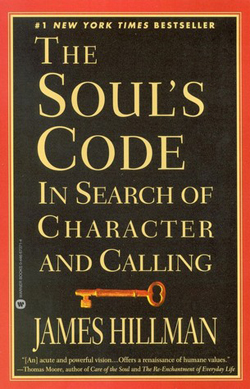
The Soul’s Code by James Hillman

the soul's code

James Hillman (1926-2011), a prolific post-Jungian psychologist, thinker, and cultural critic, wrote more than 20 books, but The Soul’s Code: In Search of Character and Calling (1997) is probably his best known work.

In a head-on attack upon the reductionist nature of both the nature and nurture camps of western developmental psychology, Hillman proposes a view of individual destiny based on Plato’s Myth of Er. Are we nothing but helpless products of our mothers in the first year of life or our luck-of-the-draw genetics? Or is there a deeper meaning to how we grow and unfold?

Hillman proposes an “acorn theory,” arguing that each acorn holds the pattern of the oak it may become, just as each soul that enters the world may bear a destiny shaped by intelligence rather than random chance: “what is lost in so many lives and what must be recovered [is] a sense of personal calling, that there is a reason I am alive.”

Hillman expounds his theory in a number of biographical sketches. He writes of Manolete, the most famous bullfighter of 20th century Spain. As a child, he was sickly and frail. “He stayed so much indoors and clung so tightly to his mother’s apron strings that his sisters and other children used to tease him.” Then, at the age of 11, he became fascinated with bulls.

Current psychology theory would hold that Manolete chose a macho vocation to compensate for his mama’s-boy childhood. Hillman wonders if somewhere deep inside, was “the acorn” that realized his destiny was to face down charging, thousand pound bulls, including the one that gored him to death at age 30. Of course that was too frightening a vision for a boy of 8 or 9 to hold!  Of course he held tight to his mother!

Hillman also discusses the childhood of Eleanor Roosevelt, one of the 20th century’s most influential women. As a child, Eleanor was “funny,” as well as “sullen, stubborn, spiteful, [and] sour…She lied; she stole, she threw antisocial tantrums in company.”

She lost her mother, a brother, and her “playboy father” before she was nine, but all the while carried on a vivid fantasy, “the realest thing in my life,” in which she lived with her father in a large household and traveled the world with him.

Psychotherapy would have regarded her fantasies as delusions and prescribed psychotropic medications to try to return her to normal. But what of the possibility that her visions meant something? What if her fantasies were “invented by her calling,” Hillman asks, and “were indeed more realistic in their orientation than her daily reality.”

“Imagination acted as a teacher, giving instruction for the large ministering tasks of caring for the welfare of a complex family, of a crippled husband, of the state of New York as the governor’s wife, the United States as its first lady, and even of the United Nations. Her fantasies of attending to “Father” were a preliminary praxis into which she could put her call, her huge devotion to the welfare of others.

Hillman is always provocative, inviting us to look deeper into, or “see through” the ideas that limit soul and it’s individual expression. Psychological literalism is often in his crosshairs, as when he says, “Our lives may be determined less by our childhood than by the way we have learned to imagine our childhoods.”

James Hillman, 1926-2011

James Hillman, 1926-2011

The Soul’s Code is a challenging book, but valuable as it sheds new light on many unquestioned assumptions about development, the individual, and destiny that need to be questioned.