“Affirmations are simply the practice of repeating to yourself what you want to achieve while imagining the outcome you want.” – Scott Adams
For a long time, the word “affirmation” brought to mind, “Every day in every way, I am getting better and better.” When you see it in print like that, it’s hard to believe and easy to dismiss. The phrase was created by Emile Coué (1857-1926), a French psychologist and pharmacist who developed a method of psychotherapy based on autosuggestion.
Later, when I studied the teachings of Paramahansa Yogananda, I found a broader concept of affirmations and why certain types of suggestions work for certain types of people. In Scientific Healing Affirmations, (1925), Yogananda wrote:
“Imagination, reason, faith, emotion, will, or exertion may be used according to the specific nature of he individual – whether imaginative, intellectual, aspiring, emotional, volitional, or striving. Few people know this. Coué stressed the value of autosuggestion, but an intellectual type of person is not susceptible to suggestion, and is influenced only by a metaphysical discussion of the power of consciousness over the body. He needs to understand the whys and wherefores of mental powers. If he can realize, for instance, that blisters may be produced by hypnosis…he can understand the power of the mind to cure disease. If the mind can produce ill health, it can also produce good health.”
Recently, I found an even simpler testimonial to the power of affirmations in Scott Adam’s book, How to Fail at Almost Everything and Still Win Big. Discussing affirmations in an earlier book, Adams drew negative email from people who claimed he believed in magic. In two chapters of his latest work, Adams lays out the principles of affirmations without venturing any guesses on why they have worked for him, with the exception of one simple principle:
“The pattern I have noticed is that the affirmations only worked when I had a 100 percent unambiguous desire for success.”
He then summarizes his experience with affirmations, leading up to the big one in his life: “I, Scott Adams, will be a famous cartoonist.” As the book makes clear, he was already working in the field and committed when he practiced this suggestion.
I recommended How to Fail when I reviewed it, and the chapters on affirmation alone are worthy of another recommendation.
Last Friday, August 15, the theme of National Public Radio’s “TED Radio Hour” was “Simply Happy,” and carried the message that “finding happiness may be simpler than you think.” Narrator Guy Raz reviewed the ideas of five speakers whose TED presentations focused on happiness as something that can be cultivated.
Matt Killingsworth, a researcher at UC San Francisco, gathered real-time input from 35,000 people via a simple smart phone app one can register for at trackyourhappiness.org. Several times during the day, volunteers receive three questions on their phones:
1) How do you feel right now? (on a scale from very good to very bad).
2) What are you doing? (check one of 22 choices).
3) Are you thinking about what you are doing? (as opposed to “mind wandering”).
Killingsworth discovered that 47% of the time, people are thinking of something other than what they are doing (ranging from a high of 65% when taking a shower, to an interesting 10% whose minds wander while having sex). His finding, across all activities is that “people are substantially less happy when their minds are wandering.” This includes even unpopular tasks like commuting to work. He concludes that “mind wandering is a cause rather than a consequence of unhappiness.”
Though he doesn’t cite the growing interest in mindfulness meditation practice, it’s significant that recent articles in Scientific American have mentioned studies of this practice, including Is Mindfulness Good Medicine, which appeared on the Scientific American blog the day before NPR posted Killingsworth’s findings.
Carl Honore is a journalist and the author of In Praise of Slowness: Challenging the Cult of Speed (2005). He claims our world is “addicted to speed” and living “the fast life rather than the good life.” He says his wakeup moment came when he realized he was speed-reading bedtime stories to his young son, compulsively rushing through one of the richest times of his day.
Honore says we are “so marinated in the culture of speed that we almost fail to notice the toll it takes on every aspect of our lives – on our health, our work, our relationships and our community.” For one thing, speed and adrenaline can be exciting. For another there is a strong cultural bias that equates slowing down with being a slacker. One common meaning of “slow” is “not very bright.”
Honore says he still enjoys the fast pace of life as a journalist in London, but he is now “in touch with his inner tortoise,” and doesn’t unconsciously overload himself. “I feel like I’m living my life rather than actually just racing through it. So is it possible? That’s really the main question before us today. Is it possible to slow down? And I’m happy to be able to say to you that the answer is a resounding yes.”
Graham Hill was an early ’90’s internet millionaire by the age of 30. He sold the company he had built with friends, and then filled “the void” he felt inside with stuff: “I bought a 3,600 square foot home, Volvo sedan, tons of furniture, gizmos, technology, stereos, probably had one of the first MP3 players. You can’t believe how much stuff.”
Unlike most of his wealthy peers, Hill realized his stuff wasn’t making him happy so he got rid of most of it. He now lives in a custom designed, 420 square foot New York City apartment that is wonder of space efficiency:
Hill notes that Americans use three times as much space as we did 50 years ago, yet we have still spawned a $22 billion dollar, 2.2 billion square foot self-storage industry. Other consequences include, “Lots of credit card debt, huge environmental footprints, and perhaps not coincidentally, our happiness levels flatlined over the same 50 years. Well, I’m here to suggest there’s a better way – that less might actually equal more.”
Dan Gilbert, Harvard Psychologist and author of Stumbling on Happiness (2007), spoke in his talk of the many ways in which our happiness does not depend on circumstances or getting what we want. Humans are resilient enough, he says, to recover from serious trauma, though imagination generally tells us otherwise. Gilbert cited three cases, drawn from a single edition of the New York Times.
Jim Wright, Speaker of the House of Representatives before Newt Gingrich, resigned in disgrace after a scandal involving “a shady book deal.” He lost his position, reputation, and money, but now says, “I am so much better off physically, financially, mentally and almost every other way.”
Pete Best, The Beatles’ first drummer, was replaced by Ringo Starr just before the band became world famous. Still a drummer and studio musician, Best says, “I’m happier than I would’ve been with The Beatles.”
And most dramatic to me was Moreese Bickham, 78, released from prison because of DNA evidence after serving 37 years for a crime he did not commit. Upon release, Bickham said, “I don’t have one minute’s regret. It was a glorious experience.”
Baring “extraordinary” people like Gandhi or Nelson Mandela, we can hardly imagine prison as being worthwhile, let alone “glorious,” but Gilbert uses these and other examples to underline the power that “reframing” events has on our outlook. The stories we tell and the meaning we find in experience are critical. “It is wrong to say that we have no control over our happiness. It is wrong to say that we have complete control over our happiness. We have some input into how happy we will be…We can learn to see events in a constructive and positive way.”
Brother David Steindl-Rast, a Benedictine monk, has devoted himself to interfaith dialog and the interaction of religion and science. His TED topic was gratitude, as one might expect of a man whose home page is gratefullness.org. He says most people think we are grateful when we are happy, but the opposite is true: gratitude leads to happiness.
He outlines a simple way to cultivate gratitude, beginning with stopping our minds and our busyness to reflect that “You have no way of assuring that there will be another moment given to you. And yet, that’s the most valuable thing that can ever be given to us. We say opportunity knocks only once. Well, think again – every moment is a new gift, over and over again, and if you miss the opportunity of this moment, another moment is given to us, and another moment. We can avail ourselves of this opportunity or we can miss it. And if we avail ourselves of the opportunity, it is the key to happiness.”
Such a simple step, repeated, carries great weight, for Steindl-Rast reflects that grateful people are not fearful, and if we are not fearful, we will not be violent. “If you’re grateful, you act out of a sense of enough and not from a sense of scarcity, and you’re willing to share.If you’re grateful, you’re enjoying the differences between people and you’re respectful to everybody, and that changes this power pyramid on which we live. And it doesn’t make for equality, but it makes for equal respect, and that is the important thing. A grateful world is a world of joyful people, grateful people are joyful people. And that is what I hope for us.”
***
The question of attitudes and habits that lead to wellbeing has emerged as the key theme of theFirstGates this year. I’ve posted ideas from Carl Jung, the Dalai Lama, and Scott Adams, creator of Dilbert. Here are five more voices (and more to come) saying that happiness is not an accident, not given to a few select or fortunate people. It is a choice we can all make, a direction we can aim for at any given moment
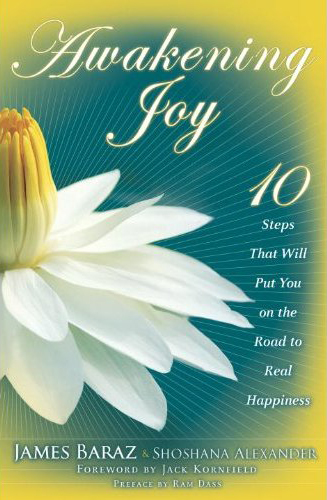
In March, I reviewed Scott Adams’ latest book, How to Fail at Almost Everything and Still Win Big. It has much in common with the book I’m reviewing today: both focus on the myriad, day-to-day choices we make and how they can steer us toward or away from the lives we want to live.
Though one of the numerous “failures” Adams recounts was a book on meditation, he wrote How to Fail in purely secular terms. Baraz, who took up the study of mindfulness meditation in 1974, writes from a Buddhist perspective, but says, “many people, including myself, consider Buddhism to be more a philosophy than a religion, a way to live a harmonious life.” This tone should make Awakening Joy accessible to people of any faith or no faith.
Baraz, a founding member of Spirit Rock, first taught an Awakening Joy class in his living room in 2003. In working with initially interested but skeptical students, who didn’t just want to sit around singing Kumbaya, Baraz honed the presentation that is encompassed in his book and a five month online class.
The book has ten chapters or “Steps,” which center on topics like mindfulness, compassion, forgiving oneself, and letting go. In some ways the first step is most challenging – figuring out what “joy” means personally and accepting that we want it and deserve it, now and not at some future time when we will have “earned” the right to feel good.
Baraz quotes the Buddha who said, “Whatever the practitioner frequently thinks and ponders upon, that will become the inclination of the mind.” Can it really be that simple? Anyone who has ever tried to meditate knows that working with the “inclination of the mind” may be simple but isn’t easy.
Awakening Joy is written with simple concepts, personal stories, and exercises designed to cut through our suspicion that feeling good means becoming Pollyanna. We’ve all seen small children manifest joy. What happened to us along the way? Baraz presents a series of simple steps designed to help us turn back toward the direction we’d rather travel.
Sometime during the first semester of graduate work in psychology, our clinical practice professor made an interesting observation. “The funniest people I know,” she said, “have all deeply experienced sorrow.” Her words came back when I heard we had lost Robin Williams.
They say he suffered from alcoholism and depression, both progressive, fatal diseases that can be arrested. Interestingly, the media has done much to remove the stigma from both conditions. Ted Danson, as bartender, Sam Malone on Cheers, helped normalize an alcoholic abstaining and going to meetings. And the constant din of TV antidepressant commercials has probably primed millions to “Ask their doctor” about this oh so modern affliction.
Untreated depression, like untreated alcoholism, puts a person at risk for suicide, accidents, and poor health choices that end too many lives far too early. It’s futile to speculate on why some people reach out for help and others do not, but no individual, not you nor I, is a statistic. We are not bound by any kind of odds.
In this world where information is so easy to come by, it is my hope than anyone who sees in themselves the conditions that took Robin Williams from us may hit google and check out the mountains of information on what they may have and what can be done about it.
Subtle body from 1899 yoga manuscript. Public domain.
One of the key themes emerging for me this year, both in living and blogging, involves mental hygiene, in particular, watching what ideas and thoughts I dwell on. I tried to express it in posts like Guarding the Mind and The Wishing Tree Revisited. Cheri Huber a Zen teacher, sums it up like this: “The quality of your life depends on the focus of your attention.”
As I check out things online, I bookmark articles that look like they might lead to interesting posts. Several recent posts center on a parallel theme, the intimate connection of mind and body.
The first comes from Julieanne Victoria’s blog, Through the Peacock’s Eyes. In a post called, Effect of Thought on Health and the Body, she describes a small book by James Allen, amazing because of its visionary nature – it was written in 1902 and published in 1920.
Nowadays we’re used to seeing people practice Tai Chi in parks. We find yoga classes at local gyms and hear of corporate executives learning mindfulness meditation. A discussion of the ends and means for lifting such practices out of traditional contexts is a topic for another time. The point is, general awareness of the mind-body connection snowballed in the west in the latter half of the 20th century. I think it’s just beginning, which makes James Allen’s conclusions, penned 112 years ago, all the more unique. Check out Julieanne Victoria’s post. It is inspiring to read these words of a man who understood these truths before almost anyone else in our culture.
One manifestation of the mind-body connection that everyone knows about involves stress. Stress is bad and A-Types have it worst, right? What if you learned, as I did in a recent NPR article, that almost all of the studies that created “stress” and “A-Type” as modern words and concepts were funded by big tobacco companies, seeking to prove that stress and not cigarettes, cause heart problems and cancer? This article is an eye opener, and not because of this single topic. It’s illuminating to see how far money can go in creating the “truths” we try to live by.
The final post that caught my attention comes from the Scientific AmericanBlog, What does Mindfulness Meditation do for your brain. Leaving aside all questions of what might be lost in separating mindfulness practice from it’s Buddhist context, the benefits appear to be compelling:
“It’s been accepted as a useful therapy for anxiety and depression for around a decade…It’s being explored by schools, pro sports teams and military units to enhance performance, and is showing promise as a way of helping sufferers of chronic pain, addiction and tinnitus, too. There is even some evidence that mindfulness can help with the symptoms of certain physical conditions, such as irritable bowel syndrome, cancer, and HIV.”
Beyond these experiential findings, the Scientific American post presents a powerful physiological finding. MRI scans of people after an eight week mindfulness meditation course show the amygdala shrinking. This is the brain’s fight or flight center, associated with emotion and fear. At the same time, the pre-frontal cortex, “associated with higher order brain functions such as awareness, concentration and decision-making,” becomes thicker. In addition, brain links are altered: “The connection between the amygdala and the rest of the brain gets weaker, while the connections between areas associated with attention and concentration get stronger.”
These few posts are just the barest notes on a huge topic, but one I find fascinating. I’ll be posting more as I see more interesting stories along these lines.
I find the tinfoil helmet image is always good for a laugh – don’t want those pesky aliens messing with our thought patterns! At the same time, we all know aliens aren’t the problem. I recently read a statistic that in the US, we see as many advertisements in a year as people 50 years ago did in their lifetimes. Advertisers explicitly set out to mess with our thought patterns. Now an NPR post reveals that “Facebook scientists” have messed with our thoughts as well.
The Bride of Frankenstein, 1935
Here’s the gist of their experiment:
“For one week back in 2012, Facebook scientists altered what appeared on the News Feed of more than 600,000 users. One group got mostly positive items; the other got mostly negative items.
Scientists then monitored the posts of those people and found that they were more negative if they received the negative News Feed and more positive if they received positive items.”
Experimental methods rapidly followed the birth of psychology in the last century as social scientists sought acceptance into the real community of science. Freud, after all, won his Nobel Prize in literature, not science.
Back in the day, psych experiments were conducted on helpless animals and hapless college students who needed to make a buck. Now, Facebook Scientists (don’t you wish you could see their credentials?) can run such tests on all of us for free, because no human being now living has ever read the Terms of Service for anything online that they wish to join.
I actually find it interesting that this particular test confirmed a hunch I’ve been working out on this blog over the last few months: Reading negative news makes me crabby, while reading positive news improves my disposition. Only took me four years of blogging to work that out, a truth that could also be summarized by these wise words of British author, Kingsley Amis: “Nice things are nicer than nasty ones.”
Oh yes, and I was being precise when I said four years – I launched this blog four years ago on June 28. They say most blogs don’t last that long, and I know I’m posting less often lately – it seems like I always get lazy in summer, especially in June. But all of you readers keep me hunting for interesting things, or weird things (like Facebook scientists) to share. So thanks, I appreciate it, and please stay tuned!
Lego Indiana Jones by Tim Norris, 2009, Creative Commons
Clear out your living space and you clear out your mind. And vice versa. I don’t remember where or when I picked up that bit of wisdom, but over the years, it has proven to be true. I’m back in the de-cluttering mode, a task I started in the spring, and continued in fits and starts since then.
Most of the stuff I’ve collected over the years is made of paper: countless boxes of books, piles of notebooks and journals, file boxes of essays composed during various academic forays, and a few portfolios of drawings. Layers of artifacts. One trunk is even filled with genealogical lore. My mother was into that. I am not, and yet I don’t quite know what to do with these small black and white prints carefully pasted into albums nearly 100 years ago. I recognize very few of these aunts, uncles, and distant cousins. I’ve lost track of anyone who might value the prints, and yet, there they are, my ancestors. It doesn’t feel right to just pitch them into the trash. So they’ll sit a while longer in the garage, taking up space.
I believe this is a good analogy to some of what clutters the mind – there is much we are attached to that no longer serves any purpose. It just takes up space. What we need is the wisdom and will to make a clean cut, an energy shown in traditional images of Manjushri, the Buddha of Wisdom, whose right hand holds a flaming sword which can cut through our knots of confusion.
While sorting through old books, journals, and papers, I find that most have lost their meaning. A few mark important phases of life, and I hang onto them like graduation or wedding photos, or a favorite old coffee cup. Only a very small minority of items seem current. A rare find was this personal statement I included in a brochure for a local storytelling festival in 2001. It would fit this blog today.
“I believe we all tell ourselves stories almost all of the time, largely unnoticed interior narratives of what we are like and what the world is like. Telling or listening to stories in a “formal” setting, besides being pure fun, can invite us to re-imagine our own lives. Our lives may not be so different from the lives of the characters of Story. Anywhere can be the crossroads, and any voice can be the helpful creature by the side of the path, and the Water of Life may be nearer than we think.”
Archaeologists uncover pot shards and skulls and try to figure out what vanished people were like. I periodically sift through these relics and find myself wondering what my vanished selves were really like. There are threads of continuity, of course, but I think they’re a lot more subtle than I ordinarily imagine, like a fluttering movement, glimpsed at the corner of the eyes.
In the end, I really believe that these day-to-day selves come down to a matter of just which stories we favor and tell ourselves over and over. Which papers, books, and pot shards we keep nearby.
I think it’s a lot like the movie, Secondhand Lions, which is all about stories, when Hub (Robert Duvall) says, “If you want to believe in something, believe in it. Doesn’t matter if it isn’t true. You believe in it anyway.”
I spent a lot of time this week staring at a blank screen while trying to sum up two recent posts (No discouraging words 1 and 2). The ways in which thought/stories create reality is a massive topic. Not only has it been central to eastern thought for thousands of years, but I wrote several chapters along those lines in a master’s thesis in psych. So that particular screen is going to stay blank.
I did, however re-read one of my early posts where I discussed an Indian story that centers on the creative power of mind. The story itself provides a nice summary. “The Wish Fulfilling Tree” is recorded in Hindu scripture as a story Shiva told Parvati. I quoted a version written by Paramahansa Yogananda which I like for its clarity:
In their kindness toward spiritual seekers, the gods placed certain “wish fulfilling trees” in remote Himalayan regions so pilgrims could refresh themselves. Once a young man with mixed aspirations climbed to the heights in search of one of these trees. At last, out of food and seemingly out of luck, he spied a solitary tree at the center of a small valley, and hurried toward it.
Under it’s branches he wished for a meal, and instantly, servants appeared and set out a feast before him. After his hunger was satisfied, he wished for wine and music, and then dancing girls, and all of his thoughts materialized. Enjoying himself immensely, he wished for a castle, with fruit trees, fountains, and soldiers to defend it.
By then he was tired and sought out the lush master bedroom for a rest. As he closed his eyes, he noticed a jungle not far away and felt a prickling of danger. “There are no bars on the window to keep jungle beasts out. A tiger could easily leap into this room.” Sadly, that was the last thought he ever had.
In his commentary, Yogananda said everyone spends their life beneath a wish fulfilling tree. Fortunately, ours don’t work as fast as the one in the story, but in the end, inexorably, they manifest what we hold steady in our minds. The name of this tree is imagination, and it is important to realize its power and be mindful of how we use it. it.






 The First Gates