Njal’s Saga: an introduction

Njal’s Saga. 13th c. manuscript page. Public domain.

Those who follow this blog have seen messages and photographs from Iceland over the last two weeks.  Mary and I spent a week there with Robert Bella Wilhelm and two other storytellers.  Several decades ago, Robert and his wife, Kelly, created “Storyfest Journeys” to lead small groups of people on “storytelling travel seminars.” http://www.storyfestjourneys.com

We discovered Storyfest Journeys in 1991 and spent a memorable week in west England and Wales on a themed trip, “The Quest for Arthur’s Britain.”  Since then we’ve joined the Wilhelms in Arizona and New Mexico for seminars on the folklore of the southwest and on desert spirituality while their trips to Iceland remained a “someday, maybe” fantasy.  Someday arrived this year.

This was Robert Wilhelm’s  seventh trip to Iceland.  Past seminars have focused on Icelandic and nordic storytelling in general, but Robert had always wanted to lead a seminar on Njal’s Saga.  He knew that such a specialized theme would result in a very small group, which was even smaller, because Kelly, who was teaching, couldn’t come.

Imagine a small group of lovers of myth and folklore, staying in a comfortable guesthouse with great food and lots of coffee, meeting to discuss a unique, 700 year old piece of literature, and then touring places where the events took place.  If that kind of travel appeals, check out the Wilhelm’s website.  In the first half of 2013, they are planning story-related trips to Hawaii, Arizona, the Orkneys, and Iceland again in May.

I tried to show some of the visual richness of Iceland in previous posts.  Now it’s time to focus on the saga.

***

The Icelandic word for saga means both “story” and “history.”  Forty Icelandic sagas are known, and Njal’s is the longest and most popular.  The events took place roughly between 970 and 1020 and were written down in the 13th century.  Njal’s Saga brings The Illiad to mind, but unlike the epic poetry of the ancient world, Icelandic sagas were literary creations from the start.  Single authors gathered the threads of shorter stories and oral histories and wove them into something new.  The sagas were read to an audience from manuscripts that were prize possessions of certain well to do families.  Nineteen early copies of Njal survive.

Several features resulting from the sagas’ origin and intention can surprise a 21st century reader.  Nail biting action adventure scenes are mixed with long genealogies and descriptions of who sat where at a certain banquet.  There are far too many characters and subplots for a contemporary novel.

The 13th century, when the sagas were created, was a period of strife for Iceland, with pitched battles that only ceased when the country submitted to Norwegian rule.  The sagas were written, in part, to affirm the Icelanders’ personal and national identities.  Many living then could trace their origin back to one of the first 400 settlers, so detailed accounts of the doings of their ancestors were always of great interest, in a way that won’t be clear to us at first.

Winter is the traditional time for stories, and in the depth of winter, southern Iceland gets only four hours of daylight.  In the northern part of the country, it’s three.  In the times described in the sagas, families and friends would gather to spend the winter together.  It’s not hard to imagine a dark hall, with people huddled around the charcoal fires, following the reader’s voice into another world, and as the narratives pace became familiar, I found myself settling into the story and understanding why Tolkien borrowed from the sagas in his creation of Middle Earth.

Here is what Robert Cook, translator of the Penguin edition, says in his introduction:

“In Njal’s Saga we read of battles on land and sea, failed marriages, divided allegiances, struggles for power, sexual gibes, malicious backbiting, revenge, counter-revenge, complex legal processes and peace settlements that fail to bring peace, not to mention dreams, portents, prophecies, a witch-ride and valkyries.  Behind all this richness lies a well-crafted story of decent men and women struggling unsuccessfully to control a tragic force propelled by persons of lesser stature but greater ill-will.”

Next: The characters, the structure, and the events of Njal’s Saga

More photographs from Iceland

Here are a few more photographs from the week we spent in Iceland. In a few days I’ll write about our discussions of Icelandic sagas in general, and Njal’s Saga in particular, which framed and guided our travels through the countryside.

Thingvellir

Farmhouse, Hlidarendi

Kerio, a collapsed volcanic crater

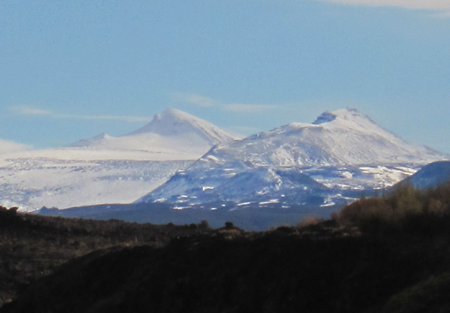
Volcanos Eyjafjallajökull (right) and Katla (left). Mary’s photo.

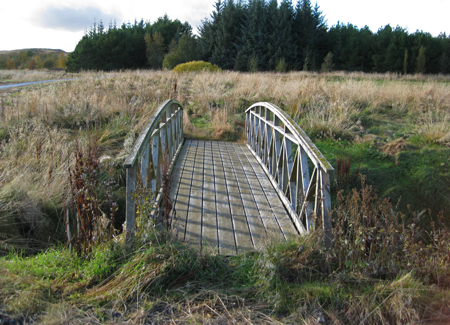
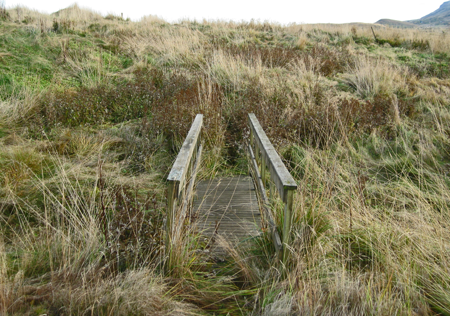
Bridge to nowhere, Skalholt

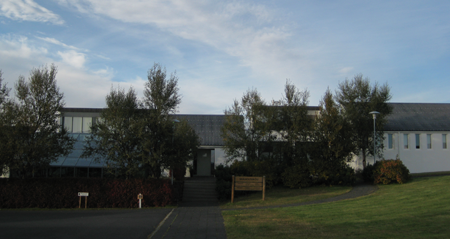
Guesthouse, Skalholt

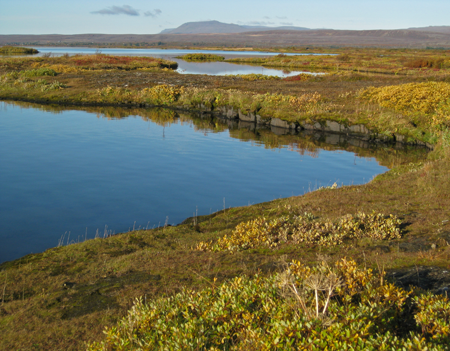
Shore of Lake Thingvallavatn, the largest natural lake in Iceland

Another bridge to nowhere – the metaphorical possibilities are endless.

Skalholt Cathedral from the river path

Churchyard at Oddi

Thingvellir

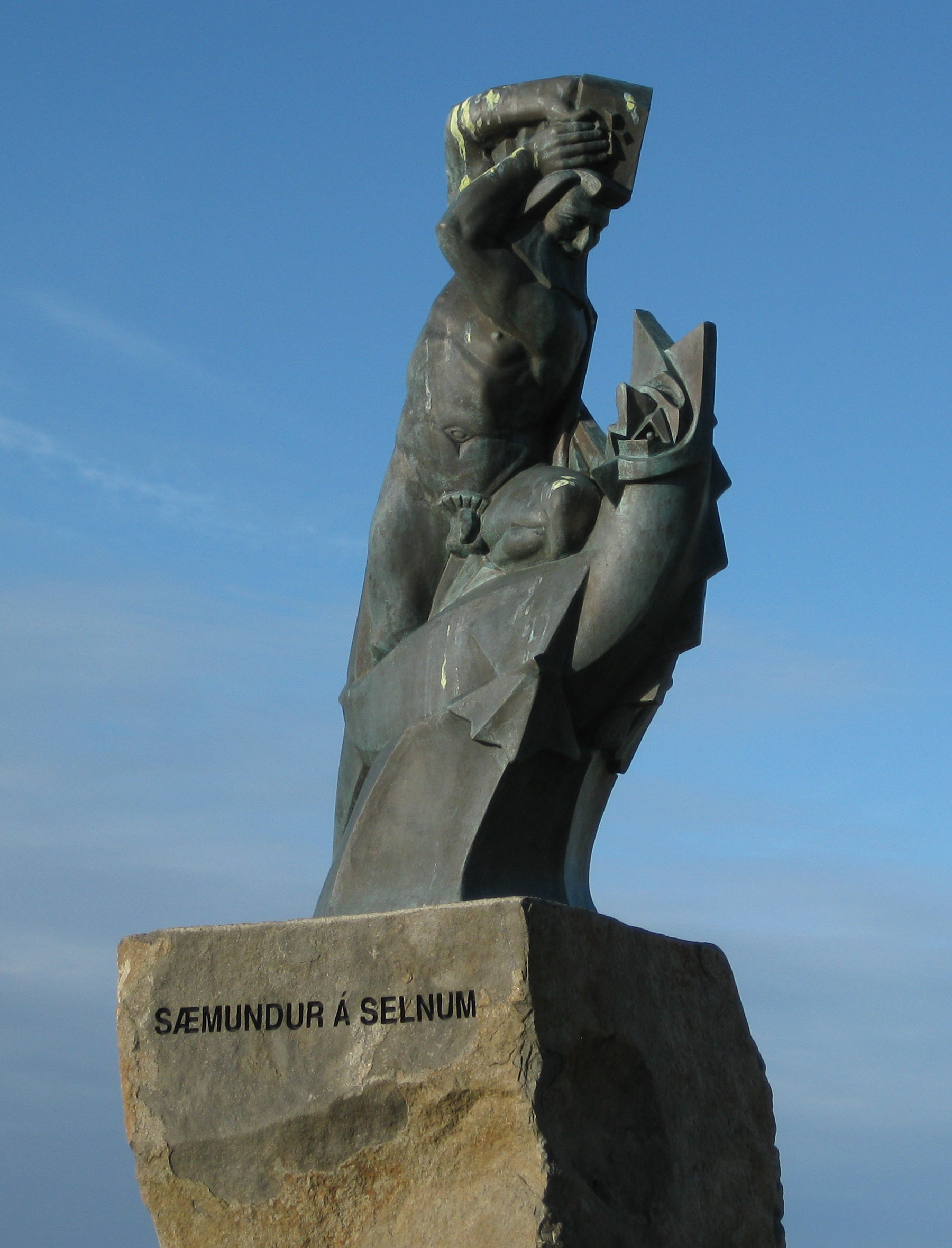
Yours truly by the statue of Saemundur the Learned.

Next: The sagas

Photographs from Iceland

We are back from a week in southern Iceland, which we spent studying one of the great sagas with a small group of storytellers.  We also visited places where this thousand year old drama unfolded. I’ll speak of Njal’s Saga in future posts, but here are a few pictures of the striking Icelandic autumn.
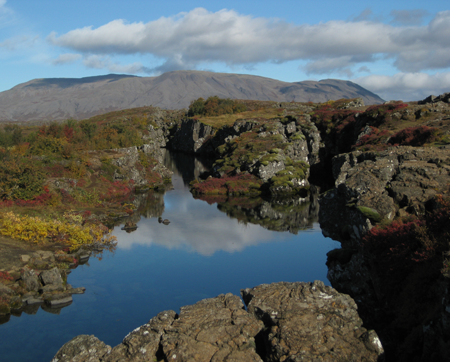
Pool at Thingvellir

A thousand years of volcanic eruption and cutting trees for heat stripped most of the native birch and willow forests.  A joke we heard several times is, “If you get lost in a forest in Iceland, stand up.”  Reforestation efforts are underway, but meanwhile shrubs and even some of the lichen that covers the boulders provide dramatic fall colors.

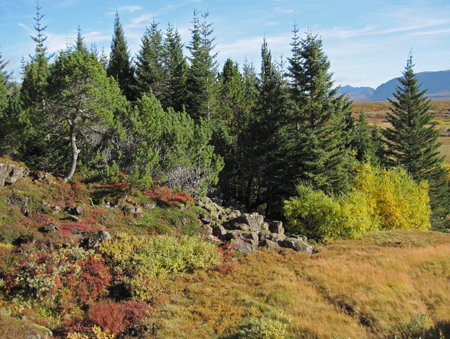
Thingvellir Park. Photo by Mary

Pines are not native to Iceland, but this stand, planted by the government at Thingvellir Park, made a welcome spot for a picnic.

Thingvellir from the cliffs above.

The Law Circle, where the National Assembly met every summer, stands behind the church (a later addition).  Beginning in 930, the Icelanders’ efforts to govern by rule of law was key to the life of the nation and to Njal’s Saga as well.

Njal’s Saga, like The Illiad, is based on historical incidents and people.  This historical marker, along the Ranga River, marks the spot where a key character, the consummate warrior hero, Gunnar Hamundarson, was attacked by 30 men while riding home with his two brothers. The Hamundarson’s killed 14 attackers, but Gunnar’s youngest brother, Hjort died in the battle. In a nearby burial mound, archeologists found a ring engraved with a stag; the name Hjort means “stag.”

Hlidarendi with Eyjafjallajökull in the background

Gunnar lived and died at a farmstead in Hlidarendi, a name that means “Hill’s end.” This is where the highlands slope down to the coastal plain. The green area with a pine border in the middle ground is Nina’s Grove, a park and sculpture garden in honor of Nina Saemundsson (1892-1965), a world-renowned Icelandic sculptor who was born in Hlidrendi, but also spent 30 years in the US. Her statue, The Spirit of Achievement was placed over the entrance of the Waldorf Astoria hotel in New York.

In the distance is Eyjafjallajökull (Icelandic for “Island, mountain, glacier), which erupted in 2010. An explosion of lava blasting through a 700 meter thick glacier created tons of ash that blew toward the continent and stopped European air travel.

View from Nina’s grove over the coastal plains, to islands (on the right horizon) in the Atlantic

This view over the coastal plains shows a view of Nina Saemundsson’s sculpture of a mother holding two children.

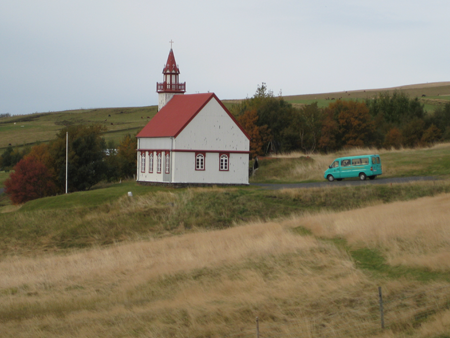
The church at Hlidarendi and a view of the little green van we toured in. Much of the information here came from our driver, who spoke excellent English. He tried to teach us how to pronounce “Eyjafjallajökull,” with little success.

To be continued.

Saemundur the Learned

Saemundur Sigfusson (1056–1133) was an Icelandic scholar, priest, and according to legend, sorcerer, who founded an important center of learning at the southern costal town of Oddi. He was known to have studied abroad, and many said he’d been at “The Black School,” though no one quite knew where it was. People said the headmaster was the Devil.

Seamunder and his fellow students received a fine education in witchcraft and sorcery, but graduation was iffy. The Devil would grab the last student out the door, and that soul was lost for eternity. Seamunder told his classmates not to worry. He told them to file out first, and then he donned a large overcoat. When the Devil reached out, he caught the coat.  Seamunder slipped free and ran out the door, though as it closed, it injured his heel.

The Devil had it in for Seamunder after that, always trying to trick him. Once Seamunder told the Devil he’d give him his soul in return for a voyage to Iceland in which he never got wet. The Devil took the form of a large seal and told Seamunder to climb on his back. The Devil was careful – not a drip of water touched his passenger. Seamunder spent his time on the Devil-seal reading his psalter, and as they neared the shore, he began to beat the seal with his prayer book. Startled, the seal dove under water, Seamunder got dunked, and made his way to the shore near Oddi, a free man.

Seamunder beats the seal with his psalter – statue in the churchyard at Oddi

Legend has Seamunder playing numerous other tricks on the Devil, who is always portrayed as honest and not quite the sharpest tool in the shed.

This information comes from a pamphlet designed by the Oddi Society. Founded in 1990, the Society’s goal is to make Oddi a center of learning again, this time with an emphasis on the environment as well as Icelandic heritage and culture.

A visit to Iceland continued

Gullfoss (Goldwater) falls, southern Iceland

It’s hard to pack for cold weather when it’s 90 degrees, as it was at home before we left. We did pretty well, but today was a challenge. Snow ringed some of the nearby hills as we left for the Gullfoss falls – not the largest in Iceland, but the largest that is easily accessible. The temperatures were below freezing as we climbed down the stairs from the overlook to the level where I took this picture. Rain, wind, and frozen spray from the falls drove us into the heated gift shop, where “California Girls” by the Beach Boys played on the radio.

We stopped down the road at Geysir, home of the geyser named Geysir that gave geysers their name. Is that clear? Geysir itself has grown quiet, erupting only infrequently, but there are many other geysers there, including Strokkur, which erupts at five minute intervals. In the cafe at Geysir, the Stones and the Doors were playing.

Strokkur quiescent

Strokkur erupting

According to Wikipedia, Iceland has about 23 days of rain in September, which fits our experience. Our one sunny day came during our trip to Thingvellir, which not only gave us a chance to admire spectacular autumn colors, but also to explore a spot that is key to Icelandic sagas and to the history of the nation.

Iceland was settled in 870. Sixty years later, the settlers, mostly vikings, formed a national assembly at Thingvellir, on land that was confiscated from a man who was outlawed for murder.

In the best known Icelandic saga, Njal (pronounced NEE-ahl, from Neal, an Irish name) says, “With law our land shall rise but without law, it will perish.” The assembly moved to Reykjavik in 1798, but a quarter of the population met at Thingvellir in 1944 to declare independence from Denmark.

As we left the cafe at Geysir, “Aquarius” came on the radio. “No way!” one of us said, but there it was…

Skalholt, Iceland

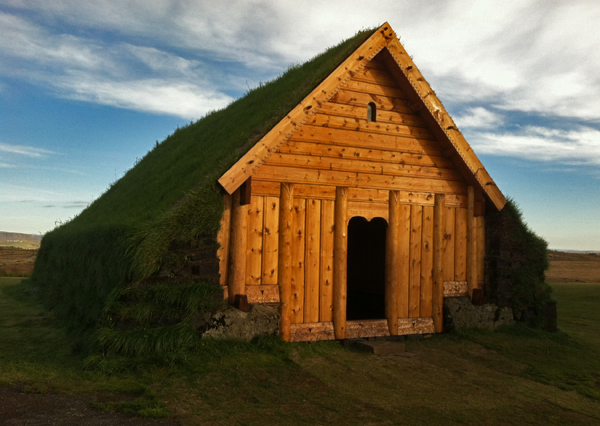
The view out my window is Skalholt Cathedal and this reconstructed chapel which is part of an archeological dig at one of Iceland’s key historical sites.  On the horizon behind the chapel likes Hekla, one of Iceland’s most active volcanoes.  In the middle ages, Europeans called it the Gateway to Hell.  Hekla last erupted in February, 2000, but with luck, it will continue to sleep through the rest of the week.

Mary and I are here for a different type of archeology – a dig into an ancient tradition of story.  We are here with three other storytellers to explore Njal’s Saga, the account of a feud with tragic consequences, not unlike the American tale of the Hatfields and the McCoys.  In both cases, events are based in history; we’re visiting some of the key locations mentioned in the saga.  Njal was shaped by an anonymous author into the masterpiece of a unique tradition that influenced Tolkien, among others.

Meeting of the continents: the North American tectonic plate (left) meets the Euro-Asian plate at Thingvellir, Iceland.

This week of the equinox, the temperature drops to freezing at night, but the guesthouse where we are staying is warmed by geothermal energy, by water bubbling up from hot springs that is shipped through pipes to cities and settlements throughout the island. Iceland is 99% energy independent.

I’ll have more to reflect on in future posts, but meanwhile it is seven hours later than west coast time – tomorrow is almost here, so it’s time to log out.  Please enjoy your week and stay tuned for future posts.

Swan Maidens and Fairy Lovers, Part 2

It’s good to know that glasses can help us drink.  The problem is, we don’t know the purpose of thirst. – Antonio Machado

I hope I didn’t create the impression that I have any solid answers to the questions The Bride of Llyn y Fan Fach raises. Just “hints followed by guesses,” to quote T.S. Eliot.

In stories of this type, from all over the world, beautiful Otherworld women enter the lives of mortal men and then leave.  It’s not too great a stretch to imagine they represent the beauty, the love and fulfillment, the joy and intensity we long for in the world, but usually find to be fleeting.  The occasion for the lake woman’s departure is a tap on the shoulder that counts as a “blow.”  In a literal sense, this is absurd.  I take it to mean that the radiance of the Otherworld is like a spectacular sunset:  it illuminates our world but does not endure.  If it hadn’t been a tap, it would have been something else.  Perhaps as T.S. Eliot said, “Human kind cannot bear very much reality.”

Renunciation is not giving up the things of this world, it’s giving up the idea that they last – a Zen master.

Traditional fairytales are not linked to specific dates and places, but this one is.  This indicates a modern sensibility shaping the story pattern, and it seems especially clear in the lake woman’s belief that the world is a veil of tears.  The usual fairytale heroine does not cry at weddings, where people are “entering trouble,” nor does she laugh at funerals where people are “leaving their troubles.”  Her legacy is the gift of healing to help alleviate suffering.

In the lake woman’s view, this world is not our home, but while we are here, compassion is the highest virtue.  This sentiment could have come from Celtic Christianity.  It is also very eastern and reminds me of the theory that the Celts are linked, by diffusion, with the Aryan warriors of India.  Either way, this is a very different world from the Cinderella tales or stories like The Water of Life which suggest you can find your prince or princess and live a happy life together.

And you know the sun’s setting fast, And just like they say, nothing good ever lasts. – Iris DeMent

At the opening of this story, we learn that the young man’s father “died in the wars.”  The dates vary in different texts. One says the end of the 12th century, and others, the 13th century.  The latter date would coincide with the conquest of Wales by Edward Longshanks, the villain in Braveheart.  Edward invited all the bards in Wales to a council and had them killed, understanding that a nation without stories ceases to be a nation.  What Longshanks didn’t understand was that Celtic stories survive wherever there is a pub, a hearth fire, or a quiet country lane, yet I think the sadness of a conquered people infuses the story.

We know there is another world.  The question is, how far is it from midtown and how late is it open? – Woody Allen

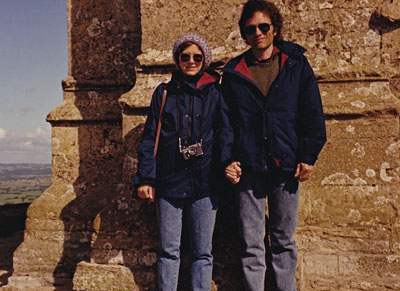
Twenty years ago, Mary and I travelled with a small group of storytellers on a tour called, “The Quest for Arthur’s Britain.”  Our guides were a remarkable couple, Robert Bella Wilhelm and his wife, Kelly, who have devoted their lives to storytelling and the sacred.  I’m happy to say they are still at it.  You can check out their website for details on storytelling trips to the Orkney Islands in May, to Iceland in September, and to Hawaii in Jan., 2013:  http://www.storyfestjourneys.com/

On Glastonbury Tor, Sept., 1991

We spent the last days of this journey at an Elizabethan manor house in the Black Mountain foothills, not too far from Llyn y Fan Fach.  It was one of a very few times in my life that I heard no traffic sound at night and saw no lights of a city.  When the moon was down, it was pitch black.  You could see the shapes of trees against the stars, but little else.

One night I strolled to the end of the yew walk.  The lights from the manor were hidden.  No light, no wind, no sound.  That alone was uncanny, but there was something more.  My Jungian training, which had taught me to understand spirits and fairies as archetypes of the psyche, vanished in a visceral rush of ice down the spine.  Part of me wanted to know what lay beyond, out in the open fields, but I couldn’t bring myself to take another step.  The hair on my neck stood up until I got back to the manor.

Do I believe in other worlds?  I did that night, and I think I do still.  I’m glad I knew the old stories and their lesson:  as human beings, this world is our home, for good or ill.  The peril is very great – too great – for those who venture too close to any other.

Great Info on Charles Dickens From a Reader

I enjoy all the comments I receive, and sometimes they lead me down the trail to another post. One like that came in this morning, when blogger, Nixy43 (aka, Helen Nix) left a note on my recent post, Humbug Revisited:  http://wp.me/pYql4-1sF.

Ms Nix, a Londoner, is compiling a detailed list of 1000 interesting things to do in London for less than a tenner.  Any idiot can enjoy London on a large bankroll, she says, but it’s not so easy for the frugal tourist or people who live there.  She sent me a link to her marvelous post, “Thing 86:  Enjoy a literary evening at Foyles and bond with Dickens at Christmas.”  http://wp.me/p1I6Mp-5m

There is much information about Dicken’s, about changing attitudes to Christmas when he wrote A Christmas Carol, and links to much information about this classic.  London is gearing up for an all out celebration of Dicken’s in 2012, the 200th anniversary of his birth, so if there is any chance you will visit next year, this post is a must.

Stop by, enjoy the story, and thank Helen for posting it!

Charles Dickens