
How Garth Nix Writes a Novel

Who is Garth Nix?  He is a prolific Australian writer of young adult fantasy, whose “Abhorsen Trilogy,” (1995-2003) more than any other fiction, inspired my own current efforts, and “gave me permission” to write the stories I’m working on now.

Garth Nix and Yokimo at World Fantasy Con 2009

Writing anything is better than not writing something perfect – Garth Nix

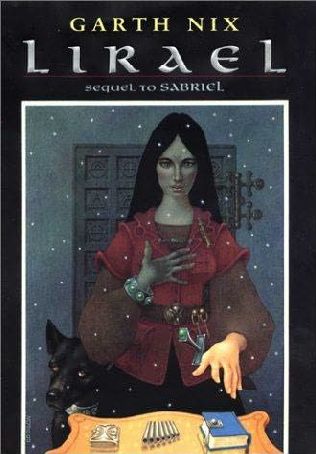
Abhorsens (there is only one at a time), are necromancers charged with keeping the dead, dead – the nastiest dead do not want to stay that way. We’re talking zombies before zombies were cool. In Liraeal (2001), my favorite book of the series, a young woman, apparently a washout from an academy of magical women, sets out with her only friend, the Disreputable Dog, and an inexperienced prince, to save a thinly disguised England and Scotland from several “Greater Dead” leaders of an army of reanimated corpses. Great stuff, like I said!
You can’t write if you don’t read – Garth Nix

Tonight I was browsing Garth Nix’s website (there is a permanent link on my Blogroll) and I came across the author’s account of the nine general stages he has gone thorough in the creation of his 14 novels.  http://www.garthnix.com/Nine%20Stages%20of%20a%20Novel.htm/a>

The nine stages are:

  1. Daydreams and Musing
  2. A Small Vision
  3. Building the Bones
  4. That First Chapter
  5. The Long, Hard Slog
  6. Sprinting Home
  7. Rest and Revision
  8. Revulsion and Dejection
  9. Parting Company

It is instructive to read all of his comments, but here is a summary:

Daydreams and Musing

This is about gathering ideas.  Nix says many people think coming up with ideas is difficult, but he says it’s easy, the fun part.  The difficulties come later.  Images, snatches of conversation, a hunch of a character, these are the the sort of things he gathers, like picking up rocks which “may or may not contain a useful gem.”   He gives examples:

  • The look of the sky in summer when a light rain is falling at sunset
  • Two old men bickering light-heartedly on the street about something that occurred forty years ago
  • The Venetian agents who stole the body of St Mark from Alexandria
  • A car with a cracked speedometer

A Small Vision

This, says Nix, is like a still from a movie he knows nothing about, but it will evoke a mood:

“Two old men are watching the rain from inside a car (with a cracked speedometer) as the sun sets in the distance, discussing their famous expedition to Alexandria to recover the body of St Mark and take it to Venice. The mood is somber and melancholic, something terrible is about to happen.”

Out of this, he is likely to build a scene, often, but not necessarily, the first one.

Building the Bones

After weeks or months or even years, Nix will review any notes he has made, and write a very simple chapter summary.  He says he often does not know why he does this, since he usually diverges from any such plan within a few chapters, and by the half-way mark the book has little if any relation to the outline, but he notes that an outline serves other purposes:

…it makes me think about the overall structure of the novel, which I think kickstarts some subconscious process that will continue through the writing, monitoring the narrative structure. The second purpose is that it serves as a psychological prop. If I have a chapter outline, I presume I know where I’m going, even when I don’t really.
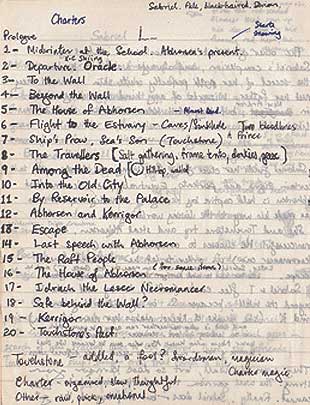
Chapter Outline for "Sabriel"


The First Chapter

By “first chapter,” Nix says he usually means “prologue,” and that once that and the chapter outline (in whichever order) are complete, the book usually rests for weeks or months.   During the interval he works on other things, and continues to think about the project, but doesn’t actually work on it.

The Long, Hard Slog

Nix always used to write first drafts longhand before copying them to a computer.  Now he is not likely to do an entire draft longhand, but usually the opening chapter(s) are first written in notebooks.  I never tell myself I am writing a 100,000 word book. When I sit down to write, I focus on the fact that I am writing a 2,000-4,000 word chapter. A chapter is a do-able thing. Even so, he calls it a slog, and says 90% of his writing time is an uphill battle to complete the first 2/3 of the novel.

Sprinting Home

At a late stage in the narrative, the writing will kick into overdrive, and the author will find himself working both day and night (he ordinarily likes to keep regular office hours and spend evenings with his family.  I think there is some relationship between the energy put into a book and the energy of the narrative, and when everything is building to the climax and resolution of the story I think that for me at least, it helps to keep at it, to write fast and really charge for the finish line.

Rest and Revision

Nix likes to let the story lie fallow for several weeks before doing revisions, though he says now that’s he is often working on deadline, he has only so much time before he has to send it off to an editor.

Revulsion and Dejection

Nix says, …halfway through a book I usually doubt my work, but I get over it and keep going. Often, when the book is done and has gone off to the editor, this doubt returns and I think that not only have I lost the ability to write, I’ve demonstrated this lack in the latest manuscript. He mentions several of his strategies for getting past this mindset on the website.

Parting Company

The final point he makes is the importance of letting go.   Before breaking into print, Nix worked as an editor at HarperCollins, and says,  In my years in publishing I often met authors whose whole self was entirely bound up in a single book, usually their first. Their lives would rise or fall depending solely on that book’s fate, and in this business, that’s an incredibly foolhardy and dangerous gamble to make.

Garth Nix first came to my attention through an interview in the arts section of the local paper.  I liked his matter-of-fact tone about his writing process then, and I like it on his website now.  He simply offers his process as one approach, not the approach, and the message is, you really do know what to do – now go do it.

Just write one chapter at a time and one day you’ll be surprised by your own finished novel – Garth Nix

A Kindle for Christmas: Thoughts on Ebooks

I wasn’t a stranger to ebooks.  I have apps on the iPod that I use for reading in places like doctors’ waiting rooms, but the screen is too small to look at for long at a time; it would never do on an airplane, for instance.  I have Kindle, Stanza, and Nook apps on my laptop as well.  It’s  great for reference materials, but not for kicking back on the couch with a mystery.

This year, after a lot of vacillation, I sent my letter to Santa, and he brought me a Kindle.  So far, I love it.  This no more negates my love of “real” books than enjoying an apple means I’m about to give up oranges, but it does raise some interesting questions.

After charging the device and reading the instructions, I jumped on Amazon to find something new to read, and I wound up downloaded half a dozen free Kindle books in rapid fire – indulging the rare guilty-pleasure of judging books by their covers.  Unfortunately, I deleted most of them after the first few pages; they were simply not very well written.

On one hand, I was reminded of the predictions of Laura Roberts, a literary agent who cautioned that the eBook revolution is not necessarily going to be a simple egalitarian paradise for creative people too long repressed by the publishing establishment.  In an article I quoted here in July, she said that when paid agents and editors no longer serve as screeners, we’ll have to do it for ourselves, on our own time and our own dime:   https://thefirstgates.com/2010/07/08/the-brave-new-world-of-epublishing

I find my somewhat ambivalent judgements interesting too.  (“Not very well written” in this case, a euphemism for “this book sucks.”)

I have often encouraged people by saying, “Everyone has a story to tell.”  That is, everyone. Is it a bad thing that anyone who wants to can now post their ebook to Amazon?  Aren’t many of my judgements arbitrary and conditioned by the literary and publishing status quo?

I suppose it boils down to something simple.  Everyone may have a story to tell, but that doesn’t mean I’m going to pay money to read it.  And given a finite amount of time, there are some books I want to read before the others.

My first new rule of thumb for managing the Kindle is this:  never pay for (an unfamiliar) book that does not have a print edition I can search through first.  I really understand why editors and agents emphasize the importance of the opening pages.

I’m sure there will be further revelations.

The Dream-Maker’s Magic

I have loved fantasy since I was little, growing up on a diet of Norse Mythology, British folklore, and Godzilla.

For years, I helped bankroll the fantasy genre; I patronized specialty bookstores, and even (introvert that I am) went to conferences and Renaissance Faires.  I probably ate up every Tolkien-spinoff quest series ever written.  Eventually, I burned out and wandered to other sorts of reading, but over the last decade, several wonderful books revived my love of fantasy.  One of those gems was Sharon Shinn’s, The Dream-Maker’s Magic.

Shinn’s first book, The Shape-Changer’s Wife, (1995)was critically acclaimed. With her Samaria series, she went on to make a name for herself as an author of adult fantasy. In 2004 she launched a trilogy of thematically connected young-adult fantasies, publishing one a year: The Safekeeper’s Secret in 2004, The Truth-Teller’s Tale, 2005, and The Dream-Maker’s Magic in 2006.

The stories are set in the same world, where magic is part of the fabric of life, and yet it plays a surprisingly minor role. These are not sword-and-sorcery tales. They are more akin to Shakespearean comedy. They are coming of age stories with romantic intrigue, complicated by plot twists and questions of identity, some even resulting from babies swapped at birth.

In The Dream-Maker’s Magic, Kellen Carmichael’s mother almost dies in childbirth. Two weeks later, when she is well enough to care for Kellen, she becomes hysterical, convinced beyond reason, that she gave birth to a boy – and Kellen is a girl.

Kellen says: I was that baby. I was that strangely altered child. From that day on, my mother watched me with a famished attention, greedy for clues. I had changed once; might I change again?  Into what else might I transform, what other character might I assume?  As for myself, I cultivated a demeanor of sturdy stoicism…It was as if I hoped my unvarying mildness would reassure my mother, convince her to trust me.  It was as if she was some animal lured from the wild lands and I was the seasoned trainer who habitually made no sudden moves.

But, Kellen concludes, She never did learn to trust me…or accept me for who I was. It was my first lesson in failure, and it stayed with me for the rest of my life.

If life is hard for her as a child – growing up in boy’s clothing, with sugar-bowl haircuts and a mother who refuses to acknowledge what she is – it becomes even worse in adolescence. Luckily, Kellen begins to meet allies, none more important than Gryffin, a boy who was born lame, whose legs are getting worse, and whose uncle periodically beats him.  Kellen initially scoffs at his unquenchable optimism, at his belief that with an education, he can be anything he desires.  Several days after they meet, however, these two broken people are inseparable friends.

Betsy Palmer, an innkeeper, and her daughter, Sarah, also befriend Kellen, and teach her such arcane mysteries as how to sew a dress that fits and how to do her hair, yet that alone does not end Kellen’s confusion:

…there was one person who was not fooled by my new looks or my modulated personality, and that was Gryffin…He did not seem to notice what I was wearing or how I had arranged my hair…I did not bewilder or surprise him.  He did not think I was trying to be something I was not, as my mother did; he did not think I was trying to break a chrysalis and become something I was meant to be, as Betsy and Sarah surely believed.  He just thought I was Kellen.

I found this the most comforting thing that had ever happened to me.  At times, when I lay awake at night, confused myself about what role I should take and what direction I should try to follow, all that kept me from slipping into tears was knowing I was not completely lost if Gryffin knew how to find me.

That was the point where I put the book down on my first reading, and have every time since, to marvel at the simple way Shinn breaks through all the limits of genre, to evoke something everyone probably longs for:  I was not completely lost if Gryffin knew how to find me.

The Dream-Maker’s Magic is about magic, but it cuts both ways when it appears, and separates Kellen and Gryffin.  The story is a lyrical romance, though you have to watch for the two kisses that Kellen and Gryffin exchange at the very end of the book.  It is a novel whose ending surprises Kellen and the reader; she is not the person she and we imagine her to be.

The ending satisfies in the way that Shakespearean comedies satisfy: what was lost is found, those who were separated are reunited, and poetic justice is meted out.  The story ends on Wintermoon, the holiday when people attach tokens of their hopes and dreams to a wreath, and burn it at midnight, to let the smoke carry their desires to heaven.  Kellen asks Gryfinn what he wishes.  “That every Wintermoon be better than the last,” he says.

Not a realistic wish, as anyone could have told him – but I would not be the one to say so.  Why limit your dreams, after all?  Why not hope for the grandest and the best?  I watched Chase throw the wreath into the bonfire, and I saw the flames scrawl secrets on the sky, and I closed my eyes and knew no end of dreaming.

Be sure to check out Sharon Shinn’s website.  There’s a permanent link in my Blogroll.

Donald Maass and the Breakout Novel

I first heard about Writing the Breakout Novel by Donald Maass in a notice from Amazon, but dismissed the book, reasoning that writing a novel is hard enough without the added burden of trying to invent the next Harry Potter.

Later, a friend in one of my critique groups recommended the book and passed around his copy. I found it interesting enough to order and  give a quick read, but it wasn’t until a few months later that I really started to pay attention.   In that time, my friend’s fiction improved so dramatically that I gave the book a second reading and ordered its companion, the Writing the Breakout Novel Workbook.

As a literary agent for 25 years, and the author of 14 novels (under pseudonyms), Maass knows the publishing industry. In the Breakout Novel introduction, he says good enough is not good enough anymore: “the midlist has been in crisis since I was a green editorial assistant in 1977. Its demise has been pronounced many times. I never believed it…until now.”

The reasons he cites pale beside the experience of another critique group friend, author of ten published biographies for children.  She passed around a rejection letter she had received from an editor for a novel she recently submitted:  I loved your story.  I stayed up late to finish it.  Unfortunately, I do not think it has the qualities that will allow it to break out.

It’s not hopeless, according to Maass, and as a matter of fact, we not simply pawns at the mercy of the publishing industry, or demographics, or new technologies spinning out of control.  In a 2007 interview, Maass insists that “99% of success is in the manuscript.  Everything else flows from that.” http://writerunboxed.com/2007/11/30/interview-donald-maass-part-1/.  Not that he claims that anything about it is easy.

One of Maass’ motives in writing these books was to explore why some novels, regardless of genre, are dramatically successful and others are not.  What are the qualities of those stories we come back to read and reread?  The ones we can’t wait to share with our friends?

I actually prefer the Breakout Novel Workbook, since it breaks the humongous task of creating “cut above” fiction into manageable chunks. Here is one from the second part of that interview, an exercise he presents at his fiction seminars, which are clearly not for beginners, but for those who actually have a manuscript in hand and want to take it to “the next level:”

Maass: The absolutely essential exercise that everyone should do, with every novel, is to toss the manuscript pages in the air and collect them again in random order. (The pages must be randomized or this won’t work.) Next, go through the manuscript page-by-page and on each page find one way to add tension. Now, that sounds easy enough but most people are quickly stymied. That is because they do not truly understand what tension means. In dialogue, it means disagreement. In action, it means not physical business but the inner anxiety of the point-of-view character. In exposition, it means ideas in conflict and emotions at war. Study your favorite novelists. If they make you read every word, even while turning pages rapidly, it is because they are deploying tension in a thousand ways to keep you constantly wondering what’s going to happen. Tension all the time is the secret of best selling fiction, regardless of style, genre or category. If it sells big, it’s got tension on every page. http://writerunboxed.com/2007/12/07/interview-donald-maass-part-2/

One page at a time – the same way any writing is going to happen.  I got hooked on the Workbook in the first exercise, which starts with the importance of a character we can identify with and care about.  From Winnie the Pooh on, the books in my life that have mattered have all had living characters that shaped my imagination and personality. How does that come about?

Who are your heroes? What are their special qualities? How can your own fictional characters manifest those qualities? These are the first exercises in the workbook, and…hey, I can do that!

For anyone writing fiction, in any genre, I seriously recommend that you take a look at both of these books.