RIP Maurice Sendak

If you haven’t heard, Maurice died today of a stroke, at age 83.  Here is a nice five minute interview he gave in 2002 that ran on the PBS Newshour tonight.  It’s illuminating to hear him say, “I don’t know how to write for children.  I don’t think anyone knows how to write for children, and those that say they do are frauds.”

He goes on to say, “I write for me,” and adds that it isn’t always easy to be driven by something internally that is “riotous and strange.” What a great gift he gave to riotous strangers!

http://www.pbs.org/newshour/bb/entertainment/jan-june12/wildthings_05-08.html

Mark Coker on the Justice Dept. vs. publishers

Mark Coker, the founder of Smashwords, is probably the best known advocate of ebooks as an alternative to traditional publishing, yet he doesn’t want those publishers to disappear.  He made this clear in an article on cnn.com on Sunday entitled, “A dark day for the future of books.” http://www.cnn.com/2012/04/15/opinion/coker-book-publishing/

Mark Coker

The Justice Department launched an anti-trust suit against Apple and five large publishing companies for adopting “agency pricing” and allegedly forcing Amazon to comply.  At the time, Amazon was pricing many books below cost, a move the other publishers feared would harm their print book sales. Three of the publishers have settled, while the remaining two, plus Apple, are going to court.

Coker seldom sides with big publishers, but in this case his reasons are clear:  he fears the Justice Department’s intention to protect consumers could actually harm them by harming the publishing industry by “forcing them to comply with onerous conditions…including restrictions on collaboration with fellow publishers and increased federal auditing and reporting requirements — [which] will increase publisher expenses and slow their business decisions at the very time when publishers need to become faster, nimbler competitors.”

Coker says that although agency pricing raises ebook prices, it “prevents deep-pocketed retailers or device makers from engaging in predatory price wars to harm competitors or discourage formation of new competitors. It would enable the marketplace to support more retailers, which would mean more bookstores promoting the joys of reading to more readers. And it would force retailers to compete on customer experience rather than price. Customers are best served when we have a vibrant e-book retailing ecosystem.”

As I understand Coker’s argument, if ebook prices drop too low, print publishing, the staple of brick and mortar stores as well as libraries, will become a money losing proposition.  I think we all know a certain “deep-pocketed retailer or device maker” who isn’t above “predatory price wars.”  Much as I love my kindle, I don’t want Amazon to become the only game in town.

I suggest everyone with an interest in writing, publishing, and ebooks read Coker’s article, the latest installment in a very convoluted drama.

An Era-less Era?

A critique group friend gives me back issues of The New York Times Book Review.  In the stack she gave me this week, I found a provocative article in the March 11, edition called “Convergences,” by Douglas Coupland.

Coupland noticed something unexpected during TV coverage of the 10th anniversary of 9/11:  nothing appeared very different than it had a decade ago.  The clothes, the cars, the hair, seemed pretty much the same.  This led him to speculate that:  “…we appear to have entered an aura-free universe in which all eras coexist at once – a state of possibly permanent atemporality given to us courtesy of the Internet.  No particular era now dominates.  We live in a post-era era without forms of it’s own powerful enough to brand the times.”

He then says, “The zeitgeist of 2012 is that we have a lot of zeit but not much geist.” (To Coupland’s credit, he does a mea culpa for this sentence).  He goes on to say there is something “psychically sparse” about the present, and writers and artists are creating new strategies to track it.  He then reviews Gods Without Men by Hari Kunzru, and calls it an example of “translit,” a new genre that fractures time and space while telling a single story.  In other words, it isn’t time-travel, or intercut parallel tales, like Pulp Fiction, but a singular narrative that unfolds all over the map.

Yet if Translit is a new genre, Once Upon A Time, a popular TV program, got there before Gods Without Men.   Though it doesn’t have as many sub-stories, structurally it’s the same.  Maybe part of our zeitgeist is a world where highbrow and lowbrow forms are equally likely sources of innovation.  (That sentence, containing the word, “zeitgeist,” was payback).

Once Upon A Time

Besides, who says this decade lacks “forms of its own powerful enough to brand the times?”

OK, when I was in grade school, my nightmares were not of winding up naked in public, but in my pajamas [this is true], so this particular fashion crime draws my attention.  But my reason for this post isn’t cultural artifacts – it’s something I’ve wondered about for a long time, that Coupland’s article brought to mind:  how and when the distinctive feel of a decade is formed?

Sometimes there’s a distinctive moment.  What we know as “the sixties” started the day John F. Kennedy was shot.  The last decade began on September 11.

Some decades don’t start with a single event; at a certain point, everyone simply knows the times have changed.  The eighties began when the good times started to roll.  In our current decade, something is rolling, but not good times.  We sense it, though it doesn’t yet have a name.  Read the paper or turn on the news, and you find a miasma of anger and greed, driven by fear and disillusionment.

This morning, with my coffee, I read details of how the New Orleans Saints bounties for injured opponents especially targeted head shots, even as overwhelming evidence points to concussive injuries as the source of higher than average rates of dementia in retired NFL players.  A little while ago I read of women arguing over a Facebook profile outside a waffle house.  Police arrived after shots were fired.  No external foe can destroy us, but we are doing pretty well on our own.

Lately politicians have been touting “American Exceptionalism.”  I first came across the term in Andrew Bacevich’s book, The Limits of Power:  The End of American Exceptionalism, 2008.  Both the politicians and Bacevich mean economic, political, and military superiority, things no country ever retains indefinitely, though they all believe they will when they have it.

President Obama got in trouble for speaking the truth when he said every nation thinks it’s exceptional.  Every nation has the potential to be, if you think in terms of character.  In those terms, our story might fall in the Translit genre – a narrative told across long reaches of time and place.  This decade would be a chapter set deep in the second act, when things are cascading downhill from bad to worse.  The darkness is pretty thick.  Who knows how the story is going to end?

My 301st Post

Confession time.  I slipped in post number 300 without saying anything. Double-digit posts, like end-of-decade birthdays, make me a little nervous.  Such events seem to require wisdom, but I don’t do wise-on-demand especially well.  So here are some blogging thoughts, commemorating post 301, which I think we can all agree is a more humble and friendly number than 300.

Blogging as a means of discovery.  I’ve experienced this in other modes of writing, notably fiction.   At times I’ve also kept a journal, not to record my thoughts, but to discover what they are.  Because of its public nature, I wasn’t sure for some time that blogging had that capacity.  I discovered once and for all that it does while working on some recent two-part posts.  Every time I ended with, “I’ll share my conclusions next time,” I wondered what those conclusions were going to be.  Typically all I had was a hunch – nothing as solid as a conclusion.  I found in every case that the act of writing itself generated conclusions.  

It’s immensely satisfying to know that blogging can help me discover where I am in the present moment.  Everything changes, and it’s important not to be bound to outworn habits of thinking, feeling, and acting.  If the public nature of blogging sometimes causes self-consciousness, it also demands a rigor that (hopefully) keeps me from entertaining or posting my silliest notions.

Just Blog.  If you visit writing blogs, read writing magazines, or go to a writer’s conference, you’re likely to hear about using social media to “build your platform.”  I don’t want to put this idea down, just look at it critically.  I’ve met several successful ebook authors who work very hard to promote their fiction and think up inventive ways to do it.  But the reason for their success is compelling fiction.  Promotion works because they have something worth promoting.

I started this blog because I’d been told I should get a platform.  That idea lasted only a week or two.  Curiosity about blogging as a unique medium took over.  There are lots of Zen stories advising us to do what we’re doing with single minded focus.  Just run.  Just cook.  That kind of thing.  My effort here is, “just blog.”  If the day comes when I need a platform, I’ll do what I have to do.  Like I said in a recent post, I’m skeptical of “whisperers.”

What to write about my social and political concerns?  I don’t like blogs that harp, yet I find it hard not to write about these issues.  I’ve never had so much concern about the future of our democracy, or feared that the very word, “democracy,” is an artifact of nostalgia, like a Norman Rockwell painting.  Consider the following definition from Webster’s College Dictionary:  oligarchy:  a form of government in which the ruling power belongs to a few persons.

Back in the ’90’s, my employer, like many others, provided free training in Steven Covey’s 7 Habits of Success.  One of the concepts that stayed with me is “circle of influence vs. circle of concern.”  Covey taught that outcomes I can affect lie within my circle of influence.   My circle of concern, however, includes things I cannot change.  If I spend my time worrying over these, I miss the chance to do what is in my power.

It’s like the serenity prayer:  God grant me the serenity to accept the things I cannot change, the power to change the things I can, and the wisdom to know the difference.  Covey goes a step further.  He says that changing the things I can will grow my circle of influence.  For example, complaining about the government is a useless hobby, but it is within my power to write to elected representatives.  All of them say direct communication carries weight because so few bother.  If I do so, my circle of influence grows a little bit.

Growing one's circle of influence by acting within it

What about blogging? Does this activity alter outcomes?  I believe it can, by carrying information if nothing else.  Have you heard about the “99% Spring,” initiatives starting on April 9?  Here’s a link: http://billmoyers.com.  Elsewhere on the website, Bill Moyers offers these words of hope:

Many of you have asked what you can do to fight back. Here are some thoughts. First, take yourself seriously as an agent of change. The Office of Citizen remains the most important in the country.

Second, remember, there’s strength in numbers. Find others like you in your neighborhood, apartment building, community – and act together. The old African proverb is still true, “If you want to walk fast, walk alone; if you want to walk far, walk together.”

Amen to that!  There is strength in numbers and strength in sharing hope.  As bloggers, that lies within our circle of influence.

Writings.  I appreciate all of your comments; they are one of the main things that keeps me going.  I’ve been especially happy with the response to recent articles on mythology and folklore.  This is like returning to something I lived and breathed 20 years ago.  In one way, it seems like a new emphasis for thefirstgates, but in another, it clarifies what I’ve been reaching for all along.  I’ve said this before and I’ll say it again, for it has really become my mission statement:  To discover the reality in our fantasies, and the fantasy in our realities.

Thanks to you all and stay tuned!  Here’s to the next 101 posts.

Imagine by Jonah Lehrer: A Book Review

Update, July 31, 2012.

On July 30, author Jonah Lehrer admitted fabricating quotes in Imagine. He resigned his position as staff writer for The New Yorker, and Houghton Mifflin suspended sales of the book. You can read my full post on the topic here, which contains a link to the newspaper story. http://wp.me/pYql4-2hg

It is with much sadness that I’ve decided to remove the text of my review. Some of Lehrer’s observations on creativity remain insightful. At the same time, I think it is vital to stand up for ethics wherever we can find it in public life.

Blogging Reflections

Have you noticed how people use the word “whisperer,” where they once used “guru?”  Both terms imply a super-normal expertise, in some cases justified.  I’d love to have the Dog Whisperer visit our home!  Meanwhile, a quick check revealed you get 13,800,000 hits when you google on “blog whisperer?”

Last year, at a local writer’s conference, a “social media expert” who I think called himself a blog whisperer, offered to critique the blogs of those willing to come for the pre-session and pay $20.  That’s a bargain compared to the first blog whisperer to pop up on google, who charges $900 for a 90 day course on how to speak with “the voice of your soul.”

Think about that.  Though we might balk at the price, we live in a world that accepts the idea of hiring a coach to teach us to speak from our soul.  Afterwards, I guess we can look for a seminar on how to reclaim our power.

We live in a world of specialization and necessarily rely on experts in every phase of our lives.  In many cases, I think it’s a boon.  Those who long for the good old days are not in the throes of a toothache or facing surgery.

I have nothing against experts.  I like to have them around when the car breaks down or I break down.  For the garden, or home repairs, or internet security.

Yet something within us demands room to make our own discoveries and mistakes.  To come to our own conclusions.  To find out where we stand on things, what we really believe, regardless of the experts.

I used to think of writing as such an activity, but no longer.  Google on “writing, how to” and you get 1.9 trillion hits.  That’s a lot of whisperers!

The one little niche that is still free and clear, as far as I can see, is blogging, a medium that is unique because it allows us to think out loud in public.  For me, it is like a journal, a place to explore ideas, but the threat and promise of the “Publish” button forces me to go a step further.  When I pull the weeds from a first draft, I may find the seed of a new idea, or two, or three, or none.  Sometimes a draft lies fallow for weeks, and sometimes I publish within the hour.  More than a few get deleted.  One time I hit “Publish” when I meant to “Save” and got some practice in really fast editing.

I’ve heard some expert advice on blogging, and tend to ignore it all.  Before you say, “I knew it,” let me tell you what I mean – tips like:

  • Don’t write more than 250 words in a post.
  • Do not write about politics or religion.
  • Pick a single theme for your blog and stick to it.

The feedback I really take seriously comes from readers.  First there are simply the stats; people vote with their eyeballs.  Beyond that, is the power of even a single comment.

I’ve recently gotten enthralled, as I have in the past, with looking at old stories and legends.  When Adam, who blogs at Reviews and Ramblings http://blizzerd03.wordpress.com/ said he likes such posts, that was all the confirmation I needed.  “Yeah, this is road I have to follow.”  I value some of your comments more than 1.9 trillion articles on how to write.

As I have quoted more than once, as Joseph Campbell told the legends of the Holy Grail, he said every knight sought their own path into the forest; it would have been shameful to follow another’s trail.

This post is a way of thanking you all and a wish that we may all find our own way through the forest.

Justice Department Goes After eBook Price Fixing

The Wall Street Journal reports that the Department of Justice warned Apple and five major publishers that it plans to sue them for “allegedly colluding to raise the price of electronic books.” http://online.wsj.com/article/SB10001424052970203961204577267831767489216.html

The publishers include Simon & Schuster, Hachette Books, Penguin, Macmillan, and HarperCollins.  The suit centers on Apple’s plan to move ebook pricing from the “wholesale model” to the “agency model,” as it prepared to release the first iPad.  Biographer, Walter Isaacson, quotes Steve Jobs:

“We told the publishers, ‘We’ll go to the agency model, where you set the price, and we get our 30%, and yes, the customer pays a little more, but that’s what you want anyway,'”  

The publishers were then able to impose the same model across the industry, Mr. Jobs told Mr. Isaacson. “They went to Amazon and said, ‘You’re going to sign an agency contract or we’re not going to give you the books,'”

William Lynch, CEO of Barnes & Noble, testified in a deposition that abandoning the agency model would effectively transfer even more power to Amazon, since they can afford to sell ebooks below cost to build market share.

Everyone who intuitively knows that an ebook is not “worth” as much as a physical book must wonder why the two are so often priced within a dollar of each other.  If ebooks were “fairly” priced, would traditional publishers fall farther behind?  Would more brick and mortar stores disappear?

I don’t know…

But I do know that everyone who has a stake in the issue, or is just curious about the upheaval in publishing, should read this article to keep up on the latest events in the ongoing drama.

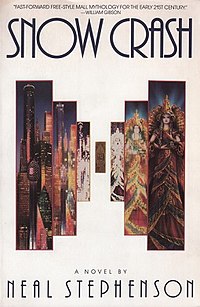
Snowcrash by Neal Stephenson – An Appreciation

Twenty years ago, Mary and I got our first real home computer (the Commodore 64 didn’t quite count).  With an Intel 486 processor, 500k of ram, an 8k external modem, and AOL memberships, we were wired!  Full-fleged members of the information age, at least by the standards of the day.

The same year, 1992, Neal Stephenson published a visionary novel called, Snowcrash. In retrospect, it merits the word, “prophetic,” for its sketch of life in the metaverse – a word Stephenson coined – and in the inconvenient world we call “reality.”

Consider:

In Snowcrash, Stepenson posits a world where nation states have transferred most of their power to corporations. Most people are corporate citizens and live in corporate enclaves, or less prestigious burbclaves.  The hero of Snowcrash, Hiro Protagonist, is a citizen of “Mr. Lee’s Greater Hong Kong.”  Military power belongs to private contractors, as do the roadways, which vie for driver/customers.  The post office is gone; private couriers deliver snail-mail.  The United States occupies a smallish territory centered in the Mohave Desert, and keeps it’s employees busy with make-work projects.  The former United States economy hinges on two industries – computer microcode and high speed pizza delivery, which has been revolutionized since the Mafia took control.

Though Hiro is a citizen of Hong Kong, as a pizza driver, he can’t afford to live in their enclaveclave.  Home is a self-storage unit under the flight path at LAX.  Like most of his hip and cyber-savvy generation, he spends most of his time online in the guise of his avatar, navigating virtual worlds.  But something is happening in the online world.  A strange new computer virus, when opened, generates a graphic pattern that scrambles the brains of the user.  They are dazed and speak in tongues.  With a young woman named YT, for Yours Truly, Hiro sets out to unravel the mystery.

The villain turns out to be a charismatic preacher.  In his attempt to secure both temporal and spiritual power, he has tapped into the ancient Sumerian glyphs that first scrambled human speech patterns in the event known as the Tower of Babel.

It’s been 20 years since I’ve read Snow Crash, so I’m writing this from memory.  I’m not necessarily recommending the whole novel.  The first jaw-dropping 100 pages, where Stephenson built his world, flew by and still leave me in awe.  I remember the rest of the book dragging in parts, but I still think of the story all the time.  Most futuristic fantasies prove as silly as the 1930’s movie shorts that show humans zipping along in their air cars between high rise buildings, happy and without any accidents.  This book is different.

In 1992 there were no virtual worlds.  Now there are, and you have to create an avatar to negotiate them.  These days, it isn’t so hard now to imagine a bright young man living in a self-storage shed.  But above all, Snow Crash comes to mind because in the wake of “citizens united,” it’s so easy to see corporate power growing while government power wanes.  With Super Pac money rolling the election year dice, does the government control corporations or do corporations control government?  Neal Stephenson saw this and other aspects of our world coming 20 years ago.

Snow Crash, is a visionary novel that all lovers of fantasy should know.