No-Self, Part 1

For several months, I have been side-stepping the article I really want to write, because it is difficult, potentially upsetting to some readers if I say it wrong, and because “who do I think I am?”

I have been wanting to write about the Buddha’s teaching of “No-Self,” or Anatta, in the up-close and personal way I have come to experience it.

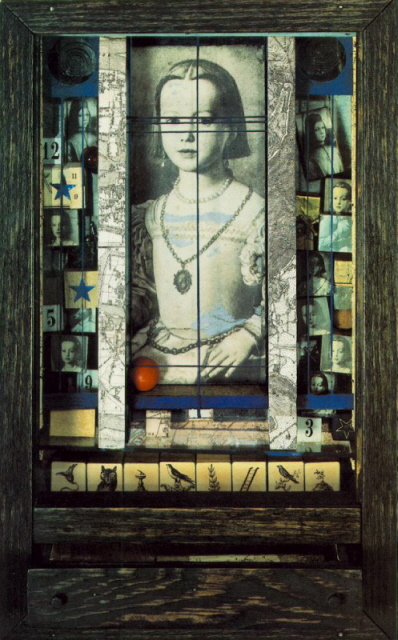
Joseph Cornell - "Medici Princess"

One of the saner things I did at the end my mis-spent youth, was to begin practicing meditation and contemplative spirituality.  Twenty-five years later I was still at it.   I had experienced incremental results: better, health, concentration, relaxation, and so on.  But something was still missing.

Around 2005 I was itching to drop some of my baggage of meditation techniques, theories and beliefs and “cut to the chase.”  To simplify!  It was like walking into a cluttered room and deciding some of the crap has to go.  My thoughts turned to  Zen practice because I had read The Three Pillars of Zen, and I couldn’t think of anything more bare-bones than just to sit and breathe, which I was (hopefully) going to continue doing anyway.

I had shied away from Buddhism because I once tried to read Thich Nhat Hahn and misunderstood what he had to say about “No-Self.”  I thought he was saying the soul or “true-self, that part of us that feels very valuable, is not real.  Buddhists do not say that “self” isn’t real, so much as they say it isn’t real in the way we think it is real.

I like the analogy to a rainbow.  A rainbow is real (while it lasts) but it isn’t real in the way it appears – and we’re better off not pinning our hopes to the pot of gold at the end.

Jerry Uelsmann - "Undiscovered Self"

Anyway, in 2005, I attended a Zen Sesshin (several days of morning-to-night practice) taught by a Catholic priest (which isn’t as uncommon as people might think).  It was…nice.  Not bad, not great, but overall, relaxing and…nice.  I appreciated the simplicity and it hooked me enough that I kept sitting like that once I got home.  And a few months later, nice turned into something a lot more powerful.

One evening during the holiday season, as I thought of family members and friends who were gone, and a parent who was ailing, I felt a profound sense of loss, of precious things slipping away.  But in the next instant a thought came; with perfect, instant, compelling clarity.  The thought just appearedWho is sad? And in that instant, there was nobody there! All that saddness was gone because there was no one there to feel sad.

I didn’t need the priest to confirm that it was the real deal, though he did a while later when I spoke to him again.   I got a further confirmation when I attended a daylong retreat led by Anam Thubten, a Tibetan Buddhist teacher whose message is summarized in the title of his book, No Self, No Problem.  His basic suggestion for meditation is simply to rest from all physical and mental effort:

As we begin to rest and pay attention, we begin to see everything clearly.  We see that the self has no basis or solidity…We might want to apply this simple inquiry whenever problems arise.  If we feel angry or disappointed, simply ask, “Who is the one being angry or disappointed?”  In such an inquiry, inner serenity can effortlessly manifest…When all the layers of false identity have been stripped off, there is no longer any version of that old self.  What is left behind is pure consciousness.  That is our original being.  That is our true identity. No Self, No Problem pp. 5-6.

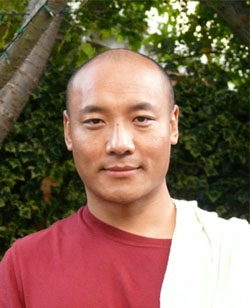
Anam Thubten

Anam Thubten’s website:  http://www.dharmatafoundation.com/about.aspx

TO BE CONTINUED.

RIP – Leslie Nielsen

Part of my holiday weekend was a self-imposed media blackout; often enough, it’s refreshing not to know what is going on, and so it was only this morning that I learned that Leslie Nielsen is gone.

http://www.npr.org/blogs/monkeysee/2010/11/29/131661180/remembering-leslie-nielsen-a-master-of-the-art-of-not-being-funny

There are precious few movies that stay fresh after three or four viewings, and almost any of his silly flicks will have me in stitches though I have seen them numerous times. Laughter and good humor – what a gift in this world!

http://www.youtube.com/watch?v=dTHsNVXXlus

So long, Shirley!

“Tinsel,” by Hank Stuever, and other Christmas musings.

Last night I was working at the computer while a TV Christmas movie that neither of us were watching droned on in the background. I looked up when a little girl whose father had died said she was going to the north pole “to ask Santa to make Daddy not dead.”

I instantly recognized the world-view I’d had  at the age of four.  I went to Sunday School, of course, but knew that Santa Claus was the man with the mojo – the go-to guy.

I watched the movie for a while.  It was interspersed with commercials designed to lure me to the parking lots at 4:00am on Black Friday – and tried to remember certain art history lectures I’d heard at this time of year.  “The iconography of Christmas,” that kind of thing.

I remembered that the Puritans outlawed the celebration of Christmas, while in early 19th century New York, Christmas tended to be a drunken revel.  Wealthier citizens would find themselves terrorized by the rabble – kind of trick-or-treat with an edge – give us money or else.  I recalled that the well-to-do seized the “Night Before Christmas,” to attempt to transform the holiday – to get some of those energetic revelers into the stores.

I googled on “Christmas History in America,” and here are a few tidbits I found on the first site that came up: http://www.thehistoryofchristmas.com/

  • Christmas was illegal in Boston from 1659-1681. Anyone “exhibiting the Christmas spirit” was fined five shillings.
  • Congress and everyone else worked on Christmas Day, 1789, the first one celebrated  in the new American nation.
  • The New York City police force was formed in 1828, in response to a Christmas riot.
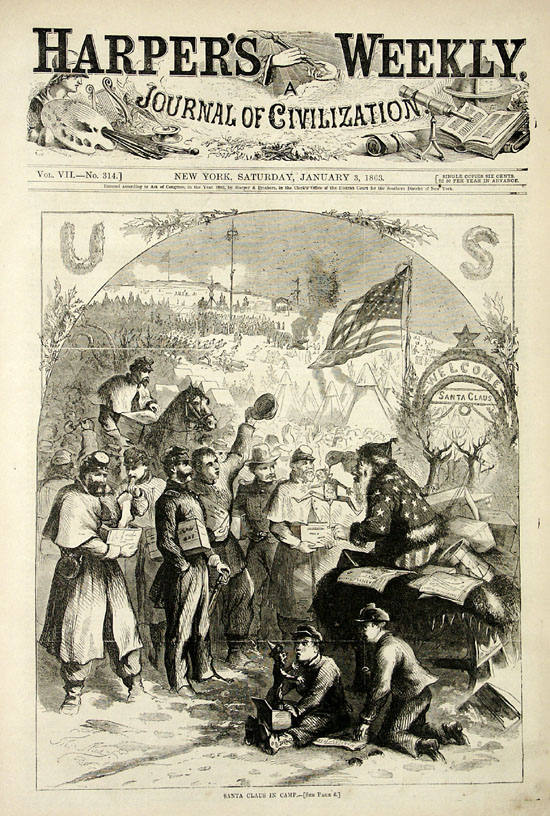
  • Before the civil war, north and south were split on Christmas.  The holiday was regarded as somewhat sinful in the north, while celebrated as an important social occasion in the south.  Yet in the 1860’s, Abraham Lincoln asked Thomas Nast for an illustration of Santa Claus with union troops, which had “a demoralizing influence on the Confederate army – an early example of psychological warfare.”

St. Nicholas delivers gifts to the Union Army

  • After the civil war, children’s picture books and women’s magazines had a large role in transforming the holiday into something we would now recognize.
  • Christmas was finally declared a United States holiday on June 26, 1870.

***

One interesting piece from a year ago was an NPR interview with Hank Stuever regarding his book, Tinsel:  A Search for America’s Christmas Present, an account of three Christmas holidays he spent in Frisco, Texas. http://www.npr.org/templates/story/story.php?storyId=121720242&ps=rs

Tammie explained to me early on about life in Frisco, that fake is okay here. And I think that’s a theme running through the book, fake is okay. If you’re going to ever fall in love with Christmas again, you have to embrace the fact that fake is okay here, no matter where you are.


The "Griswald house" in Frisco, Texas


Stuever wanted to do a piece on the Christmas season in a place well out of the snowbelt – where a White Christmas is pure fantasy.  He chose Frisco, Texas in part because he grew up in that part of the country, but also because it’s a town with seven million square feet of chain retail space, and:

[Christmas is] a half-trillion-dollar event in our lives. It steamrolls everything…so I wanted to go to one of those new fangled 21st century American places that are built around malls and box stores and big houses and big churches…demographics led me to Frisco.

It’s clear listening to the interview that Stuever isn’t there to make fun of anyone.   He expressed gratitude several times to those who invited him to shop with them, decorate with them, and celebrate in their homes.  He speaks with admiration of the single mother who tries to provide a nice Christmas for her three children with $1200 total, in a town where as many as 50,000 lights are part of home lighting displays.

She struggles really hard to always remain positive, which I think makes her emblematic of a lot of Americans who just, you know, come what may, we’re always told to make ourselves happier and be positive. And Christmas is really a freight train coming full of that, you know…there’s something wrong with you if you’re not happy at Christmastime.

Steuver, who writes about popular culture for the Washinton Post, doesn’t wind up too sanguine about Christmas. I wrote about Christmas because Christmas sort of freaks me out, like it’s so big and people have so much expectation heaped upon it that they can only come out of it with a smidgeon of melancholy amid all that joy.  

***

It’s the dark time of year.  The traditional time for sitting by the fire and telling stories.  Reflecting.  Hoping for renewal and the return of the sun as another year passes (where did the time go?).  Hoping for warmth and belonging, connecting with friends and family, our hearts full of the memory of and hope of Christmas peace:  hot cocoa around the fire, under the tree.  Mistletoe.  The star of Bethlehem, Currier and Ives prints, the Christmas we got that brand new bike as a kid. 

Hank Steuver’s book seems to ask, in Dr. Phil’s words, “How’s that workin’ for ya?”

It’s probably a good thing I cannot find my copy of  King of Morning, Queen of Day, a fantasy novel by Ian McDonald, which contains the funniest and most scathing single page on Christmas that I’ve ever read.  As in how will “Jingle Bell Rock,” or the Beach Boys’ “Little Saint Nick,” strike you in the stores four weeks from now?

The refreshing thing about reading the history of Christmas is seeing how dramatically the holiday has morphed in a short period of time.  Has and certainly will again.  Christmas as we know it or think we do is already a thing of the past – it is anything but solid and fixed, either for individuals, families or the culture.  And that’s really good news.  Did I mention how I feel about, “I saw Mommy kissing Santa Claus?”

The Wishing Tree

I was recently trying to find a story I read a long time ago, a version of a traditional eastern tale told by Paramahansa Yogananada, called, “The Wishing Tree,” or something very similar.

A search on that name turned up:  a 1999 movie, an acoustical music group, a Salvation Army campaign, an award winning book about a girl whose father goes off to war, a flower shop in Hoboken and another in Singapore – and that was just on page one of the 1,750,000 results reported by Google.

The phrase “wish-fulfilling tree” brought links more in line with what I was after, stories and cautionary tales that seemed to echo a comment of George Bernard Shaw, “There are two tragedies in life. One is not to get your heart’s desire, the other is to get it.”

For Hindu’s, the tree is called Kalpataru and was revealed by Shiva to his wife Parvati.  He tells her,  “‘Kalpa’ means ‘whatever you desire’ and ‘taru’ means ‘tree.’ “Whatever you wish for, you will immediately get from this tree.”

Kalpataru

The site where I found this illustration, http://www.petermalakoff.com/the_wishfufilling_tree2.html, has a version of the story I was looking for, but I like Yogananda’s telling better, and this is how I remember it:

Once a spiritual seeker, who had long roamed the Himalayas in search of enlightenment, spied a single tree growing in the center of a small valley. He took shelter under its boughs and remembered the legend of special wish-fulfilling trees that angelic beings place in such remote regions to help wandering ascetics, and he wondered if maybe….

He pictured a nice juicy orange, and it instantly appeared in his hand. How long had it been since he’d had a good meal? He thought of every delicacy he had ever enjoyed, served on gold plates, and servants appeared bearing the feast. He’d been sleeping in the open so it was natural to wish for a house – no wait, a palace! And anyone with a palace and gold plates needs guards and soon, our friend had a squadron of soldiers saluting and awaiting orders.

He conjured butlers, and cooks, and seamstresses.  Dancing girls, too, of course, and while he was at it, gardens and fountains.

Satisfying one’s every whim isn’t easy, and at last the seeker sought out his own room for a nap.  He gazed through the window at the lush forest he’d planted nearby for hunting, and as he drifted off, he wondered if that had been wise.  What was to prevent a fierce tiger from jumping into his window?

And that was the last thought he ever had.

***

I’m not usually fond of stories with explicit morals, but I first came upon this as a teaching story, in the context of a transcribed talk Yogananda gave on the power of thought.  He summed up by saying we all live our lives under a wishing tree, only we call it imagination. Lucky for most of us, our normally scattered minds are slower to manifest what we dwell on than the tree in the story.  At one point, Yogananda said, “If you doubt the power of thought, try repeating the mantra, ‘headache, headache,’ and see what happens.”

A similar aphorism that’s stuck with me since I first heard it came from Zen teacher, Cheri Huber:

The quality of your life is determined by the focus of your attention.

…which is actually very good news, as is my new favorite bumper sticker:

( you can get it at http://www.snowlionpub.com/html/product_7869.html)

Hint Fiction Contest Winners – and Two More Competitions

I almost missed the email, but here is a link to the winner and some of the runner-up entries from the Gotham Writer’s Workshop 25 word story contest that I mentioned here earlier.

In addition to enjoying the stories, scroll down to the bottom of the page for links to two more competitions.   There is a 30 word (that is 30 words exactly) story contest that is underway – entry deadline is Nov. 30.   There is also a “YA Discovery Novel Contest” with a deadline of Nov. 30.  For $15 you can submit the first 250 words of a YA novel for prizes including an invitation to submit the full manuscript to a YA agent in New York, a free writing workshop, and critiques by editors at Candlewick, Scholastic, Harlequin, MacMillan, Viking, Roaring Brook Press, and Sourcebooks, who will judge the finalists.

Why not give it a shot?

http://www.writingclasses.com/InformationPages/index.php/PageID/720?utm_source=streamsend&utm_medium=email&utm_content=12936417&utm_campaign=An%20Editor%27s%20Advice%20to%20Writers%20+%202011%20Guide%20to%20Literary%20Agents

Good Grief – A Visit to the Charles Schulz Museum

Eleven years ago, in December, 1999, we managed to round up everyone and get to the mountains for Christmas. There was good health and good cheer in abundance, and we had an exceptionally nice holiday. One of my gifts was a watch with this picture of Snoopy and Woodstock, which I still have, and which still evokes the memory of family and dogs, together, warm, and happy.

Snoopy and Woodstock

The man who gave us Snoopy and Woodstock died six weeks after that Christmas, in February, 2000. When a long-planned museum opened in his home town of Santa Rosa, it instantly became a desired destination, one of those spots I “definately had to visit someday.” Funny how many trips of thousands of miles we took, perhaps because they seemed like real vacations, before getting to this gem in our own backyard.

Snoopy, Woodstock, and Me

The displays do a fantastic job of illuminating Schulz’s creative process. Anyone who has flipped through a Peanuts picture book has seen the evolution of drawing styles for Lucy, Charley Brown, and Snoopy, but this exhibit goes a lot farther. Schulz worked out ideas using doodles and notes, often on yellow legal paper, which he tossed. One secretary recovered these crumpled drafts from the wastebasket, took them home and ironed thm flat, and now several of them are displayed beside the published comic strips they inspired. We get to see themes, characters, and narrative styles that were tried and discarded, along with some of Schulz’s comments, like:  “That was a bust,” or, “If I’d known then…”  We really get to see how the Peanuts we know and love resulted from the fifty year struggle of a man with a lot to say in a very strict medium, who developed his own unique form of visual-verbal haiku.

Charley Brown outside the skating rink

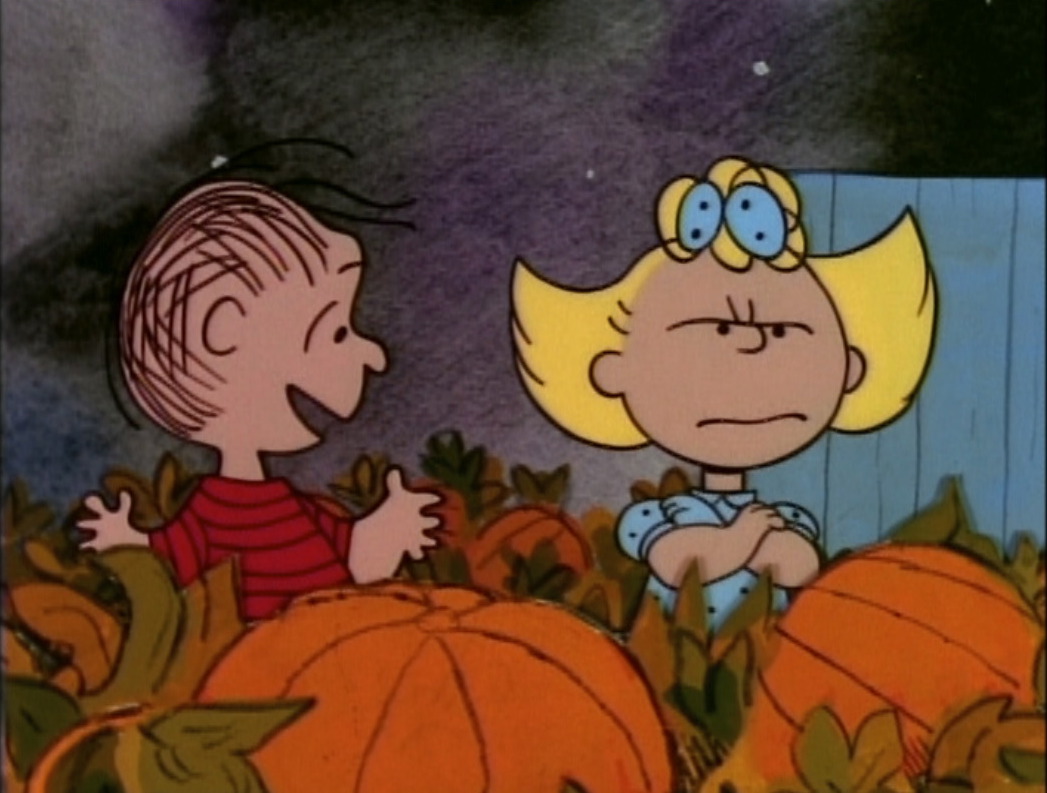
I just got up to fill my coffee cup and glanced out the kitchen window. How many rites of autumn have been forever shapped by Charles Schulz? Leaves. Football kickoffs. Hot chocolate. World series pitchers (GIANTS ROCK!!!!!!!). The eternal longing for the Great Pumpkin. And soon, our attention to the little orphan Christmas tree at the back of the lot, that nobody wants.

Waiting for the Great Pumpkin

One more hint if you visit:  the burgers at the Warm Puppy Cafe are exceptional, better than any fast food I can think of.  For those who can do it without breaking their necks, the attached ice skating rink is as fine as the rest of the facilities. 

Over by the door at the Warm Puppy is an empty table with a flower and a sign that says, “Reserved.” That is where Charles Schulz sat for lunch, where he watched the skaters and people passing outside. Where he dreamed and dreamed up a humble little comic strip that did things the medium hadn’t done before, and is still as much a part of starting the day as coffee.
http://www.schulzmuseum.org/

Charis – a Dog Story

We named our first dog Charis after Merlin’s mother in an Arthurian fantasy novel.  Some time later we realized the word meant “grace” in Greek.  That was just one of many things she brought into our lives.

We walked into the breeder’s living room where five little puppies huddled together in their pen.  Charis raised her head and hopped over her litter-mates to dash up to us, her little tail wagging furiously.  We took it as an omen – only later did we understand it was fairly predictable alpha behavior.  One of her mottoes could have been, “Obedience is optional.”  Luckily, “Will work for food,” was a motto too, so with the help of dog treats, we came to an understanding.

She was a purebred bichon frise, and we only got her because her red nose and blue eyes didn’t match the breed standard, so the breeder couldn’t use her as a show dog.  Her blue eyes turned gold by the time she was a year old, just like a wolf.  I thought she was about the most beautiful puppy I’d ever seen.

Charis as a puppy

Once we took her to a pet friendly motel on the Oregon coast that had it’s own nine-hole golf course. She was a trickster and a runner.  She scampered out the door as we were carrying things in and ran a merry chase, stopping to pee on several greens until another golfer called and she pranced up to him, wagging her tail, and for all you could tell, pleased as could be with herself.  The following year when we called, the motel was no longer pet friendly.  I’m not saying that Charis changed that all by herself, but still…

In the trickster mode - can you see it?

The same recessive gene that gave her wolf eyes, probably took her eyesight when she was 13.   She adapted to that pretty well, but also,  she was large for her breed, so by 14, she was blind and needed medication for joint problems. The vet said it might not be much longer. That night I dreamed that the aging Charis was not the real one. In the dream, I saw the real Charis dashing through the back yard, jumping over rocks and hurdles as if gravity didn’t exist.

But the Charis who had to deal with gravity and the passing of time could still go for walks, find her way around the house by smell and touch, and generally enjoy our company and that of her younger “sister.” It wasn’t quite time.

Charis

I think of her in November because the time finally came when she was 15 1/2.  We took her in to the vet for our final act of kindness four years ago on Veteran’s Day.  Extraordinarily difficult things happen to every one, but I have never had to initiate anything harder in my life.

There are some permanent lessons I learned at the end of her life, things that have stayed with me, but that’s for another time.  This is just a moment to remember, and put up several of my favorite photographs of a beautiful little soul that wore the shape of a dog for a few precious years.

Murder, Magic, and Redemption – the Story of Milarepa

This rather dramatic lead-in comes from a movie teaser: “Milarepa is a tale of greed and vengeance – demons, magic, murder and redemption. It is the story of the man who became Tibet’s greatest mystic.” http://www.imdb.com/title/tt0499238/

Milarepa film poster

“Milarepa is one of the most powerful and moving stories of love and transformation in world literature” – Richard Gere

To borrow a term from the previous post, the stories of mystics and prophets are almost always strange attractors. History, shaped by our collective imagination of ultimate things, is guaranteed to be larger than life. Milarepa’s (1052-1135 CE) own teachings are found in the songs and poems he wrote, while the magical legends are from a biography written several centuries later.  The Dalai Lama said, “I cry, weep, and feel a strong sense of faith each time I read or hear the story of Milarepa, the greatest yogi of Tibet.”

Here is a one sentence synopsis: A young man in ancient Tibet commits mass-murder to save his mother, undertakes rigorous spiritual practice to expiate his sin, and becomes a saint whose teachings are still alive nine-hundred years later.

This is the story in greater detail:  Milarepa was born into a prosperous family, but his father died when he was seven, and the house and property went to a greedy aunt and uncle, who treated the family like slaves; they lived in a hovel, ate swill, and toiled in the fields all day.  When he was 15, Milarepa’s mother demanded that he visit a certain sorcerer and learn black magic to extract revenge.  If he didn’t do her bidding, she threatened to kill herself in front of him.

In our culture, where obeying your parents is optional, it’s easy to think the mother was just a whack job, and why didn’t someone think to call CPS?  To understand Milarepa’s story at all, we have to imagine a culture where family honor was more important than life itself.  Where a human incarnation was held to be infinitely precious, and your mother was revered as the chief giver of this gift.  Where allowing harm to come to your mother if you had the power to prevent it was an unimaginable sin.

We speak casually of choosing the lesser of two evils, and for most of us, the dilemma will be over once election day is past.  Not so for Milarepa.  The closest I can come to imagining him wrestling with his choice is to recall the scene of Gary Cooper on the mountain in Sergeant York, a Bible in one hand and the Constitution in another, trying hear the voice of his own conscience.
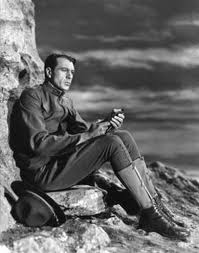
Gary Cooper as Sergeant York

Milarepa chose to obey his mother.  He went to the sorcerer and learned a complex practice that allowed him to invoke spirts who pulled down the stone house where his uncle’s family was celebrating a wedding.  Thirty-five people were in the house.  Ironically, only the aunt and uncle survived.

All hell broke loose.  The relatives of the dead were furious and gave chase.  Milarepa barely escaped pursuit, but he couldn’t escape his own conscience or the negative karma for 33 murders that was sure to land him in Buddhist hells for quite a few incarnations.  His sorcerer contact advised him to seek out a famous guru named Marpa.  When he heard the name, a thrill went through Milarepa, as if a glimpse of his destiny had just opened up.  The night before he arrived, the guru dreamed of someone very special coming into his life.  Though he instantly recognized Milarepa’s potential, he also saw the dark karma and knew the boy would have to work it out before anything else could take place.

Milarepa asked for initiation into spiritual practice, but Marpa refused, saying such treasures were not for someone as “worthless” as he.  Instead, he told Milarepa to move a stone tower to another location three miles away.  It took Milarepa three years to carry the rocks on his back.  Marpa looked at his work, scratched his chin, and said, “You know what?  I think I liked it better at the first location.  Move it back.”

At that point, most of us would be on the phone to our therapist, but Milarepa did what he was told.  In those days, spiritual seekers sometimes endured great hardships and life-threatening journeys for spiritual instruction.  It was all right;  Marpa never wound up on the 6:00 news with charges of fraud or scandal.

Milarepa toiled for for twelve years before receiving spiritual initiation.  After that, he undertook an eleven month retreat in a sealed cave with only a butter lamp for light, and a little slot where someone passed him one meal a day.  Later he moved to another remote cave where he lived on nothing but nettles and local vegetation.  He looked like a living skeleton, but there he attained final awakening.  Just like the parable of the Prodigal Son and related stories from India, Milarepa’s tale asserts that no one is beyond redemption once they sincerely turn in that direction.
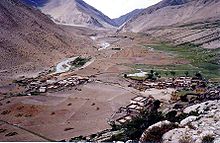
View from Milarepa's cave

Naturally, there are miracle stories about Milarepa.  One of them tells that he pressed his hand into the rock wall of his cave where it still holds the impression.  Here is an online account of someone who visited the site:  http://www.dreammanifesto.com/milarepa-miracle-set-stone.html

During a group pilgrimage to Tibet in the spring of 1998, I chose a route that would lead us into directly to Milarepa’s cave…To demonstrate his mastery over the limits of the physical world, Milarepa had placed his open hand against the cave’s wall at about shoulder level . . . and then continued to push his hand farther into the rock in front of him, as if the wall did not exist! When he did so, the stone beneath his palms became soft and malleable, leaving the deep impression of his hand for all to see…

In anticipation of my questions, our Tibetan translator…answered before I even asked them. “He has belief,” he stated in a matter-of-fact voice. “The geshe [great teacher] believes that he and the rock are not separate.” I was fascinated by the way our 20th-century guide spoke of the 900-year-old yogi in the present tense, as if he were in the room with us. “His meditation teaches him that he is part of the rock. The rock cannot contain him.”

Milarepa

“In my youth I committed black deeds. In maturity I practiced innocence. Now, released from both good and evil, I have destroyed the root of karmic action and shall have no reason for action in the future. To say more than this would only cause weeping and laughter. What good would it do to tell you? I am an old man. Leave me in peace.” – Milarepa http://en.wikipedia.org/wiki/Milarepa

I’m all for stories of solitary heroes going against the crowd.  For stories of finding your life’s purpose and for tales of redemption and spiritual mastery.  My fiction always seems to circle around such themes, but for me, there is even more to the tale of Milarepa.  I’ve been fortunate enough to experience the living nature of his teachings in the person of Lama Kunga Thartse Rinpoche.

Born in Lhasa in 1935, he was recognized at the age of 7 as a reincarnation of Sevan Repa, one of Milarepa’s closest disciples.  He entered a monastery at 8, was ordained as a monk at 16, and became a Vice-Abbot at 24.  Lama Kunga fled from Tibet in 1959, and in 1972, he founded Ewam Choden Tibetan Buddhist Center in the hills just north of Berkeley (there’s a permanent link to the website on this blog).
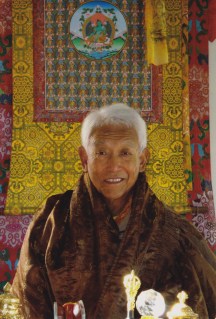
Lama Kunga Thartse Rinpoche

I met Lama Kunga two years ago while searching online for a particular Tibetan ceremony. I knew there was a place in Tucson and had calculated the cost of plane tickets when I found the ceremony was being offered at Ewam Choden, in two days time. I left a phone message, afraid there would be some barrier or pre-requisite, but when Rinpoche returned my call a little while later, he said, “Just come!” I asked if he was sure, and he said once more, “Just come, you are very welcome.”

Ewam Choden is just 90 minutes away, and I’ve been back many times.  On several occasions, I’ve sat through all day teaching sessions that end with the 75 year old lama more energetic than the students who are – at least speaking personally – desperate for a cup of coffee.

No rocks on the back or towers to move.  Lama Kunga is not that sort of teacher at all, as one can gather from the story written about him in the November, 2002 issue of Golf Digest, where he told the interviewer that good golf demands getting past the ego, but then said, “I would like to be reincarnated as a better golfer someday.” http://www.ewamchoden.org/?page_id=46

And finally, if the story of Milarepa seems like a pretty decent fantasy tale and nothing more, that’s fine. It would be fine with Milarepa and with the Buddha before him, who told a group of seekers, “Don’t take my word for anything.”

“Do not go by oral tradition, by lineage of teaching, by hearsay, by a collection of scriptures, by logical reasoning, by inferential reasoning, by a reflection on reasons, by the acceptance of a view after pondering it, by the seeming competence of a speaker, or because you think: ‘The ascetic is our teacher.’ But when you know for yourselves, ‘These things are wholesome, these things are blameless; these things are praised by the wise; these things, if undertaken and practiced lead to welfare and happiness’, then you should engage in them. (Numerical Discourses of the Buddha, p. 66)