The Chronicles of Narnia: The Voyage of the Dawn Treader

Okay, once again I waited until nearly the end of a theatrical run to see a popular movie. I don’t know if there is a name for my condition: an almost pathological fear of seeing new releases in crowded theaters that harks back to the trauma we suffered when first attempting to see Star Wars. The theater sold overbooked tickets, just like an airline, and we had to leave just as Darth Vader appeared.

Voyage of the Dawn Treader is the third book of C.S. Lewis’s Chronicles of Narnia, and this movie is the first produced by Fox after Disney let go of the franchise when Prince Caspian, the second film, posted disappointing returns.

I can understand that to a degree. I’ve read the first Narnian chronicle, The Lion, The Witch, and the Wardrobe, many times; not so the others. The first book has things guaranteed to enchant the dreamer in all of us: a magical world in a clothes closet, filled with talking animals, where children become kings and queens, and defeat a great evil with the help of a lion who is a thinly disguised Christ figure.

I do not propose to outline the series for those who are not familiar with it, but pose a question the movie raised. What do we make of a film that is more compelling than the book because of the director and screenwriter have added elements the author did not?

Blasphemous as this may sound, I found Peter Jackson’s film treatment of Tolkien’s Lord of the Rings more compelling than the book, but those movies remained scrupulously faithful to the text.

In Dawn Treader, the two youngest Pevensie children, Lucy and Edmond, and their obnoxious cousin Eustace, are transported to Narnia to help King Caspian on his voyage to the east to find seven missing lords of Narnia.  I remember the book as a series of episodes that were not connected thematically except through the characters’ battles with temptation:  Lucy’s desire for Beauty, Edmond’s desire for Power, and Eustace’s Greed which causes his temporary transformation into a dragon.

Let’s just say that when the first of this series of movies came out in 2006, I set out to reread the seven books, and gave up in the middle of this one.

In Dawn Treader, the final test that is overcome is a dark island where dreams come true.  Lewis alludes to, but doesn’t dwell on the possibilities of a world where truth and illusion are indistinguishable; with Aslan’s help, the crew rescues the final lord and makes their escape.

Director Michael Apted makes this dark island central to the story:  the crew and all of Narnia are threatened by a great evil that can take any shape – it mirrors each individual’s hopes and fears.  This is a very personal darkness, a tailor-made evil, a Satanic force that Christian theology imagines, but which Lewis did not in the third book of his series.

This force is also Mara, the demon lord of Buddhist theology who evoked the most piercing desires and fears in an effort to overcome Prince Siddartha on the night of his enlightenment.

“Value added,” is a business term I first heard in the 90’s applied to Intel, which takes silicon, one of the most common elements on earth, and transforms it into microprocessors.

“Value added” is also what Michael Apted did in fleshing out the unrealized potential of C.S. Lewis’s book, to portray each individual’s unique path of heroism.  In the words of the magician, Coriakin, “You cannot hope to overcome the darkness without until you subdue the darkness within.”

Another Short Short Story Competition

Here is another short-short story contest, this one with no restrictions other than word count.  It is sponsored by the Sacramento Branch of the California Writer’s club, but listed as open to all writers.

750 word maximum,

March 31 deadline.

$10 entry fee.

Prizes of $100, $50, and $25.  Winners will be announced in the June Sacramento Branch newsletter and subsequently published there.    Here are the details:

http://www.cwcsacramentowriters.org/special-events/contests/2011-short-short-story-contest/

Welcome to the New World Order

The title of this post is actually a lyric from one of the Springsteen songs I posted, but also fits what I want to talk about today.

One afternoon twenty years ago, as I sat in my cubicle watching the clock inch toward 5:00, two friends from the IT department came over and asked if they could install something interesting called, “Mosaic” on my computer.  Ready for any diversion, I said, “Sure.

For those who do not remember, Mosaic was the first publically available internet browser. I spent the next three hours transfixed, only logging off when hunger drove me from the building. I didn’t realize I had witnessed something as significant as the steam engine – the world had started to change.

The other half of this equation manifested within the year – NAFTA – although us techies were slow to see what was happening as we continued to rake in the bonuses, at least for a while, for enabling the change.

It’s old news now:  the twin engines of the internet and globalization have changed the landscape of work forever, for everyone.  According to two significant articles I came upon recently, too few of our leaders are acknowledging what everyone in the trenches knows.

I glossed over the articles in my Springsteen post, which does not do them justice; both are worth reading.  The gist is that no amount of stimulus money, or politicians “plans,” or “business friendly environments” are going to bring back many jobs that a changing world has made obsolete.  In this country, economic recovery will not restore opportunities for elevator operators, gas station attendants, most travel agents, most manufacturing workers, or the tens of thousands of software engineers whose work is now done overseas.  New “efficiencies” have allowed occupations in all industries to be “right-sized.”

Here are the articles:

“Where the Jobs Aren’t:  Grappling With Structural Unemployment,” by Zachary Karabell, Time, January 17, 1011.
http://www.time.com/time/business/article/0,8599,2040966,00.html/

“Many Jobs Gone Forever Despite Onset of Recovery,” by Darry Sragow, The Sacramento Bee, Jan. 8, 2011,
http://www.sacbee.com/2011/01/08/3308378/many-jobs-gone-forever-despite.html/


In my opinion, all this was well underway ten years ago, but masked by a decade-long economic sugar-rush comprised of a housing bubble and military spending.  Quite a few people saw it for what it was.  In 2005, someone on a financial bulletin board quipped that soon Americans would earn their living selling each other beanie babies on eBay.

The grand irony as a tech worker over the last decade has been seeing so many positions eliminated as a direct result of our success.  Young yang always becomes old yang, according to the I Ching.

***

I have been thinking about how this affects writers.   On one hand, as Dylan said, “When you got nothin’ you got nothin’ to loose.”  I know published authors, but none who make their living solely from writing.   A while ago, someone asked Gary Snyder what he would do if he was just starting out as a poet.  Snyder, who has written poems about fixing old pickups, said he’d probably get a day-job as an auto mechanic.  For most of us, with vocations different from our avocation, not too much has changed.

This may be Pollyanna-ish, but I tend to think the internet represents mostly upside for us.  I do not mean just opportunities for exposure, though these are important, and I am certain new avenues will continue to emerge.

I am talking of information or services that one may fairly ask and receive payment for.  One example is Randy Ingermanson, whose AdvancedFictionWriting.com is listed on my Blogroll.  He charges a nominal fee for some of his online classes, and if they are as worthwhile as his free discussion of the “Snowflake Method” (for working out plot and structure), they are probably worth the cost.

The internet holds more information and services than any of us could use in ten lifteimes.  How does any one site rise above the crowd?  By specializing, somehow aligning with personal passion, I suspect.  Beyond Google I probably visit no more than a dozen sites on a regular basis, all of them very focused on topics of interest to me.

Sometimes over coffee I fantasize different internet ventures the way I fantasize story plots.  It recently struck me that it’s probably harder to write even a bad novel than to dream up an online venture that could generate income, if one was so moved and motivated.

What does it take after all, at a minimum, to write a novel?

  • A high degree of desire and determination.
  • In depth knowlege of fiction in general and one’s genre in particular.
  • Imagination to dream up story ideas, pick one, and continuously refine it.
  • The company of like minded people for advice and support.
  • Several years worth of evenings and weekends.

Isn’t it likely that if someone focused this kind of effort on an online endeavor, something worthwhile would come of it?  And if it happened to mesh with one’s passion…well, that is worth pondering over a cup of coffee.   Hmmm, now what features would you want in a beanie baby exchange?

750 Word Short Short Story Contest

Could you write a 750 word story with bars and restaurants as the theme?  How about for $1000 and the chance to have your story broadcast on the Selected Shorts public radio series?   Those are the prizes in the 2011 Stella Kupferberg Memorial Short Story Contest.

The entry fee is $25, the deadline March 1, and this year’s judge will be Jennifer Egan:  “a National Book Award finalist and the author of The Invisible Circus, Look at MeThe Keep, as well as a short story collection, Emerald City. Her new book, A Visit from the Goon Squad, was published in June and her short story Safari was selected by Richard Russo for Best American Short Stories 2010″

The following link has all the details and a FAQ that explains a bit about the contest and the Selected Shorts organization:

http://www.writingclasses.com/ContestPages/Kupferberg.php?utm_content=13221253?utm_campaign=New%20Writing%20Contest%20-%20New%20Workshops%20-%20Advice%20from%20Janet%20Evanovich?utm_source=streamsend?utm_medium=email

Let’s see:

It was a dark and stormy night.  “Of all the gin-joints in all the world,” he muttered…

Only 733 words to go!

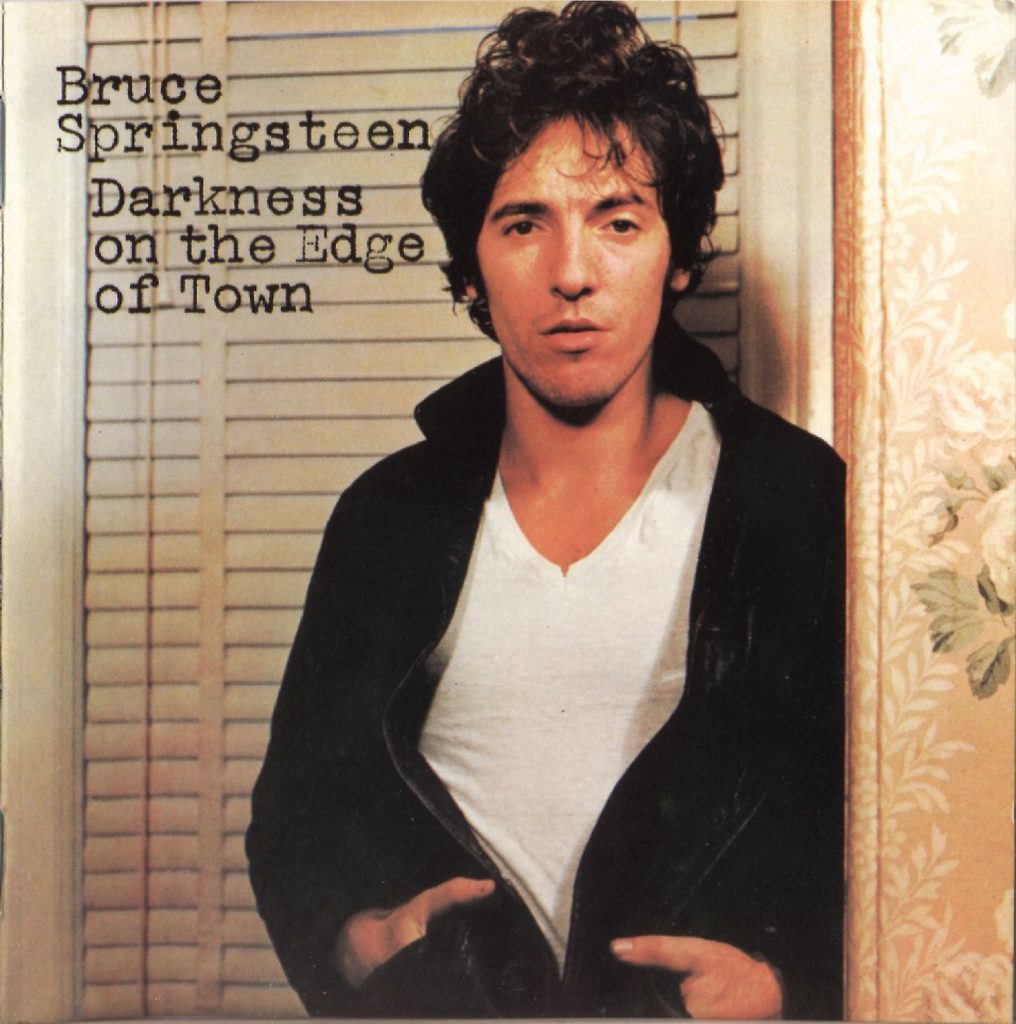
Darkness on the Edge of Town: Homage to The Boss


This post started as something completely different, but it swung like a compass needle toward something I truly love – the music of Bruce Springsteen.

I blog about all sorts of things that interest me, that I enjoy, that make me laugh. I sometimes write about ambitions and guiding philosophies, which are very important, but strangely, I have neglected how much music means to me.

I’ve been a huge Springsteen fan since I first picked up Greetings From Asbury Park in 1973. The man should be Poet Laureate of America, for as someone observed, who else can make you feel nostalgia for New Jersey?

***

I started the morning intending to post on two very significant articles I read in the last two days on structural, rather than cyclical, unemployment in this country.  This is something I think about often because my career in technology spanned the revolution that made it so easy to “offshore” and eliminate so many vocations.  Show of hands, how many are reading this on a computer that was assembled in the US?  As I thought, not a one.

The following are very good articles, that point out that we have a real problem that cannot even be addressed until it is acknowledged, which politicians have yet to do:

“Where the Jobs Aren’t:  Grappling With Structural Unemployment,” by Zachary Karabell, Time, January 17, 1011.
http://www.time.com/time/business/article/0,8599,2040966,00.html/

“Many Jobs Gone Forever Despite Onset of Recovery,” by Darry Sragow, The Sacramento Bee, Jan. 8, 2011,
http://www.sacbee.com/2011/01/08/3308378/many-jobs-gone-forever-despite.html/

As usual, however, poets see things before others, and Springsteen has been telling us since 1978 that we have a darkness at the edge of town.

***

What follows is a blatant excuse to upload some really good music – kind of like a Blues Brothers movie, where anything resembling a plot is secondary.

Here is an anthem everyone loves, perhaps because so few of us live in the place where we grew up.  Yet “My Hometown,” 1984, explicitly laid out the issue of “structural unemployment” a quarter of a century ago:

Now Main Street’s whitewashed windows and vacant stores
Seems like there ain’t nobody wants to come down here no more
They’re closing down the textile mill across the railroad tracks
Foreman says these jobs are going boys and they ain’t coming back


A poet will also recognize how work is much more than balance sheets and GDP; it touches every aspect of individual and family life.  From “The River,” 1980, live at Glastonbury:

I remember us riding in my brother’s car
Her body tan and wet down at the reservoir
At night on them banks I’d lie awake
And pull her close just to feel each breath she’d take
Now those memories come back to haunt me
they haunt me like a curse
Is a dream a lie if it don’t come true
Or is it something worse…


And finally, two more recent favorites, from the 1995 album, “The Ghost of Tom Joad.  They are self-explanatory.

Hot soup on a campfire under the bridge
Shelter line stretchin’ round the corner
Welcome to the new world order
Families sleepin’ in their cars in the southwest
No home no job no peace no rest

The highway is alive tonight
But nobody’s kiddin’ nobody about where it goes
I’m sittin’ down here in the campfire light
Searchin’ for the ghost of Tom Joad


And from the same album, “Youngstown,” performed in Youngstown, Ohio:

From the Monongaleh valley
To the Mesabi iron range
To the coal mines of Appalacchia
The story’s always the same
Seven-hundred tons of metal a day
Now sir you tell me the world’s changed
Once I made you rich enough
Rich enough to forget my name

And finally, to end on an upbeat note, a favorite recent Springsteen cut, performed live in London, 2007 I believe.  This is “The Sessions Band,” assembled for “The Seeger Sessions,” a CD tribute to the music of Pete Seeger on the occasion of his 90th birthday.  That recording, and “Live in Dublin,” are a can’t-sit-still mix of folk, rock, gospel, and jazz music.

God gave Noah the rainbow sign
“No more water but fire next time”
Pharaoh’s army got drownded
O Mary don’t you weep


If this appeals, be sure to check out The Boss’s web page: http://www.brucespringsteen.net/news/index.html
http://www.brucespringsteen.net/news/index.html

Workshop with Donald Maass, Feb. 21, in San Francisco

In response to my post yesterday about the agent workshop in Sacramento, I got a very nice email from Margie Yee Webb, President of the Sacramento Branch of the California Writer’s club, and author of Cat Mulan’s Mindful Musings: Insight and Inspiration for a Wonderful Life which is scheduled for publication in February, 2011. Congratulations Margie!!!

Ms. Yee informed me that Donald Maass, whose, Writing the Breakout Novel, I reviewed here (see the December archive), is giving a half-day seminar called “Micro-Tension: The Secret of the Best-Sellers.”  This will be a post-conference session in connection with the San Francisco Writer’s Conference:

This workshop has been given to rave reviews throughout North America by the man who wrote the book (and workbook) on writing the novel that will break you out of the pack. In the course of two decades Mr. Maass has arrived at a number of definite and highly perceptive conclusions on just what the differences are between an ordinary, pedestrian but enjoyable novel and an ostensibly similar work that catapults the book and its author into an entirely new plane of literary success.

Details on the San Francisco conference and this workshop can be found in the comment Ms. Yee was kind enough to post here:

https://thefirstgates.com/2010/12/07/donald-maass-and-the-breakout-novel/#comments

Workshop, Feb, 5: Make Yourself Irresistable to Editors and Agents

On February 5, the Sacramento branch of the California Writer’s Club is hosting a workshop called, Make Yourself Irresistable to Editors and Agents

Steve Liddick, who is in his second year of organizing workshops for the club, has posted a notice to Craigslist and asked us to spread the news:   http://sacramento.craigslist.org/cls/2146711302.html  I’ll be happy to email the brochure upon request (click the gravatar for my email). 

Times are 9:00-4:00, in the conference room of the Luau Gardens restaurant.  This is the club’s regular meeting venue, has wi-fi, and is close to the intersection of all the Sacramento freeways.  Steve said the presentation will be lively and enterataining, and everyone will have the option of a three minute, for-real pitch to one of the agents in attendance.  Price is $99 for non-club-members, $85 for members.

Steve organized the all day blogging workshop last June that got me started in this endeavor.  The California Writer’s Club also gives me a sense of connection to one of my writing ancestors – it was founded by Jack London.  If you haven’t seen my post on a visit to his ranch, please look in the October 2010 archive.

If you do decide to attend, I’ll see you there.

How Garth Nix Writes a Novel

Who is Garth Nix?  He is a prolific Australian writer of young adult fantasy, whose “Abhorsen Trilogy,” (1995-2003) more than any other fiction, inspired my own current efforts, and “gave me permission” to write the stories I’m working on now.

Garth Nix and Yokimo at World Fantasy Con 2009

Writing anything is better than not writing something perfect – Garth Nix

Abhorsens (there is only one at a time), are necromancers charged with keeping the dead, dead – the nastiest dead do not want to stay that way. We’re talking zombies before zombies were cool. In Liraeal (2001), my favorite book of the series, a young woman, apparently a washout from an academy of magical women, sets out with her only friend, the Disreputable Dog, and an inexperienced prince, to save a thinly disguised England and Scotland from several “Greater Dead” leaders of an army of reanimated corpses. Great stuff, like I said!

You can’t write if you don’t read – Garth Nix

Tonight I was browsing Garth Nix’s website (there is a permanent link on my Blogroll) and I came across the author’s account of the nine general stages he has gone thorough in the creation of his 14 novels.  http://www.garthnix.com/Nine%20Stages%20of%20a%20Novel.htm/a>

The nine stages are:

  1. Daydreams and Musing
  2. A Small Vision
  3. Building the Bones
  4. That First Chapter
  5. The Long, Hard Slog
  6. Sprinting Home
  7. Rest and Revision
  8. Revulsion and Dejection
  9. Parting Company

It is instructive to read all of his comments, but here is a summary:

Daydreams and Musing

This is about gathering ideas.  Nix says many people think coming up with ideas is difficult, but he says it’s easy, the fun part.  The difficulties come later.  Images, snatches of conversation, a hunch of a character, these are the the sort of things he gathers, like picking up rocks which “may or may not contain a useful gem.”   He gives examples:

  • The look of the sky in summer when a light rain is falling at sunset
  • Two old men bickering light-heartedly on the street about something that occurred forty years ago
  • The Venetian agents who stole the body of St Mark from Alexandria
  • A car with a cracked speedometer

A Small Vision

This, says Nix, is like a still from a movie he knows nothing about, but it will evoke a mood:

“Two old men are watching the rain from inside a car (with a cracked speedometer) as the sun sets in the distance, discussing their famous expedition to Alexandria to recover the body of St Mark and take it to Venice. The mood is somber and melancholic, something terrible is about to happen.”

Out of this, he is likely to build a scene, often, but not necessarily, the first one.

Building the Bones

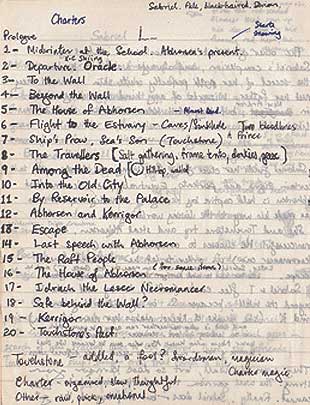
After weeks or months or even years, Nix will review any notes he has made, and write a very simple chapter summary.  He says he often does not know why he does this, since he usually diverges from any such plan within a few chapters, and by the half-way mark the book has little if any relation to the outline, but he notes that an outline serves other purposes:

…it makes me think about the overall structure of the novel, which I think kickstarts some subconscious process that will continue through the writing, monitoring the narrative structure. The second purpose is that it serves as a psychological prop. If I have a chapter outline, I presume I know where I’m going, even when I don’t really.

Chapter Outline for "Sabriel"


The First Chapter

By “first chapter,” Nix says he usually means “prologue,” and that once that and the chapter outline (in whichever order) are complete, the book usually rests for weeks or months.   During the interval he works on other things, and continues to think about the project, but doesn’t actually work on it.

The Long, Hard Slog

Nix always used to write first drafts longhand before copying them to a computer.  Now he is not likely to do an entire draft longhand, but usually the opening chapter(s) are first written in notebooks.  I never tell myself I am writing a 100,000 word book. When I sit down to write, I focus on the fact that I am writing a 2,000-4,000 word chapter. A chapter is a do-able thing. Even so, he calls it a slog, and says 90% of his writing time is an uphill battle to complete the first 2/3 of the novel.

Sprinting Home

At a late stage in the narrative, the writing will kick into overdrive, and the author will find himself working both day and night (he ordinarily likes to keep regular office hours and spend evenings with his family.  I think there is some relationship between the energy put into a book and the energy of the narrative, and when everything is building to the climax and resolution of the story I think that for me at least, it helps to keep at it, to write fast and really charge for the finish line.

Rest and Revision

Nix likes to let the story lie fallow for several weeks before doing revisions, though he says now that’s he is often working on deadline, he has only so much time before he has to send it off to an editor.

Revulsion and Dejection

Nix says, …halfway through a book I usually doubt my work, but I get over it and keep going. Often, when the book is done and has gone off to the editor, this doubt returns and I think that not only have I lost the ability to write, I’ve demonstrated this lack in the latest manuscript. He mentions several of his strategies for getting past this mindset on the website.

Parting Company

The final point he makes is the importance of letting go.   Before breaking into print, Nix worked as an editor at HarperCollins, and says,  In my years in publishing I often met authors whose whole self was entirely bound up in a single book, usually their first. Their lives would rise or fall depending solely on that book’s fate, and in this business, that’s an incredibly foolhardy and dangerous gamble to make.

Garth Nix first came to my attention through an interview in the arts section of the local paper.  I liked his matter-of-fact tone about his writing process then, and I like it on his website now.  He simply offers his process as one approach, not the approach, and the message is, you really do know what to do – now go do it.

Just write one chapter at a time and one day you’ll be surprised by your own finished novel – Garth Nix