
I recently heard the results of a poll that I found surprising: 50% of Americans report having had a “spiritual experience,” but of that group, 80% say they never want to have another. That was exactly the opposite of the 70 or 80 people who gathered on Saturday for a daylong retreat with Anam Thubten Rinpoche, sponsored by the Sacramento Buddhist Meditation Group.
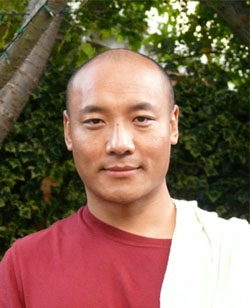
Anam Thubten Rinpoche
Rinpoche is a Tibetan word meaning, “precious one,” and is usually only applied to those recognized as reincarnations of spiritual leaders or teachers of the past, most famously, the current 14th Dalai Lama.
I first attended a retreat with Anam Thubten in December, 2005 and have been fortunate enough to get to a half-dozen more since then, for his home and teaching center, the Dharmata Foundation in Point Richmond, CA, is not far away. In the years since I first heard him, the clarity, resonance, and joy contained in his teachings have brought him greater renown: his book, No Self, No Problem, originally published by the Dharmata Foundation, has been picked up by Snow Lion Press (a self-publishing success story!), and he was chosen to kick off the ongoing series of online retreats at Tricycle.com

In my own efforts to write of the concept of no-self last December, I quoted Anam Thubten for his simple, experiential way of presenting the concept: “this ‘I’ is a fictitious entity that is always ready to whither away the moment we stop sustaining it. We don’t have to go to a holy place to experience this. All we have to do is simply sit and pay attention to our breath, allowing ourselves to let go of all our fantasies and mental images”
It should be clear that any culture like Tibet, that believes in Rinpoches, is not using the concept of “no-self” to tell us we don’t exist or that life does not continue after death. In Anam Thubten’s vision, “no-self” means an end to the painful illusion of seperation, an end to isolation, an end to living in a friend-or-foe, fight-or-flight world.
Yet although he mentioned this concept, which first drew me to his teachings, on Saturday he had a different focus, “Primordial Mind,” the unconditioned and indefinable base of what we are, prior to concepts, prior to ego, prior to all delusions. The experience of this spacious mind is surprisingly near if we are willing to let go of fixed concepts, and practice a simple meditation technique, and if we are motivated by devotion, by longing for union with the absolute the way a thirsty man longs for water.
Anam Thubten’s book elaborates the concepts we need to let go of as well as his favorite meditation practice – the simple but difficult art of learning to relax and let go of effort, even the effort to meditate “well.” This longing – for God or the guru or Buddha; for oneness, or emptiness or, selflessness, or enlightenment – however we conceive of the ultimate good, is finally a longing for love, he said, and this is what remains when our fixed ideas break down. In Anam Thubten’s teaching, God is love, or Buddha Nature is love, as it is in the words of many other spiritual masters.
My description is close to being new-agey, which is why Anam Thubten is the teacher and I am not. He didn’t gloss over the difficulty and struggles involved in a serious spiritual search, and in his quiet and understated way he noted that if one is not receptive, “this talk will be very strange.”
In the end, it is the person of the teacher himself that does the convincing. Is this person really what he seems – genuinely centered, full of peace and compassion? I believe Anam Thubten really is a man of peace and joy and I trust his message that what he has found is accessible to anyone willing to look and make the effort. More information and his teaching schedule can be found at the Dharmata Foundation website, http://www.dharmatafoundation.com/
Dharmata is a word that means, “the way things truly are.”


 The First Gates