In light of today’s events I am canceling the post I’ve been working on indefinitely. Sometimes words are insufficient. This is a time for prayer and silence, and as the president said, hugging the ones you love.
In light of today’s events I am canceling the post I’ve been working on indefinitely. Sometimes words are insufficient. This is a time for prayer and silence, and as the president said, hugging the ones you love.
That’s what they say in the tech industry. That’s what Buddha said 2600 years ago. And that’s what the National Intelligence Council says in a 140 page report, “Global Trends 2030: Alternative Worlds.”
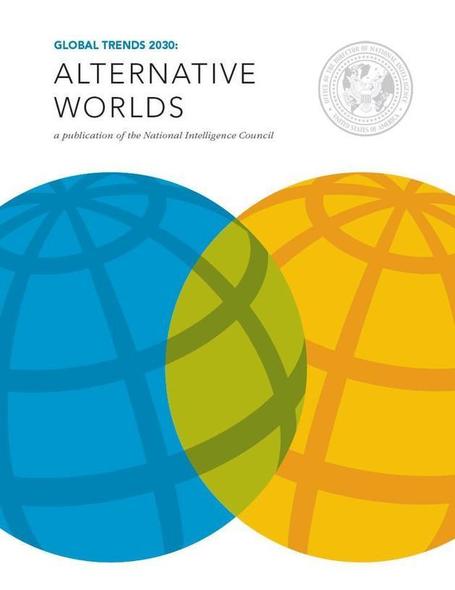
Click for the text of the whole report
Since 1997, the NIC, formed of all 16 US intelligence agencies, has issued five Global Trends reports, one after each presidential election. For this one they engaged think tanks, government, and business leaders in 14 nations and concluded that the world will be radically different in 18 years. The pace of change will be faster than at any period in modern history.
NIC Chairman, Christopher Kojm, says:
“We are at a critical juncture in human history, which could lead to widely contrasting futures. It is our contention that the future is not set in stone, but is malleable, the result of an interplay among megatrends, game-changers and, above all, human agency. Our effort is to encourage decision makers—whether in government or outside—to think and plan for the long term so that negative futures do not occur and positive ones have a better chance of unfolding.”
Here is a link to a summary of the report. ww.bloomberg.com/news/2012-12-10/u-s-intelligence-agencies-see-a-different-world-in-2030.html
The NIC defines “megatrends” as scenarios likely to happen under all circumstances. “Game-changers” are “critical variables whose trajectories are far less certain.” Additional possibilities are listed as “black swans,” discrete events that would cause large scale changes, either for good (a democratized China or a reformed Iran) or ill (global pandemic, WMD attack).
The report identifies four megatrends, changes regarded as inevitable over the next two decades:
National Geographic issue on extreme weather, published one month before Superstorm Sandy
Rather than summarize more of the report, I invite readers to check it out for themselves. Let’s step back and reflect on what this means.
My dogs do not like change. They find comfort in their routines, and if I am honest, so do I. This month a 72 year old hardware store, where you could find anything, closed it’s doors. So did a 76 year old nursery, where master gardeners could always diagnose the ugly brown spots on your roses. That’s enough to put me in a funk, imagining our big box future, and yet this is nothing compared to what Global Trends 2030 suggests is coming – change at a faster rate than anyone living has seen.
Change that rapid generates fear. Looking at the last decade, we see resistance to change spawning violence. Religious fundamentalists are more vocal in nearly all denominations. Reactionary politicians grasps at some idealized past that is gone if it ever existed. The urge to get what is mine at all costs further disrupt economic life and generates even more fear. People bemoan the loss of civility.
Do we have any guides for living through times like these?
As I asked myself the question, I remembered Joseph Campbell’s assertion that world mythology holds wisdom for all the turns that life can take. And Marie Louise Von Franz, Jung’s closest colleague, said that fairy tales offer the “purest and simplest” expression of “the basic patterns of the human psyche.” Do stories created by people who traveled by foot and ox cart really have something to teach us in the 21st century?
I believe they do. Next time we will consider what the old stories may say about living through difficult times.
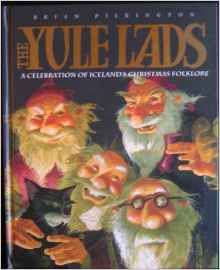
In most Christian countries, Christmas was slower to catch on than other major church holidays. The clergy may have been wary of pagan solstice celebrations which happened at the same time of year and included serious revelry. Some early Christmas festivities mimicked the custom. They were banned in 17th century England, and American Puritans outlawed them too.
According to Brian Pilkington, author of The Yule Lads, Iceland was ahead of the curve. A 16th century law stated that “All disorderly and scandalous entertainment at Christmas and other times and Shrovetide revels are strongly forbidden on pain of serious punishment.”
Icelandic winters are long and dark, with fewer than five hours of daylight at this time of the year. Imagination tends to fill the darkness with what we fear, and Pilkington’s book describes “the lads” that kept Icelandic children awake at night. The gentlemen pictured on the cover are not our shopping mall Santas!
The matriarch of the clan was the ogress, Gryla, who loved to eat stewed children. It couldn’t be just any kid though. It had to be one who was “naughty, lazy, or rude.” In one 13th century account, Gryla had 15 tails, and tied to each was a sack full of naughty children. It was not “the most wonderful time of the year” if you were young! The Icelandic word for icicle is “grylukerti” which means “Gryla’s candle.”
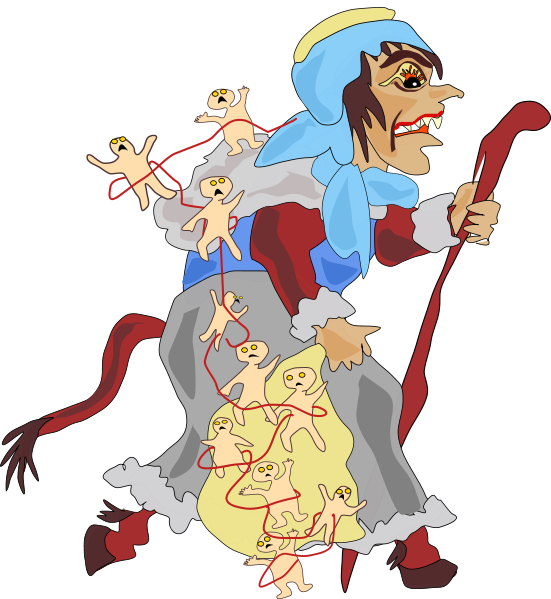
Gryla. CC-by-SA-2.5
Gryla had three husbands and 80 children, though legend now boils it down to 13 sons who visit the homes of children on successive nights from Dec. 12 – 25. Time and the law have taken the edge off the Yule Lads, for a 1746 decree said “The foolish custom, which has been practiced here and there about the country, of scaring children with Yuletide lads or ghosts, shall be abolished.” By the 19th century, the Lads had morphed from cannibals into rascals and petty thieves, who even began to leave gifts for good children who left their shoes on a window ledge.
The first to arrive was Stekkjarstaur, the “Sheep Worrier.” He would visit the the sheep cot and try to suck milk from the ewes. That doesn’t work in December and led author, Brian Pilkington to suggest that Sheep Worrier’s IQ is “somewhat less than three digits.” These days he heads for the fridge to get his milk. If a child has been good, Stekkjarstaur leaves a sugary sweet. Bad children get a potato.
Next comes Giljagaur, aka, “Gully Gawk” who travels through gullies and ravines, also in search of milk, but he looks for cow barns and inattentive milkmaids. “Stubby” arrives the third night, as short as his name suggests. He likes to raid the kitchen, as do the brothers that follow, “Spoon Licker,” “Pot Licker,” and “Bowl Licker.” In their present forms all they do is mischief, but food thieves were no joke in earlier times. For northern farming families, the time between Christmas and the spring thaw in April or May could be times of famine if food or fodder for livestock ran short.
The next lad to show up is Hurdaskellir, or “Door Slammer,” one of only two of Gryla’s sons who isn’t out to fill his belly. Imagine loud bangs in the dead of night and you know how he gets his jollies.

And as if the sons of Gryla were not bad enough, children also had to contend with Jólakötturinn, the Yule Cat, a huge feral creature who hunts children on Christmas Eve instead of mice. Like the lads, the cat discriminates in choosing his victims, eating only those who have not received a new item of clothing for Christmas. Pilkington says that “Until fairly recently in Iceland, all clothing came directly from sheep. The wool had to be washed, combed, and spun before it was painstakingly crafted into a garment. It was a long, arduous process.” Fear of the Cat induced lazy children to do their part!
This is a fun book and a fine counterbalance to the usual TV holiday movies. You can picture families gathered around the fire as the wind howls outside, thinking as we do when hearing a good ghost story, “This can’t be true…can it?” Something within the listeners then and within us now loves to be scared, to confront monsters and vanquish them in imagination. On that score, Gryla & Sons and the Yule Cat satisfy!
A click on the book cover at the top of this post will take you a site where you can order The Yule Lads.
The stigma is gone, but the road to nirvana is getting more crowded by the day. That’s the gist of Andrew Rice’s article, “The $0.99 Best Seller” in the December 10 issue of Time.

Rice visited a romance writer’s convention where Mark Coker, founder of Smashwords, was the most popular speaker, and E.L. James, the best selling author of Fifty Shades of Grey was the symbol of success for many writers in attendance. Fifty Shades began as Twilight fan fiction before going viral as an ebook and finally landing a traditional Random House contract. According to Rice, “To Coker and his audience…Fifty Shades…looked like a harbinger of the future of publishing.”

Rice said there were 30 self-published ebooks on a recent list of Amazon top sellers and four self-published titles on the New York Times ebook best seller list. Self-published ebooks are growing at four times the rate of traditionally published titles, and Rice quotes analysts as saying the “big six” publishing houses may soon become three or two or even just one.
This doesn’t mean that it’s easy. I’m reminded of the California gold rush. Some who arrived at the gold fields early – the “48ers” – made substantial amounts of money while those who came later did not. Last year’s ebook celebrity, Amanda Hocking, took a traditional publishing contract when it was offered, saying marketing and promotion got in the way of her writing. I’ve reviewed books by several excellent indie authors – Jade Scott, Amy Rogers, and Barbara Kloss, and all of them spend huge amounts of time publicizing their work.
Andrew Rice says it’s not going to get any easier: “the chances of publishing that rare blockbuster grow more remote every day as more stories flood into the market, competing for a finite amount of reader attention.”
Yet for those indie authors I know, it’s not about getting rich or hitting the long shot best seller. At the core, it’s about finding an avenue to tell the stories that live inside them. The days when aspiring authors needed traditional publishing for validation and a way of getting their work into print are history, just like quill pens and Underwood typewriters. The stigma is gone, and good riddance.
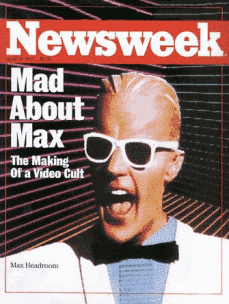
In 1984 I joined Intel as their graphic workstations were shrinking from video arcade sized units to large desktop computers. In my spare time, I sometimes played with a Commodore64 and saved quarters for Space Invaders. The first IBM personal computer did not roll out until the following year.
That was the state of technology when Max Headroom was born. The creation of a British trio, George Stone, Annabel Jankel, and Rocky Morton, Max was an artificially intelligent, disembodied personality who lived in cyberspace before the term was coined. Computer animation wasn’t advanced enough to portray the computerized look the group was after, so filming Max required a four hour makeup session that actor Matt Frewer described as “a very painful, torturous and disgusting enterprise.”
Rocky Morton described Max as a “very sterile, arrogant, Western personification of the middle-class, male TV host,” but he was also “media-wise and gleefully disrespectful,” which endeared him to younger viewers.
Max appeared on American TV in 1987, as a talking head – literally – in a TV newsroom in a dystopian near-future dominated by large corporations and television. Although he became a spokesman for “The New Coke,” and appeared on Sesame Street, only 13 shows aired.
Part of the problem was that Max was down right irritating, with his visual and vocal stutter and an op-art background that was the best computer animation could do at the time. Here is a 3o second sample from his Coke commercial:
The fact remains that Max Headroom was decades ahead of his time. In one episode, for instance, terrorists blow up all TV towers in the city, pushing the population to riot when they find they have nothing to watch. In the nick of time, city officials pacify everyone by distributing hand-held video viewers loaded with old reruns.
Remember, this was 1987, when the best technology Hollywood had to offer wasn’t enough to capture the vision of Max’s creators.
So what brought Max Headroom to mind right now? Beyond Max’s “dystopian future dominated by large corporation and television” that is. Why today, December 3, 2012?
Yesterday, after a series of storms, I ventured out to the supermarket and walked in just as they played the Christmas carol holiday song I hate most, “Little Saint Nick,” by the Beach Boys. I had to compliment the store, however – the sound was just barely audible. Not loud enough to cause real annoyance, I thought, but enough to keep silence at bay, which might cause people to riot.
That brought Max to mind. “Ha-ha-ha-happy Ho-ho-holidays, everyone.”

One day God decided to visit Adam and Eve. They welcomed him and introduced their children – all except the ones Eve had not finished bathing. After all, you want your kids to be clean when the Supreme Being drops in. God was aware of this and said, “What is hidden from me shall be hidden from men.” Those children became the elves who live in the hills and mounds of Iceland. They can see us but we can’t see them unless they wish it.
I know this because I read a magical book, Tales of the Elves, based on the Icelandic folktales of Jon Arnason, adapted by Anna Kristin Asbjornsdottir and illustrated by Florence Helga Thibault. I found the book on our visit to Iceland, which I wrote about in the fall.
Interest in elves isn’t limited to children in Iceland. One day, as we toured the countryside, our driver pointed to a spot in a wide valley where the highway curved around a pair of volcanic rocks. The stones were only 8′ – 10′ tall, nothing modern earth movers couldn’t remove. That was the intention of the highway crew. The problem was, the bulldozers broke down or stalled every time they approached the twin rocks. Every time. Locals explained that the stones marked the entrance to an underground elven settlement. The equipment worked perfectly after the construction crew decided to route the highway around the stones.
If this reminds you of Irish fairies, there’s good reason. Genetic testing has proven that many Icelanders, especially the women, came from Ireland, specifically, the viking settlements there. The stories themselves teach us similar lessons in coexisting with “the hidden ones.”
“Midwife to the elves” shows how the elven folk can give the gift of the sight and take it away again. “Elf Wind” demonstrates the courage and cunning required to set things right if you do something foolish, like cut the grass on an elven mound. “Payment for Milk” is about the boons the elves can grant if you treat them with kindness and goodwill.
I’d been looking forward to writing this review since I found Tales of the Elves, but unfortunately I couldn’t find any venue where interested readers can find the book. Not on Amazon US or UK. Not on bookfinders.com or ebay. I couldn’t find ordering information on the publisher’s website. I posted a request for information on the illustrator’s Facebook page, and I’ll pass along anything I discover. Meanwhile, here is the information – if you love folklore and fine illustration of fantasy themes, it’s worth keeping an eye open for this book.
Anna Kristin Asbjornsdottir (adaptation), Florence Helga Thibault (illustration), Victoria Cribb (trans), Tales of the Elves, Bjartur publishing, Reykjavik, 2012
ISBN: 978-9979-788-80-5
Please post any information you may discover.
In the wake of the election, I more or less swore off posting political content here, except on special occasions like when the first day of a new month falls on Saturday. On days like this, I am allowed to provide links to stories I think are important.
Please check out this post on the website of Sen. Bernice Sanders (Independent) of Vermont: http://www.sanders.senate.gov/newsroom/news/?id=D3227558-DD10-4C92-AD1A-AD1E1E54543D
The good news is, Senator Sanders won a decisive re-election victory this past November. The people of Vermont know a good thing when they see it!
 The First Gates