The Ocean at the End of the Lane by Neil Gaiman

ocean

I’ve loved fantasy since my earliest childhood days of hearing stories read aloud.  Growing up I lived on The Wind in the Willows, Godzilla, Norse mythology, science fiction, Frankenstein and the folklore of many cultures.  In college, I discovered Tolkien, The Odyssey, C.S. Lewis, as well as Jung and Campbell, who served as guides to the often trackless realms of the other worlds.

If you follow fantasy literature for any length of time, you notice that authors who bring forth new visions are often followed by scores of knockoffs by writers looking for bandwagons to ride.  Neil Gaiman is an exception to that rule; he sows his unique personal visions across traditional genres in a manner that can’t be imitated.

How would you follow the Hugo and Nebula award winning American Gods, 2001, a dark, modern day Iliad that pits old gods like Mr. Wednesday (Odin) against new deities like Media, the goddess of television?  A year later, Gaiman published Coraline, sometimes compared to Alice in Wonderland for its unflinching look at the terrors of childhood and winner of Hugo and Nebula awards for best novella.
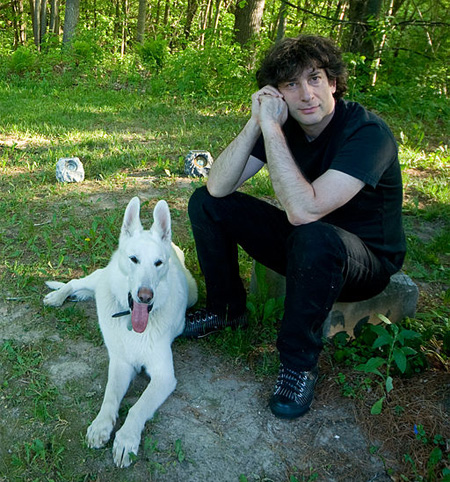
Neil Gaiman, 2009, by Kyle Cassidy.  CC-BY-SA-3.0

Neil Gaiman, 2009, by Kyle Cassidy. CC-BY-SA-3.0

In June, Gaiman released The Ocean at the End of the Lane, which he called “the most serious, dark, weird and personal thing I’ve ever written” in an interview called “The Illusionist” in the June 24, 2013, issue of Time.     

Illusionist is the only possible title for the creator of Ocean, which began as a short story and grew.  You reach the end of a nail biting ride with a man recalling a summer of terror and beauty that happened (or probably happened) when he was seven, and you realize that although you have been in his head and his heart for 180 pages, you don’t even know his name.  You know the name of Lettie Hempstock, who lives at the end of the lane, an 11 year old girl who claims that her duck pond is really an ocean.  You know Lettie’s name, but you don’t know what she is, and when you ask how long she has been 11, she gives you a smile but no answer.

Like Dr. Who’s TARDIS (Gaiman wrote an episode this year), Lettie’s ocean is bigger inside than it appears from without.  When he ventures in, Gaiman’s protagonist says, “I saw the world I had walked from my birth and I understood how fragile it was, that the reality I knew was a thin layer of icing on a great dark birthday cake writhing with grubs and nightmares and hunger.  I saw the world from above and below.  I saw that there were patterns and gates and paths beyond the real.  I saw all these things and understood them and they filled me, just as the waters of the ocean filled me.”

One of Gaiman’s numerous strengths is his ability to remember “extremes of horror and ecstasy that children experience.”  He read books as a child and realized the adult writers had forgotten.  He vowed not to, and The Ocean at the End of Lane proves that he has not.

Gaiman resists “fantasy” as a label, but for convenience I will use it to say this is one of the finest fantasies I have ever read.  In the Time interview he also said, “I’m now more famous than I’m comfortable being.”  Though I understand his concern, I have to say, “Dude, you brought it on yourself – learn to deal with it.”

Washedashore.org: art to save the sea

Meet Lidia the Seal. She stands as tall as I can reach, in a vacant lot in Bandon, Oregon, the creation of artists and volunteers of the Washed Ashore Project.

Lidia2

The group’s goal is to turn plastic and other ocean garbage into art that illustrates the harm to marine life and the entire food chain resulting from careless dumping.  So far, 1000 volunteers have collected three and a half tons of marine debris along 20 miles of coastline and used it to create 18 giant sculptures.

Detail of Henry the Fish, showing the kinds of objects used to make the sculptures.  Henry is 15'x9'x8'

Detail of Henry the Fish, showing the kinds of objects used to make the sculptures. Henry is 15’x9’x8′

Plaques beside the sculptures explain a little about the dangers of the degrading petrochemicals in plastics in the ocean, as well as the process of collecting, washing, sorting, and recycling what the volunteers collect.

One of the plaques affirms that, “Every action you make in your life has an impact.  Even small actions make a positive difference.  People working together CAN create results.  This project proves it!”

I wish you could have been there to share the delight of rounding a corner to find Lidia and Henry, but for the next best thing, please visit the project website: washedashore.org. There are many more photos and descriptions illustrating the process of turning these castoff items into art, as well as information on exhibits in other locations.

Maybe one day soon, one of these washed ashore creatures will visit a spot near you!  Meanwhile, enjoy these, and perhaps, as one of the plaques says, you will be moved to see art where others see garbage, right where you are today!

Face Rock, Bandon, Oregon

face rock

From this perspective, it’s easy to see how Face Rock, got it’s name.  Legend says that long ago, Chief Siskiyou from the mountains came to the sea to trade with the four tribes that lived in this region.  Warriors stood on the bluffs above the ocean fearing that the evil sea-spirit, Seatka might cause trouble.

Siskiyou’s daugher, Princess Ewauna, was not afraid of the spirit, and one night, when the moon was full, she slipped away from camp with her faithful dog and a basket with her cat and kittens nestled inside.  She went swimming, farther and farther from shore, ignoring the warning barks of her dog.  Seatka captured the princess.

Carrying the basket of cats, the dog swam out to Ewauna and bit the evil Seatka.  Howling, he shook off the dog and threw the cats into the sea.  Seatka tried to make Ewauna look into his eyes, but she refused and kept her gaze on the moon.  The dog ran on the beach howling, but in time, he, the cats, and Ewauna, still gazing up at the moon, were frozen into stone where they remain to this very day.

I first passed through Bandon, Oregon back in college days, and it’s one of those places that has drawn me back ever since.  I took the current blog header photo two years ago at a spot about half a mile up the beach overlook trail.

With the wind off the sea and afternoon fog, it is downright chilly.  I had almost forgotten what chilly is like, but I remembered this afternoon, rolling into town in cutoffs and t-shirt.  It’s hard to pack for cold weather when it’s 100+ degrees outside, so tomorrow will likely involve shopping for a sweatshirt.

This will probably be a quiet week on thefirstgates, as we wander the shore, listen to the ocean, and eat cranberry oatmeal cookies.

Photo by Casey Fleser, CC-by-3.0

Photo by Casey Fleser, CC-by-3.0

See you then, with more stories and photographs.

Artifacts of our ambition

artifacts1

Last night at dusk I went out to turn off a backyard sprinkler and noticed a broken garden plaque that lay among fallen leaves and plums.  It’s been there for quite some time, one of those objects I don’t know what to do with but like too much to throw away, so I leave it where it lies.  Last night, in the twilight, I noticed it.

A phrase sprang to mind:  “You look for the artifacts of their ambitions.”  This is the first line in Michael Koryta’s superb supernatural thriller, So Cold the River.  The main character goes on to say, “The reality of someone’s heart lay in the objects of their desires.  Whether those things were achieved did not matter nearly so much as what they had been.”

The plaque was a primitive image of the sun – the word “SOL” is still visible.  We got it in Mendocino a long time ago and hung it on the fence at a time when gardening was one of our major activities.  Its importance waned under the time pressures that came with more “gainful” employment,” but this little artifact, like a Velveteen Rabbit made out of stone, can still speak when I stop to listen.

After I snapped this photograph, I went looking for other such artifacts, both in a box of old pictures of mine and among vintage postcards, photos, and tintypes I’ve collected.  If you are a packrat like me, you surround yourself with such things. 

Dreams change, and ambitions, just like our lives, can be fleeting. The artifacts often outlive them. Nothing shows that more clearly than this picture of my father, my sister, and me by a stone wall I helped build.

father, me and jan

The Kodachrome is fading and my father is gone, but not long ago, I checked Google’s satellite view, and that stone retaining wall, some 3,000 miles from where I now live, still appears to be standing.  How can you even begin to say what it means when you’re five and your father shows you how to place stones in a wall and trowel the concrete into place between them?  “The reality of someone’s heart lay in the object of their desires.”

boys of summer

I’ve always liked this team photo, with its mix of bravado and shyness in front of the camera.  Did any of these boys of summer dream of playing in the majors?  Did any of them come close?  Did they love the game any less than the 2013 all stars who played in front of millions of viewers last week?  I’m guessing that at the moment this picture was taken, they may have loved it more.

stereo picture

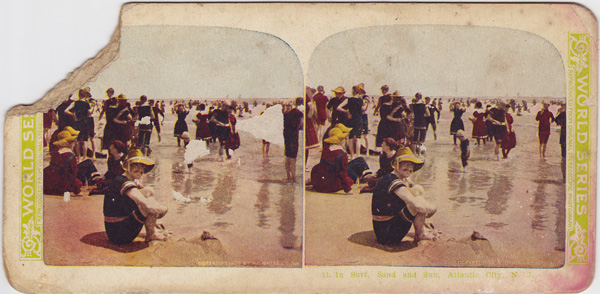
What about the fellow in the foreground of this stereopticon slide? Do we even want to know about his ambitions?  Close up, he looks like Groucho Marx in a yellow hat.  The picture is labelled “Surf, Sand, and Fun, Atlantic City, NJ.”

cemetary photo

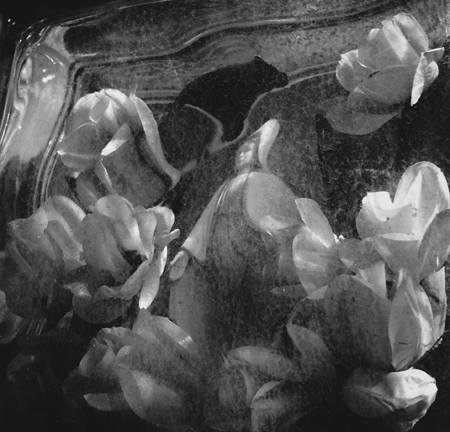
This is a poignant image, from a photo I took of an arrangement in a glass box, embedded in a gravestone in an old Italian cemetery in Binghamton, NY.  Virgin Mary stands amid plastic roses, her image distorted by thick old glass.  I spent a summer there working in a factory, and returned again and again to this cemetery, which was full of angels and lambs and redeemers, for don’t these all speak of a nearly universal ambition – the longing for redemption, in the here, the hereafter, or both?  The world is alive and things within it can speak to us if we listen.

And finally, one of my more important artifacts.  I kept this photo of a young 19th century woman over my desk while writing my first novel.  This, I thought, was how the book’s heroine would have looked if she’d posed for a picture.  So this photograph, taken more than a hundred years ago, of a woman whose dreams I cannot begin to fathom, became an icon for one of my own ambitions.

old photo of young woman

I didn’t tell her story very well, but as the character in So Cold the River observes, that often doesn’t matter.  Sometimes when I look at this picture now, it holds a greater mystery than it ever did when I used it as a writer’s prompt.  Now I can see its own inscrutable mystery.

James Hillman often quoted John Keats who said, “Call the world if you please ‘The vale of Soul-making.’ Then you will find out the use of the world.”  In the same letter to his brother and sister, Keats added that our pains and troubles “school an Intelligence and make it a Soul.”

Artifacts of our ambitions are things we notice as the eyes of soul begin to open.


Despicable Me 2

despicableme2

In this year of superheroes and sequels, with intrusive digital effects everywhere you turn and an actor who should know better wearing a stupid dead crow on his head, it is July and I’ve been to the movies exactly twice.

I had the most fun at Despicable Me 2, and was delighted to find it a beautifully crafted film.  If you’ve been waiting…and waiting…and waiting some more for a movie worth venturing out to the cineplex, the drought has lifted with this one.

Disclaimer:  I get nothing in return from anyone for writing this review, but I’m still sort of hoping that karmic forces, somehow and somewhere may award me a minion or two for my efforts.  Come on – wouldn’t you like a few of the happy little guys to do the chores around your home?

You know you would…

Informed Citizen Disorder

Words can sometimes illuminate.  Bill Moyers’ recent interview with Marty Kaplan, Professor of Entertainment, Media, and Society at USC, gave me a phrase that crystalizes the sense of despair that increasingly follows attending to current events.  “Our spirits have been sickened by the toxins baked into our political system,” Kaplan says.  That’s one definition of what he calls, “Informed Citizen Disorder.”

Marty Kaplan by adamrog, CC-by-SA-3.0

Marty Kaplan by adamrog, CC-by-SA-3.0

Kaplan has an impressive and varied resume; a degree in Microbiology from Harvard; a Ph.D in Modern Thought and Literature from Stanford; twelve years as a Vice President at Walt Disney Studios.  Kaplan wrote speeches for Walter Mondale and co-authored the screenplay for The Distinguished Gentleman (1992) starring Eddie Murphy.  He was the founding Director of the Norman Lear Center at USC, which studies “the social, political, economic and cultural impact of entertainment on the world.”

In the interview with Moyers, called Weapons of Mass Distraction, Kaplan spoke of the weeks he recently spent in Brazil, watching the widespread protests against “political corruption, economic injustice, poor health care, inadequate schools, lousy mass transit, [and] a crumbling infrastructure” while the government spends billions to host the 2014 World Cup and the 2016 Summer Olympics.

One of the obvious questions Kaplan asks is where are the protests in our country?  With ills so blatant and parallel to Brazil, where is our outrage?

“Sickened spirits,” is one of his answers.  Another is misdirection; what passes for journalism often has us asking the wrong questions as it feeds us “the infotainment narrative of life in America.”  Learned helplessness is another factor that Kaplan often cites.

Learned helplessness entered the language of psychology in a now-famous experiment conducted by Martin Seligman in 1967.  Dogs were subjected to electro-shocks with no means to avoid them.  Eventually, they stopped looking for an escape and entered a passive and “hopeless” mode.  In the experiment’s final phase, when means of avoidance were introduced, the dogs did not discover them, because the helplessness had been so thoroughly learned they no longer even tried.  Researchers had to retrain them to manipulate their surroundings again.

The analogies to our situation are obvious.  Citing incidents like the lack of change after Sandy Hook, Kaplan wonders how many times can we stand to have our hearts broken?  Answering a question from Moyers on “Informed Citizen Disorder,” he adds:  

“Ever since I was in junior high school, I was taught that to be a good citizen meant you needed to know what was going on in your country and in your world. You should read the paper, you should pay attention to the news, that’s part of your responsibility of being an American.

And the problem, especially in recent years, is the more informed I am, the more despondent I am, because day after day, there is news which drives me crazy and I want to see the public rise up in outrage and say, no, you can’t do that, banks. You can’t do that, corporations. You can’t do that polluters, you have to stop and pay attention to the laws, or we’re going to change the laws.

…every time that doesn’t happen…something bad happened and nothing was done about it…the sadder one is when you consume all that news…all the incentives are perverse. The way to be happy, to avoid this despondency is to be oblivious to it all, to live in Aldous Huxley’s ‘Brave New World.'”

Despite everything, Kaplan remains an optimist.  “I have kids,” he says, “I have to be.  The world has kids, we have to be.”  The alternative to optimism, Kaplan warns, is to “medicate yourself with the latest blockbuster and some sugar, salt, and fat that’s being marketed to you.  The only responsible thing that you can do is say that individuals can make a difference and I will try…”

Not the happy-happy answer we’d get from the “infotainment” world, but though Kaplan is an optimist, he’s not going to feed us bullshit.  I urge everyone to listen to the interview or read the transcript.  A key finding with learned helplessness that researchers discovered and Kaplan cites, is that since it is based on perception rather than fact, it can be quickly reversed.  We’re not there yet, he thinks, but maybe as people become more and more unhappy with the state of affairs around them, a critical mass is building that will lead ordinary citizens to demand change as we have done in the past.

More good news on the food front

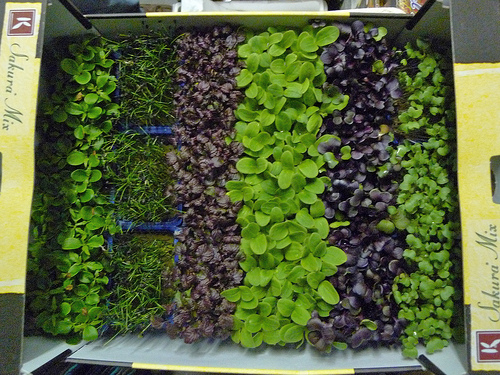
Last week, two posts on npr.org opened a startling window on the capacity of well tended small gardens. The first article, “Why Micro-Gardening Could Go Big,” discussed the UN’s Food and Agriculture Organization (FAO) as a large supporter of micro-gardens, defined as “intensely cultivated small spaces.”  They claim that an 11 square foot garden can produce “as much as 200 tomatoes a year, 36 heads of lettuce every 60 days, 10 cabbages every 90 days, and 100 onions every 120 days.”

Micro-garden by Nick Saltmarsh, 2009.  CC-by-3.0

Micro-garden by Nick Saltmarsh, 2009. CC-by-3.0

The post features a number of links to other sites with numerous links of their own, and it soon becomes clear that many groups and individuals are finding new ways of boosting yields.  As I discussed recently (Good news on the food front), unless agriculture finds ways of keeping pace with population growth, disaster is a mathematical certainty.

These articles show that there are far more efficient configurations than traditional, single row gardens. Raised beds and containers are common features of the gardens pictured online.

Rooftop garden, Senegal, CC-by-2.0

Rooftop garden, Senegal, CC-by-2.0

One nice thing about these photos is that they make you want to get your hands dirty! Maybe not this afternoon, with temps in the mid 90’s, but I’ve already got a spot in mind for the fall and spring.  We used to have a veggie garden when we lived north of here and had more time and far better soil.  With micro-gardens you don’t need large amounts of time or good soil to get started.

Photo by USDA.  CC-by-2.0

Photo by USDA. CC-by-2.0

NPR’s second post, Micro-Garden Madness, has additional photos of places where people are growing things.  Unlike the ambitious plots at the local community gardens, where you often see couples and families work long hours on weekends and evenings, the smaller gardens can work for people who spend their evenings and weekends in strange pursuits like blogging.

Phil Weiner co-founded a company that makes products aimed at micro-gardeners.  “Everyone in the world should have a victory garden,” he says.

Can we even begin to imagine what such a world would be like?  With these articles and photos, we can begin to envision such a transformation.

Tis the season?

First Christmas catalog arrival date for 2013 - July 5

First Christmas catalog arrival date for 2013 – July 5

At the risk of being accused of having an idle mind, let tell you that over the last few years, I have tracked the arrival date of the first Christmas catalogs.  It was the end of July in 2010, and over the next two years, the trend seemed to reverse – no Santa’s in the mail until August.  This year we’ve hit a new low.  The first one, inviting me to “Celebrate life’s special moments,” was delivered July 5, with two more arriving the next day.

Here I am, just beginning to mourn the beginning of shorter days as a new threat looms on the horizon – if “the most wonderful time of the year” can almost breach the Independence Day bulwark, can “holiday music” be far behind?  Are you ready for “Little Saint Nick” in the stores in September?  Note to self – carry earbuds everywhere!

Every year it seems I come to a greater appreciation of the pre-repentant, “Humbug” Ebenezer.

And when the days grow short and the weather turns cold, I’ll be singing along with Joni Mitchell – “Wish I had a river I could skate away on.”