A blogging friend, Calmgrove, commented on my previous post, saying how strange it is that in modern times, despite an abundance of comediennes, there are no female tricksters. Then it struck me – and it’s so obvious, I can’t believe I didn’t think of this earlier.
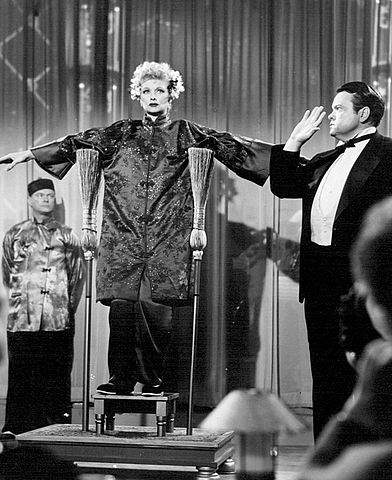
In an era when tricksters come to us on screens rather than stories told around a campfire, we cannot forget Lucille Ball’s role in “I Love Lucy.” The show ran from 1951 to 1957 and was the most watched the American television program during four of those six seasons. It is still in syndication in dozens of countries around the world.
Lucille Ball and Orson Welles.From a 1956 episode. Public domain.
Lucille Ball, with her clowning and physical comedy, set a tone that is still at the core of many sitcoms. Most of the best known women comics who followed cite her as a groundbreaker, an inspiration, a mentor, and often a friend. In terms of our “classic trickster” test, that is what she was, at all times. Never just a funny housewife, Lucy was an outrageous but charming disrupter, whose pioneering humor enlivened the spirits of millions who watched her.
I dare you to get through the chocolate factory scene with a straight face.
Quite a few full episodes of the show are available on YouTube.
I want to argue a paradox…that the origins, liveliness, and durability of cultures require that there be space for figures whose function is to uncover and disrupt the very things that cultures are based on. – Lewis Hyde
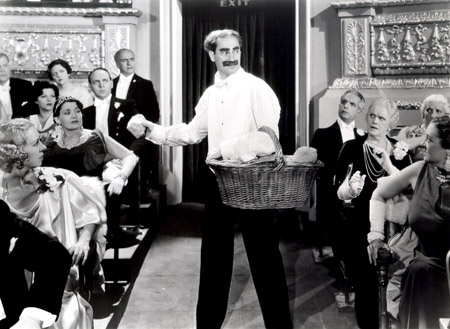
It has always made sense to me that the 1920s, 30s and 40s, when times were hard for so many, gave birth to our great movie tricksters: Charlie Chaplin, Laurel and Hardy, The Marx Brothers, and The Three Stooges. Their send ups of the 1%, among other things, are still hilarious. Where are their equivalents today?
My self-imposed moratorium on negative blog themes has passed. As I caught up on news I had kept at arms length, I found myself thinking often of trickster stories. In part because they are funny, and most of the news is not. And partly because the folly of tricksters has a sacred dimension while the folly of our headline makers is often just foolish. If you invite the Three Stooges to lunch and serve pie, the outcome is fairly certain. I read that the Georgia legislature voted to allow patrons to carry guns into bars; the result is likely to be just as predictable, but without the catharsis of laughter.
1) Tricksters both make and violate boundaries and live in relationship to them. Where there are no boundaries, trickster creates them, as in several Native American creation myths where Coyote makes the land and separates it from the sea. Where there are cultural boundaries, tricksters blur or invert the distinctions: right and wrong, friend or foe, male or female, living or dead.
2) Tricksters are usually on the road, and this makes them outsiders.
Through most of human history, solitary travelers have been rare. Until the last century, most people lived and died close to the area where they were born. Nomadic people travelled as tribes or clans, but Hyde says trickster is “the spirit of the doorway leading out, and of the crossroad at the edge of town. He is the spirit of the road of dusk,” who may pass through city and town but only to “enliven it with his mischief.”
Hyde points out that although there is an abundance of clever women who know how to be deceptive in world mythology, they are seldom full-time tricksters. Once the evil is vanquished, the curse lifted, they tend to settle down. Coyote and Loki do not domesticate, and the older cultures who gave us these stories would have had trouble imagining a woman who opted for a solo life on the road.
3) Tricksters are liars and thieves, but they are not petty criminals.
Tricksters steal things like fire and cattle, and according to Hyde, are often honored as creators of civilization. “They are imagined not only to have stolen certain essential goods from heaven and given them to the race but to have gone on and helped shape this world so as to make it a hospitable place for human life.”
We cannot be too doctrinaire about these things, for there is a distinction between “large” stories, like creation myths, and “small” folktales, where trickster sometimes steals cattle for himself. When he does so, however, in tales like “The Little Peasant” from Grimm, it is usually a case of swindling a swindler, or people who are dishonest and greedy to start with.
For obvious reasons, trickster isn’t welcome in corporate boardrooms. Like Robin Hood, he is into redistribution of wealth. He’s the patron of whistle blowers everywhere, and will gladly gum up the machine when it is no longer serving the greater good.
Perhaps that is why we need him now more than ever. We don’t even have to do anything. Hermes travels as fast as thought. For good and for ill, trickster is already here.
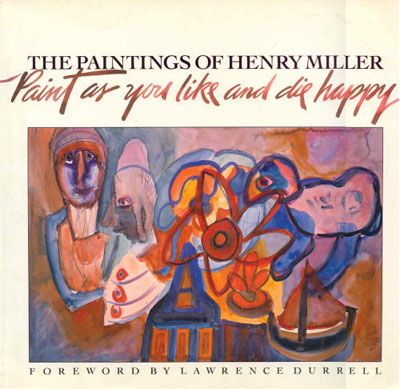
When I first started to write, in my teens and early 20’s, I was hugely influenced by an eclectic group of American writers that included vocal social critics from the earliest years of the 20th century. People like Theodore Dreiser, who wrote famously clunky prose, but whose An American Tragedy (1925) was a stinging indictment of greed in our culture. Main Street (1920) by Sinclair Lewis depicted the soul-crushing conformity of a milieu we often imagine as small town innocence. But greater than any other influence was Henry Miller, who demonstrated the power of personal essays. His books, like The Air Conditioned Nightmare (1945) shaped my view of our dominant culture.
It was natural that this kind of critique, along with that of more recent writers and essayists like Michael Ventura, should influence my blogging. But this spring something strange happened. At the start of Lent, though I do not celebrate the season in any formal way, I announced that I would “give up” negative posts for the duration. As expected, the experiment was more interesting than I expected.
“Rodin’s thinker?” by Patricia van Casteren, 2006, CC BY-NC-ND 2.0
I’ve already blogged about some of my findings, especially the obvious ones, like the preponderance of bad news in all varieties of media. And I knew in advance there would be less to say if I excluded negative themes. What I didn’t expect was to find myself wondering whether it mattered – it’s virtuous to write about things like climate change and income inequality – isn’t it? A very interesting question since I don’t really believe many writers and artists change social ills directly. Maybe Charles Dickens did, or Jacob Riis, with his photos of child labor, but Dreiser didn’t eliminate greed and Miller didn’t break the ruts of conformity. Writers and artists sometimes change individual hearts and minds, but how does that work? That is not a rhetorical question, but something I often wonder about. How does it work?
Perhaps it was this kind of question that moved Phil Ochs, one of the best of the 60’s protests singers, to write, “You must protest, you must protest they say, it is your diamond duty / Ah, but in such an ugly world, the only true protest is beauty.” Maybe it’s what led Henry Miller, in his last years, to write books like, My Bike and Other Friends, and to focus on his watercolors.
My biggest discovery, while turning away from negative stories during Lent, concerned inner dialog rather than outer events. I’ve attended to this in a focused way in the past at various times, but not for a while. Mindfulness practice appeared on the cover of Time, so it must be gaining fad status, but that does not diminish its worth. It’s an ancient contemplative discipline that involves simply watching the contents of consciousness. Not fixing, fighting, or merging with, but simply observing what flits through awareness (here’s a good introduction to the practice).
I don’t know about anyone else, but I often find a subtle but persistent stream of critical inner narrative on self, others, and events. The narratives tend grow in the darkness yet dissolve when observed, the way shadows disappear when you turn on the light in a room. Observation eventually leads one to suspect that thoughts have no more substance than shadows, and no more inherent reality, and yet they can have profound effects. I suspect we have all had interesting synchronicities, met things in the world corresponding to our inner states. And if one subscribes at all to notions of the effect of collective thoughts, an idea given names like, “tipping point” or “hundredth monkey,” then the contents of consciousness take on a meaning beyond their effect on oneself alone.
I follow the Dalai Lama on Facebook and often note that when he is asked about topical issues like climate change, he always gives a thoughtful answer, the tone of which is invariably, “I am hopeful.” If I learned anything with this Lenten experiment, it is how hard it can be to cultivate a hopeful attitude. I also cannot imagine anything more important. Can there be a more important seed to plant than this one – “I am hopeful?”
Just in case you’ve had too much of cutesy bunnies this season, Ms Vickie Lester, who blogs at Beguiling Hollywood, can fix that. Stop by to learn why Monty Python didn’t really know the first thing about scary rabbits. When I was a kid, I was terrified of lambs. My parents thought it was weird, but Vickie shows that there’s more going on than we think with these seemingly “harmless” creatures.
“On a day like today, my master William Faulkner said, ‘I decline to accept the end of man’. I would fall unworthy of standing in this place that was his, if I were not fully aware that the colossal tragedy he refused to recognize thirty-two years ago is now, for the first time since the beginning of humanity, nothing more than a simple scientific possibility. Faced with this awesome reality that must have seemed a mere utopia through all of human time, we, the inventors of tales, who will believe anything, feel entitled to believe that it is not yet too late to engage in the creation of the opposite utopia. A new and sweeping utopia of life, where no one will be able to decide for others how they die, where love will prove true and happiness be possible, and where the races condemned to one hundred years of solitude will have, at last and forever, a second opportunity on earth.”
medley (med-lē) n., 1a mixture of things not usually placed together; heterogeneous collection; hodgepodge.
A quiet week, with many ideas wandering through my mind without quite attaining blog post velocity. Sitting here, with a cup of coffee and the windows open to a fine spring morning, I decided to scoop up some of these notions, not necessarily in order of importance, and present them to you as a medley, or hodgepodge as the case may be.
On Mickey Rooney: I wish I had known that last Sunday, all day, Turner Classic Movies was hosting a day of Mickey Rooney movies. I tuned in late, but did get to see Boy’s Town (1938) and The Human Comedy (1943), both notable for their idealistic and almost too sentimental presentation of American life. Boys Town tells the story of Father Edward Flanagan (Spencer Tracy), who founded a home for abused and delinquent boys in Nebraska. Rooney plays Henry Hull, the tough kid who tests Flanagan’s belief that there is “no such thing as a bad boy.”
Tracy and Rooney in “Boys Town,” 1938
In addition to the real life humanity of Flanagan, whose Boys Town still exists in the Midwest, the film reflects 1930s progressive ideals, as well as an older, deeper, American romanticism, the belief that by nature, we are noble beings, corrupted only by cultural dysfunction. Watching Boys Town, I thought of the next great eruption of that ideal in the ’60s and remembered a line from Crosby, Stills & Nash that almost stands as an epitaph for that era: “It’s been a long time coming / it’s gonna be a long time gone.” The album came out in 1969, the year Charles Manson called optimism like Father Flanagan’s into serious question.
Mother Nature on the run: Now that I’m thinking of Crosby, Stills & Nash, that phrase popped to mind as title for this subsection, though it’s really about animals on the run. An editorial in yesterday morning’s paper, The case for banning wildlife-killing contests by Camillia H. Fox, outlines the common practice of for profit, recreational predator hunting contests.
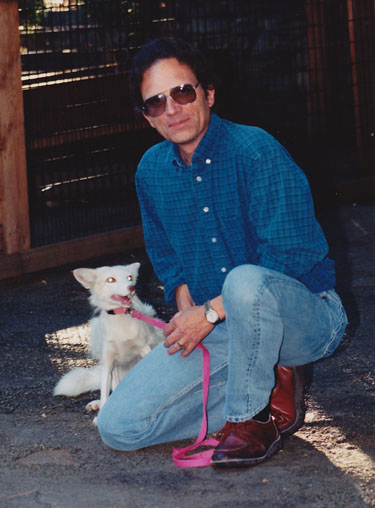
Exercising Vixen the fox while a volunteer at the Folsom City Zoo, ca. 1996. She was a sweetheart, though a bit of a drama queen. Is this the enemy?
“The greatness of a nation and its moral progress can be judged by the way its animals are treated,” said Mahatma Gandhi. It is heartening to learn that pushback is growing, both from citizens and state Fish and Game Commissions. In California, commission president, Michael Sutton said:
“I’ve been concerned about these killing contests for some time. They seem inconsistent both with ethical standards of hunting and our current understanding of the important role predators play in ecosystems.”
The way we treat the animals seems increasingly to be like the way we treat each other. Witness the case cited in the article, of the organizer of one of these killing contests, who (allegedly) pushed a 73 year old man to the ground for trying to photograph the event. We have to say, “allegedly” because, although the older man’s spine was fractured, the perpetrator has yet to be charged. This is not what our founding fathers meant when they spoke of a “well ordered militia.”
Of Jungians and Tibetans: I’ve recently started, with keen interest, The Psychology of Buddhist Tantra (2012) by Rob Preece, an in depth practitioner of both Jungian psychology and Tibetan Buddhism. Tibetan iconography is striking and vivid, almost begging for Jungian analysis, but most western commentators, including Jung himself, have written about it as outsiders looking in.
Not Preece, who studied with Lama Thubten Yeshe, one of the greatest 20th century Tibetan teachers to come to America. Lama Yeshe understood Jung and understood that Buddhist practice has always undergone change when crossing geographic and cultural boundaries.
Preece writes of Col. Francis Younghusband, who visited Tibet in 1904. Seeing pictures of wrathful deities, Younghusband concluded that this was a culture that worshiped demons. Jungians may pounce on the concept of shadow, but that too, will often be wide of the mark. Although Tibetans and Jungians both understand such imagery as depicting internal qualities, in this case, it is wrathful energy in the service of compassion. It’s the energy of, “This shit’s gotta stop!” The energy that led Camilla Fox to start a foundation to stop the slaughter of animals.
Two large gatherings: Over the last two weekends, I took part in two separate events which drew hundreds of people. Both were immensely satisfying days of harmonious groups, drawn together by shared interest, working cooperatively and having a lot of fun doing so. It’s almost enough to make you believe in no such thing as a bad boy or girl, in Mickey Rooney’s America.
That fundamental goodness is precisely what the Tibetans and Buddhists in general believe, even with their finely honed awareness of both relative truth, here in the trenches, and ultimate truth. Our ultimate nature, they say, the ground of our being is pure, unstained by any event, the way the sky is unstained by pollution. The bad news is, it can take eons for us to figure this out; a weekend at Woodstock is clearly not enough.
Still, I always feel energized after such gatherings, even as that wrathful energy rises at the thought of all the artificial barriers that divide us in our day to day lives. That’s something everyone has to work out for themselves. Meanwhile, I felt like listening again to Crosby, Stills & Nash. I hope they’re right in this song: that it’s always darkest before the dawn.
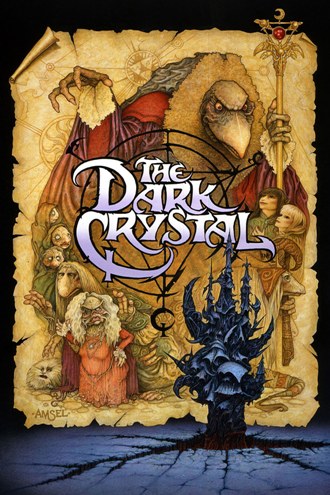
“Another world, another time. In the age of wonder.”
So begins The Dark Crystal (1982), a movie that pushed the limits of what was possible in animation when it was released 32 years ago. That was the year the Commodore 64 hit the market, becoming the best selling personal computer. Ms Pac-man was the hot new item in digital animation. Pixar, as we know it, was more than a decade away. Jim Henson, who wrote, produced, and co-directed the movie with Frank Oz, used models, puppets, and costumes for human actors to make this extraordinary film, which has largely been forgotten now that we’ve come to take sophisticated animation for granted.
Dark Crystal is a hero’s quest. A thousand earlier, when the three suns of the planet, Thra, came into alignment, the Dark Crystal shattered. At that moment two new races appeared, the evil skeksis and gentle mystics. Jen is the last of the gelflings (or so he thinks), a race wiped out by the skeksis for fear of a prophesy that one of them would be their undoing. As the thousand year alignment nears, Jen’s master, a dying mystic gives him a quest – find the missing shard and heal the crystal before the suns line up, or the skeksis will rule forever.
Dark Crystal: Jen’s master gives him a quest
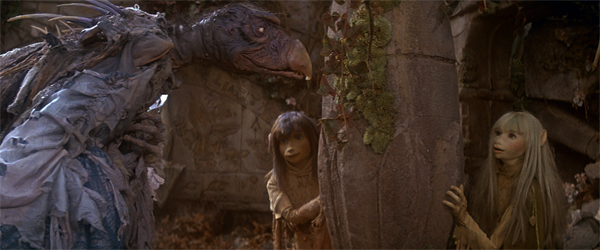
Jen reacts like any fledgling hero at the start of a quest – “But master, I am only a gelfling “ he says. “I am not ready to go alone.” But go alone he does, aided by the ancient seeress, Aughra, who helps him find the shard, and Kira, last of the female gelflings, who joins his quest. In a moment of despair, Jen flings the crystal shard away. Unable to sleep, he mutters, “Master, nothing is simple anymore.” Kira helps him find the shard at “The House of the Old Ones,” where they are confronted by a treacherous skeksis.
The Dark Crystal: Jen and Kira confront a Skeksis at The House of the Old Ones
They flee, but the treacherous one surprises them at the Dark Castle where the crystal is housed. He captures Kira and the skeksis begin to drain her life essence, which will prolong their own lives and leave Kira in the state of their other slaves, a mindless automaton. Jen and Aughra help Kira to save herself, the mystics arrive at the castle, the three suns’ come into alignment, and the final confrontation begins.
Prior to Dark Crystal, animation involved full length cartoons, claymation shorts, and The Muppet Show, which ran on TV from 1976-1981. I’m not aware of another full length feature involving such detailed world-building animation before this movie. It feels a little dated now, but then so do movies like Casablanca which stand as classics in their genre. That’s how I think of Dark Crystal. I think it’s required viewing for lovers of animation and fantasy in the movies.
I have written on several occasions of Snow Crash, the visionary science fiction novel that Neal Stephenson published in 1992. The book envisioned a future where nation-states had diminished importance. Most people lived as citizens of corporate enclaves and spent their free time jacked into virtual worlds. Snow Crash was written a year before the release of Mosaic, the first popular internet browser, and eleven years before the inception of Second Life, the best known virtual world.
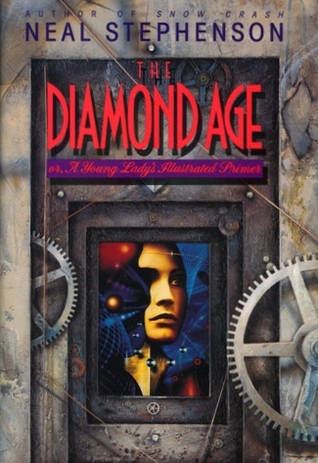
Stephenson’s next book, The Diamond Age (1995), gives us a world transformed by nanotechnology, the manipulation of matter at the molecular level. In Stephenson’s 21st century, the integration of molecular biology and semiconductor physics has transformed everything. In the first scene, we meet Bud, a would-be enforcer for the lucrative “alternate pharmaceutical” industry, who has bulked up his muscles with intelligent, micro-robotic implants and wears what we now know as Google glasses to precision aim his “skull gun,” an implant as nasty as it sounds. In passing, Stephenson shows Bud in a waiting room, where people read articles on smart paper, essentially tablet computers, that have replaced magazines. Remember: The Diamond Age was published 15 years before the iPad and 17 years before the first Google Glass prototype.
In the diamond age, so named because synthetic diamond is cheaper than glass, objects made by hand are expensive and revered, since everything else is produced by matter compilers (a generation beyond 3d printers)? Just as in Snow Crash, nation states are obsolete. The upper classes live as members of cultural enclaves known as phyles or tribes, whose settlements are often above ground level, while the lower class “thetes” or people without a tribe, live below.
John Perceval Hackworth is a nano tech engineer for the Neo-Victorian, “New Atlantis” tribe. New Atlantis sits on an artificial mountain a mile above the polluted streets of Shanghai. The clave is ruled as a corporate oligarchy by “Equity Lords” who style their culture after 19th century English royalty.
Hackworth is commissioned by Lord Finkle-McGraw to program an artificially intelligent book, A Young Lady’s Illustrated Primer, a subversive text, which will help his daughter Elizabeth lead a life beyond the boundaries of the status quo. Hackworth makes an illegal copy for his own daughter, Fiona, but this is stolen when Hackworth is mugged. It falls into the hands of Nell, Bud’s daughter, a thete who lives in a ground level slum. Hackworth, Fiona, Nell,her brother Harv, an actress named Miranda, and a Chinese black market engineer named Dr. X are all involved with the Primer for reasons of their own; at its deepest level, the Primer holds the key to decoding and reprogramming humankind’s future.
The Diamond Age, whichwon Hugo and Locus awards in 1996, is classified by genre wonks as “post-cyberpunk,” whatever that means. As he was in technology and socio-economics, so was Stephenson decades ahead of his time in speculative fiction. We call this kind of book “dystopian” now. I can think of at least two recent movies that play upon themes explicit in The Diamond Age. I won’t name them because I have no evidence that their creators read the book. Still, it is hard to imagine any serious writer of dystopian fiction who hasn’t marveled at Neal Stephenson’s vision.






 The First Gates