Of Hamsters, Wisdom, and Persephone

Persephone the Innocent

The protagonist of Karyn’s Magic, the young adult novel I’m writing, is a teenager who lets something evil into the world.  Not only must she scramble for damage control, but she is forced to see the same evil as a potential within herself.  I usually think of “loss of naiveté” as theme of adolescence, but remembering hamsters brought to mind a personal experience that happened earlier than that.

My fifth grade teacher had a pair of hamsters, favorite classroom pets.  At one point she could no longer keep them, and asked if anyone could provide them a good home.  I spend my Saturdays at a small museum in Alum Rock Park, in San Jose, that had a small zoo and classes and field trips for young people.  We had day trips to ocean tide pools, a weekend camping trip to the Mojave, plus at the museum we got to play with some of the critters.  One of my favorite stunts was to wrap a boa constrictor around my neck and explain to startled visitors that these snakes never squeezed anything they didn’t regard as food.

I told the teacher I had a home for her hamsters and took them to the museum.  “Great, we can use these,” the director said.  At the end of the day, after the museum closed to visitors, I learned what he had in mind.  Before I quite realized what was happening, he dropped one of the hamsters into a glass case with a huge rattlesnake.

The ensuing drama seemed to go on forever:  the hamster sniffing, scooting around, knowing something was wrong but not quite knowing what.  I wanted to look away but couldn’t.  The snake coiled in slow motion, almost lazily, with hard, unblinking eyes.  It’s strike was a blur, you couldn’t see it;  you could only hear, not see, the hamster slammed into the top of the cage by the force.  It was over in less than a second.  The animal did not even twitch.

I asked about the other hamster and learned that a snake that big cost several hundred 1960’s dollars, and live food was expensive.  I didn’t demand the other hamster back.  There were older kids there, some in jr. high, and I wasn’t about to wimp out. And scientists sometimes have to suck it up, right?

On Monday, the teacher asked how the hamsters were doing.  I told her and the class that they were fine.  I never put another boa constrictor around my neck.  I was at the edge of adolescence, and the world was poised at the edge of “the sixties;” there would be more and bigger occasions for guilt soon enough, but most of those are long forgotten.  This is the event I come back to when I think or write about the loss of innocence.

***

What does she hear on the wind?

James Hillman, the prolific author who coined the phrase, “archetypal psychology,” for his own brand of post-Jungian thought, borrows a phrase from Keats and calls our world, “the vale of soul-making.”  For Hillman, the natural movement of soul is down, into the depths, where a darker kind of wisdom lies.

(to understand Hillman it is critical to know that he uses the world “soul” as the ancients did:  not as the “eternal soul” of western religion, but more as we use the phrase, “psyche.”  He places “soul,” the source of imagination and fantasy, between the “eternal spirit,” and the body – a three-part image of personality you seem to see in biblical references, as well as in eastern religion even now).

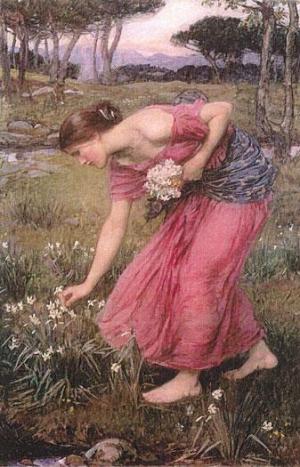
The story that illustrates Hillman’s perspective on “innocence,” is the myth of Persephone.  As a beautiful young girl, she is playing one afternoon with her friends, when she bends to pluck a narcissus flower.  The ground opens up, and Hades, the Lord of the Underworld, scoops her into his chariot and carries her into the depths.  Hillman writes:

“Each of us enacts Persephone in soul, a maiden in a field of narcissi or poppies, lulled drowsy with innocence and pretty comforts until we are dragged off and pulled down by Hades, our intact natural consciousness violated and opened to the perspective of death.”  Revisioning Psychology

By the time the Olympian gods put enough pressure on Hades to cause him to relent, Hermes, messenger of the gods is stunned to see Persephone transformed. No longer the naive maiden, she is the darkly radiant Queen of the Underworld. She has eaten the food of the underworld – six pomegranate seeds, and must spend that six months of every year under the earth.

Supposedly that explains why there is winter, but in a far more interesting sense, it gives us an image of why, despite our wishes, wisdom doesn’t lie in the sunny, flower dotted fields of youth, but in the depths of a soul that knows both light and darkness.
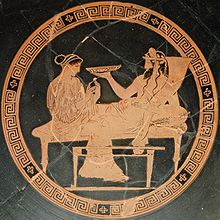
Persephone and Hades
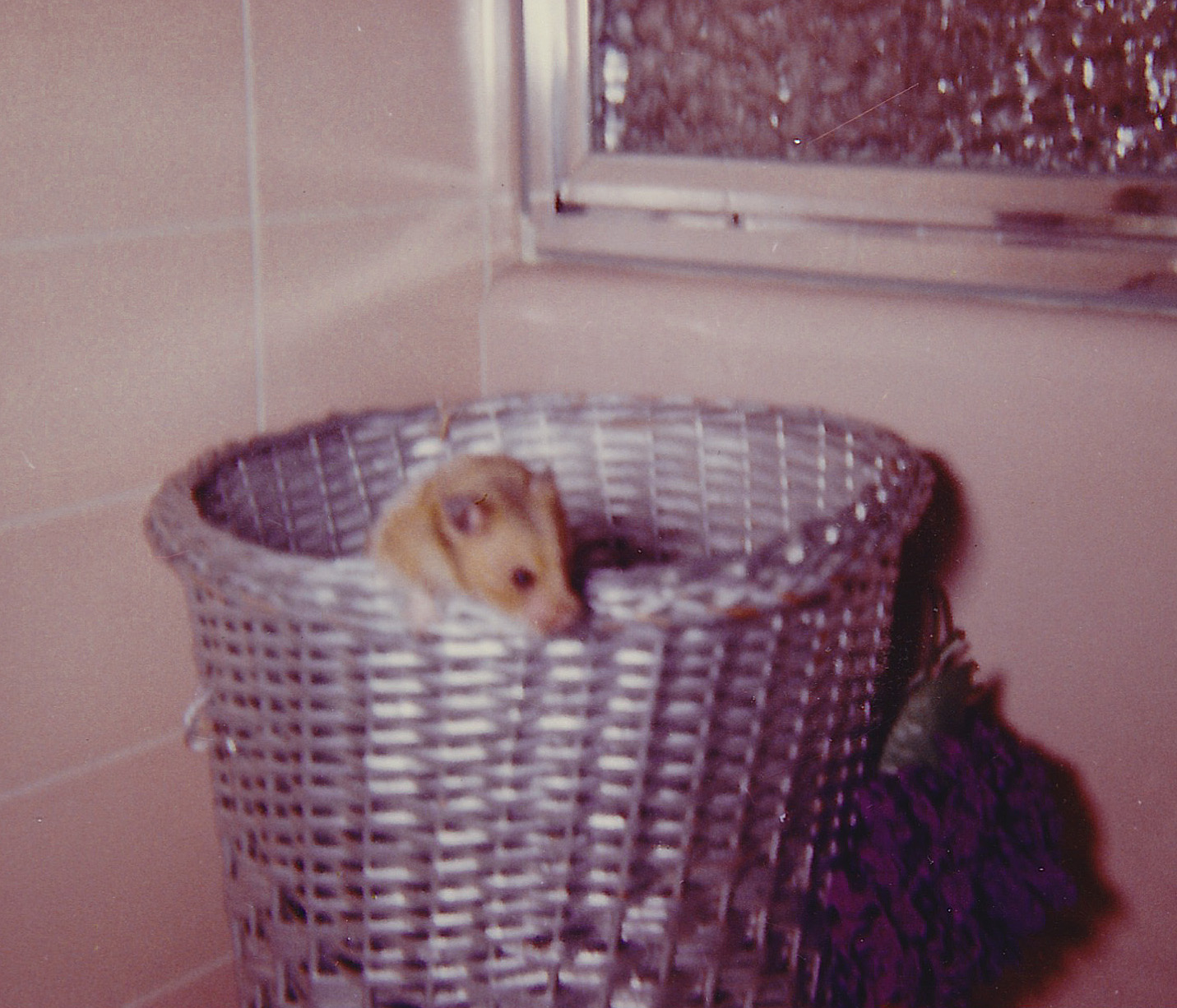

Hamster Collaborates with Nobel Laureate

I love NPR!

During this morning’s commute, I learned how the spirit of play led two Russian-born scientists, Andre Geim and Konstantine Novoselov, to the discovery that won this year’s Nobel Prize in physics.

http://www.npr.org/templates/story/story.php?storyId=130344815

The pair teach at the University of Manchester in Britain, and the custom in their lab is to dedicate Friday afternoons to “crazy experiments.” One day, while picking up graphite with scotch tape, the idea that led to graphene was born. Graphene is a sheet of carbon one atom thick. It is the thinnest material on earth, 100 times stronger than steel, transparent, and an excellent conductor. Experiments with photovoltaic cells are already underway, and potential uses include better touch-screens, replacements for silicon transistors, and power generating clothing.

Geim, in particular, has a wacky streak. He once used magnetic fields to levitate a frog, and another time, listed his favorite hamster, Tish, as a collaborator on a scientific paper.

I can very much identify with that; my first serious literary project, in the fifth grade, was a sequel to Wind in the Willows, starring my hamster, Herman.

Herman gets some exercise

Doesn’t it seem like the funniest people are very, very serious about their humor?

More on, “So Cold the River”

(Warning: spoilers ahead)

It is rare and delightful to find a book I hate to see end.  It is rarer to find a creepy book I hate to see end, and this is the first time ever I have hated to see a story end when the most compelling character is the villain.

Campbell Bradford, the villain of Michael Koryta’s,  So Cold the River, is no ordinary bad guy; he not just a bad man, he is evil. This important distinction is made by eighty-something, Edgar Hastings.  “He [Bradford] put a chill in your heart. My parents saw it; hell, everybody saw it. The man was evil.” The only fictional villain I can think of in his class – as evil and fascinating – is Hannibal Leckter in Silence of the Lambs

The evil Campbell Bradford is not the ninety-five year old Campbell Bradford who freaks out when hero, Eric Shaw, shows him a bottle of haunted “Pluto Water.”  This faux Bradford whispers, “So Cold the River,” and dies a short time later, sending Eric, a failed Hollywood filmmaker, to West Baden, Indiana, to learn the story of Bradford, Pluto water, and the newly restored West Baden hotel, (which actually exists), a once famous spa that was the domain of presidents, prize fighters, royalty, and gangsters.

The West Baden Hotel

The evil Campbell Bradford is a ghost, a very malevolent ghost, who possesses his great-great-grandson, Josiah, and later tries to possess Eric.  Bradford’s era is the roaring twenties, but his voice and tone suggest an earlier time.  Perhaps it is his fictional distance, the sepia toned feel of the old west that surrounds this villain, that works like the glass that allows us to watch a cobra in a zoo with an equal degree of fascination.  Imagine the Clint Eastwood of the sphagetti westerns as an angry psychopath, ready to sacrifice anything and anyone for his ambitions.  The ambitions of Campbell Bradford’s ghost drive the story.

“Look for the artifacts of their ambitions.”  That is Eric Shaw’s philosophy of documentary filmmaking, announced at the opening of the book.  The artifacts of Bradford’s ambitions are dead people. In the end, the mysterious Pluto Water, which carried Bradford’s spirit back to West Baden, allows Eric to survive his onslaught to tell the tale.

But Eric stops short of trying to unravel the whole story.  He will not seek the honey-flavored spring where Bradford lost his life.  Is the spirit really gone? Apparently. And yet, as Anne McKinney, who has devoted her life to watching the weather and waiting for the big storm cautions, “You can’t be sure what hides behind the wind.”

Sequeul anyone? I will definately read it if it comes.

Short Short Story Competition

This one is from Writer’s Digest, for stories of 1500 words or less, due Dec. 1. http://writersdigest.com/short

PRIZES
First Place: $3,000 and a trip to the Writer’s Digest Conference in New York City
Second Place: $1,500
Third Place: $500
Fourth Through Tenth Place: $100
Eleventh Through Twenty-Fifth Place: $50 gift certificate for Writer’s Digest Books

I do not see any genre categories for this. 1500 words is about six pages. Hmmm. I’m not a short story writer, but this might be a chance to exercise some unused muscles…

New help for coulrophobics

According to an NPR report, coulrophobia, the fear of clowns, is the third most common phobia in Britain, right behind the fear of spiders and needles. Our cousins across the water fear clowns more than they do flying in airplanes. Coulrophobia on NPR

Now there is new hope for sufferers thanks to the dedicated clownselors of the John Lawson circus, who offer pre-show therapy. Paul Carpenter, aka, Popol the Clown, explains how clown therapy works:

...we invite them to the big top during the day when it’s quiet and they meet me and our other clown, but they meet us in our normal, everyday guises, not in makeup or anything. And then we take them into the circus ring, and they watch us as we slowly transform ourselves into our clown personalities.

Popul (Paul Carpenter), right, and his friend, Kakehole

We put on our makeup very slowly, and then we put on our costumes. And if that goes well and they haven’t run for the door, we then try and get them interacting with us in the circus ring. We go through a few clown routines, getting them involved. And if that goes well, our ultimate aim is to get the person themselves dressed up in costume and makeup, and then we help them find their own inner clown..they come into the circus being scared, and then they end up leaving as a clown themselves.

Hmm…I’m not sure ’bout that. Finding my inner clown sounds pretty good, but why do I keep thinking of Stephen King and Chuckie?

I knew a real clown who was truly funny. I met Amelia Mullen, aka, Pansy Potts the Clown, at the Sacramento Storyteller’s Guild. There seem to be two general ways of telling a story to a crowd, either in “quiet” way of a storyteller around the campfire, or in the dynamic way of an actor on a stage, the way vaudeville must have been. My way is very much the former, while Amelia worked the crowd, strutting across the stage with gestures and wild voices. No one fell asleep when she was telling a story.

I later realized she developed this style of storytelling as a way of keeping the attention of rowdy four year olds while entertaining at birthday parties – now there is something to give you a phobia!

Writer’s Digest Popular Fiction Awards

Here is a Popular Fiction competition from Writer’s Digest for stories of 4000 words or less in the categories of:

  • Romance
  • Mystery/Crime
  • Science Fiction/Fantasy
  • Thriller/Suspense
  • Horror

Entries are due November 1 with a $20 fee.  Multiple entries are allowed, online or by snail mail.  Prizes are:

Grand Prize: a trip to the Writer’s Digest Conference in New York City, $2,500 cash, $100 worth of Writer’s Digest Books and the 2011 Novel & Short Story Writer’s Market.

First Prize: The First Place-Winner in each of the five categories receives $500 cash, $100 worth of Writer’s Digest Books and the 2011 Novel & Short Story Writer’s Market.

Honorable Mention: Honorable Mentions will receive promotion in Writer’s Digest and the 2011 Novel & Short Story Writer’s Market.

Full details are available here: http://www.writersdigest.com/popularfictionawards

The Peddler of Swaffham

A comment here on a post about ghost stories put me in mind of certain tales that everyone has seen or heard in one variation or another.  Show of hands – how many heard “The Hook Man,” around the time they started to date?  How many variations of “The Vanishing Hitchhiker” have been made into TV movies or episodes of The Twilight Zone?

A much older tale that is widely distributed tells of a poor man who becomes rich by paying attention to a dream.

I first heard “The Peddler of Swaffham” told by Robert Bela Wilhelm, who, with his wife Kelly, has devoted his life to inspiring people to tell stories and explore the spirituality of stories.  Be sure to check out some of the riches on the Wilhelm’s website: http://www.storyfest.com.

Carving of the Peddler in a Swaffham church

Bob told “The Peddler of Swaffham” on one of his “Storyfest Journeys.”  More about the journeys soon when I dig out some of the pictures.

The gist of the story is, a peddler from a village in Norfolk dreams that he will find gold if he travels to London bridge.  He makes the journey with his dog, spends three days and nights on the street waiting, and is wondering what went wrong when a merchant asks what he is about.  The peddler says he dreamed of the riches he would discover at London Bridge.  The merchant laughs and says dreams are just foolishness:  “Why just last night I dreamed of a bag of gold under the peddlar’s oak in the village of Swaffham, wherever that is, but you don’t see me running all over the countryside, do you?”

According to Wikepedia, (http://en.wikipedia.org/wiki/Pedlar_of_Swaffham) the first version of this story was a poem by Rumi, In Cairo Dreaming of Baghdad; In Baghdad Dreaming of Cairo, that later became a story in The Arabian Nights. I know I have seen a Jewish version of the story where the city is jerusalem. The story more recently was incorporated into the plot of The Alchemist by Paulo Coelho.

Monument to the Peddler in Swaffham

What the Peddler of Swaffham or Cairo or Jerusalem has in common with countless folktales all over the world is it’s lesson that it is voice of the small, the despised, the overlooked, the ignored – the dream, the third son, the dwarf, the old woman, the child, the animal beside the road, that points the way toward the riches of a more awakened existence.

I once heard a psychology professor say that the way to get moving again if we are stuck in our lives is to listen for the small hunch, the little impulse, the passing thought that, “Oh, this might me interesting to try.”

The same teacher, on another occasion said that in his study of folklore, the greatest predictor of success, bar none, was the hero or heroine winning the help of a talking animal – but that is a story for another occasion.

September Writing Contests

Zoetrope:  All-Story Short Fiction Contest: http://www.all-story.com/contests.cgi

Prizes: $1,000, $500, and $250 and seven honorable mentions. Deadline October 1. 5000 words or less.

The announcement says: We accept all genres of literary fiction.   If the juxtaposition of “genre” and “literary fiction” has you scratching your head, you can purchase an online issue to get an idea of what that means.

They also say:  There are no formatting restrictions; please ensure only that the story is legible. That puts me in mind of colored inks and napkins, but that’s just because I do not knowingly write literary fiction.

Delacorte Press Contest for a First Young Adult Novel: http://www.randomhouse.com/kids/writingcontests/

This contest is in its 29th year. First prize is a book contract from Random House, $1,500 cash, and a $7,500 cash advance against royalties. This is for fiction in a contemporary setting, between the ages of 12 and 18, with manuscript length between 100 and 224 pages.

Fairly standard formatting requirements (no napkins) and entries must be postmarked between October 1 and December 31. The judges reserve the right to not award a prize and looking at the list of past winners it is clear that sometimes they have not.

Hint Fiction Writing Contest: http://www.writingclasses.com/ContestPages/hintfiction.php

This is the 25 word short story contest I talked about in another post here.   There are still five weeks left.  I initially set out to write a story a day…so far I have done five, so I need to get busy.

I find it a fun way to play with images, especially with “other” genres, imagining things like an innocent person kneeling beside a corpse.  It isn’t hard to write good 25 word stories, but I am finding it is maddeningly hard to do great ones.

I’m sure there are many other contests coming up, and one of these days I will have to go looking for them.