Favorite Fictional Detectives

Sherlock Holmes by Sidney Paget.  Public domain.

Sherlock Holmes by Sidney Paget. Public domain.

In literary gatherings, I usually introduce myself as part of the fantasy camp, but I’ve probably read and enjoyed just as many mysteries over the years.  In my previous post, I gave a lukewarm review to James Patterson’s latest Alex Cross thriller.  I think the real reason is that I’ve never bonded to Alex Cross the way I have to other favorite detectives.

Character is key to detective novels just as it is to other types of fiction, and this is separate from an issue that has surfaced over the last decade, the distinction between plot driven and character driven stories.

In character driven tales, some attribute of the protagonist begins and sustains the action, the way Katniss Everdeen’s sacrifice for her sister gets things moving in The Hunger Games.  Mysteries are almost always plot driven – the story begins when the first body is found.

These days, agents and editors say they’re looking for character driven tales.  Dan Brown wasn’t listening when he wrote The DaVinci Code, now one of the five best selling books of all time, a distinction shared with The Bible and Harry Potter.  Like much advice for writers, I think it misses the point.  Regardless of what moves the action, we love novels with characters we love, in worlds we’d love to visit.  Have you ever imagined yourself in Baker Street when Holmes jumps up and cries, “The game is afoot?”

If so, read on!  I’ve listed a few of my favorite detectives, not necessarily in order, for that, like everything else, is subject to change.

Sherlock Holmes:  This is obvious.  How many popular books of today will still be read and loved 100 years from now, spawning a lively stream of new presentations in all the popular media of the future?  I seldom reread mysteries – often there is no point when you know the criminal’s identity, but I still dive into Holmes for recreation.  Has there ever been a more dastardly villain than Dr. Grimesby Roylott in “The Adventure of the Speckled Band?”  And for chills up the spine, one sentence has never been beaten:  “Mr. Holmes, they were the footprints of a gigantic hound!” 

I enjoy all the presentations of Holmes in film, but my favorite movie Holmes is still Jeremy Brett for his perfect blend of genius and madness, without the slightest trace of modesty:

Cadfael:  The Brother Cadfael mysteries were the creation of Edith Pargeter, under the pseudonym, Ellis Peters.  In early 12th century England, during a period of contention for the crown known as The Anarchy, Cadfael, a middle aged and disillusioned veteran of the crusades, becomes a Benedictine monk.  With keen powers of observation, a scientific turn of mind, and an in depth knowledge of herbalism, he solves the many murders that just happen to happen whenever he is near.

I enjoy the film versions more than the books, thanks to renowned Shakespearean actor, Derek Jacobi, who plays Cadfael.

Hercule Poirot and Miss Marple:  Most writers are lucky if they can create a single unforgettable character.  Agatha Christie gave us two.  Sometime in the early 90’s, I went on an Agatha Christie binge, and over the next few years, read all the stories of both characters I could find, some 80 novels in all.  Poirot and Miss Marple turn up often in films and on TV.  I’ve enjoyed several versions of Murder on the Orient Express and Death on the Nile.

The bad news is that Miss Marple stories are usually classed as “cozy mysteries,” a sub-genre with a distinctly unmanly name.  The good news is that  I’m too old to care.  There is no definitive movie Miss Marple, but British actor, David Suchet takes the honors for his portrayals of Hercule Poirot:
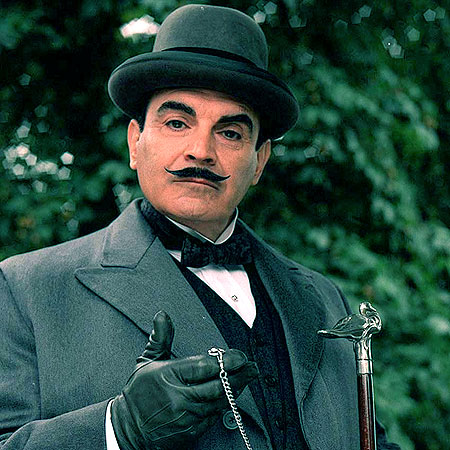
David Suchet as Hercule Poirot

David Suchet as Hercule Poirot

Wallender: To re-establish my manly credentials, I add Kurt Wallender to the list.  Wallender is sort of a Swedish, existentialist, high plains drifter, and the most angst-ridden detective in the history of the world.  The creation of Swedish novelist, Henning Mankell, Wallendar was adapted for British TV, beginning in 2008.  Episodes are show up here on PBS.

The series stars Kenneth Branagh, another great Shakespearean actor.  Branagh says Wallender is “an existentialist who is questioning what life is about and why he does what he does every day, and for whom acts of violence never become normal. There is a level of empathy with the victims of crime that is almost impossible to contain, and one of the prices he pays for that sort of empathy is a personal life that is a kind of wasteland.”  

Don’t watch this guy when you’re feeling blue!

Kenneth Branagh as Wallender

Kenneth Branagh as Wallender

Jim Chee and Joe Leaphorn:  These officers in the Navajo Tribal Police star in 18 mysteries Tony Hillerman wrote between 1970 and 2006.  The grandeur of the American southwest and Navajo tribal beliefs are the background against which these unique detective stories unfold.  Chee, the younger officer, struggles to hold on to tribal traditions in 20th century America.  Leaphorn is more world weary and cynical, but he knows that where there is talk of witches and taboos, trouble erupts.

Hillerman, who died in 2008 loved the four corners and wrote about it so vividly that it’s really another character in the stories.  His books won many awards, but he always said what pleased him most was being named a Special Friend of the Navajo Nation in 1987.  Adam Beach and Wes Studi starred in three movie versions of Hillerman’s novels, including Skinwalkers, (the Navajo name for malevolent sorcerers), that is regarded as Hillerman’s breakout novel.

Amelia Peabody:  Elizabeth Peters’ 19 book series centers on the adventures and detective skills of independently wealthy and independently minded Egyptologist, Amelia Peabody and her family, which at first includes her husband Radcliff Emerson (who hates his first name and refuses to use it), and their son Ramses, who was born as stubborn as his parents.  Later Amelia and Emerson take in two wards, David, the son of a Muslim and a Christian whom they rescue from semi-slavery, and Nefret, a red headed former priestess of Isis who will eventually marry Ramses.

Set in the years between 1884 and 1923, there are rascals, rogues, adventurers, tomb robbers, mummy’s curses, and Sethos, aka, The Master Criminal.  Historical Egyptologists and archeological events are woven into the series which ends with the 1922 discovery of the tomb of King Tut.  The author has said that Amelia herself is based in part on Amelia Edwards, a Victorian novelist and Egyptologist, whose 1873 travel book, A Thousand Miles up the Nile was a best seller.

The middle east has changed since Peters began writing her novels, but they remain among my favorite beach reads of all time.  For anyone who enjoys a good mummy movie or has ever fantasized lost tombs, pith helmets, and midnight at the oasis, these are great adventure stories, ever complicated by the corpses that turn up wherever Amelia goes.

I’ve only listed detective series here because I cannot remember every good singular mystery novel I’ve read.  Please add any favorites of yours to the list.  There’s always room for more, since the game is always afoot somewhere!

Alex Cross, Run: an audiobook review

In the 15 years since Morgan Freeman starred in the first Alex Cross movie, Kiss the Girls, I’ve enjoyed quite a few James Patterson thrillers in films, books, and audiobooks.  He knows how to keep you on the edge of your seat, whatever the medium.  Alex Cross, Run, the 20th tale in the series, is no exception.

When I’m doing a lot of driving, I often choose Patterson audiobooks – they make the miles fly, but once I started this one, I kept the earbuds plugged in while fixing breakfast, walking the dogs, and even late at night.  It wasn’t exactly pleasure that kept me listening.  It often felt like drinking coffee when nervous.

There’s an amped up quality to Alex Cross, Run that couldn’t quite hide a formulaic quality, even though Patterson created much of the formula.  Throw in enough serial killers – Alex Cross Run had three – and an author like Patterson will create plenty of tension, but I often felt manipulated.  Every book tries to manipulate an audience; successful ones do it with subtlety.  Here, elements like bad guy motives and family interludes felt somewhat perfunctory, like I might do if I started with a list of plot points and checked them off one by one.

Alex Cross, Run is not a bad book by any means.  I’d give it three and a half stars out of five.  It’s a thriller by any measure, but it adds nothing new to the series or the genre.

Perhaps it simply felt rushed compared to books I’ve read in Patterson’s other signature series, the “Women’s Murder Club.”  I find Lindsay Boxer a more rounded character, with a richer circle of friends and environment than Alex Cross.

Any reader who likes thrillers and any writer who wants to learn about tension will be rewarded by reading James Patterson, but Alex Cross, Run is not where I would advise them to start.

One Nation Under Stress

The title of this post comes from a new book reviewed on NPR, One Nation Under Stress:  The Trouble With Stress as an Idea, by Dana Becker, PhD.

According to Dr. Becker, “stress” is a recent concept.  The first article on stress in the New York Times was published in 1976.  The first diagnoses of “nervous disorders” or “neurasthenia,” came from the work of Dr. George Beard ca 1869.  In the NPR interview, Becker says that physicians of the time considered “American nervousness” to come from outside factors, related to the increasing pace of life after the civil war.  “Stress,” as we understand it today, is the polar opposite.

Now we have internalized stress, focusing on the risks to our health and the ways we should cope with it, through diet, exercise, yoga, and so on.  Our experience of stress derives from our ideas of stress, Becker says.  The internal emphasis on health is necessary, but we let it divert us from questioning the external causes of stress.  She gives an example in the NPR interview: many articles are written to help working mothers cope with stress – far fewer are written about the need for affordable daycare.  We may eat kale and do yoga to survive the 24/7 world, but we seldom ask why this is the norm and what the alternatives are.

This argument echoes a major concern of James Hillman, who I frequently write about here.  Though he was once Director of Studies at the Jung Institute in Zurich, in 1992 he co-authored a book called We’ve Had a Hundred Years of Psychotherapy and the World is Getting Worse.  In it, he said:

“Every time we try to deal with our outrage over the freeway, our misery over the office and the lighting and the crappy furniture, and the crime in the streets, whatever – every time we try to deal with that by going to therapy with our rage and our fear, we deprive the political world of something.”

In her NPR interview, Dana Becker presented a balanced view of stress – it’s fine to treat the symptoms, which are personal, as long as we don’t gloss over the underlying causes, many of which are not.  The promise of new view of a modern ailment is enough to put One Nation Under Stress near the top of my “to read” list.

Fans of movies and fairytales will love this 1922 Cinderella (Aschenputtel), a 12 minute animated silhouette feature by Lotte Reiniger (1899-1981). Reiniger went on to create the first animated feature film in 1926. Those who appreciate the art of fantasy will want to know about Lily Wight’s blog, where so many finds like this appear.

Lily Wight's avatarLily Wight

     German animator Lotte Reiniger created the first surviving full-length animated feature, The Adventures Of Prince Achmed, back in 1926.

     An enchanting collection of Reiniger’s paper silhouette Fairy Tale adaptations is now available on DVD.

     You can watch Cinderella (1922) right here…

     Recommended…

     The Wonderful World Of Froud

     From Aliens To Vampires And Angels To Zombies

     Fantastic Fashion Fairy Tales

     Little Red Riding Hood With Christina Ricci

View original post

Who would you choose to write your biography?

Although I enjoy reading and mulling over the WordPress Daily Writing Prompts, I’ve never used one as a subject before.  That changed on March 11 with a post called Ghostwriter by blogger Michelle W. who asked, “If you could have any author – living or dead – write your biography, who would you choose?”  The answer for me is Carl Jung, and it has been fruitful to remember why.

When I was in high school, a teacher who was a mentor to me said, “You should really study psychology.  Not all that behaviorist crap, but Jung.”  As a college freshman, I remembered his words when I spotted a copy of Man and His Symbols, an introduction to Jung’s ideas that he began and his close colleagues finished after his death in 1961.  After that, I read his autobiography, Memories, Dreams, Reflections.  These are excellent books to get the gist of his thought.

Dr. Carl Jung, 1875-1961

In our fast-food world, where medication and brief therapy are the norms, Jungian analysis survives at the margins.  Two key exceptions, where Jung’s ideas entered the mainstream, come to mind.  The Meyer-Briggs Personality Profile is structured on his theory of psychological types; even the words, introversion and extroversion were his.  And through one of his patient’s contact with Bill Wilson, co-founder of Alcoholics Anonymous, Jung’s insistence on the psyche’s spiritual orientation found its way to the core of 12 step programs.

More more widely known are Jung’s contributions to the study of literature and folklore.  The theory of archetypes, which found expression in areas like Joseph Campbell’s work on the hero myth, were first stated for our times by Jung.

All these credentials, however impressive, are not the reason I’d choose him as a biographer.  Here’s something he said in a lecture in London in 1939:

“We have no symbolic life, and we are all badly in need of the symbolic life. Only the symbolic life can express the need of the soul – the daily need of the soul, mind you! And because people have no such thing, they can never step out of this mill – this awful, banal, grinding life in which they are ‘nothing but.’ . . . These things go pretty deep, and no wonder people get neurotic. Life is too rational; there is no symbolic existence in which I am something else, in which I am fulfilling my role, my role as one of the actors in the divine drama of life.”

When I first read these words, at about the age of 20, I recognized a kindred spirit, one who could articulate things I only felt and struggled with.  I read the words now and still feel the sense of kinship.

There’s not that much in my outer life to write about.  Any biographer I’d hire would have to be the kind of person who looks beneath the surface and understands that it’s really about the effort to find one’s role “as one of the actors in the divine drama of life.”

If you could have anyone do it, who would you pick to write your biography?

Kacey Musgraves: a talented singer makes her recording debut

In my twenties, when I spent a lot of time in Oregon and the southwest, I came to love country music.  I enjoyed the roots of the genre as you hear it in artists like Hank Williams, Bill Monroe, and The Carter Family.  I also favored contemporaries of the time like Emmy Lou Harris and Johnny Cash.

I haven’t listened so much since the genre tilted toward glamour and glitz.  That’s one reason I was delighted to hear a fresh young artist introduced on NPR.  Twenty-four year old Kacey Musgraves writes and sings with the heart and authenticity of her country ancestors, even as her songs are squarely 21st century.  Her debut album, “Same Trailer, Different Park,” comes out on March 19.  You can sample the songs on the NPR page,  First listen: Kacey Musgraves.

Kacey Musgrave. Photo by Dave Hensley. CC By-NC-ND 2.0

Kacey grew up in Mineola, Texas.  In the words of NPR, she writes “about and for people who’ve learned to fit their dreams into recession-sized moving boxes; who gain comfort from their family traditions…who find their pleasures and pains not in the excesses promoted by Hollywood or Nashvegas, but in jokes shared during a work break at the Waffle House, or nights of glory at the local karaoke bar.”

Available youTube clips don’t have the acoustic quality I expect to hear after the album release, but I was taken by the optimism that underlies the poignancy in “Silver Linings:”

Woke up on the wrong side of rock bottom
Throw a lot of pennies in a well
That done run dry
Light up and smoke ’em if you have ’em
But you just ain’t got ’em
Yeah ain’t we always looking For a bluer sky?

I’m planning to visit iTunes for this on March 19.

More on Robot Surgery

In a strange synchronicity after my robot post yesterday, our Sunday paper business section carried an article called “Robot surgery faces lawsuits.”

The source for the piece is listed as Bloomberg News, and this appears to be original story, posted on their website March 5.  No cute robot pictures this time, and no comments from me except to suggest everyone read this: Robosurgery Suits Detail Injuries as Death Reports Rise

Robots ‘R Us (?)

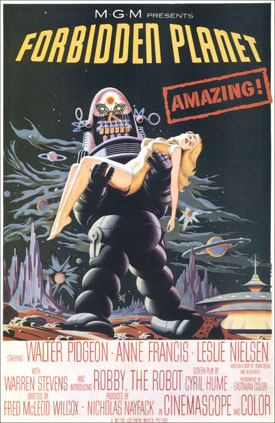
forbiddenplanet

In the field of robotics, as in so many other areas of life, science fiction writers saw the future decades before the rest of us; they warned that androids were coming and the relationship would not always be easy.

Recently, I’ve seen adds on the cable channels by legal firms inviting the “thousands of victims” of botched robot surgery to join class actions suits (go to badrobotsurgery.com).  Ironically, the same Google search that brought up the lawsuit page also showed adds for robotic prostate surgery, which is not the time you want your robots going rogue!

Practicing medicine without proper training isn’t all the dastardly droids have been up to.  In an article called, When the future comes, what are we going to do with it?, blogger Orkinpod looks at how robots eliminate manufacturing jobs.

As an Apple geek, I was dismayed last year to hear stories of mistreated workers at Foxconn, the mammoth Taiwanese contractor that assembles iPads and iPhones.  Apple hired independent auditors to investigate, and Foxconn agreed to clean up its act, but that was not their only decision.  According to links in Orkinpod’s post, Foxconn is stepping up plans, announced in 2011, to deploy a million robots across their assembly lines.  They are much less inconvenient than humans.

If the sheer size of this transition is hard to grasp, the trend itself isn’t news.  Industry experts have already warned us not to get too excited about Apple’s move to bring mac production back to the states.  The process is now so automated that the number of new jobs will be far less than hoped for.

All this prompts Orkinpod to pose a question I haven’t heard anyone ask before:  “When the future arrives (and I believe that it is very, very close), and machines can supply all the things that humans could possibly ever want, what is everybody going to do?”  

That’s a question I’ve been thinking about since I read his post, and it generates many other questions centering on the value of work.  Even excluding the jobs that are dangerous or abusive, no work situation is perfect.  Everyone wants more respect or money or benefits than they currently get, but if we’ve learned anything over the last few years, it’s that being out of work is usually worse than being badly employed or under employed.  Aside from the money, work lies close to the core of self-esteem and meaning in our lives.  Even if we are working on the great American novel at night, as an artist I admire once said, “You’ve got to do something during the day.”

Even where there are safety nets, ever larger numbers of people displaced by technology is an issue I don’t think any nation has started to address.  In December, I discussed a report by the National Intelligence Council called Global Trends 2030:  Alternative Worlds. The report’s most definite conclusion was that the next 18 years will usher in more rapid change than anyone living has ever seen.  Summing up the findings, NIC Chairman, Christopher Kojm said:

“We are at a critical juncture in human history, which could lead to widely contrasting futures. It is our contention that the future is not set in stone, but is malleable, the result of an interplay among megatrends, game-changers and, above all, human agency. Our effort is to encourage decision makers—whether in government or outside—to think and plan for the long term so that negative futures do not occur and positive ones have a better chance of unfolding.”

I recommend Orkinpod’s post, which asks important questions “for the long term, so that negative futures do not occur and positive ones have a better chance of unfolding.”