Anatomy of the Deep State by Mike Lofgren

Be warned, this post has disturbing content.  If it was a movie, I’d rate it “R,” not because of sex or violence, but because it concerns a penetrating essay on the current state of the US government.  Change the channel now if you’re squeamish.

If you’re still here, good, because disturbing or not, I think everyone ought to read Anatomy of the Deep State, by Mike Lofgren, a former GOP Congressional aide who retired after 28 years as a staff member for Congress and the Senate.  This article is a distillation of ideas he explored in his recent book, The Party is Over: How Republicans Went Crazy, Democrats Became Useless, and the Middle Class Got Shafted.

party is over

Lofgren says what many of us have long suspected, that our visible political landscape is merely the tip of a much bigger iceberg – that our various issues, debates, and elections often have little to do with the real trajectory of power in this country.  Much of this “real” trajectory is hidden in plain sight.  With almost three decades inside the belly of the beast, Lofgren can show us where to look.

He cites many examples.  During the political circus surrounding the 2011 debt ceiling “crisis,” our leaders had no problem finding money to topple Gaddafi.  A few months later, during the government “shutdown”, while debates raged over canceling meat inspections and air traffic control, we gave $112 million to Syrian rebels, to keep that conflict going.  And since 2007, as our bridges collapse, schools fail, and cities go bankrupt, we’ve spent $1.7 billion on an NSA building in Utah the size of 17 football fields.  Its purpose is to house a yottabyte of data.  A yottabyte, the largest number computer scientists have so far coined, equals 500 quintillion pages of text.  “They need that much storage to archive every single trace of your electronic life,” Lofgren says.

The best news, according to Lofgren, is that what he calls the Deep State is far from invincible.  He notes how sufficient ineptitude draws pushback even from allies, citing our two failed wars and the Snowdon revelations among other things.  Past elites have often reacted to challenges in one of two ways.

Some have tried to “stay the course,” and Lofgren observes that,“The dusty road of empire is strewn with the bones of former great powers that exhausted themselves in like manner.”  Others have followed reformers, as diverse as Franklin D. Roosevelt, Charles de Gaulle, and Deng Xiaoping.  What each of these men developed in common was a deep understanding that their cultural stories and myths were ossified and that survival depended upon renewing both vision and action.

Mike Lofgren, a self-described “former proud Republican” now says, “there is…a deep but as yet inchoate hunger for change. What America lacks is a figure with the serene self-confidence to tell us that the twin idols of national security and corporate power are outworn dogmas that have nothing more to offer us. Thus disenthralled, the people themselves will unravel the Deep State with surprising speed.”

The first step in dealing with any problem is understanding its nature.  In this time of deliberate political and economic obfuscation, I highly recommend Anatomy of the Deep State as one of the best and most succinct diagnoses I’ve yet seen of what ails us.

An unplanned television fast

CC BY-NC-ND 2.0

CC BY-NC-ND 2.0

We are a week into a major home reconstruction project that has about 2/3 of our living space sealed off against dust.  Bedroom, study, kitchen, and bath are available.  Internet too, since I carried the modem down to this end of the house.  A little cramped at times, but overall, just fine for a short period of time.

What surprises me is how little I miss TV.  More than that, it’s refreshing in many ways not to have it.  The sound was on at one of the TV’s at the gym and I found it so irritating I moved away.

It hasn’t been a completely video-less week.  One day we ventured out to the cineplex to watch Frozen.  Another evening we viewed an Agatha Christie mystery on youTube (the 13″ screen of my mac was ample).  On Friday, I watched a 20 minute Newshour segment on pbs.org.  And last night, we clambered through the dust curtains, out to the living room where the furniture is clumped, to watch the finale of Downton Abbey.

I’m not going to waste any time with polemics against television.  I enjoy several shows and of course, Turner Classic Movies.  I expect to watch those when the house is back to normal.  But a cautionary story came to mind as I looked for images for this post.

It’s possible some readers may not remember analog TV and the pre-404 no-signal pattern called “snow.”

Snow.  CC BY-NC-ND 2.0

Snow. CC BY-NC-ND 2.0

This always reminds me of Neal Stephenson’s visionary novel, Snow Crash.  Published in 1992, Stephenson envisioned a post-nation state world in which people lived as citizens of corporate territories.  The former United States still excelled at two things, computer micro-code and high speed pizza delivery, the latter because the mafia had taken over the business.

In 1992, the year I first got a windows computer, an 8K modem, and an AOL membership, Stephenson imagined virtual worlds where people created avatars to jack in and interact.  Then someone launched a virus that messed with people’s brains.  Anyone who opened this malware saw a pattern based on ancient glyphs that led to the Tower of Babel.  Viewing these symbols scrambled their neurons, in essence, turning their minds to snow.

What struck me this past week were the parallels to our current media world.  I can’t help thinking of all the ways that commercials, local news, political debates, and most of what passes for entertainment scramble our neurons, though much more slowly and in ways that leave us perfectly able to buy stuff.

I could say more, but this is enough – something to think about.

Part-time penury

Serfs

Between 1981 and 1984, I worked as a part time instructor at a community college in northern California.  Like most part-timers, I dreamed of the tenure track.  I was lucky.  At one point during a faculty meeting, I looked at all the other hopefuls, did the math, and realized I was on, if not a sinking ship, one that was dead in the water.  I started building a lifeboat and made my escape.

According to a recent NPR story, a million part-time, or adjunct professors, have not been so fortunate.  That’s 75% percent of U.S. college teachers who are stuck in part time positions; like workers at McDonalds, many rely on food stamps to get by.  Current pay for adjuncts is $2,000 – $3,000 a class with no benefits of any kind.  “Freeway fliers” is what we called ourselves when I was in the ranks, zipping between nearby schools to pick up any available classes.

One adjunct interviewed in a parallel story on the PBS Newshour teaches six English classes at three Ohio universities.  With a family to support, he couldn’t afford to stay home when he had pneumonia last fall.

At the time, I assumed the dismal prospects were my fault; I only had an M.A. and taught at a small town, two year school.  The articles make clear that although the trend began at two year schools in the 1970’s, it soon spread to all types of colleges and universities.

Peter Brown, professor emeritus of the State University of New York at New Paltz says the average salary of adjuncts there is $12,000 a year – less than the custodial staff.  “Between 1970 and 2008, the adjunct pay has gone down 49 percent,” says Brown.  “The salary of college presidents has gone up 35 percent.” 

In the 80’s we talked of organizing, and finally, three decades later, some colleges are granting part timers collective bargaining rights.  Twenty-two percent of adjuncts now belong to a union.  The death last fall of an 83 year old Duquesne University adjunct, who had taught for 20 years with good reviews, only to die impoverished, served as a wake-up call, as did a January congressional report that found adjuncts are treated like “cheap labor.”

In general, we get what we pay for, and as college students go ever deeper into debt, it’s worth asking what their education dollars are buying.  Well-to-do college administrations.  Top notch football teams.  A lot of professors too sick or stressed or busy commuting to hold decent office hours.  Ever fewer real-world prospects.  And…?

If we don’t want to end up singing “Glory Days” when we think of the long-gone time when American education was the best in the world, something will have to change.

Final notes on the Grail and the Wasteland

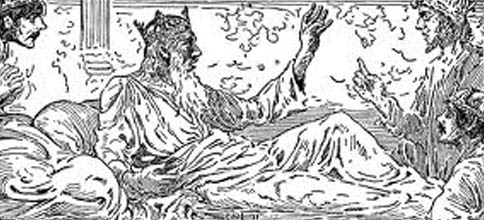
An ailing king lives at the heart of the Wasteland. We often find this figure in fairy tales, such as “The Water of Life,” where efforts to heal him launch the story.  Jungians interpret the king as the “dominant ruling attitude” of a culture or individual, which grows atrophied unless it is periodically renewed.

water of life king

In seeking a simple description of our own collective attitude, I thought of an often misquoted phrase spoken by President Calvin Coolidge in 1925: “The chief business of the American people is business.”  This attitude swept the world in the years since then and sheds much light on our current Wasteland with an ecosystem in crisis.  Sadly, few people know what else Coolidge said in that speech:  

“Of course, the accumulation of wealth cannot be justified as the chief end of existence…So long as wealth is made the means and not the end, we need not greatly fear it…But it calls for additional effort to avoid even the appearance of the evil of selfishness. In every worthy profession, of course, there will always be a minority who will appeal to the baser instinct. There always have been, probably always will be, some who will feel that their own temporary interest may be furthered by betraying the interest of others.” (1)

***

In the earliest versions of the legend, the king is healed when the hero asks this question:  “Who does the Grail serve?”  In these tellings, the Grail is a stone or a large platter that nourishes each person according to their heart’s desire.  This suggests a cornucopia, a potential earthly and spiritual abundance.  There have always been cycles of growth and cycles of famine, cultural florescence and decay.  In the legend, that question, “Who does the Grail serve?” appears to lie near the heart of these cycles.  Somehow we intuit that what Campbell termed “Greed for more  than one’s share” on a large scale is a formula for disaster.

***

In my two previous posts, I mentioned hearing many accounts of people seeking new ways of doing most everything.  I’ve collected so many stories it took several days figure out how to present them.  Simplicity won out in the end; here is one brief account, with more to follow in the future.

I’ve listened to Jill Stein on several occasions, most recently on BillMoyers.com in November, 2013.  Stein, a Harvard Medical School graduate, “became so outraged by how politics adversely affected her patients” that she ran as the Green Party candidate for president in 2012.

Naturally, she was not allowed to participate in the presidential “debates,” which don’t really deserve the name, but in 2012 she and Green vice-presidential candidate, Cheri Honkala, were arrested for simply trying to enter the debate hall.  “We were arrested, taken to a secret detention facility, and handcuffed to metal chairs for eight or nine hours until the debate was long over.”  

Jill Stein, 2012 Green Party candidate for president

Jill Stein, 2012 Green Party candidate for president

You’d expect her to be discouraged after this blatant violation of civil liberties, as well as a host of other abuses she cited during the interview, but she was not, saying instead that,

“America is ready to move. And when we start moving together…all we have to do is realize how numerous, strong and inspired we are. And then we are unstoppable. You know, in the words of Alice Walker, the biggest way people give up power is by not knowing we have it to start with. It’s by flicking that switch and rejecting the disempowerment that’s beaten into us every waking moment by every media source that surrounds us.”

I encourage everyone to watch the interview or read the transcript.  There much that was frightening but even more that was hopeful in this discussion of our current situation.  As time goes on, I’ll feature other optimistic stories I have collected, featuring “ordinary” people searching for those Grails that can transform and renew the world and the lives we are living.

Notes from the Wasteland

Photo by David Mark, public domain.

Photo by David Mark, public domain.

Talk of drought in California isn’t uncommon.  Normally it means lower levels in reservoirs and thinner snowpacks in the Sierras.  Bad news for skiers, and boaters, and farmers, perhaps, and an earlier start to the fire season, but’s it’s January, and for those who don’t ski, or boat, or farm, it’s easy to ignore until summer. But this time it’s different. This year it simply will not rain.

Even in “dry” winters, you see warnings that river currents are cold and swift.  This year the river’s so low there is no visible current.  Half of the local lawns are brown, and those that are green invite visits from the “water patrols” the districts threaten to form.  They say the reservoir from which we get our drinking water is at 17%; that image isn’t easy to forget.

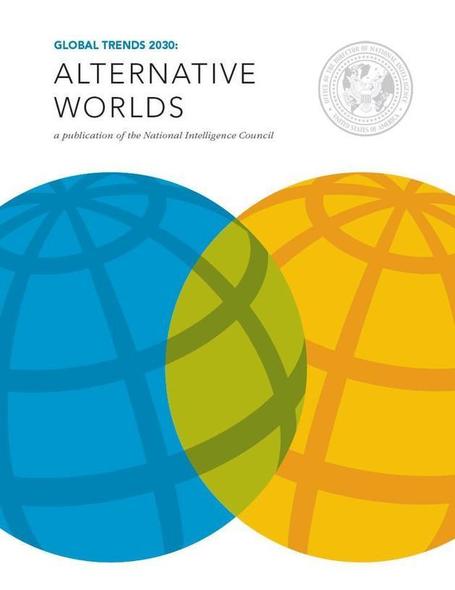
A year ago, I posted a report from the National Intelligence Council.  Every four years, the NIC, representing every US intelligence agency, collaborates on a summary of the world situation to give the incoming president.  They post the report online for anyone to read.  After the last presidential election, the NIC gave the administration a report called Global Trends 2030: Alternative Worlds:

Click for the text of the whole report

I discussed the report in detail in a post in December, 2012, but it’s worth reviewing one of the four “Megatrends” the report identified.  The CIA, the NSA, the FBI, and the 13 other agencies that compiled the report do not waste time debating climate change; they accept it as a given and factor it into predictions, saying that by 2030:

Demand for food, water, and energy will grow by approximately 35, 40, and 50 percent respectively owing to an increase in the global population and the consumption patterns of an expanding middle-class. Climate change will worsen the outlook for the availability of these critical resources. Climate change analysis suggests that the severity of existing weather patterns will intensify, with wet areas getting wetter and dry and arid areas becoming more so.

What gives you pause is their conclusion:

We are not necessarily headed into a world of scarcities, but policymakers and their private sector partners will need to be proactive to avoid such a future.

At this time, if we have to depend on our “policymakers and their private sector partners” to be proactive, we’re screwed, but there are different ways to look at our situation.  As usual, I try to relate literal “truth” to archetypal patterns, and in this case, the obvious mythic story is that of the Wasteland.

The story relates how Camelot fell apart.  How the rift between Arthur and his queen threw the land into ruin.  How the ailing king sent his knights in search of the Holy Grail, the one thing that could restore the barren world.  Those who reached the Grail Castle found another mysterious king inside, wounded through the testicles, in constant pain but unable to die.  His only relief by day was to float in a boat on a lake near the castle.  For this reason, he was known as “The Fisher King.”  He could only be healed by the right knight arriving at the castle to ask the right question.

Antecedents to the story are ancient and predate the Arthurian tales, perhaps by thousands of years.  In writing his poem, The Waste Land (1922), T.S. Eliot relied on an anthropological study, From Ritual to Romance by Jessie Weston, who in turn, drew on The Golden Bough, Sir James Frazier’s study of sacred kingship.

In the mythic cycle Frazier explored, the earthly king was “married” to the Goddess of the Land.  His potency and the earth’s fertility were one.  When he became old and infirm or impotent, the health of the land suffered.  He was ritually killed and a new king selected.  We find echoes of this in Arthur’s estrangement from Guinevere, though of course by then, the era when monarchs submitted to sacrifice was past.

We aren’t ruled by kings anymore, but if we consider “governments” alongside the word, “impotent,” and if we ignore what Viagra can fix, we find these meanings: “weak; ineffective, powerless or helpless; having no self-control.”

Yet the news isn’t all bad, and that is a theme I plan to explore in a series of posts exploring the Wasteland.  For one thing, the Grail hides there and nowhere else.  For another, the old stories never suggest that rulers can save us.  Renewal comes from the outsider, the dummling, the fool, Parsifal the rustic youth, or a carpenter from Nazareth.  

There are literally thousands of people today, already in or ready to enter the metaphorical forest on a quest for better ways to live.  I plan to discuss a few of their stories here.

“Arming the Grail Knights” by Edward Burne-Jones, tapestry, 1890’s, public domain

Help wanted, heroes and heroines: must be civil and adroit

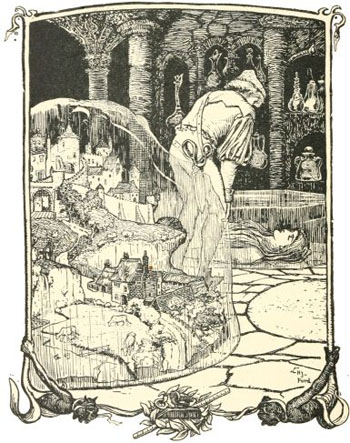
This unusual job description comes from the opening lines of a Grimm’s fairy tale I recently read for the first time.  Fairy tale characters never get more than a word or two of description, and most of the time, tags like “clever fox” and “evil stepmother” are so familiar they don’t make us stop and think.  The opening of “The Glass Coffin,” was different enough to catch my attention:

“A civil, adroit tailor’s apprentice once went out traveling, and came into a great forest, and as he did not know the way, he lost himself.”

Civil and adroit are good terms for key attributes of successful folklore protagonists.  Though the words may sound quaint to us now, the traits they describe are as relevant to our own world as they are to travelers in Faerie.

The Glass Coffin

The Glass Coffin

The virtue of civility:

Some of the Grimm Brothers’ stories seem to locate these attributes along gender lines, implying a world of civil females and adroit males.  But if we review a number of tales, much of the time we find both characteristic needed by men and women alike.

Girls who are rude or mean may wind up dead or have their eyes pecked out like Cinderella’s step sisters.  Toads may jump from their mouths when they try to speak.  Feminists point to such story features as efforts to domesticate young women and make them docile.  Yet for many youngest sons, success also hinges on civility, often to seemingly insignificant creatures.  It’s a dwarf who offers council in  The Water of Life.  When the worldly-wise older brothers mouth off to the little man, they end up imprisoned in stone.  The youngest brother, who is respectful and heeds (most of) the dwarf’s advice, wins his heart’s desire and more.

In many of these stories, motives are greater than simple expediency.  The hero of The White Snake shows genuine compassion.

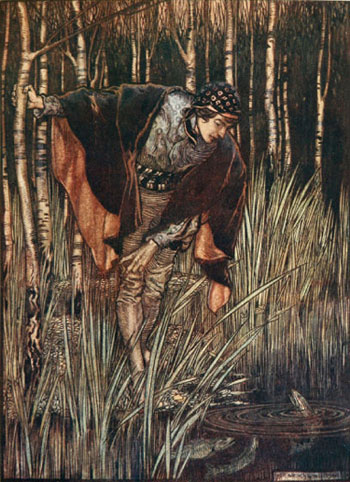
The White Snake by Arthur Rackham

The White Snake by Arthur Rackham

Through a bit of (adroit) trickery, a king’s servant gains the power to understand the speech of animals. He goes traveling and saves three different kinds of “lowly” creatures – fish, ants, and baby ravens.  Kind heartedness rather than self-interest drives him, for though the creatures promise to help him, they only do so after he sets them free.  There were no strings attached to his generosity.

The story is not just a simple call to spare the lives of all creatures, for the servant kills his horse to feed the ravens.  It would take another post to explore this detail, but to the extent that these stories dwell on  compassion, their theme is both ancient and timely.  The Dalai Lama put it in simple terms:  “If you want others to be happy, practice compassion.  If you want to be happy, practice compassion.”

The virtue of being adroit:  

The dictionary defines adroit as “skillful in a physical or mental way; clever; expert.”  In fairy tales, this sometimes means knowing when to kill your horse to feed the ravens.  At other times, it means cunning, trickery, and lies.  In stories, we often imagine these as men’s attributes, perhaps because traditional full time tricksters, from Hermes to Coyote, are usually male.  Yet in Grimm’s stories, young women need to understand and master deceit as often as men.  In Bluebeard-type tales, and notably a frightening story called “Fitcher’s Bird,” it’s a matter of life and death.

Part of being adroit is the intuitive sense of when someone or something feels wrong; when civility is not in order.  In fairy tales, women often do this better than men.  Typically, in three-brother stories, the youngest prince will trust his older brothers, even after the dwarf has warned him not to.  Cinderella and girls like her know better than to be fooled by older siblings.

Instinctively knowing when something is off has new relevance in the 21st century.  Interviews with 9/11 survivors adds to research suggesting our brains are not very good at processing radical changes or threats.  People on the upper floors of the South Tower had just over 16 minutes before the second airplane hit; those who left survived and those who waited did not.  On average, people took 1o minutes to choose.  In times of radical change, we need that cunning, adroit part of our ourselves to cut through the illusion that things will right themselves and return to “normal.”  It can be a matter of life or death.

***

Few things in fairy tales are certain, and the first story in the Grimm’s collection, The Frog King, is an exception that proves the rule proposed by this post.  The princess is neither civil nor adroit.  She’s a petulant brat, who gets what she wants by hurling the frog against a wall (the kiss only comes in later versions).  To our sensibilities, she doesn’t deserve the prince who appears when her act of violence breaks the spell.

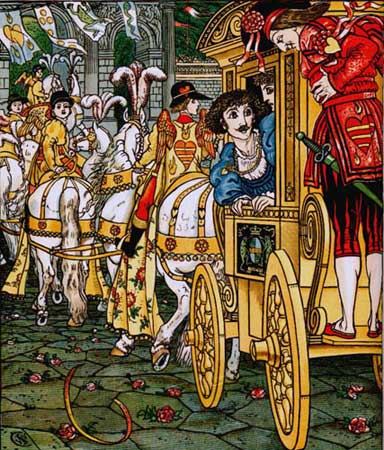
There’s an irony in the original “Frog King,” however.  When the transformed prince reunites with his faithful servant, Heinrich, he almost seems more delighted than he is with his new bride.  At least one illustrator, Walter Crane (1845-1915) implies that the princess won’t have everything to her liking.  Who does the prince have eyes for in the closing scene, and how does the princess appear to react?  Does this story end with a twist that the Brother’s Grimm shied away from?

The princess, the prince, and Heinrich in Walter Crane's 1874 illustration.

The princess, the prince, and Heinrich in Walter Crane’s 1874 illustration.

Experienced explorers warn us that the way through Faerie is perilous.  Trails may shift beneath our feet, and hard-and-fast rules don’t apply.  As Joseph Campbell observed, everyone must find their own way through the forest.

My latest exploration leads me to wonder if “adroit” is another word for “street smarts,” something we need in our own world as well as in dark imaginal forests and castles frozen in time.  And isn’t “civil” an attitude that understands that our own wellbeing, even in the most practical terms, must include the welfare of others?

The old stories may offer no certain answers, but with careful reading, they can always lead us to ask interesting questions.

Chimps in charge

chimp

The day after my post on how to find healthy veggies, Mary and I decided to grab some burgers for lunch.

As we sat down, I noticed “Heart of Stone,” from the Rolling Stones’s first album, playing in the background.  I was contemplating impermanence – how quickly the songs of youth wind up on the oldies station – when the song ended, and “Rudolph the Red Nosed Reindeer” came on.

I looked at Mary.  I muttered an expletive and said, “I thought we were done with all that!”

Our food came, and the music shifted to “Chain of Fools,” a good old Motown classic.  I sighed with relief.  Life was good.  January was good.  January means months and months without “holiday music.”

Or so I thought…

Until “Holly Jolly Christmas” began to play…

More than any other song, “Holly Jolly Christmas” reminds me of pre-transformation Scrooge and the wisdom of his comments concerning boiling certain people in their own Christmas puddings.

“Maybe they just want to hurry us out the door,” Mary said.

I slugged down the rest of my drink.  “It’s working,” I said.

The question I’m left with is, who put together that playlist?  I’m ruling out computer generation, since in my experience, the algorithms, (like iTunes’s “Genius” function) are too sophisticated to create such a mishmash.  I’m left with two theories:

  1. In an effort to save money, satellite radio stations now use institutionalized sociopaths to assemble their playlists.
  2. In an effort to save money, satellite radio stations now use chimps.

I kind of hope it’s the latter, although chimps-in-charge is not a trend that bodes well for things like TV schedules or mid-term election advertising, which will probably start up next week.

If you have any other ideas on who is to blame for Burl Ives in January, please let us know so we can free the poor chimpanzees from blame!

photo by Will Brenner, CC BY-ND 2.0

photo by Will Brenner, CC BY-ND 2.0

Another great story rediscovered: Bamboo Charlie

Here is another inspiring tale that I bookmarked some time ago and then forgot.  Coincidentally, like the previous post, its subject is a uniquely creative folk artist.  I read about Bamboo Charlie in a memorial published in the L.A. Times in September, 2012.

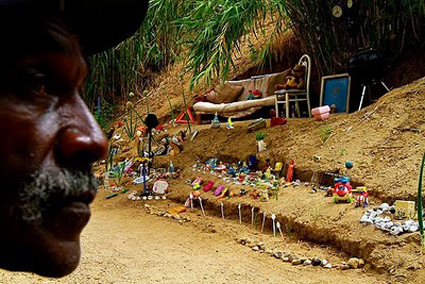
Bamboo Charlie and his whimsical paradise

Bamboo Charlie and his whimsical paradise

Twenty years ago, a homeless Texan named Charles Ray Walker noticed a bamboo grove along a narrow stretch of land by the Los Angeles River in Boyle Heights.  The property owner told Charlie he could stay there if he kept the place clean.

On the strip of land, about 40′ x 200′, squeezed between a parking lot and a warehouse, Walker grew fruits and vegetables.  He carved stairs into the bare slopes and decorated them with hundreds of discarded toys and signs.  He built a shack under a tree, with a TV, bed,and sofa, and then he invited guests to visit: graffiti artists, children and their parents, musicians, police officers, and homeless friends.  He assembled a library out of salvaged books, including best sellers and one called The Semi-Complete Guide to Sort of Being a Gentleman.  Bamboo Charlie was featured on the front page of the L.A. Times in 2010.

"Bamboo Charlie"

During the 20 years he spent on the parcel, he collected cans for money, sometimes working late into the night. Duruing occasional trips back to Texas to visit his family, he operated a crane at a steel company. “I’m not going to ask another grown man for money. I never have, and I never will,” he said. “People expect that from a homeless man.”  

That pride may have contributed to an early death.  He suffered greatly from ulcers during his final years, but insisted he was fine when friends suggested he see a doctor. On Aug. 26, 2012, a young friend named Teyuca found him dead in his shack, of what the coroner determined was heart disease.  He was 61.

“I really think what he did was folk art, built out of scraps and things found, things that people gave him,” Teyuca said.  “He was a mad genius.  He had such a wild imagination.”