An Author’s Guide to Publishing in 2012 – A Guest Post by Amy Rogers

Last September, I wrote an enthusiastic review of Petroplague by Amy Rogers http://wp.me/pYql4-1ep. With a PHD in microbiology, Dr. Rogers is uniquely qualified to bring her considerable writing skills to bear on a thriller in which an oil-eating bacteria ravages Los Angeles.  Airplanes fall from the sky.  Millions of cars stall on the streets and freeways.  No food deliveries.  No ambulance, police, or fire service as a greedy corporate criminal and deluded eco-terrorists strive to suppress a solution.

On two occasions, New York agents represented Amy Rogers’ work but were unable to sell it.  With a keen understanding of the turmoil in traditional publishing, Amy decided to take matters into her own hands.  After I posted my review, I invited her to write a summary of her experience for us.

Last week I received an email saying she’d finished a “5,000 word treatise” on current publishing options for writers.  This will form the basis for her presentation at the June meeting of the Sacramento California Writer’s Club branch.  She graciously sent a 1500 word, abridged version, for thefirstgates.  I am delighted to be able to share her account, for I think her observations and experiences can serve as as Ariadne’s thread as we work our way through the current publishing maze.

Because of the length, I am going post this article in two parts.  Meanwhile, I invite everyone to visit Amy’s blog, Science Thrillers.com (listed on my blogroll), and to follow her on Twitter at, @ScienceThriller.  Also, check out her Facebook fan page, where you’ll see that she has been invited to participate in the New Author’s Breakfast at the Left Coast Crime 2012 conference in Sacramento at the end of the month. http://www.facebook.com/pages/Amy-Rogers/202428959777274

And now, without further delay…

_____________________________________________________________________

An author’s guide to publishing in 2012 by Dr. Amy Rogers

Part 1: What’s going on with publishing today?

Book publishing is undergoing a revolution unlike anything seen since the invention of moveable type, an explosion of diversity in the paths leading to publication.  After centuries in a desert of limited choices, writers now have a rainforest of options to get their work in front of readers.

But the changes are so profound and happening so rapidly, many writers can’t keep up with the business.  We’re writers, so we write, but what then?  The simple formula—write book, sell rights to a print publisher, collect royalties—doesn’t apply to the majority of published books today.  Is this a bad thing?

The big changes in publishing are both challenge and opportunity.  Whether the changes are “good” or “bad” depends on where you stand.  In this series, I’ll first summarize some of the major trends in the book business that are affecting the way books get published and sold.  In the second, I’ll discuss how writers seeking “publication” of their work can navigate the path that’s right for them.

So why does the publishing business feel like a Kansas farmhouse in a tornado?  Simple: technology.  Digital disruption devastated the music industry; now it’s rolling over publishing.  The end results for various stakeholders (authors, publishers, readers, retailers) are far from certain.

1.  Ebooks

Top of the list of disruptive technologies: e-books.  Amazon’s Kindle e-reader is now in its third or fourth generation.  The critical $100 price point has been breached (a Kindle now costs as little as $79).  Barnes & Noble’s Nook e-reader and tremendous numbers of Apple’s iPad plus various smartphones (which can also be used as e-readers) give millions of Americans easy access to e-books.  (Not to mention ubiquitous laptop and desktop computers, which can be used to read e-books, though uncomfortably.)

How rapid is the rise of the e-book?  The Economist reports that in the first five months of 2011, “sales of consumer e-books in America overtook those from adult hardback books” and “amazon now sells more copies of e-books than paper books”. http://www.economist.com/node/21528611 Granted, Amazon’s experience does not represent the entire bookselling business, but it is significant.  In my own genre—thrillers—over half the books sold are now in digital formats.

2.  Distribution

Digital technology is changing the way books are distributed.  Obviously, e-books can be sold online—from anywhere in the world, to anywhere in the world, no neighborhood bookstore required.

But it’s not only e-book sales that are affected by digital tech.  The emergence of amazon as a global book retailer with no physical presence in communities has also changed how paper books are sold.  People are shopping for paper books over the Internet and getting them shipped.  Neighborhood and mall bookstores are struggling.  Browsing is nice, taking your book home with you on the spot is nice too.  But amazon’s price advantage is killing these stores.  The giant online retailer subsidizes much of its bookselling business, has smaller fixed costs, and still dodges sales tax in most states.

3.  Publicity

The best way to get a person to buy a book is word of mouth: a trusted source, whether a friend or a reviewer, mentioned the book.  Digital technology—the Internet and “social networking”—is truly revolutionizing word of “mouth”.  Successful book marketing is increasingly based in this virtual world.  Book bloggers, readers’ collectives like GoodReads and LibraryThing, Facebook, Twitter, book trailers on YouTube—this is what sells books.  Reviews remain critical, but the traditional venue—newspaper sections devoted to in-house book reviews—is vanishing.  Only a few papers still publish their own book reviews, and generally these reviews are few in number.  So authors and publishers must go online to get reviews and build “buzz” around a title.

_____________________________________________________________________

Section two of Dr. Amy Rogers, A Writer’s Guide to Publishing in 2012 will be featured in my next post.

Life: The Movie by Neal Gabler – A Book Review

In his final movie, Being There, 1979, Peter Sellers plays Chance, a gardener with a low IQ, who becomes an advisor to the president and business tycoons. In one iconic scene, Chance is accosted by a knife wielding youth in Washington, DC.  He pulls out his TV remote control and clicks it to change the channel.  He is puzzled when the assailant doesn’t vanish.

Peter Sellers as Chance in “Being There”

This might be the perfect illustration for Neal Gabler’s, Life, The Movie:  How Entertainment Conquered Reality, (2000).  Gabler quotes historian, Daniel Boorstin, who wrote in the early 60’s that, “We risk being the first people in history to have been able to make their illusions so vivid, so persuasive, so ‘realistic’ that they can live in them.”  Done deal, according to Gabler, who calls us, not just a “post-modern culture,” but a “post-reality culture.”

At times I had to keep my own assumptions in check:  subjects like reality and imagination open onto psychological and spiritual vistas beyond the scope of this or any other single book.  But when Gabler cited concrete examples, I found myself nodding my head on almost every page.

“You know how to brood because you have seen Rebel Without a Cause,” Gabler says, quoting cultural analyst, Louis Menand.  “What better model does the world offer?”

Gabler charts the ascendency of entertainment in America from the early 19th century, where the split between high and low culture was fueled by our democratic suspicion of all elites.  Calling someone “aristocratic” was a serious insult.  During the 1840 presidential campaign, when a man called Daniel Webster an aristocrat, he thundered back that he’d grown up in a log cabin, and anyone calling him an aristocrat was “a coward and a liar.”  ( Sound familiar? )

Nathaniel Hawthorn despaired of the fate of serious writers amid the flood of “trash” being published.  One publisher sold four million dime novels in five years, at a time when the US population was only 25 million.

In 1850, 1% of the population owned 50% of the nation’s wealth and held almost all public offices.  Upward mobility was a myth, since 98% of that wealth had been inherited.  While the one-percent held the power, then as now, culture wars raged, sometimes with a violence that we (thankfully) haven’t seen yet.  One night in New York, rival Shakespearean actors, one British and one American, were both scheduled to perform, the former in an uptown theater, the latter downtown.  Police ejected the rabble who had bought tickets solely to heckle the British actor.  A much larger crowd gathered across the street to throw rocks as the “aristocratic” crowd tried to leave.  The militia was called, a riot ensued, and before the night was over, 22 lay dead and more than a hundred wounded.

In the end, it was movies that won the day for popular culture.  The 1% stayed away from the early nickelodeons, which tended to be crowded and crass.  Later, with middle-class patronage, refined behavior became the norm, but the elite have never fared well in the movies, from the Marx Brothers  Night at the Opera, to the present, where a too-expensive suit is always the mark of a villain.

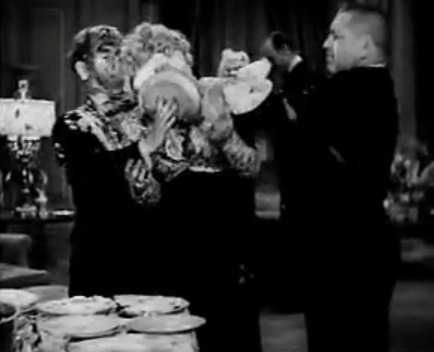
Three Stooges + high society + pies = disaster

As he charts the history of high vs. popular culture, Gabler makes a telling point.  It isn’t just about high brow and low brow – it’s about the ascendency of entertainment.  Being entertained is easy, and the corollary is that when the goal is entertainment, grabbing and holding audience attention is the supreme value, and “things that do not conform – for example, serious literature, serious political debate, serious ideas, serious anything – are more likely to be compromised or marginalized than ever before.”

Life: the Movie is a complex and disturbing book.  Gabler says in the introduction, it is diagnostic and not prescriptive.  To offer easy answers, he says, would be like the movie illusion where we meet the monster in act one and see it vanquished in act three.  Writing 12 years ago, Gabler said:

“One is almost compelled to admit that turning life into escapist entertainment is a perversely ingenious adaptation to the turbulence and tumult of modern existence.  Why worry about the seemingly intractable problems of society when you can simply declare ‘It’s morning in America,” as President Reagan did in his 1984 reelection campaign, and have yourself a long-running Frank Capra movie right down to the aw-shucks hero?”

I read this book after watching Neal Gabler speak on the fictions that lace the current election campaign on Moyers & Company, as I described in the preceding post. Because of it’s scope, I would recommend Life: the Movie only to those who want to delve into this issue in some depth.

But  I would recommend that everyone watch the ongoing conversation this year between Gabler and Moyers.  The confusions and illusions surrounding the political process are more convoluted than when the book was written, but Neal Gabler remains a reliable guide to pulling back the curtains and helping us draw closer to the truth.

The Shape-Changer’s Wife by Sharon Shinn: A Book Review

I’ve enjoyed several young adult fantasies by Sharon Shinn and reviewed one of them here http://wp.me/pYql4-iQ.  Before she published her first YA book, Summers at Castle Auburn, in 2001, Shinn had a solid reputation as an adult fantasy writer.  I recently finished her first novel, The Shape-Changer’s Wife, which won the Locus award for Best First Fantasy Novel in 1995. Shinn was nominated for the John W. Campbell Award for Best New Writer that year.  On top of these honors – all well deserved – long time readers of this blog will know I am fascinated by stories of shape shifters (check out three posts I wrote on the theme in Feb., 2011).

At the start of The Shape-Changer’s Wife we meet Aubrey, a young man with a sunny disposition who is already on his way to becoming a skilled magician. His master sends him to study with Glyrenden, highly skilled in the art of shape-changing:

“Learn everything he teaches you so well you can cast his own spells back at him,” the old wizard had said. “Glyrenden respects only those stronger than he is, and those he hates. If you cannot beat him, he will destroy you.”

With the optimism of youth, Aubrey brushes the warning aside and sets out. Even when local villagers react to Aubrey’s request for directions with narrowed eyes and cold responses, his hunger to learn drives him on.

Shinn is masterful in building a sense of menace, which begins the moment Aubrey steps into the 3″ of dust that cake the entry way of the shape-changer’s house.  It builds when he meet the uncanny servants – Orion, covered with hair except for his eyes and nose, and Arachne, a woman who fights a loosing battle against the dust, while muttering curses and shooting everyone hostile glances.  Above all, Aubrey is fascinated by Lilith, the shape-changer’s wife, whose emerald eyes seem to see right through him, who is silent and self-contained, and doesn’t react to anything like any other woman he’s ever met.

Shinn’s presents magic as matter-of-fact.  Shape-changing sounds dramatic to Aubrey, so he is dismayed when Glyrenden hands him piles of books on anatomy and science and makes him practice hours of concentration exercises.  “How can you change into something you don’t understand in all of it’s details,” the shape-changer asks.  In Shinn’s books, magic is seldom dramatic.  More often, it forms an atmosphere like the felt danger offstage in a Hitchcock movie.

By the middle of the tale, Aubrey is hopelessly in love with Lilith, even as he perceives that “She seemed to be fashioned from the idea of a woman, and not to be a woman at all.”  This and other related perceptions lead him to pierce the secret of Glyrenden’s house – why the townspeople fear him, and why no bird or animal will come anywhere near the wizard’s dwelling.  Aubrey learns that the only way to undo Glyrenden’s “barbaric spells” is to kill him or become a better wizard, and even if he succeeds, the spells may prove too strong to break.

“I came to magic with joy.” Aubrey says.  “I thought it was a splendid thing to take the well of power that I found within me and shape it to marvelous uses…But magic, I have discovered…is not inherently good in itself.  And some of it – yes, some of it is inherently evil.  There are wicked spells, savage spells, enchantments that are so black that even to know them withers the heart just a little, taints the soul.  And yet to be a great magician, to be a sorcerer of any ability or renown, those spells must be learned as well.  For if a magician does not know them, they can be used against him.”

With measured pace, Shinn has brings us through her imagined world to one of our oldest stories, that of tasting the fruit of the Tree of Knowledge.  The Shape-Changer’s Wife is also a love story, but told with a kind of restraint that is rare in the fantasy genre.

You seldom see titles by Sharon Shinn on the shelves of Barnes&Noble, and never her YA titles.  At first glance, her books are not the stuff of blockbuster series and lucrative movie deals, though I can see them as moody, gothic dramas.

Shinn is a wizard in her own right.  Beyond the pleasure I’ve gained from six of her novels, I return to them often to study the masterful way she can weave character and atmosphere into stories I cannot forget.

Sharon Shinn

Ann Patchett Interviewed on the Colbert Report

By a happy coincidence, I was channel surfing Monday night at just the right moment to catch author and indie bookstore owner, Ann Patchett, on the Colbert Report.  In an earlier post, I discussed Ms Patchett’s bookstore venture. http://wp.me/pYql4-1qW.

Author and owner of Parnassus Books, Ann Patchett

Colbert played devil’s advocate, arguing that brick and mortar bookstores are obsolete, and besides, Amazon’s Jeff Bezos is no one to mess around with – didn’t he bludgeon the owner of Borders to death with a tire iron?

Patchett said, fine, stay indoors, never talk to anyone, live your life online, “But you’ll wake up one day and find you’ve become the unibomber.”

“A strong argument,” Colbert conceded.

From the sound of it, Patchett’s Parnassus Books has become a community gathering place – not just a bookstore, but a literary salon, a poets corner, a venue for local musicians, and a place where the staff is composed of avid readers who can make suggestions for every taste.  If I were an independent bookstore owner, I’d be tempted to travel to Nashville to look at this model of success.

The full episode is available online: http://www.colbertnation.com/full-episodes/mon-february-20-2012-ann-patchett.  The Patchett interview is about 2/3 of the way through the show, though with a cup of coffee and a slightly twisted sends of humor, you may enjoy listening to it all.

King of Morning, Queen of Day by Ian McDonald: An Appreciation

My recent discussion of unlikely mentors and guardians http://wp.me/pYql4-1J8 reminded me of Tireseas and Gonzaga, two “mystical vagabonds” (book jacket description) in one of the best fantasy novels I’ve ever read.

Ian McDonald, a visionary author who lives in Belfast, published  King of Morning, Queen of Day in 1991.  I still pick it up to read certain passages or a random chapter, to study and enjoy the ideas, the writing, and characters.

The narrative follows three women of three generations who are alternately attracted and attacked by creatures of the Mygmus, a technical name for the infinitely overlapping worlds of Faerie.

“The Mygmus may be viewed not so much as a place, a spatio-temporal relationship, a quasi-Euclidean geometrical domain, but as a state.  The concept is a familiar one in modern quantum physics, in which time is not considered a dynamic process, but a succession of recurring states eternally coexistent.  Such thinking liberates us from our essentially linear concepts of time, with past, present, and future.”  So reads a manuscript given to one of the women by a strange group of deformed, “Midnight Children.”

The first of the women, romantic, Edwardian Emily, dreams of a faerie lover and seeks him out.  First her rapes her, and then she disappears.

Gonzaga and Tireseas help Emily’s daughter, Jessica, battle free of the otherworld threat, which is personified by her mother, who has become a demonic force.

Jessica’s daughter, Enye, modern young woman in Dublin, battles Otherworld manifestations at night with martial arts swords.  Gonzaga and Tireseas charge her blades with high tech wizardry as well as ancient charms that allows her to win her way into Faerie, redeem her grandmother, Emily, and return to modern day Dublin.  The author gives the ending a contemporary twist that I won’t reveal here.

McDonald’s characters are among the most vivid in any novel I can remember, painted with a sure touch both in broad stroke and detail.  Every December, for instance, I reread “Enye’s soliloquy” – my name for it, with a nod to Molly Bloom.  It’s her internal monologue, in response to the question, “Wouldn’t it be nice if we could have Christmas all year long?”  It’s a long single sentence paragraph – not quite as long as the one that ends Joyce’s Ulysses, but then Joyce doesn’t make me laugh out loud.  I’ll quote the whole thing next December.

With his first book, Desolation Road, 1988, Ian McDonald won critical acclaim, and an Arthur C. Clarke award nomination.  Like other cyberpunk authors at the time, his vision of the impact of  technology at the birth of the internet age continues to amaze.  As a quick aside in King of Morning, Queen of Day, McDonald throws out a challenge to fantasy writers that has largely remained unanswered in the 21 years since it was written.  In the same manuscript that defined the Mygmus, Enye reads:

“I have this dread that…somehow we have lost the power to generate new mythologies for a technological age.  We are withdrawing into another age’s mythotypes, an age when the issues were so much simpler…and could be solved with one stroke of a sword called something like Durththane.  We have created a comfortable, sanitized pseudo feudal world of trolls and orcs and mages and swords and sorcery, big-breasted women in scanty armor and dungeon masters; a world where evil is a host of angry goblins threatening to take over Hobbitland and not starvation in the Horn of Africa, child slavery in Filipino sweatshops, Colombian drug squirarchs, unbridled free market forces, secret police, the destruction of the ozone layer, child pornography, snuff videos, the death of whales, and the desecration of the rain forests.

Where is the mythic archetype who will save us from ecological catastrophe, or credit card debt…where are the Translators who can shape our dreams and dreads, our hopes and fears, into the heroes and villains of the Oil Age?”

Ian McDonald

I haven’t kept up with the work of Ian McDonald in the two decades since I first read King of Morning but returning to the book via the characters of Tireseas and Gonzaga reminded me to do so. McDonald published Planesrunner, his first YA fantasy, in December, 2011. Here’s the blurb:

“When Everett Singh’s scientist father is kidnapped from the streets of London, he leaves young Everett a mysterious app on his computer. Suddenly, this teenager has become the owner of the most valuable object in the multiverse—the Infundibulum—the map of all the parallel earths, and there are dark forces in the Ten Known Worlds who will stop at nothing to get it.”

I don’t know about anyone else, but this is my very next read.

Lunch with Ebook Advocate, Mark Coker

According to Time Magazine, in 1812, the year Charles Dickens was born, 66 novels were published in Britain.  Many were written by “Anonymous,” since novels were not very reputable.  No one dreamed of making a living writing them.  Dickens, the first literary celebrity, whose bicentennial we celebrate this year, was instrumental in changing that, but he never could have imagined today’s literary landscape, which his work helped to create.

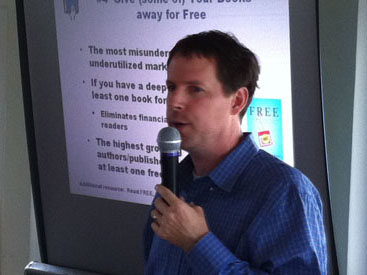
Mark Coker, guest speaker for January’s California Writer’s Club lunch, described an experience that is emblematic of the challenges faced by new writers today.  Coker and his wife co-wrote a novel.  They went through the revision process, and eventually became clients of a prestigious New York agency.  Two years later, their book remained unsold.  Coker’s solution was Smashwords, an ebook publishing service he started in 2008 that is at the forefront of changes rippling through the industry.

Mark Coker

Coker says that large publishers “look in the rearview mirror” for what has worked in the past.  There is little financial incentive for them to risk new concepts and new authors.  Even an author who wins the publishing game and gets a book on the shelves has no guarantee that a title with slow sales will not be remaindered within a matter of weeks.  That may not be enough time to establish the buzz that drives success.

Publishing on Smashwords is free and fast.  Correctly formatted books are distributed to all the major ebook publishers, and authors receive 85% of the sales.  Books do not go out of print, so there’s time for word of mouth to evolve.  Smashwords usage is growing exponentially.  Authors uploaded 140 books in 2008.  In 2011, the total was 92,000.

Smashwords historical usage, from a chart on their blog

Coker’s talk was animated with a sense of mission.  He said what gets him up in the morning is, “enabling writers to express themselves.”  He never suggested it’s easy, however, and most of the rest of his presentation detailed what is required.

First in importance, of course, is a really good book.  Coker suggested as many revisions and beta readers as necessary, and possibly professional editing.  At stake is the trust of readers, hard to build and easy to lose.

Next in importance are a well designed cover and compelling blurb.  Coker says polls reveal that “discovery” accounts for 50% of ebook sales – in other words, we still buy books by their cover.  This is good news for indie authors.  Only 18% of readers polled reported sticking with authors they know.  This means that for independent authors without design skills, hiring an artist is almost essential to come up with a cover that will capture attention as readers scroll through pages of thumbnails.  An email to list@smashwords.com will generate an auto reply listing 3d party artists and people who handle format.

Coker presented more information than I can cover in one article.  He has free guides to ebook formats and marketing at https://www.smashwords.com/.  Other topics are covered on the Smashwords blog, (referenced on the blogroll here) and at http://www.huffingtonpost.com/mark-coker.

With ebook sales continuing to climb; with Apple’s move into electronic textbooks; with Smashword’s impending foray into library distribution, it becomes increasingly clear that ebooks are where the future of publishing lies.  Mark Coker used the phrase, “democratization,” which again brought to mind the Time article on Dickens I referenced to begin post.

“The flood of books in the 19th century elicited two powerful institutional responses:  the rise of prize culture and the rise of literature as a field of study.  The message (sometimes subliminal, sometimes not) was that the masses needed help figuring out what to read, and the cultural elite…was going to provide it.”  (“Charles in Charge” by Radhika Jones in Time, Jan. 30, 2012)

Noting that such elitism broke down well before the advent of ebooks, (for example, with the rise of Oprah as our great taste-maker), Radhika Jones ends her article with a question that would likely delight Mark Coker and maybe Charles Dickens as well:  “Will the readers of the future find their 21st century Dickens on the Pulitzer roster or the best-seller list or FanFiction.net?”

“The future is in your hands,” said Coker at the end of his talk.  “The power of publishing is shifting to the authors.  Go and serve your readers.”

The Lightning Thief by Rick Riordan: A Book Review

I’ve been less active on my blog this week because of the happy event of finding a book I couldn’t put down. Like most such discoveries, I came to it by word of mouth.  In December, we called my sister-in-law to ask what our fifth grade nephew might want for Christmas.  She said he had really enjoyed  The Lightening Thief by Rick Riordan, the first book in a middle grade series called Percy Jackson and the Olympians.  Without even stopping to read the blurb in that hectic season, we ordered the boxed set on Amazon, had it shipped as a gift, and forgot about it – until this month, when I spotted a display of the series at the local Barnes&Noble.

I was instantly impressed as I realized these books feature the 12 year old son of Poseidon and a mortal woman in a 21st century America where the figures of Greek mythology – and their numerous offspring – are on the loose.  If you remember your Greek myths, you recall that the gods were best avoided by mortals.  There was a lot of collateral damage in the Olympians’ constant bickering.  Think of Troy.

Percy Jackson, our half-blood (aka, demigod) hero, would not wish his fate on anyone.  Dyslexic, diagnosed with ADHD, and a D student, he has been shuffled from school to school six times in six years.  And that was when his life was easy – before one of the furies and the Minotaur try to kill him.  By sheer luck, he finds refuge in Camp Half-Blood, but not for long.  Zeus believes Percy has stolen his thunderbolt thrower.  If Percy does not return it in ten days time, a battle will erupt on earth, “that will make the Trojan war look like a water-balloon fight,” according to Chiron the centaur, Percy’s mentor.

Though this book is aimed at a young audience, it has all the attributes writers are taught to build into their novels:  an engaging protagonist, a unique premise, tension on every page, and ever-rising stakes.  I love the way this story encourages younger readers to explore the classics.  One of the items I saw on display at the Barnes & Noble was an illustrated summary of the figures of Greek myth, presented in contemporary form.  Zeus had shoulder length hair, a pin stripe suit, and the good looks that could land him on the cover of a romance novel.  Dionysus was a pudgy, middle-aged reprobate, given to loud Hawaiian shirts.  Such images make the gods more immediate than the older toga and grape-eating portraits.

I am late to this party.  The Lightning Thief was published in 2005. A movie version was made in 2010. I don’t know if it was ever released, but the Wikipedia summary shows it diverges significantly from the novel.  That makes me wary since I liked the book so much.

Most of the online reviews I read were written by adults who enjoyed Riordan’s stories as much as younger readers. Several mentioned the kind of pleasure they found in Harry Potter.  I can’t say for sure, since I’ve only read the first book, but I know I’m looking forward to reading the others.

Bill Moyers is Back!!!!

On Sunday evening, I was delighted to catch the first episode of the new PBS series, Moyers & Company.  You can view it, and a lot more, on the new website, http://billmoyers.com/.

Moyers interviewed political scientists, Jacob Hacker and Paul Pierson, authors of, Winner-Take-All Politics:  How Washington Made the Rich Richer–and Turned Its Back on the Middle Class.

The conversation startled me, as Hacker and Pierson said they were startled during their research.  They found that the current income gap in this country – greater than in some third world countries like Egypt – was not an inevitable consequence of free market dynamics or trends like globalization.  It was politically engineered over the last 30 years.  Hacker and Pierson argue that the current American leadership more closely resembles a third world oligarchy than the democracy our parents knew.

“Who’s the culprit? “American politics did it– far more than we would have believed when we started this research,” Hacker explains. “What government has done and not done, and the politics that produced it, is really at the heart of the rise of an economy that has showered huge riches on the very, very, very well off.”

Bill considers their book the best he’s seen detailing “how politicians rewrote the rules to create a winner-take-all economy that favors the 1% over everyone else, putting our once and future middle class in peril.” – (from billmoyers.com)

Jacob Hacker and Paul Pierson on Moyers & Company

Winner Take All Politics is going into my already overcrowded book-queue, since it appears to be of critical importance.  The first step in correcting a problem is gaining an accurate understanding of its nature.  The fact that the assault on the middle class was created and not fated is good news, according to Hacker and Pierson.  Something done can be undone.  Along with Moyers, they agree that our current national sense of outrage is a positive sign.

Moyers’ work and website are important to bring up today.  On the website you can find an April, 2010 interview with two African American lawyers, discussing what Dr. King would have made of America today. Lawyer Bryan Stevenson said:

“I think in America, the opposite of poverty is justice. I think there are structures and systems that have created poverty, and have made that poverty so permanent, that until we think in a more just way about how to deal with poverty in this country, we’re never gonna make the progress that Dr. King envisioned.”  http://billmoyers.com/content/bryan-stevenson-and-michelle-alexander/

These are important things to consider, especially today.