How Much is Too Much?

I have to thank Ceinwenn for this topic.  He or she (I can’t be sure, since the link takes me to a password protected forum) commented on my previous post, Three Requirements of a Book Review (?).  Ceinwenn felt I had given away too much plot info in my review of  David Baldacci’s First Family.  It’s entirely possible.  Several comments mentioned avoiding spoilers, something I have not considered as much as I will now.

In my own defense, I would cite the similarities of a synopsis, which you use as a design and advertising tool with your own fiction, and the plot exposition section of a book review.  In a synopsis, you must reveal what happens; you can’t leave an agent or editor guessing.  In a book review you must not.  Got it.  Thanks.

But that wasn’t what I really wanted to talk about here.  Ceinwenn’s comment spun me off thinking of several recent things I’ve said about blogging, and specifically my discovery that the public act of blogging is far more stimulating than the private act of writing in a journal.  The public nature of blogging makes it challenging in terms of deciding how much self-revelation is right.

My wife has commented on my tendency to get too academic and boring, which is an easy path for me to take.  On the other hand, I remember a psych teacher who was Mr. Sensitive-Self-Revelation, and it wasn’t a pretty sight!  A remember a very calm and poised young woman walking out of the class, shaking her head and making barfing noises.

You get what I’m saying.  As a blogger I want to be real and I enjoy the same quality in others, but I’ve used the delete key on posts that went to far.  I might write about an embarrassing moment, especially if there is humor involved, but I’m probably not going to post my most mortifying-ever experience.  You know the one – you’re driving along and it comes to mind and you slink down in your seat in case the nearby drivers can read your mind.

Some topics rouse caution immediately, notably politics and religion.  Mary and I have a couple of long-term friends that are long-term because we learned early on to stay off these topics.  Here on this blog I circle both politics and religion, but I keep more of a distance than I would personally like to.  Still, because I really dislike door to door religion or candidate salespeople, I don’t want to risk using this space to invade anyone’s right to decide for themselves.  Fortunately, tonight I get to quote someone brilliant on a political topic.

I’m traveling.  As a matter of fact, I’m attending a two day intensive teaching session let by a Tibetan Buddhist teacher of international renown (forbidden topic #1).  I got back to my room and flipped on the news just in time to see the President’s message that a compromise is in the works. (forbidden topic #2).  Whew!  No one with their head screwed on right could wish to see our country in default, and yet, the whole situation is icky!  Have you ever gone for a swim in a lake or river that was too full of alge?  You come out feeling slimy.

It’s far to easy to blame someone else, but none of us are innocent in this mess.  We elected these clowns, most of whom are doing what they think we want them to do in order to get re-elected.  It cuts a lot deeper than that, and once I get home, I may quote from an article I found that has a lot to say about this dance of the public and the politicians.

Meanwhile, here is the brilliant comment I promised, from Walt Kelly, creator of the wonderful comic strip, “Pogo.”  This particular panel was printed in 1971, on the occasion of the first Earth Day, but its message took on a life of its own that goes beyond any single issue.  If we could learn one thing from this latest crisis, this would be my vote.  We, as a nation, will not be destroyed from without, goes the common wisdom, often repeated over the last decade – but clearly we can do it to ourselves.

Three Requirements of a Book Review (?)

In a post entitled, “How Not to Write a Book Review,” Robert Pinsky, who has been writing reviews since typewriter days, discusses a famous and venomous book review a critic leveled at John Keats in 1818. http://www.slate.com/id/2299346/pagenum/all/#p2.  The review, by Irishman, John Wilson Croker, founder of modern political conservatism, became known as “the review that killed Keats.”  Croker really is nasty, but by himself,would not inspire me to write a blog post.

What I found noteworthy in the article are the basic principles Pinsky has used for decades to write his reviews.  In the 1970’s, when he wrote freelance for newspapers, one of them gave him a mimeographed style sheet with three rules  for every book review:

1. The review must tell what the book is about.
2. The review must tell what the book’s author says about that thing the book is about.
3. The review must tell what the reviewer thinks about what the book’s author says about that thing the book is about.

At first reading, the list seems to apply to non-fiction more than fiction.  Novelists don’t really say things about what their books are about except during interviews, but if we are less literal, do these criteria work?  As an experiment, let’s consider Harry Potter and the Sorcerer’s Stone, which I’m choosing because it’s pretty well known.

Criterion #1 is really the synopsis:  A lonely orphan discovers he is a wizard and finds allies as well as a deadly enemy at Hogwarts School of Witchcraft and Wizardry.  I like to set a story in context with (relatively) objective information.  For the first Potter, I might discuss characteristics of middle-grade fantasy – a magical world must be internally consistent, but does not require a detailed explanation:  some people are wizards and some are muggles, and that’s how it is.  This is common in middle grade, while adult fantasy needs more – a theory of mutant genes or something like that.  This first criterion, a summary of what the book is about, is essential for any review.

Criterion #2, is phrased in a strange manner.  An author writing a history of the Third Reich will have things to “say about that thing that the book is about,” but J.K. Rowling doesn’t.  For fiction, I interpret this as detailing what the author does to flesh out the plot and make it dynamic.  Rowling’s main characters, for instance, are so well drawn that they feel like people we’ve known.  You feel like you’ve met Hermione, Snape, and Hagrid, whether or not you have.  In addition, this is where I would speak of the richness of the world of Hogwarts, and maybe research a brief history of academies of magic in fiction and legend.

Criterion #3 is a tongue twister that boils down to my take on #1 and #2.  For Potter, I might talk about how it evokes the longing for connection; how sometimes we all feel like orphans longing for a virtual family  of kindred spirits like Ron, Harry, and Hermione.  How Hogwarts is an endless world our imaginations want to explore.  In other words, if I can find words for my deepest reactions, presumably – hopefully, others will know or echo what I am talking about.

I enjoy reading and writing book review as do a lot of bloggers I follow.  The exact phrasing of Pinsky’s rules seem a little too cutesy, but they got me thinking and I can come up with lots of ways to conceptualize the same thing. Here is one, off the top of my head:

1.  What is the story about?
2. How does the author make it uniquely their own?
3. Does it work for me?

Can you write an effective review with less than these basic criteria?  Are there others that will make it more effective?  Is it possible to do all of this and still wind up in left field?

The Letters of Georgia O’Keeffe and Alfred Stieglitz

In 1916, when they met, Alfred Stieglitz was 52, and an internationally known photographer whose avant-garde gallery in Manhattan made him one of the most influential men in early 20th century American art. Georgia O’Keeffe was 28, and an unknown schoolteacher from Texas.  Their professional and personal relationship spanned three decades and is documented in 25,000 pages of correspondence.  The first volume of these letters has just been published as, My Faraway One: Selected Letters of Georgia O’Keeffe and Alfred Stieglitz, Volume I, 1915-1933, edited and annotated by Sarah Greenough.

Georgia O'Keeffe and Alfred Stieglitz, 1944

Sarah Greenough discussed this correspondence recently on NPR:  http://www.npr.org/2011/07/21/138467808/stieglitz-and-okeeffe-their-love-and-life-in-letters.  Stieglitz and O’Keeffe were prolific correspondents, sometimes writing two or three letters a day, up to 40 pages long.  These documents “track their relationship from acquaintances to admirers to lovers to man and wife to exasperated — but still together — long-marrieds.”   

The two began living together soon after O’Keeffe moved to New York.  They were married in 1924.  Greenough notes that tensions began to appear between them almost immediately, but the deciding moment in their relationship came in 1929, when O’Keeffe visited New Mexico and discovered the landscape of her soul.  Stieglitz had promoted her work in New York, but in New Mexico, O’Keeffe found the subjects and colors that made her famous.  You cannot really think of her living anywhere else, just as you cannot think of Stieglitz outside of New York.  The two maintained their relationship at a distance, struggling to grow as individuals and as a couple, until Stieglitz’s death in 1946.

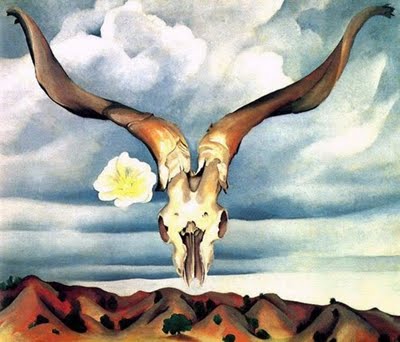
"Ram's Head," by Georgia O'Keefe

More is generally known about O’Keeffe than Stieglitz, for her powerful canvases have a distinct 20th century feel, and her life has become emblematic for generations of women struggling to champion their own personal and creative gifts.

"Light Iris" by Georgia O'Keeffe

Stieglitz is not as important to contemporary artists, but his influence on early 20th century American art and especially modern photography cannot be overstated.  He was an early and ardent champion the idea of photography as an art.  Later 20th century masters of the medium – Paul Strand, Edward Weston, Ansel Adams, and Minor White – all made the pilgrimage to New York to seek the “master’s blessing,” and those who won his approval never doubted themselves again.  In her NPR interview, Sarah Greenough notes that Stieglitz was “amazingly egotistical and narcissistic,” but he had the ability to establish “a deep communion with people.”

Stieglitz was also a “hinge” on which the transition to modern photography swung.  Prior to Stieglitz, most people made and saw photographs in terms of their literal subject matter.  Stieglitz used the medium of visible shapes to evoke states of awareness and feeling that move beyond the visible.  He named his efforts, “equivalents,” a term which Minor White later picked up, championed, and made known to subsequent generations of photographers.

No one before Stieglitz had made photographs as evocative of meaning beyond their literal subjects:

"New York Central Yard," by Alfred Stieglitz

Georgia O'Keeffe's Hands by Alfred Stieglitz

Equivalent, 1930, by Alfred Stieglitz

O’Keeffe and Stieglitz met almost 100 years ago, but their relationship seems utterly contemporary, laced as it was with tension between self-expression and commitment to the other.  Even so, their attitude might be summed up by what Minor White reported after his visit to Stieglitz’s gallery.  White wondered if he had what it took to become a serious photographer.

“Have you ever been in love?” Stieglitz asked.  White said he had.

“Then you can photograph,” was the reply.

The Gettysburg Battlefield

I spent the spring and summer of 1973 working at IBM and living with my parents in the western New York factory town they had moved to a year before.  I had just gotten a VW van and while I was there, I offered to take each of them camping to the place of their choice.  My father chose the Jersey shore.  My mother wanted to tour Gettysburg, so that’s where she and I went.

My mother was born in Richmond and remembered seeing old gray-bearded veterans rocking on porches in nursing homes when she was a girl.  Her Uncle Bob was an avid Civil War historian and inspired the same passion in her, which she in turn passed on to me.  I think she first took me to see Gone With the Wind when I was six.  On a summer visit to Richmond, Uncle Bob toured us around local battlefields and bought me a minnie ball.  He had a civil war musket over his fireplace and gave my mother a first edition of General Sherman’s Memoirs.

It was natural then, for us to set out for Gettysburg, but it turned out to be far more than either of us expected.  Growing up on the east coast, I had visited other battlefields, but Gettysburg is about something more than history.  Everyone I have ever met who who has been there has the same thing to say:  Gettysburg is sacred ground.  These are the exact words people use.

Little Round Top, courtesy of TripAdvisor.com

First of all, the battlefield is incredibly beautiful.  In early June, 1973 everything was in bloom.  At the Devil’s Den, my mother said it looked like a team of Japanese gardeners had been working the land for a hundred years.  There was a distinct oriental feel to the granite boulders, the blooming dogwood, and the surrounding fields of wildflowers.

But our nation is filled with natural wonders, and the feeling at Gettysburg is not about beauty alone.  It is like the feeling of peace you sometimes experience in old cemeteries, especially the old ones on the east coast, with statues of sad angels silently keeping watch.  At the start of July, 1863, 150,000 men fought on this ground.  In the next three days, they suffered 50,000 casualties; one out of every three men was killed, wounded, or captured.

In a place of so much horror, you would expect a negative vibe, but Gettysburg is the opposite.  In some places, you lower your voice, as if you were standing in church.  Lincoln got it right in his address:  in some inexplicable way, the blood of so many young men forever hallowed this ground.

***

I think of Gettysburg and often watch the movie again at this time of the year.  Gettysburg was released in 1993 and was based on the best historical novel I’ve ever read, The Killer Angels, 1974 by Michael Shaara.  The book won a Pulitzer prize, and I believe it is still required reading in military academies.  Over the next few days, I am going to post about what happened there.  This was the turning point of the war.  At moments, the outcome depended on just a few men who did the right or the wrong thing under fire.  Some of these stories are better than fiction.

***

The soldiers of both armies showed incredible courage, but the south had dominated the battlefields for the first two years of the war.  They had brilliant generals, while the north put the wrong men in leadership roles at precisely the wrong times.  By the summer of 1863, Lee was convinced that a victory on northern soil would finish the north’s already flagging will to fight.

It was just at this pivotal moment that Lee’s own judgement and that of some of his key commanders failed.  At the same time, several Union field commanders made precisely the right moves, and all these actions combined to tip the outcome.  Part of Lee’s problem was beyond anyone’s control – he had lost Stonewall Jackson, the general he called his “right arm,” at the battle of Chancellorsville in May.  The new commanders of the Stonewall brigade did not have Jackson’s uncanny instinct for always doing the right thing.

What was avoidable was the serious lapse in judgement of Lee’s cavalry commander, J.E.B. Stuart.  Cavalry was the eyes and ears of the army, but Stuart had gone “joyriding,” as some of the other commanders put it – tearing through Pennsylvania, trying to sow confusion and panic in the population.  He succeeded, but left Lee without knowledge of the Union army’s location and strength.

On July 29, 1863, Lee’s army was stretched over miles of Pennsylvania roads, vulnerable to attack.  Late that night, an actor-turned-spy named Harrison reported to Generals Longstreet and Lee that elements of a stronger Union force were no more than four hours away.  Lee send word to all his commanders to assemble at a sleepy little town called Gettysburg where all the highways happened to meet.

To be continued.

Books for Brainiacs (literally)

I was browsing the NPR list of recommended Sci-Fi titles today, and could barely manage a ho-hum.  I’ve slipped into one of my periodic non-fiction moods, and I’ve learned to follow such whims to see where they take me.  I fear that my book queue may get even more unmanageable after stumbling upon these NPR recommendations:  Insane Science:  Five New Books that Explain the Brain.  http://www.npr.org/2011/06/08/136896426/insane-science-5-new-books-that-explain-the-brain  Here is a quick summary of the article:

The Compass Of Pleasure: How Our Brains Make Fatty Foods, Orgasm, Exercise, Marijuana, Generosity, Vodka, Learning, And Gambling Feel So Good  by David J. Linden.  Everyone probably guessed Fatty Foods, Orgasm, Vodka, and perhaps Generosity, but the author claims that Paying your taxes belongs in that category too.

The Believing Brain: From Ghosts To Gods To Politics And Conspiracies — How We Construct Beliefs And Reinforce Them As Truths by Michael Shermer.  Shermer, a former Evangelical Christian who became an agnostic in college claims that belief precedes the explanations we invent for them.  However, Shermer acknowledges that, “we could be wrong.”

The Psychopath Test: A Journey Through The Madness Industry by Jon Ronson.  The bad news:  an estimated 1% of the population is psychopathic.  The good news:  if you wonder if you are, you almost certainly are not.

The Optimism Bias: A Tour Of The Irrationally Positive Brain by Tali Sharot.  Even if you are a cynic, your brain is probably hardwired for optimism.  “Most people are programmed to predict happy endings in all facets of our lives.”  As you might have guessed, there is measurable survival value in thes.

A Billion Wicked Thoughts: What The Worlds Largest Experiment Reveals About Human Desire by Ogi Ogas and Sai Gaddam.  If you want to know what people really think about sex, look online, claim the authors, and that is what they did.  Their conclusion, after sifting through “reams” of data?  Men’s sexual brains “are more like Elmer Fudd,” and women’s, “like Miss Marple.”  That hook I think, is enough to get me to download this one.  Not that I would be crass enough to ever make a joke about Elmer Fudd and Congressman Wiener – nope, no way.

Happy reading, everyone, and I categorically deny all rumors that I have too much time on my hands!

The Emerald Atlas by John Stephens: A Book Review

I have said before, I often read middle grade fantasy for the sheer fun of it, and I recently picked up The Emerald Atlas, published in April by John Stephens.   Stephens comes from the world of television production where he wrote for “The Gilmore Girls” and “The O.C..”  He also produced and sometimes directed and wrote for, “Gossip Girls.”  Most interestingly, he says what he really wanted to do all along was write novels, but when he finished grad school, “I was pretty bad at it.  I really kinda stunk.”  Stephens learned his craft in Hollywood:

“Writing for Hollywood turns out to be a great training ground. You learn how to work on a schedule, tell a satisfying story, build character, construct scenes, you develop a feel for dramatic momentum…and you get to tool around the Warner Bros lot on a golf cart, which is kind of awesome.” 

He says working for television was so much fun he forgot about writing until he read Phillip Pullman’s, The Golden Compass and realized that “all” he wanted to do was write fantasy novels for children.  (thought he still misses the golf carts).

The Emerald Atlas is the story of three very special children whose parents mysteriously vanish when they are young.  One night when she is four, Kate’s mother slips into her room and insists that she promise to care for her younger siblings, Michael, two, and Emma, one. The three children are hustled to a waiting car driven by an elderly man who barely eludes magical pursuers in a chase reminiscent of Harry Potter.  After ten year of ever more awful orphanages where they never seem to fit in, the children are sent to an apparent “last stop,” facility in Cambridge Falls, New York, run by the mysterious Dr. Pym.

Dr. Pym, it turns out, is the wizard who had taken the children for safekeeping ten years earlier, to keep them from the grasp of the beautiful but evil witch who calls herself, the Countess.  The forces of both good and evil are interested in Kate, Michael, and Emma for they each have a magical bond with one of the three Books of Beginning, where the great wizards of old in Alexandria encoded their lore when the worlds of magic and humans began to seperate.

Kate’s affinity lies with the first book, The Emerald Atlas, which enables one to travel in time and space.  When they stumble upon the volume in Dr. Pym’s basement, Kate, Michael, and Emma are whisked into the past before they understand the powers they have awakened.  They become separated and fall under the power of the Countess and her minions.

There’s a lot to like in The Emerald Atlas.  The characters are nicely fleshed out.  Fourteen-year-old Emma, clever, brave, with intuitive understanding of magic, suffers under the burden of keeping her brother and sister safe, as well as the other children of Cambridge Falls.  Twelve-year-old Michael, who sometimes drives his sisters nuts with his camera, notebook, and bent for scientific experiment, has the thrill of his life when he meets real dwarves, the people he admires more than any other.  Eleven-year-old Emma is the feisty one – part of the reason they’ve been shuffled from orphanage t0 orphanage is Emma’s habit of mouthing off to prospective adoptive parents.  The three are desperate to locate their real parents and and learn who they really are.  The value of loyalty and family runs like a constant thread through the book, even through Michael’s betrayal and forgiveness, which is reminiscent of Edmund in The Lion, the Witch and the Wardrobe.

Something else I liked in the story was the complexity of the time-travel plot.  Traveling into the past creates alternative pasts and futures and things can get very complicated, but there is no simplification or condescension for young readers.  Humor that will appeal to all ages pervades the story as well:  “How was [Emma] supposed to know how to defuse a mine?  No one had ever taught her that in school.  Her classes had always been about useless things, like math or geography.”

This is the sort of book, like the Narnia tales or Harry Potter, that will appeal to readers of all ages.  With the cinematic sense of its author, I won’t be the least bit surprised to see it made into a movie.  Stephens said, in his Amazon interview, that none of the studios have contacted him yet, but I suspect it is only a matter of time.  I will certainly buy a ticket, just as I expect to read and enjoy the next two books of the trilogy.

A Job From Hell by Jayde Scott: A Book Review

Several weeks ago, a young author from London, Jayde Scott, emailed and asked me to review her ebook, A Job From Hell.  She sent the link to her Smashwords page, which can serve as a model of how to present an ebook; the cover, description, and the montage of images and music in the trailer are very professional and lend a clear sense of what the book is about.  Have a look:  http://www.smashwords.com/books/view/56864

A Job From Hell is a paranormal romance featuring vampires, but what separates it from similar stories is the tongue in cheek tone set by the protagonist, seventeen-year-old, Amber, who takes a summer housekeeping job on a  remote estate in Scotland where the cab driver will not take her after dark – not a promising omen, but Amber needs the money for college.  Amber is a teenage Bridget Jones and a refreshing change from so many breathlessly serious YA heroines who are princess material and/or destined to save the world.

Amber stumbles all over herself when she meets her new boss, the hunky Aidan, who never appears by day, but before she can puzzle out what that means, she accidentally wins a competition for otherworld creatures, held only once every five-hundred years.  The prize, five hundred years of second sight and the ability to see the dead, is nothing she wants but also proves to be nothing she can give back, even when legions of other supernatural creatures take an unwanted interest in her.  It is shocking enough when Aidan, leader of the local vampire clan, informs Amber that she is destined to be his mate for eternity, and only gets worse when the Shadows, sworn enemies of vampires, spirit Amber away to their hidden lair and tell her she will have to stay there.

More than the various thrills and chills, it was the cast of characters who kept me turning the pages.  In addition to Amber, we have Kieran, who is Aidan’s snarky brother and drives his SUV like a maniac.  There is Angel, a lonely Shadow who wants to be Ambers BFF, and my favorite, the delightfully irreverent  Cassandra, who is Lucifer’s daughter and notorious for her hellishly bad fashion sense.

The one major character who didn’t quite fit the Buffy-like tone of the story was Aidan.  Although he was “turned” into a vampire at 18, he’s had five hundred years of living experience, and I found myself wanting a bit more reserve or wisdom from him, something to set him a little apart from “the gang.”  Even so, it was the gang that made A Job From Hell appealing, and now that I’m done, I find I miss them.  No fear on that score, however, as this is just the first title in Ms. Scott’s Ancient Legends, series.  A Smashwords reviewer says the next book is due out June 1, and at a cost of $0.99, you can hardly go wrong.

First Family by David Baldacci: A Book Review

Sometimes you luck out and find good reads just by browsing, and so it was with David Baldacci’s First Family, 2009, an action adventure novel featuring private detectives Sean King and Michelle Maxwell.  As ex-Secret Service agents, both know Washingon, and in this case, the first lady, who calls them when her 12 year old niece, Willa, is kidnapped.

At first, we know who the good guys and bad guys are, and the breakdown of that certainty as the story moves forward is the single most telling feature of this tale.  In fact, for me, Sam Quarry, the mastermind of the kidnapping plot is likely to be the most unforgettable character.  He is ruthless, even fanatical, in the pursuit of his brand of justice, but then we see him stop in a nursing home to read Jane Austin to his daughter who has been in a coma for 13 years.  As the story unfolds, we come to appreciate the ingenuity he brings to bear on his personal concepts of right and wrong.  Our gradual understanding of what drives him parallels the fall of our admiration for several other characters who at first appeared virtuous but are revealed as anything but.

This is Baldacci’s fourth novel featuring the team of Sean and Melissa.  If I’d started the series at the beginning I might know why they left the Secret Service under clouded circumstances.  They are a compelling team, and the plot is complicated when Melissa’s mother is murdered in a separate event that parallels the main action when it leads to the exposure of family secrets.

The rhythm of a book, its pacing, is something very mysterious.  James Patterson sets a hook or mini-crisis every four pages, which is the length of his chapters.  Other writers speed things up even more

Baldacci steps away from constant thrills and chills.  Yes, there is the obligatory shootout early on, but the author also keeps us reading as he details the minute preparations Sam Quarry has made on his land in rural Alabama.  The little shack he has planned and constructed by hand is lined with metal and surplus dental x-ray blankets.  Why?  The video camera mounted almost invisibly near the cabin has a hidden feed to a bunker up the hill.  Why?  Quarry spends hours in the basement of his falling-apart family home, with charts and notes, illustrating a web of connections he has spent years uncovering.  We know just enough to keep us reading.  Baldacci knows that mystery and nagging questions can keep us turning the pages as eagerly as drama and shoot-em-up action.

I cannot say much more without giving away the plot.  I can say this – I am definitely going to read the first of the Sean King and Michelle Maxwell mysteries, and if First Family is any indication, I have a whole new series to enjoy.