
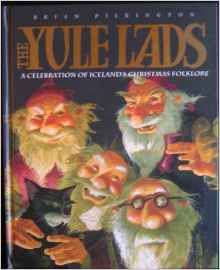
The Yule Lads: Icelandic Christmas folklore.

The Yule Lads

In most Christian countries, Christmas was slower to catch on than other major church holidays.  The clergy may have been wary of pagan solstice celebrations which happened at the same time of year and included serious revelry.  Some early Christmas festivities mimicked the custom.  They were banned in 17th century England, and American Puritans outlawed them too.

According to Brian Pilkington, author of The Yule Lads, Iceland was ahead of the curve. A 16th century law stated that “All disorderly and scandalous entertainment at Christmas and other times and Shrovetide revels are strongly forbidden on pain of serious punishment.”

Icelandic winters are long and dark, with fewer than five hours of daylight at this time of the year.  Imagination tends to fill the darkness with what we fear, and Pilkington’s book describes “the lads” that kept Icelandic children awake at night.  The gentlemen pictured on the cover are not our shopping mall Santas!

The matriarch of the clan was the ogress, Gryla, who loved to eat stewed children.  It couldn’t be just any kid though.  It had to be one who was “naughty, lazy, or rude.”  In one 13th century account, Gryla had 15 tails, and tied to each was a sack full of naughty children.  It was not “the most wonderful time of the year” if you were young!  The Icelandic word for icicle is “grylukerti” which means “Gryla’s candle.”
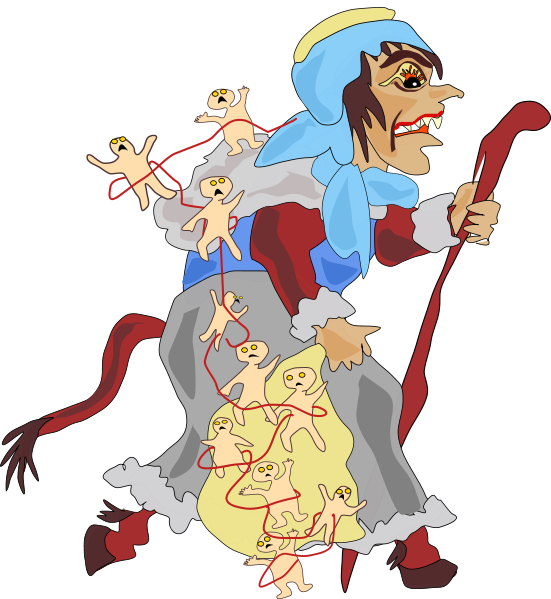
Gryla. CC-by-SA-2.5

Gryla had three husbands and 80 children, though legend now boils it down to 13 sons who visit the homes of children on successive nights from Dec. 12 – 25.  Time and the law have taken the edge off the Yule Lads, for a 1746 decree said “The foolish custom, which has been practiced here and there about the country, of scaring children with Yuletide lads or ghosts, shall be abolished.”  By the 19th century, the Lads had morphed from cannibals into rascals and petty thieves, who even began to leave gifts for good children who left their shoes on a window ledge.

The first to arrive was Stekkjarstaur, the “Sheep Worrier.”  He would visit the the sheep cot and try to suck milk from the ewes.  That doesn’t work in December and led author, Brian Pilkington to suggest that Sheep Worrier’s IQ is “somewhat less than three digits.”  These days  he heads for the fridge to get his milk.  If a child has been good, Stekkjarstaur leaves a sugary sweet.  Bad children get a potato.

Next comes Giljagaur, aka, “Gully Gawk” who travels through gullies and ravines, also in search of milk, but he looks for cow barns and inattentive milkmaids.  “Stubby” arrives the third night, as short as his name suggests.  He likes to raid the kitchen, as do the brothers that follow, “Spoon Licker,” “Pot Licker,” and “Bowl Licker.”  In their present forms all they do is mischief, but food thieves were no joke in earlier times.  For northern farming families, the time between Christmas and the spring thaw in April or May could be times of famine if food or fodder for livestock ran short.

The next lad to show up is Hurdaskellir, or “Door Slammer,” one of only two of Gryla’s sons who isn’t out to fill his belly.  Imagine loud bangs in the dead of night and you know how he gets his jollies.

And as if the sons of Gryla were not bad enough, children also had to contend with Jólakötturinn, the Yule Cat, a huge feral creature who hunts children on Christmas Eve instead of mice. Like the lads, the cat discriminates in choosing his victims, eating only those who have not received a new item of clothing for Christmas. Pilkington says that “Until fairly recently in Iceland, all clothing came directly from sheep. The wool had to be washed, combed, and spun before it was painstakingly crafted into a garment. It was a long, arduous process.”  Fear of the Cat induced lazy children to do their part!

This is a fun book and a fine counterbalance to the usual TV holiday movies.  You can picture families gathered around the fire as the wind howls outside, thinking as we do when hearing a good ghost story, “This can’t be true…can it?”  Something within the listeners then and within us now loves to be scared, to confront monsters and vanquish them in imagination.  On that score, Gryla & Sons and the Yule Cat satisfy!

A click on the book cover at the top of this post will take you a site where you can order The Yule Lads.

Time Magazine on self-publishng

The stigma is gone, but the road to nirvana is getting more crowded by the day.  That’s the gist of Andrew Rice’s article, “The $0.99 Best Seller” in the December 10 issue of Time.

Rice visited a romance writer’s convention where Mark Coker, founder of Smashwords, was the most popular speaker, and E.L. James, the best selling author of Fifty Shades of Grey was the symbol of success for many writers in attendance.  Fifty Shades began as Twilight fan fiction before going viral as an ebook and finally landing a traditional Random House contract.  According to Rice, “To Coker and his audience…Fifty Shades…looked like a harbinger of the future of publishing.”

Rice said there were 30 self-published ebooks on a recent list of Amazon top sellers and four self-published titles on the New York Times ebook best seller list.  Self-published ebooks are growing at four times the rate of traditionally published titles, and Rice quotes analysts as saying the “big six” publishing houses may soon become three or two or even just one.

This doesn’t mean that it’s easy.  I’m reminded of the California gold rush.  Some who arrived at the gold fields early – the “48ers” – made substantial amounts of money while those who came later did not.  Last year’s ebook celebrity, Amanda Hocking, took a traditional publishing contract when it was offered, saying marketing and promotion got in the way of her writing.  I’ve reviewed books by several excellent indie authors – Jade Scott, Amy Rogers, and Barbara Kloss, and all of them spend huge amounts of time publicizing their work.

Andrew Rice says it’s not going to get any easier:  “the chances of publishing that rare blockbuster grow more remote every day as more stories flood into the market, competing for a finite amount of reader attention.”

Yet for those indie authors I know, it’s not about getting rich or hitting the long shot best seller.  At the core, it’s about finding an avenue to tell the stories that live inside them.  The days when aspiring authors needed traditional publishing for validation and a way of getting their work into print are history, just like quill pens and Underwood typewriters.  The stigma is gone, and good riddance.

Tales of the Elves: Icelandic Folktales for Children

Tales of the Elves cover

One day God decided to visit Adam and Eve.  They welcomed him and introduced  their children – all except the ones Eve had not finished bathing.  After all, you want your kids to be clean when the Supreme Being drops in.  God was aware of this and said, “What is hidden from me shall be hidden from men.”  Those children became the elves who live in the hills and mounds of Iceland.  They can see us but we can’t see them unless they wish it.

I know this because I read a magical book, Tales of the Elves, based on the Icelandic folktales of Jon Arnason, adapted by Anna Kristin Asbjornsdottir and illustrated by Florence Helga Thibault.  I found the book on our visit to Iceland, which I wrote about in the fall.

Interest in elves isn’t limited to children in Iceland.  One day, as we toured the countryside, our driver pointed to a spot in a wide valley where the highway curved around a pair of volcanic rocks.  The stones were only 8′ – 10′ tall, nothing modern earth movers couldn’t remove.  That was the intention of the highway crew.  The problem was, the bulldozers broke down or stalled every time they  approached the twin rocks.  Every time.  Locals explained that the stones marked the entrance to an underground elven settlement.  The equipment worked perfectly after the construction crew decided to route the highway around the stones.

If this reminds you of Irish fairies, there’s good reason.  Genetic testing has proven that many Icelanders, especially the women, came from Ireland, specifically, the viking settlements there.  The stories themselves teach us similar lessons in coexisting with “the hidden ones.”

“Midwife to the elves” shows how the elven folk can give the gift of the sight and take it away again.  “Elf Wind” demonstrates the courage and cunning required to set things right if you do something foolish, like cut the grass on an elven mound.  “Payment for Milk” is about the boons the elves can grant if you treat them with kindness and goodwill.

I’d been looking forward to writing this review since I found Tales of the Elves, but unfortunately I couldn’t find any venue where interested readers can find the book.  Not on Amazon US or UK.  Not on bookfinders.com or ebay.  I couldn’t find ordering information on the publisher’s website.  I posted a request for information on the illustrator’s Facebook page, and I’ll pass along anything I discover.  Meanwhile, here is the information – if you love folklore and fine illustration of fantasy themes, it’s worth keeping an eye open for this book.

Anna Kristin Asbjornsdottir (adaptation), Florence Helga Thibault (illustration), Victoria Cribb (trans), Tales of the Elves, Bjartur publishing, Reykjavik, 2012

ISBN:  978-9979-788-80-5

Please post any information you may discover.

Cloud Atlas: a movie review

Synopsis by author David Mitchell: “An exploration of how the actions of individual lives impact one another in the past, present and future, as one soul is shaped from a killer into a hero, and an act of kindness ripples across centuries to inspire a revolution.”

***

One viewing isn’t sufficient for a comprehensive “review” of a movie like this.  Like Roger Ebert, who called Cloud Atlas “one of the most ambitious films ever made,” I knew before it was half over that I wanted to watch it again.  Different critics have praised and panned the movie.  I want to offer a brief synopsis and weigh in with a solid two thumbs up.

It’s harder to move around in time in movies than in books. Inception 2010, notably altered the linear flow of time, with four levels of dreaming that unfolded simultaneously, yet fundamentally it was structured as a frame-tale.  Scheherazade did the same thing centuries ago in the The Arabian Nights.

British author, David Mitchell tried something more ambitious in his novel, Cloud Atlas 2004.  Six stories take place in different times and places, with implications that past, present, and future interconnect in ways that are too complex for a linear narrative.  For one thing, Mitchell says that the main characters in the different tales that bear an unusual birthmark are reincarnations of the same character.  Somni~451, the clone-turned-visionary in the dystopian future scene voices what I take to be the core theme of the movie:  “Separation is an illusion.  All our lives are interconnected.”

Counter to what I expected, the different stories were not hard to follow.  Anyone interested in fresh ways of imagining novels and movies should not miss Cloud Atlas.  I’m pretty sure you’ll want to see it more than once.

More on the Brothers Grimm bicentennial

Earlier this month, I posted a piece on the 200th anniversary of first edition of the Brothers Grimm’s collection of German fairytales: http://wp.me/pYql4-2sw.

Yesterday the Sacramento Bee printed an article on this treasure trove of folklore and some of the worldwide activities the bicentennial has inspired (“The Grimm brothers from many angles,” by Jan Ferris Heenan, http://www.sacbee.com/2012/10/28/4939548/the-grimm-brothers-from-many-anglesin.html).

Of particular interest is the publication of a new collection, The Annotated Brothers Grimm by Harvard professor, Maria Tatar. At $35, it’s not cheap, but since I don’t do Playstation and Christmas is coming up…

In the 45 years after 1812, Jacob and Wilhelm Grimm published six more editions which were eventually translated into more than 160 languages. In the Bee article, Jan Heenan explains that the Grimm brother’s motivation was partly political – Napoleon had conquered the German states and the Grimms sought to preserve something “authentically German.” They also understood the irreversible changes taking place because of industrialization. Farms, towns, and forests, the birthplace of traditional tales for millennia, were emptying out as economic change drove people into cities and factories.

“These stories were the television and pornography of an earlier age,” said author John Updike, and the summaries of earlier versions of the tales makes this clear. Rapunzel got pregnant, the stepmother wanted to eat Snow White’s liver and lungs, and in some versions, Red Riding Hood disrobes for the wolf. Not the stuff of Disney, but according to Maria Tartar, the originals offer something more important for adults:

“These are stories that show you no matter how bad it is…if you use your wit and have courage, you can get back home again. Even if we know in the real world that you don’t always survive, these are the stories that tell you…you do have a chance.”

Tartar’s book is the new number one on my wish list.

Alternate futures

Last night, I gave up five innings of the Giants National League pennant victory to watch the presidential debate.

I sacrificed the five run 3d inning in hopes of hearing the candidates answer a single question that moderator, Bob Shieffer, asked about 40 minutes in:  “What is your vision of America’s place in the world?”

Seconds later, a voice-over interrupted with tornado warnings for several counties north of here.  By the time it ended, the candidates were talking about the economy.  I waited for Shieffer to lead them back to the question he’d asked, but it never happened.  Same old, same old, I guess – the same dysfunctional vision I wrote about in January, in a post called, “Sabre-rattling over oil:  better get used to it.” http://wp.me/pYql4-1AT

This was the first of several posts about the ideas of Col. Andrew Bacevich, a Vietnam veteran, West Point graduate, and currently a professor of History and International Relations at Boston University.  Like George McGovern, the first man I ever voted for as president, who died earlier this month, Bacevich is a warrior who hates warfare.

Sen. George McGovern (1922-2012) flew 35 bombing missions over Germany in WWII and ran for president in 1972 on a peace in Vietnam platform.

Bacevich pulls no punches in The Limits of Power: The End of American Exceptionalism (reviewed here http://wp.me/pYql4-2kX).

Rereading key passages recently, Bacevich’s anger became even more apparent – the anger of a patriot who sees his country sliding down a slippery slope to disaster.  His core thesis is that in turning away from President Carter’s 1980 call for energy independence – never mind the lip-service it gets every four years – the United States has squandered lives and wealth in a hopeless series of wars aimed at compelling the rest of the world to play by our economic rules:

“For the United States the pursuit of freedom, as defined in an age of consumerism, has induced a condition of dependence – on imported goods, on imported oil, and on credit.  The chief desire of the American people, whether they admit it or not, is that nothing should disrupt their access to those goods, oil, and credit…The chief aim of the U.S. government is to satisfy that desire, which it does in part through the distribution of largesse at home…and in part through the pursuit of imperial ambitions abroad.”

Bacevich argues that the status quo benefits those in power in Washington:

“…rather than addressing the problem of dependence, members of our political class seem hell-bent on exacerbating the problem…To hard-core nationalists and neoconservatives, the acceptance of limits suggests retrenchment or irreversible decline.  In fact, the reverse is true.  Acknowledging the limits of American power is a precondition for stanching the losses of recent decades and for preserving the hard-won gains of earlier generations going back to the founding of the Republic.”

In a 2008 interview with Bill Moyers, Bacevich said, “I happen to define myself as a conservative,” yet when you read his prescription for addressing the ills he enumerates, they parallel those of Dr. Jill Stein, the Green Party candidate for president. Moyers interviewed Stein on September 7: http://billmoyers.com/segment/jill-stein-and-cheri-honkala-on-third-party-politics/

Dr. Jill Stein, Green Party presidential candidate

Dr. Stein graduated summa cum laude from Harvard Medical School, and has specialized in environmental health.  She got her start in politics with a successful effort to pass a referendum to reform election spending in Massachusetts.  Reality set in when the Democratically controlled legislature overturned the people’s will in an unrecorded vote.

Both mainstream presidential candidates refer to their “plans” to create jobs, though they haven’t offered specifics.  Stein has a plan too:  cut defense spending in half and use the money to fund a “Green WPA” which would train and employ many of those now unemployed to work toward true energy independence.

In a 2008 interview with Moyers, Bacevich answered the obvious objection that cutting defense spending would jeopardize national security.  Those persons and groups that wish us harm are ““akin to a criminal conspiracy…Rooting out and destroying the conspiracy is primarily the responsibility of organizations like the FBI, and of our intelligence community, backed up at times by Special Operations Forces.  That doesn’t require invading and occupying countries.”  Events last year proved him correct.

***  

What chance do ideas like these have of making it into the mainstream?  Little or none at present, but I don’t think that is the point.  Ideas rooted in reality can be seeds that sprout over time.  The first Earth Day was a peripheral event, but it has picked up momentum every since.

Bacevich repeatedly stresses that not all limits are bad, and despite the title of his book, affirms that he does believe in American exceptionalism  “if American exceptionalism implies that there are certain qualities that make the United States of America a special place, a wonderful place– a place worthy of a patriot’s love.”

In the course of their critiques, both Bacevich and Stein affirm that it’s love of country and citizens that motivates their efforts to change what’s broken.

After all, what other nation on earth could have invented the World Series?

Njal’s Saga: some concluding remarks.

1879 title page in Swedish. Public domain

It took me a while to get the gist of  Njal’s Saga. The first time through, I could have used a Cast of Characters; much of the effort was just keeping track of people whose names I couldn’t pronounce.  In rereading key sections aloud with the group in Iceland – the mode of presentation the author intended – the drama and human passion began to emerge.  And as I read these passages again while writing posts for this blog, a larger picture appeared.

Njal’s story is framed by the end of an era.  The best minds of the time made wrong decisions and couldn’t hold back the tides that swept outworn institutions away.  The suffering was intense and the body count was high.  “Things fall apart, the center cannot hold,” said Yeats at a similar time.

As I read of the battle at Thingvellir, a moment of near civil war, I kept thinking of similar periods.  Of the fall of Troy, the Mahabharata war, the end of the Roman Empire, and the “great war” in Europe.  And I thought of our own time, that Andrew Bacevich likens to the period of the Peloponnesian War, when the Athenian empire bled itself dry.  We know our current mode of living cannot be sustained.  We know that our leaders don’t have the wisdom the times demand, and like Matthew Arnold, we find ourselves, “Wandering between two worlds, one dead the other powerless to be born.”

Does Njal’s Saga offer any insight for times like these?

Not directly, for simple platitudes would be of no help.  It does offer up a number of vivid characters, some of whom manifest courage and generosity in the face of disaster, and others whose self-centered designs bring the disasters about.  We can’t help but ask ourselves who we want to emulate.  And something very interesting happens at the end of the tale.

By the end of the saga, Kari, who survived the killing of Njal, and Flosi, the chieftan who led the killers, have hunted and fought each other across Iceland, Scotland, and Ireland.  Both crossed Europe on foot to seek absolution in Rome.

Flosi returns to Iceland first.  Kari’s ship is wrecked on the coast in a winter storm, though his crew survives.  They wash up near Flosi’s homestead, and make their way there during a blizzard.  When they arrive, the saga tells us Flosi recognized Kari at once and “jumped up to meet him and kissed him, and then placed him in the high seat by his side.  He invited Kari to stay there for the winter.  Kari accepted.  They made a full reconciliation.  Flosi gave Kari the hand of his brother’s daughter, Hildigunn.”

The next summer, Flosi set out for Norway in a ship in bad condition, that he said was “good enough for an old man doomed to die.”  The ship was never seen again.  Kari named one of his sons, Flosi, and this Flosi’s son grew up to be “the most distinguished man of that line.”

Marriages like this, in folklore and myth, are never one dimensional affairs – a sacred marriage also takes place that brings new life to our broken world.  The Pandava line survives the Mahabharata war, and Aeneas leads the survivors out of Troy.  Monks on the coast of Ireland preserve the wisdom of Rome, and poppies grow in Flanders field.

The sacred marriage in alchemy. Public domain.

For the rest of us, who won’t see a new dawn anytime soon, we can remember the words of Tolkien, who was inspired by the sagas of Iceland as he wove his own account of surviving Mordor, a hell he experienced first-hand at the Battle of the Somme.

“I wish it need not have happened in my time,” Frodo tells Gandalf.

“So do I,” said Gandalf, “and so do all who live to see such times.  But that is not for them to decide.  All we have to decide is what to do with the times we are given.”

Njal’s Saga, part 3

Gunnar looks back at his home, 1898 illustration. Public domain.

In order to follow this discussion, it will help if you’ve read two earlier posts:

  1. Njal’s Saga, an Introduction: http://wp.me/pYql4-2sS
  2. Njal’s Saga, part 2: http://wp.me/pYql4-2tb

Scholars suggest that the author wove together two separate stories, an oral “Gunnar’s Saga,” and a related but distinct, “Njal’s Saga.”  Both men die during attacks on their homes.  Historically 18 years passed between the events; Gunnar died in 992 and Njal around 1010.  In the last third of the saga, Njal’s son-in-law, Kari, mounts a campaign of revenge against the killers which threatens the stability of the nation.  A pitched battle breaks out at the Althing, the National Assembly, which was sacred ground where fighting was forbidden.  When reconciliation finally comes, it signifies the dawn of new vision of life and its purpose.

Once the saga gets going, certain scenes come alive like movies – I know there’s a screenplay here…

***

Soon after Gunnar and Hallgerd were married, they attended a feast with Njal and his wife, Bergthora.  In no time, the two women were at each other’s throat.  The insults grew so extreme that Gunnar dragged Hallgerd out of the hall. Soon after that, she had one of Bergthora’s slaves killed.  Bergthora paid her back in kind, initiating a feud that escalated and took the life of free retainers and then kinsmen on both sides.

The killings took place while the husbands were at the Althing which  convened for two weeks every summer.  Aside from social activities, this was the time for legal action on matters the lower courts couldn’t settle.  It was also where “compensation” for killings was determined.

If you killed a man, even in self defense, you confessed it in front of witnesses.  A hidden killing was treated as murder and could result in exile for life.  A killing confessed was manslaughter and terms of compensation could be set:  a slave was worth seven ounces of silver, a freeman fifteen, and a kinsman as much as 200.  It may seem cold, but the system was designed to break the cycles of revenge that the old ethic of “honor” and blood retribution entailed.

Gunnar and Njal tried to keep up with the legalities of the killings-for-hire their wives initiated, but it became harder as stakes were raised.  Each killing drew more people, bound by family and friendship, into the feud.  Into this deadly mix came Mord Valgardsson, son of Unn,  who despised Gunnar and Njal.

If Hallgerd spawned chaos and harm, she did so in a half-unconscious manner.  She was reactive, without clear designs or premeditation.  Mord, by contrast, was cunning, able to weave elaborate snares for his enemies.  Our tour leader, Robert Willhelm, pointed out the similarity of Mord’s name to Mordred, King Arthur’s  son and nemesis.

During a famine, Hallgerd sent a servant to steal food from a man who refused to sell any to her husband.  When Gunnar, with his concept of honor, discovered the theft, he slaped his wife, who had already buried two husbands who hit her.  Hallgerd warned Gunnar that she would never forget the blow.

Njal prophesied that if Gunnar killed two members of the same family and broke the legal settlement for the killings, he would die soon after.  Through trickery, Mord ensured that Gunnar killed the son of a man he’d already slain.  In addition to a financial settlement for the killing, the Althing court sentenced Gunnar to three years in exile.

In one of the most poignant scenes, as Gunnar and his brother rode to the harbor, Gunnar’s horse slipped while fording a river.  Springing off the horse, Gunnar looked back at his farm and said, “Lovely is the hillside – never has it seemed so lovely to me as now, with its pale fields and mown meadows, and I will ride back home and not leave.”

That autumn, Mord sent word that Gunnar was home alone and 40 of his enemies mounted an attack.  Firing arrows from the second floor, Gunnar killed two assailants and wounded eight.  Then a man named Thorbrand got close enough to cut Gunnar’s bowstring.

Gunnar defending his home, 1898. Public domain.

Gunnar turned to his wife and asked for two strands of her waist length hair for a new bowstring. Hallgerd said, “Does anything depend on it?”

“My life depends on it,” Gunnar said, “for they’ll never be able to get me as long as I can use my bow.”

“Then I’ll recall,” she said, “the slap you gave me, and I don’t care whether you hold out for a long or short time.”

Gunnar wounded eight more attackers before he finally fell, exhausted and wounded in fifteen places.  One of the attackers said, “His defense will be remembered as long as this land is lived in.”

Gunnar’s mother was ready to kill Hallgerd who fled the house.  Gunnar’s friends raised a burial mound, and one night, as two of Njal’s sons passed by, they saw the mound open.  Four lights shone and cast no shadows.  The brothers heard Gunnar’s spirt sounding content as it spoke skaldic verse.

***

Gunnar embodied the old warrior ideal of life and death with honor that won you a place in Valhalla.  The dark side of this ethos was an unending string of killings that threatened the nation itself.  Things were about to change.  Shortly after Gunnar’s death, a Christian missionary named Thangbrand arrived in Iceland.  He wasn’t the sort of evangelist you want on your doorstep, since he carried a crucifix in one hand and a sword in the other and didn’t much care which he used.

One autumn morning, as Thangbrand celebrated mass, a man named Hall of Sida approached.  “In whose memory are you celebrating this day?” he asked.

“The angel Michael’s,” Thangbrand said.

“What features does this angel have?”  Hall asked.

“Many,” said Thanbrand.  “He weighs everything that you do, both good and evil, and he is so merciful that he gives more weight to what is well done.”

Hall said, “I would like to have him for my friend.”

With his openness to new ideas and the simple way he voices his spiritual longing, Hall becomes the first convert.  In 999 or 1000, the Althing declared Christianity to be the new religion.  Mord continued to work behind the scenes fomenting trouble for Njal and his sons, and around the year 1010, 100 armed men attacked Njal’s home and burned it, with him and most of his family inside.  Only Kari of Orkney, Njal’s son in law, escaped.  He raised a force to attack the burners, and at the next Althing, when the retribution process broke down, a pitched battle erupted at Thingvellir, the spiritual heart of the nation.

Battle at Thingvellir. Public domain.

During a lull in the fighting, members of the assembly intervened to arrange a truce.  Hall of Sida stood between the combatants and said, “All men know what sorrow the death of my son Ljot has brought me.  Many will expect payment for his life will be higher than for the others who have died here.  But for the sake of a settlement I’m willing to let my son like without compensation, and what’s more, offer both pledges and peace to my adversaries.”

Things have changed.  A few decades earlier, such a statement would have cost Hall his honor, but the saga says that when he sat down, “much good was spoken about his words, and everybody praised his goodwill.”

The combatants submitted to judgement.  Cash payments were levied as well as three years exile from Iceland for the combatants.  During the exile, they slew each other in Orkney and along the coast of Ireland, but finally, when the leaders returned to Iceland, they pledged friendship to each other.  The old ways had cost too much in blood and suffering.  The survivors had no stomach for anymore fighting.  The saga ends with a sense that a new wind was blowing through the land.

Next:  reflections on the story.