I think, therefore

The Thinker, Rodin. Public Domain

The Thinker, Rodin. Public Domain

When I first started to write, in my teens and early 20’s, I was hugely influenced by an eclectic group of American writers that included vocal social critics from the earliest years of the 20th century. People like Theodore Dreiser, who wrote famously clunky prose, but whose An American Tragedy (1925) was a stinging indictment of greed in our culture. Main Street (1920) by Sinclair Lewis depicted the soul-crushing conformity of a milieu we often imagine as small town innocence. But greater than any other influence was Henry Miller, who demonstrated the power of personal essays. His books, like The Air Conditioned Nightmare (1945) shaped my view of our dominant culture.

It was natural that this kind of critique, along with that of more recent writers and essayists like Michael Ventura, should influence  my blogging. But this spring something strange happened. At the start of Lent, though I do not celebrate the season in any formal way, I announced that I would “give up” negative posts for the duration. As expected, the experiment was more interesting than I expected.

"Rodin's thinker?" by Patricia van Casteren, 2006, CC BY-NC-ND 2.0

“Rodin’s thinker?” by Patricia van Casteren, 2006, CC BY-NC-ND 2.0

I’ve already blogged about some of my findings, especially the obvious ones, like the preponderance of bad news in all varieties of media. And I knew in advance there would be less to say if I excluded negative themes. What I didn’t expect was to find myself wondering whether it mattered – it’s virtuous to write about things like climate change and income inequality – isn’t it? A very interesting question since I don’t really believe many writers and artists change social ills directly. Maybe Charles Dickens did, or Jacob Riis, with his photos of child labor, but Dreiser didn’t eliminate greed and Miller didn’t break the ruts of conformity. Writers and artists sometimes change individual hearts and minds, but how does that work? That is not a rhetorical question, but something I often wonder about. How does it work?

Perhaps it was this kind of question that moved Phil Ochs, one of the best of the 60’s protests singers, to write, “You must protest, you must protest they say, it is your diamond duty / Ah, but in such an ugly world, the only true protest is beauty.” Maybe it’s what led Henry Miller, in his last years, to write books like, My Bike and Other Friends, and to focus on his watercolors.
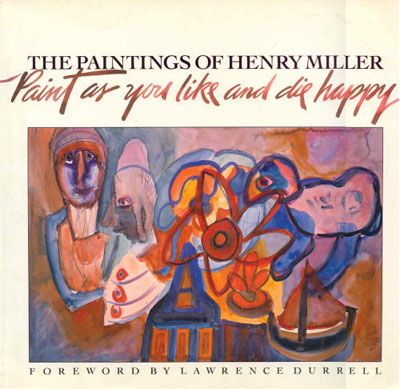
Henry Miller paintings

My biggest discovery, while turning away from negative stories during Lent, concerned inner dialog rather than outer events. I’ve attended to this in a focused way in the past at various times, but not for a while. Mindfulness practice appeared on the cover of Time, so it must be gaining fad status, but that does not diminish its worth. It’s an ancient contemplative discipline that involves simply watching the contents of consciousness. Not fixing, fighting, or merging with, but simply observing what flits through awareness (here’s a good introduction to the practice).

I don’t know about anyone else, but I often find a subtle but persistent stream of critical inner narrative on self, others, and events. The narratives tend grow in the darkness yet dissolve when observed, the way shadows disappear when you turn on the light in a room. Observation eventually leads one to suspect that thoughts have no more substance than shadows, and no more inherent reality, and yet they can have profound effects. I suspect we have all had interesting synchronicities, met things in the world corresponding to our inner states. And if one subscribes at all to notions of the effect of collective thoughts, an idea given names like, “tipping point” or “hundredth monkey,” then the contents of consciousness take on a meaning beyond their effect on oneself alone.

I follow the Dalai Lama on Facebook and often note that when he is asked about topical issues like climate change, he always gives a thoughtful answer, the tone of which is invariably, “I am hopeful.” If I learned anything with this Lenten experiment, it is how hard it can be to cultivate a hopeful attitude. I also cannot imagine anything more important. Can there be a more important seed to plant than this one – “I am hopeful?”

Gabriel García Márquez, 1927-2014

Gabriel Garcia Marquez, 2009. Creative Commons

Gabriel Garcia Marquez, 2009. Creative Commons

“On a day like today, my master William Faulkner said, ‘I decline to accept the end of man’. I would fall unworthy of standing in this place that was his, if I were not fully aware that the colossal tragedy he refused to recognize thirty-two years ago is now, for the first time since the beginning of humanity, nothing more than a simple scientific possibility. Faced with this awesome reality that must have seemed a mere utopia through all of human time, we, the inventors of tales, who will believe anything, feel entitled to believe that it is not yet too late to engage in the creation of the opposite utopia. A new and sweeping utopia of life, where no one will be able to decide for others how they die, where love will prove true and happiness be possible, and where the races condemned to one hundred years of solitude will have, at last and forever, a second opportunity on earth.”

– Gabriel García Márquez, from his Nobel Prize acceptance speech, December 8, 1982

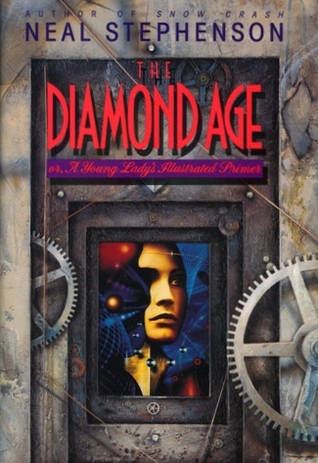
The Diamond Age: Or a Young Lady’s Illustrated Primer by Neal Stephenson

Diamond Age cover

I have written on several occasions of Snow Crash, the visionary science fiction novel that Neal Stephenson published in 1992. The book envisioned a future where nation-states had diminished importance. Most people lived as citizens of corporate enclaves and spent their free time jacked into virtual worlds. Snow Crash was written a year before the release of Mosaic, the first popular internet browser, and eleven years before the inception of Second Life, the best known virtual world.

Stephenson’s next book, The Diamond Age (1995), gives us a world transformed by nanotechnology, the manipulation of matter at the molecular level. In Stephenson’s 21st century, the integration of molecular biology and semiconductor physics has transformed everything. In the first scene, we meet Bud, a would-be enforcer for the lucrative “alternate pharmaceutical” industry, who has bulked up his muscles with intelligent, micro-robotic implants and wears what we now know as Google glasses to precision aim his “skull gun,” an implant as nasty as it sounds. In passing, Stephenson shows Bud in a waiting room, where people read articles on smart paper, essentially tablet computers, that have replaced magazines. Remember: The Diamond Age was published 15 years before the iPad and 17 years before the first Google Glass prototype.

In the diamond age, so named because synthetic diamond is cheaper than glass, objects made by hand are expensive and revered, since everything else is produced by matter compilers (a generation beyond 3d printers)? Just as in Snow Crash, nation states are obsolete. The upper classes live as members of cultural enclaves known as phyles or tribes, whose settlements are often above ground level, while the lower class “thetes” or people without a tribe, live below.

John Perceval Hackworth is a nano tech engineer for the Neo-Victorian, “New Atlantis” tribe. New Atlantis sits on an artificial mountain a mile above the polluted streets of Shanghai.  The clave is ruled as a corporate oligarchy by “Equity Lords” who style their culture after 19th century English royalty.

Hackworth is commissioned by Lord Finkle-McGraw to program an artificially intelligent book, A Young Lady’s Illustrated Primer, a subversive text, which will help his daughter Elizabeth lead a life beyond the boundaries of the status quo. Hackworth makes an illegal copy for his own daughter, Fiona, but this is stolen when Hackworth is mugged. It falls into the hands of Nell, Bud’s daughter, a thete who lives in a ground level slum. Hackworth, Fiona, Nell,her brother Harv, an actress named Miranda, and a Chinese black market engineer named Dr. X are all involved with the Primer for reasons of their own; at its deepest level, the Primer holds the key to decoding and reprogramming humankind’s future.

The Diamond Age, which won Hugo and Locus awards in 1996, is classified by genre wonks as “post-cyberpunk,” whatever that means. As he was in technology and socio-economics, so was Stephenson decades ahead of his time in speculative fiction. We call this kind of book “dystopian” now.  I can think of at least two recent movies that play upon themes explicit in The Diamond Age. I won’t name them because I have no evidence that their creators read the book. Still, it is hard to imagine any serious writer of dystopian fiction who hasn’t marveled at Neal Stephenson’s vision.

How to Fail at Almost Everything and Still Win Big by Scott Adams

How to Fail

“Don’t let reality control your imagination. Let your imagination be the user interface to steer your reality.” – Scott Adams.

How to Fail at Almost Everything is a quirky, funny, irreverent, and often inspiring “sort of autobiography” from the creator of Dilbert, that quirky, funny, irreverent, and often inspiring comic strip that lays out the truth of working in the trenches cubicles of corporate America.

This is not another collection of Dilbert cartoons or Dilbert philosophy.  It’s more of a Dilbert origin story.  We know we’re in for a different kind of kind of how-to-book when Adams begins by advising us to make sure our bullshit detectors are working before we take advice from a cartoonist.

He dismantles many self-help cliches in order to clear the way for fresh perspectives.  “Goals are for losers,” he says, and recommends strategy instead.  “I will finish my first novel,” is a goal. “I will write for an hour a day,” is a strategy.  Every day we don’t attain a goal is slightly depressing, he says, and soon after we reach it, the “what next?” question arises.  A strategy, on the other hand, brings a daily sense of satisfaction as we move in the right direction.

“I tried a lot of different ventures, stayed optimistic, put in the energy, prepared myself by learning as much as I could, and stayed in the game long enough for luck to find me…with Dilbert it did.” – Scott Adams

Adams gives a chronology of his many failed careers and entrepreneurial ventures. Shining through the story is a positive attitude that allowed him to find key lessons and life experience in every failure.  His optimism is gold, and he spends a lot of time writing of health, especially, diet and exercise, although he cautions that there is a “non-zero chance” that health advice from a cartoonist could be fatal.

“I’m here to tell you that the primary culprit in your bad moods is a deficit in one of the big five: flexible schedule, imagination, sleep, diet and exercise.”  The “big five” benefit mood, which builds personal energy, which is the driver of aspiration and effort.

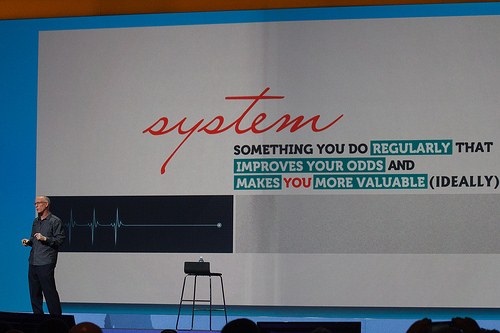
Scott Adams shares his ideas at IBM Connect 2014.  Photo by Greyhawk68, CC BY-NC-ND 2.0

Scott Adams shares his ideas at IBM Connect 2014. Photo by Greyhawk68, CC BY-NC-ND 2.0

Adams packs an abundance of topics into his book. Not every one resonated, and several dragged for me, but much of my copy is highlighted and underlined, and I’ve reread several chapters already.  If you like Dilbert, you will value this story of the life twists and turns of his creator, and you will benefit from the lessons he learned along the way.

by all means by Edward Espe Brown

by all means A ZEN CAUTIONARY TALE

by all means A ZEN CAUTIONARY TALE

“Growing up meant you were competent and stayed out of trouble…When you hit the wall, who or what would see you through?”

Traditional Zen practice is both very simple and very formal.  Think of classic Japanese brush painting.  In Zen, there are prescribed ways of bowing, walking, holding the hands in meditation, and so on.

At the end of by all means A ZEN CAUTIONARY TALE, Zen abbot, Edward Espe Brown, includes a photograph of himself, in full Zen regalia, with a stern expression on his face, and a pig puppet on a cushion beside him.  Traditional Zen masters don’t give dharma talks with pig puppets any more than traditional authors use upper and lower case in their titles like Brown does here.  by all means lies outside traditional book categories, which ironically, makes it very Zen.

When Edward, as an adult, rescues Ponce (two syllables) the Pig puppet from a cat named Turtle (not a puppet), his affection for Ponce allows him to explore many issues, especially those of abandonment:  how others abandon us, how we abandon them and ourselves, and all the things we do to try to compensate:

“A lot of things that Edward did were very important because it was important to him to be doing important things and not just wasting his time.  Otherwise how could he have any respect for himself? And wasn’t it important to be self-respecting? Because if you left it to the others, there didn’t seem to be a lot of respect going around, and you weren’t likely to get much.”

We learn how Edward lived in an orphanage after his mother died when he was three.  We learn how he turned his anger on the stuffed animals he had as a kid after he got out.  We see how childhood issues live on inside the adult and how Ponce the Pig reacts at a critical moment, when Edward abandons him.  At first Ponce weeps, but then he closes his eyes to meditate (the pig is a dedicated Dharma practitioner):

“He found his heart swelling even though nothing changed outwardly. The space within was like that: vast and expansive, warm and tender without dimensions.  All of his friends were gathering just as fast as he could think of them. A burst of astonishment flashed through Ponce.  Left without any capacity for thinking about what was happening, he was one with everything, and everything was a part of him.  No separation could be found.  Dazzling!  What was there to think about?  Nothing needed figuring out…”  Edward learns his lesson and reconciles with Ponce in the end because it’s that kind of a book.

I enjoyed by all means, but it’s not for every reader. It is not an instruction manual in Zen or a book of eastern philosophy.  If you have no interest in Zen or have not spent time talking to puppets as I have, the book might not appeal.

If you are in doubt, I suggest you check out some of the Dharma talks Edward has made available on his website.  If you like them, you’ll probably like the book.  The talks, like this book, are simply another way that Edward, with abundant humor and compassion, tells his truths, using all means. 

The American Monomyth

In my so far disappointing effort to make sense of Tumblr, I have at least found several intriguing posts, including this one from josephcampbellwasright.tumblr.com called “The American Monomyth.”

The Monomyth is a world-wide mythic pattern that Joseph Campbell described in The Hero With a Thousand Faces, 1949:  “A hero ventures forth from the world of common day into a region of supernatural wonder: fabulous forces are there encountered and a decisive victory is won: the hero comes back from this mysterious adventure with the power to bestow boons on his fellow man.”

The Tumblr post references a lesser known book by Robert Jewett, The American Monomyth, 1977, that describes an interesting variant:

“In the American monomyth, the hero is an outsider who comes into a once-perfect community in peril (the “violated Eden”) to confront the evils that have caused trouble. The hero eschews such things as joining the community, standing apart from them in order to better keep them safe, in a manner that could best be described as vigilantism. Once the evil has been vanquished, the hero either allows himself to absorb into the community (through such means as moving in, marrying, etc.), or he moves on to the next violated Eden.”

The post lists several movies as examples, but doesn’t mention several key genres that raised the “Heroic Outsider” to the mythic status of true American Hero.  What of superheroes like Batman and Superman or crime fighters like The Untouchables?  What of the genre I grew up on, the western?

Clint Eastwood and Sidney Penny in Pale Rider, 1985, my favorite "Heroic Outsider" western

Clint Eastwood and Sidney Penny in Pale Rider, 1985, my favorite “Heroic Outsider” western

While Googling for westerns with the classic, “clean up the town” theme, I came upon an interesting syllabus for a course at Dominican University, The Western:  America’s Mythology – books it would be fun to add to my geometrically expanding list of things I would like to read!

Meanwhile, I suspect that everyone has personal favorite books and movies in this “swoops in and saves the day” genre.  What are some of yours?

An ambassador for the power of stories

Author Kate DiCamillo says "Story is what makes us human."

Author Kate DiCamillo says “Story is what makes us human.”

I almost skipped the final segment of the PBS Newshour on Friday.  They announced an interview with the newly chosen National Ambassador for Young People’s Literature, a position I’d never heard of.  I feared it might involve a discussion of post-Twilight, YA romance.  Fortunately, I stuck around, for the interview was profoundly inspiring.

The new National Ambassador, a position created by the Library of Congress in 2008, is Kate DiCamillo, author of Because of Winn-Dixie and The Tale of Despereaux.  The author of these award winning books for children claims to have been the shyest kid ever.  How did she come out of her shell and become an ambassador?  By telling stories, she says.  “And telling stories helped me connect with the world. And it turned me into somebody who can talk to people, I think.”

This Newberry Award winning author calls herself a late bloomer and kept a notebook where she tracked all 450 rejection letters she got before her first story was accepted.  Over the next two years, as ambassador for children’s literature, she hopes to “remind people of the great and profound joy that can be found in stories, and that stories can connect us to each other, and that reading together changes everybody involved.”

I invite everyone to watch Ms. DiCamillo’s interview.  It’s an upbeat testament to the power of stories and the power of persistence by someone whose life embodies these truths.

Wild Eating

animal house food fight

This post isn’t really about food fights in school cafeterias – some of us have matured (a bit) since those days.  Actually, the photo of John Belushi was a classic bait-and-switch, a ploy to draw you into a post about foods that are good for us.

At the end of November, I caught an interview on NPR’s Science Friday with Jo Robinson, an investigative journalist who specializes in science and health.  She discussed the way humans, since the dawn of agriculture 10,000 years ago, have bred the nutrition out of plants, and what the science of micro-nutrition has recently learned about optimizing our food choices.

eating on the wild side

The interview was a good introduction to Robinson’s bestseller, Eating on the Wild Side, and she led off with a discussion of corn.

Wild corn came with tough husks and only a few kernels per ear. It didn’t taste very good, but it was healthy, with 20% protein and only 2% sugar.  In contrast, modern corn has 2%-4% protein and sugar as high as 40%.  Still better than Ding Dongs, but headed in that direction.

At the core of this research are phytonutrients, molecular level nutrients that are natural wonder drugs.  Lab work over the last 15-20 years reveals that some phytonutriets increase resistance to heart disease, cancer, diabetes, and Alzheimer’s.  Unfortunately, they tend to make foods bitter, a taste we would rather avoid.

Taste hasn’t been the only factor in denaturing our food.  Carrots were red and purple until 400 years ago, when a group of Dutch growers, paying political homage to the House of Orange, used mutant yellow carrots to create the orange variety we know today.  Unfortunately, orange carrots have 16 times fewer antioxidants than red and purple varieties.

There’s good news on the carrot front; Robinson says we can find the older varieties in seed catalogs, and they actually taste better.  During the rest of the interview, she presented ways to maximize nutrition and the number of beneficial phytonutrients we eat.  Her suggestions included:

  • Eat the skins.  The skin of carrots of any variety contains half the nutritional value, so wash them but don’t peel them and throw the skins away.  Don’t skin potatoes before mashing them.
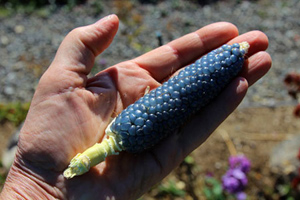
Blue Jade corn

Blue Jade corn

  • When choosing fruits and vegetables, a rule of thumb is the healthiest colors are red, blue, black, and purple.  There are exceptions, however, like artichokes, which Robinson says are among the best veggie choices.

  • Garlic really is a “wonder drug,” but it’s value depends on two substances combining after the cloves are cut or crushed, and one of these can be damaged if heated too soon.  The solution is to crush garlic then set it aside for 1o minutes before sautéing.

  • In one study three to four servings a week from the cabbage family (cabbage, broccoli, mustard greens, kale, and others) reduced the risk of prostate cancer in men by up to 60%.

  • Daily servings of Welches grape juice, made from Concord grapes, appears to improve the memory of seniors with early signs of Alzheimer’s.

  • The nutritional value of many fruits and veggies increases with cooking.  This includes berries, which makes berry pies and cobblers among the healthiest deserts.

***

Once, when I was younger, I lived as a strict vegetarian for two years.  At the time I was learning to meditate and tried out advice (which proved to be true) that a moderate diet and occasional fasting helps concentration.  My diet is different now, but I’m equally attentive to what I eat; my motive is overall health.

Wherever one stands on the issue of health care, no one can argue that the best way to stay healthy is not to get sick.  Next to quitting smoking and exercise, diet is a major behavioral variable we can tilt in our favor.  The effort is enjoyable to, in a mildly subversive way, like buying nothing on Black Friday.  In an era when the next big corporate move in fruit is patenting GMO apples that don’t turn brown, I find heirloom veggies like blue corn and purple carrots to be especially attractive.

Take a look at Jo Robinson’s website, eatwild.com; you’ll find it informative and inspiration.

***

PS:  Based on several comments, I’m adding links to possible sources of interesting seeds.

burpee.com:  For a long time, the seed catalog of choice.  Now online with info tailored to your climate zone.  I poked around enough to see that they have purple carrot seeds.

Heirloom Seed Companies: I found this link on Facebook. Haven’t checked it out yet, but it looks interesting.