R.I.P. Jerry Garcia, Aug. 1, 1942 – Aug. 9, 1995

In February, 1961,, when Jerry Garcia was 18 years old, he was a passenger in a car that flew off a curve at 90 mph.  One passenger died and two others were badly injured.  Garcia was thrown into a field and sustained only a broken collarbone.  He later said, “That’s where my life began. Before then I was always living at less than capacity. I was idling. That was the slingshot for the rest of my life. It was like a second chance. Then I got serious”

One thing he got very serious about was music, which he had practiced since early childhood.  Two months after the accident, he met Robert Hunter, a musician and poet who would become the chief lyricist for the Grateful Dead.  The two of them found a local gig and made $5 each, which helped Garcia, who was living out of his car in Palo Alto.

The story I heard was that several other key members of band met in the parking lot of Palo Alto music store in 1965.  They first played as The Warlocks in a Menlo Park pizza parlor.  After learning that another group called The Warlocks had signed a record contract, Jerry Garcia picked the name, Grateful Dead by flipping open a dictionary.  There are several accounts, but according to Phil Lesh, the bass player, the definition was:  the soul of a dead person, or his angel, showing gratitude to someone who, as an act of charity, arranged their burial.

The Skull and Roses logo

For the next thirty years, the Grateful Dead were a cultural and musical phenomenon.  You pretty much loved them or hated them.  Back when Cal Expo was open, half my department at work would show up in their t-shirts and tie dye and take the afternoon off whenever the band came to town.  The other half of my co-workers would shake their heads.  At its best, a Grateful Dead show was a unique and extravagant celebration of life.

In August, 1995, Garcia, who was overweight, diabetic, and exhausted from touring, checked into rehab to detox from heroin.  Sometime in the early morning of August 9, his heart stopped beating.  He was 53 years old.

This is one of my favorite concert clips, for it hints at the joy the musicians could evoke in a crowd.  It’s from the Bill Graham Memorial Concert in Golden Gate Park in November, 1991.

I know the rent is in arrears,
Dog has not been fed in years,
It’s even worse than it appears,
But it’s all right.

Oh well a touch of gray,
Kinda suits you anyway,
That was all I had to say,
And it’s all right.
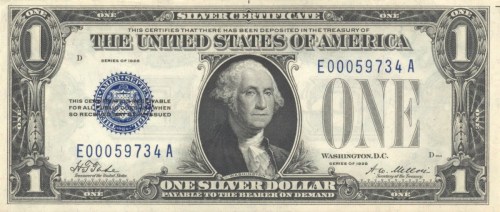
Remember Real Money?

US Silver Certificate

In 1965, my father, who worked for IBM, was assigned to the south of France for two years, so the family packed up for Europe.  Back then, except for a few parodies in Pink Panther and James Bond movies, Americans in Europe got some respect.  Our money got a whole lot of respect – everyone wanted dollars.

My mother, who was an artist and appreciated fine drawing and engraving, drew the line at most European currencies.  “It looks like play money,” she said.  No wonder!  It was colorful and had big heads!  Real money, like good old yankee greenbacks, was sober and serious – it was monochrome and the heads were decently small.  I laughed the other day at a fast food restaurant.  I handed the clerk a twenty and he held it up to the light.  No one trusts a big-head!

Our coins contained silver through 1965

My father was involved in the early development of magnetic card readers.  I remember his mood of euphoria the day engineers succeeded in programming a “1” and a “0” on a magnetic strip.  He announced that someday none of us would carry money at all.

“That sucks,” I said – my usual answer to my father when I was a teenager.  I thought of him today as I used my iPhone to buy a frappacino and then glanced at the budget headlines as I carried it out the door.

Money has always been abstract:  the great Lakota medicine man, Black Elk, called gold, “the yellow metal that drives men crazy.”  To his people, gold was just a pretty stone in the river – nothing to get excited about.

Now money is virtual as well – I used a pattern of pixels to buy my drink.  That doesn’t mean it doesn’t have as much power as it ever did – you can’t see or touch the wind, but this year especially, we have seen what it can do.  Still, in some ways, the increasingly non-material nature of money makes it seem all the more open to abuse.  As I understand it, the Fed doesn’t even have to print big-heads to increase the money supply – a few keystrokes will do it.

Standing liberty quarter

In truth, I love the convenience of electronic money.  A decade ago, when I was managing our affairs and my fathers, I had to write out 30-40 checks a month, a task that took a lot of time and was always subject to error, for my mind wanders when it is bored.  One Friday evening I wrote a payee the entire amount of my paycheck.  Luckily, that honest woman called me a few days later and said, “Uh, sir, I think you made a mistake.”

Abstract or not, we use our money for concrete things – a meal, a car, a house, a movie ticket, a new pair of shoes.  One immediately thinks of bartering, but these days, that seem rather strange.  In the last elections, a conservative senate candidate from Nevada suggested people might think of barter if their medical costs were too high.  Her opponents jumped on that statement, and their slogan, “Chickens for checkups” was a factor in her loss.

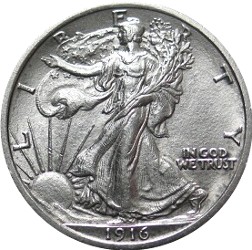
There is one aspect of money we do not think of often – in some of its forms, it is beautiful.  When I was a kid, I collected coins – just pennies for the most part.  I tended to spend anything bigger on baseball cards.  Now I have come to appreciate the sheer beauty of the two types of coins pictured here:  walking liberty halves, and standing liberty quarters.  These pictures show the amazing quality of the engraving.  Coins in this condition are premium, but fortunately, more heavily circulated specimens can be purchased for just a few dollars.  It’s quite an exercise in imagination to hold a coin that is 80 or 100 years old and wonder about its story.

It’s a lot more fun to think in these terms – of the beauty of money – than it is to think of our headlines or watch politicians on TV.  One thing “those European countries” did when we lived abroad, was periodically throw their governments out.  Even now, some nations hold votes of no confidence, which amount to a mass recall.  I remember feeling superior to that  – our system worked after all.  Now as I look at the big-heads in my wallet  – my mother’s old criterion for funny money – I doubt that I am alone in the fantasy of charging our leaders with high crimes of cluelessness and voting the rascals out.

The Letters of Georgia O’Keeffe and Alfred Stieglitz

In 1916, when they met, Alfred Stieglitz was 52, and an internationally known photographer whose avant-garde gallery in Manhattan made him one of the most influential men in early 20th century American art. Georgia O’Keeffe was 28, and an unknown schoolteacher from Texas.  Their professional and personal relationship spanned three decades and is documented in 25,000 pages of correspondence.  The first volume of these letters has just been published as, My Faraway One: Selected Letters of Georgia O’Keeffe and Alfred Stieglitz, Volume I, 1915-1933, edited and annotated by Sarah Greenough.

Georgia O'Keeffe and Alfred Stieglitz, 1944

Sarah Greenough discussed this correspondence recently on NPR:  http://www.npr.org/2011/07/21/138467808/stieglitz-and-okeeffe-their-love-and-life-in-letters.  Stieglitz and O’Keeffe were prolific correspondents, sometimes writing two or three letters a day, up to 40 pages long.  These documents “track their relationship from acquaintances to admirers to lovers to man and wife to exasperated — but still together — long-marrieds.”   

The two began living together soon after O’Keeffe moved to New York.  They were married in 1924.  Greenough notes that tensions began to appear between them almost immediately, but the deciding moment in their relationship came in 1929, when O’Keeffe visited New Mexico and discovered the landscape of her soul.  Stieglitz had promoted her work in New York, but in New Mexico, O’Keeffe found the subjects and colors that made her famous.  You cannot really think of her living anywhere else, just as you cannot think of Stieglitz outside of New York.  The two maintained their relationship at a distance, struggling to grow as individuals and as a couple, until Stieglitz’s death in 1946.

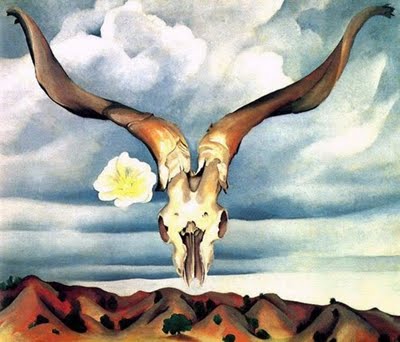
"Ram's Head," by Georgia O'Keefe

More is generally known about O’Keeffe than Stieglitz, for her powerful canvases have a distinct 20th century feel, and her life has become emblematic for generations of women struggling to champion their own personal and creative gifts.

"Light Iris" by Georgia O'Keeffe

Stieglitz is not as important to contemporary artists, but his influence on early 20th century American art and especially modern photography cannot be overstated.  He was an early and ardent champion the idea of photography as an art.  Later 20th century masters of the medium – Paul Strand, Edward Weston, Ansel Adams, and Minor White – all made the pilgrimage to New York to seek the “master’s blessing,” and those who won his approval never doubted themselves again.  In her NPR interview, Sarah Greenough notes that Stieglitz was “amazingly egotistical and narcissistic,” but he had the ability to establish “a deep communion with people.”

Stieglitz was also a “hinge” on which the transition to modern photography swung.  Prior to Stieglitz, most people made and saw photographs in terms of their literal subject matter.  Stieglitz used the medium of visible shapes to evoke states of awareness and feeling that move beyond the visible.  He named his efforts, “equivalents,” a term which Minor White later picked up, championed, and made known to subsequent generations of photographers.

No one before Stieglitz had made photographs as evocative of meaning beyond their literal subjects:

"New York Central Yard," by Alfred Stieglitz

Georgia O'Keeffe's Hands by Alfred Stieglitz

Equivalent, 1930, by Alfred Stieglitz

O’Keeffe and Stieglitz met almost 100 years ago, but their relationship seems utterly contemporary, laced as it was with tension between self-expression and commitment to the other.  Even so, their attitude might be summed up by what Minor White reported after his visit to Stieglitz’s gallery.  White wondered if he had what it took to become a serious photographer.

“Have you ever been in love?” Stieglitz asked.  White said he had.

“Then you can photograph,” was the reply.

Disruptive Technologies and the End of Borders.

In the electronics industry, one of our truisms was that change is the only constant.  We also talked and thought a lot about “disruptive technologies.”  The term was coined by Clayton Christensen in a 1995 article and elaborated in his 1997 book, The Innovator’s Dilemma.  Even well managed firms (and Borders does not seem to have been one of these), can be blindsided by failing to recognize “the next big thing.”  This is because its first manifestations tend to be clunky and crude.

The makers of fine coaches were probably not too worried when the first loud, dirty, and expensive horseless carriages appeared.  The empty factories and smokestacks in Rochester, NY are mute witnesses to Kodak’s failure to recognize the threat that digital photography posed to their chemical business.  Tower Books, which I loved, failed to develop an online presence, and Borders, among other things, was late to the eReader party.

There is no good news in this for anyone, least of all the 11,000 employees who are out of a job.  Or everyone who found wonderful things while browsing the stacks.  Even the idea that disappearing big-box bookstores will give indies a second chance seems unlikely.  One writer interviewed on NPR, whose books are carried by Borders, suggested that future bookstores may resemble what you find in airports:  “cookbooks, vampire novels, and celebrity tell-alls.”  http://www.npr.org/2011/07/19/138499967/mich-book-chain-borders-closing-after-40-years

I remember a college town where a wonderful independent bookstore closed soon after a Borders opened. Now it has come full circle and both are gone.  All I can think of are these words of the late George Harrison: All things must pass.

The Government and the Marx Brothers

Where's the Seal?

Back in college, one of my professors gave me an idea I’ve never forgotten.  He spoke of myths that shape and inspire our national consciousness, and how they always relate to a past that is not only gone but may not even have happened.  It must have been back in the 70’s, because he referenced the gun-in-the-rack, survivalist twist on the rugged individualism that Bonanza brought into our living rooms once a week.

The Cartwright boys get the job done

I’ve been thinking of myths of politics lately for one simple reason.  In following the current debate in Washington on the debt ceiling, I’ve come to a conclusion I have never reached before, through good times or bad – until now.  Quite simply, I think we are fucked.

Perhaps not over this particular crisis, for I don’t think any politician who wants to get re-elected – all of them, in other words – wants to get stuck with the blame for a national default.  But I think this “debate” reveals how utterly disfunctional our system has become.  Handwringing over the gummint has probably always been a national pastime – I finally believe it is justified.  Still, I prefer laughter and even creative thinking to handwringing, so I have been mulling over what myths I believed about about our leaders in the past, and what might be a better fit now.

Back in the days when my favorite TV show was “Leave it to Beaver,” I watched  Mr. Smith Goes to Washington with my parents: a rugged individualist from Montana takes on the system, and proves that right and integrity still can prevail.

Jimmie Stewart fights the good fight

Soon after I saw Mr. Smith, for a few brief years, we had Kennedy’s Camelot:  “Ask not what your country can do for you; ask what you can do for your country.”   Fast forward six years and there was Kent State and with Crosby, Stills, and Nash singing, “Soldiers are gunning us down.”  It’s been a roller coaster ride since then with ups and downs, times of malaise and times of letting the good times roll, but all along, at least for me, there was the faith that we can make things better.  Our system may be flawed but it works.  There was always someone to believe in, someone like Senator Robert Byrd, a real-life Jimmie Stewart who carried a copy of the Constitution in his pocket.

Sen. Robert Byrd, one of my heroes

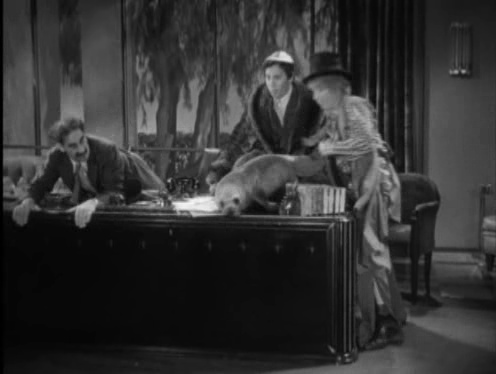
Senator Byrd is gone now, and so is my faith that we can right ourselves in time to avoid driving off a cliff.  What kind of myth fits that?  I’ve been mulling it over for several weeks, and it came to me yesterday, thanks to Turner Classic Movies.  They aired my favorite Marx Brothers film, Horse Feathers, and there it was:  my latest take on the current state of our government:

Do you think there’s a kinder way to depict our current crop of elected “servants?”  If so, please let me know!

After Potter

Of course it is happening in your head, Harry, but why on earth should that mean it isn’t real?  –   Albus Dumbledore

The fact that everyone is weighing in on Harry Potter stands as a tribute to the impact the saga has had on us all.  There’s no doubt the release of the final movie is most poignant for those who grew up with the series; a span of 13 years for the books or 10 for the movies is huge when you are young.  Some of those who picked up The Sorcerer’s Stone in grade school have finished college.

Annie Ropeik, an intern at NPR suggests three adult fantasies for the “Hogwarts Grad.”  She calls one of them, The Magicians by Lev Grossman, a cathartic examination of the nature of magic and our relationship to the stories we wanted to live in as kids — required reading for anyone trying to recover from a lifelong love affair with a fictional world.  http://www.npr.org/2011/07/14/137802346/3-grown-up-books-for-the-hogwarts-grad

Note the language Ropeik uses, especially the word, “recover,” which suggests that a love affair with a fictional world is something we should fight the way someone “in recovery” uses the 12 steps to fight for freedom from an addiction.

I’ve been sensitive to this kind of nuance ever since one of my psychology professors, a colleague of James Hillman and Joseph Campbell, recommended The Neverending Story by Michael Ende with the comment that, “It’s about our culture’s war on imagination.”  Can we graduate from the fictional worlds we have loved and lived in?  Should we even want to?  According to Hillman, our greatest danger is literalism, the mind that is closed to fantasy, or rather, refuses to see the fantasy in all our realities and the reality of our fantasies.

Today may be a day to mourn the end of an era, but it is also a day to celebrate the gifts we have received from Rowling, the young actors, and everyone who worked on the movies.  They have given us an unforgettable world of imagination and dreams where courage and friendship matter, even when the odds are bad, in the struggle of good against evil.

Harry Potter Fan Fiction

Harry, Ron, and Hermione in The Sorcerer's Stone, 2001

Fan fiction did not begin with Harry Potter or the internet.  According to Lev Grossman’s article, “The Boy Who Lived Forever,” in the July 18, issue of Time, xeroxed fanzines appeared after the premier of “The Man from U.N.C.L.E.” in 1964, and really took off with “Star Trek.”

In the broader sense, telling original stories with borrowed settings and characters is nothing new at all.  Homer did not create the Trojan War, Achilles, or Odysseus.  Shakespeare did not make up either King Lear or Henry V.  But with the internet and Harry Potter, fan fiction has exploded.  There are more than 2 million pieces on fanfiction.net and more than a quarter of these are based on Potter – everything from short stories to full length novels.

The final movie will not be the end of original Potter creations

Grossman explodes most of the stereotypes of those who write and read these tales.  One 38 year old writer and actress says it’s like character improvisation.  A best selling fantasy writer whose novels have been optioned by Peter Jackson says, “Fanfic writing isn’t work, it’s joyful play.”  This raises the key question of why writer’s of fiction write.  Joyful play, a platform, and an appreciative audience are there – and it’s not like many creators of “original” stories get to leave their day-jobs.

Well known authors fall on both sides of the unanswered copyright issue.  J.K. Rowling and Stephanie Meyer encourage new fiction based on their characters and worlds.  Orson Scott Card, Anne Rice, and George R.R. Marin, author of A Game of Thrones do not, and threaten lawsuits.  It may or may not be coincidence that the authors Lev Grossman names as supporting fanfic are more recent and write for a younger audience than those who are in opposition and write for adults.  So far, all cease and desist requests have been honored, so there are no legal precedents in the world of fiction, though court cases involving music have been liberal in their interpretation of what constitutes “fair use.”

This begs the interesting question of who a character or world belongs to.  Groosman says that until recently:

Writers weren’t the originators of the stories they told; they were just the temporary curators of them.  Real creation was something the gods did…Today the way we think of creativity is dominated by Romantic notions of individual genius and originality and late-capitalist concepts of intellectual property, under which artists are businesspeople whose creations are commodities they have for sale.

Personally, I have always loved the poet’s invocation at the start of The Odyssey:  Sing in me, muse, and through me tell the story… 

In my experience, the “I” does not invent worlds or characters.  Whether you call it the muse, the gods, or the collective unconscious, fictional worlds and imaginal people come from somewhere else.  With a bit of luck and humility, the “I” may get to witness what happens, and may even get adept at finding new rabbit holes.  To me, the idea of “owning” a “product” of imagination smacks of hubris.

There is no real data on whether fanfic hurts an author economically.  Intuitively, I can only imagine it benefits Rowling and Meyer.  I hope so.  Creativity is creativity, regardless of what spark ignites it.  I’m thinking of dropping by some of the sites to see what these authors are up to.  For those who write for the joy of it, I wish them a lot more.

So Long to the Space Shuttle

Yesterday afternoon, I stopped at a Starbucks and used an app on my smartphone to pay for a drink.  Then I glanced at my email while waiting for the barista to finish my frappacino.  I would not be doing any of that without the the US space program, which has reached the end of an era with the last space shuttle flight.

For it was during the ten year “space race” to put a man on the moon, that miniturization of electronices found the means, motive, and opportunity to thrive.  Intel opened its doors in July, 1968, a year before the moon landing, with 100 employees and a plan to make SRAM’s.  Three years later, when they introduced the first microprocessor, the game was afoot.

In hindsight, we can see that during the tech boom, the law of unintended consequences was operating full tilt, carrying many seeds of our current bust:  the sophistication of the internet which enables the “offshoring” of hundreds of thousands of jobs even as ever increasing “efficiencies” allow employers to do more with fewer people.

Where will the “next new thing” come from?  From dreamers like  Jobs and Wozniak, who built the first Apple computer in their garage.  Or from childhood friends, like Bill Gates and Paul Allen, who were inspired by the January 1975 issue of Popular Electronics to build and sell an early BASIC Interpreter and form a company that Allen named, “Micro-Soft.”

***

In 1972, when Adam Frank was ten years old, a collection of books on space exploration  in the local library changed his life.  He decided to become a scientist.  Now an astrophysicist, teaching at the University of Rochester, he asked a number of scientists across disciplines what set them on their path.  He found that fully three generations of dreamers claim they were inspired by NASA.  What is going to ispire the next generation of scientists, he asks, for:

The loss of that dream would feel terrible for the 10-year-old I was all those years ago. More importantly, it would be a terrible loss for all the 10-year-olds dreaming now of exploration and science. And for a nation that needs science and scientists to survive, it would the most terrible loss of all.  http://www.npr.org/blogs/13.7/2011/07/08/137678718/the-inspiration-gap-and-the-shuttles-last-launch

***

Beyond all practical considerations, the space program gave moments that those who lived through them will never forget.  If you’re old enough, you probably remember exactly where you were and what you were doing when Neil Armstrong stepped onto the moon.

You probably also remember that beautiful day in January day when Challenger exploded.  Who had any idea that the loss of that crew could cut so deep?

We all know there are rhythms of expansion and contraction, of dreaming and the end of dreams.  The stars aren’t going anywhere.  Let’s hope we are able to stretch ourselves toward them again soon.