Yule ~ The Beginner’s Guide To The Wheel Of The Year

Just in time for the solstice, here is another of Lily Wight’s wonderful “Wheel of the Year” posts, with beautiful illustrations and commentary on the Celtic and Nordic stories surrounding this ancient holiday. Enjoy her post and enjoy the return of light!

Lily Wight's avatarLily Wight

Updated 18/12/2014

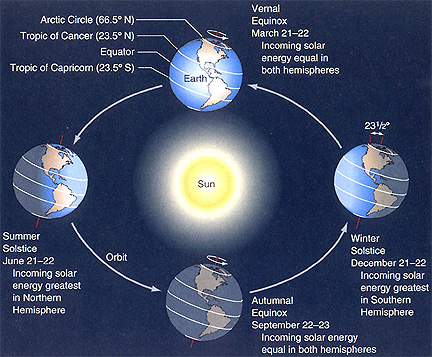
     There are four Solar Quarter Days (two equinoxes and two solstices) on The Wheel of The Year calendar.  Yule or The Winter Solstice is celebrated during a twelve day period from December into January.

     Yule commemorates the demise and rebirth of the sun’s powers because The Wheel continues to turn and daylight hours begin to lengthen again beyond The Shortest Day.

     The name “Yule” is thought to derive from the Old Norse ” jólnar”  – a collective term for the gods or “Yule Ones”.   Jólfaðr (Yule Father – interchangeable with All-Father) is one of many names attributed to Odin.  In Old Norse poetry names and terms for Odin are frequently synonymous with celebration and feasting.  Odin The Gift-Giver is undoubtedly the origin of our Santa Claus.

     The Midwinter period between the last harvest (Samhain)…

View original post 390 more words

Samhain ~ The Beginner’s Guide To The Wheel Of The Year

Here is another of Lily Wight’s fine articles on the Celtic Wheel of the Year. This one discusses Samhain, a time of ending and beginning, when the veil between the worlds was especially thin. This is key information for those who love Celtic mythology as well as providing fun background for those who love Halloween.

Lily Wight's avatarLily Wight

     Updated 23/10/2014

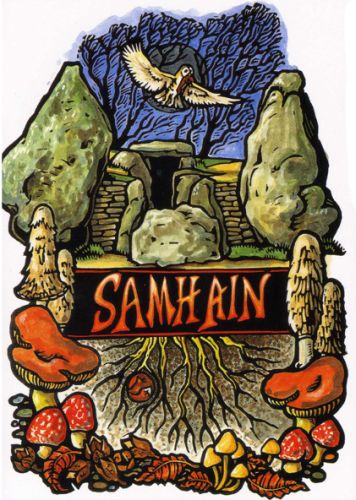
     Samhain – pronounced “sow – inn” and known presently as Halloween – is celebrated from sunset to sunset on 31st October to 1st November.  It is the most important Fire Festival or Sabbat on the ancient Wheel of The Year calendar.

     “Samhain” has been variously translated as “first frost” or “Summer’s end”:  opposing suggestions with the same meaning.  It is the name for November in ancient and modern Gaelic.

     Samhain lies between The Autumn Equinox and The Winter Solstice.  It marks the death of the year and the end of the annual agricultural cycle.  Many ancient cultures throughout The Western Hemisphere regarded Samhain as their New Year’s Eve.

     Samhain is the third and final harvest on The Wheel of The Year calendar.  After Lughnasadh (grain and cereals) and Modron (fruit and vegetables) herding…

View original post 428 more words

Stardust: a movie review

Stardust-3-NCGZF0OUJX-800x600

One day while Neil Gaiman was driving in England, he noticed a wall by the side of the road and imagined Faerie on the other side. He conceived the story of an American author visiting Britain who would discover the wall. Shortly after this, on the night he received a literary award, Gaiman saw a shooting star, and the idea for Stardust was born.

Stardust was first released as an illustrated series in 1997 and then as a novel in 1999, which won an award from the Mythopoetic Society.  A movie version in 2007 received favorable reviews.  After my recent review of Gaiman’s 2013 novel, The Ocean at the End of the Lane, I realized I’d never seen the Stardust movie.  It’s available for rent on iTunes, and I highly recommend it.

Stardust gives us the wall, a wonderful metaphor for much of human culture, erected to keep us out of Faerie, the realm of imagination, heightened emotion, wonders, terrors, true love, and our true selves.

Responsible citizens don't cross the wall.

Responsible citizens don’t cross the wall.

Tristan Thorn (Charlie Cox), a young man who lives in the town of Wall, is a classic dummling.  He’s a klutz who can’t keep a job and is infatuated with Victoria, a girl who won’t take him seriously and whose finance delights in tormenting him.  Yet Tristan’s father, who has been over the wall, says that might be a good thing – most people who find it easy to fit in “lead unremarkable lives.”  Then he tells Tristan the secret of his birth on the other side of the wall.

Tristan and Victoria see a shooting star fall into Faerie.  Still infatuated, Tristan vows to bring the star back to win her hand in marriage.  He forces his way through the wall to begin his search, but he is not the only one who saw the star.

The murderous sons of a dying king in the realm of Stormhold set off to find the star when their father vows that the one who finds it will be his heir.  And Lamia (Michelle Pfeiffer), senior member of a trio of witches joins the hunt – when stars fall to earth, the witches cut out their hearts and eat them, a little at a time, to preserve their youth and beauty.

Tristan reaches Yvaine the star (Claire Daines) first. Still intent on winning the hand of Victoria back in Wall, he uses a Faire chain to compel her to follow him.

Yvaine and Tristan

Yvaine and Tristan

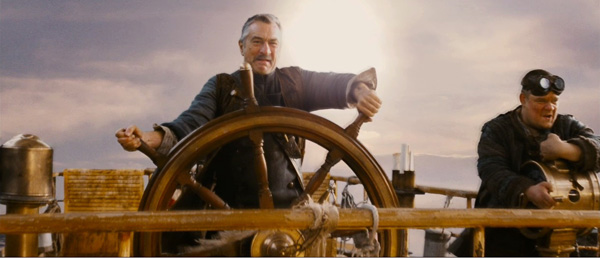
At first they bicker constantly, but their time on the road and helping each other survive attempts on their lives creates a bond of friendship and finally love between them. Ever the dummling, Tristan is the last to realize this, but is helped when he finds a mentor.  Robert De Niro, in a virtuoso role as Captain Shakespeare, the gay captain of a flying steampunk pirate ship, teaches Tristan to fight, Yvaine to dance, and with a parting gift of  wisdom, whispers to Tristan, “She is your true love.”

Captain Shakespeare at the helm

Captain Shakespeare at the helm

As with any good dummling story, the ending of Stardust will leave you happy.  Though rooted in the sensibility of a modern coming of age tale, with elements of character development that the old traditional stories lack, Stardust fits Tolkien’s paradigm of the classic fairytale – the wonders and terrors we mortals encounter when we venture into other worlds.

Faerie whispers to us in sunlight, in starlight, and in our dreams.  Those intimations may be what make us most truly human.  No wonder we have an endless appetite for wonder tales, and Stardust is one that thoroughly satisfies.
The Ocean at the End of the Lane by Neil Gaiman

ocean

I’ve loved fantasy since my earliest childhood days of hearing stories read aloud.  Growing up I lived on The Wind in the Willows, Godzilla, Norse mythology, science fiction, Frankenstein and the folklore of many cultures.  In college, I discovered Tolkien, The Odyssey, C.S. Lewis, as well as Jung and Campbell, who served as guides to the often trackless realms of the other worlds.

If you follow fantasy literature for any length of time, you notice that authors who bring forth new visions are often followed by scores of knockoffs by writers looking for bandwagons to ride.  Neil Gaiman is an exception to that rule; he sows his unique personal visions across traditional genres in a manner that can’t be imitated.

How would you follow the Hugo and Nebula award winning American Gods, 2001, a dark, modern day Iliad that pits old gods like Mr. Wednesday (Odin) against new deities like Media, the goddess of television?  A year later, Gaiman published Coraline, sometimes compared to Alice in Wonderland for its unflinching look at the terrors of childhood and winner of Hugo and Nebula awards for best novella.

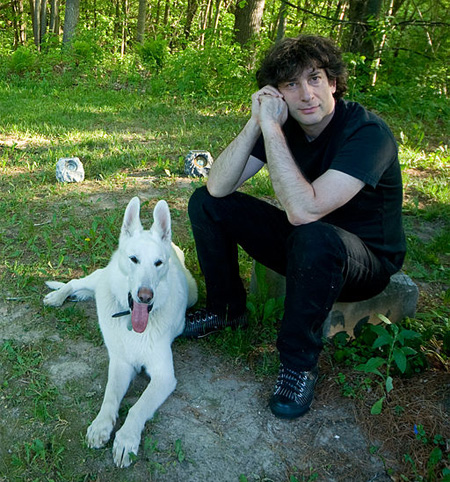
Neil Gaiman, 2009, by Kyle Cassidy.  CC-BY-SA-3.0

Neil Gaiman, 2009, by Kyle Cassidy. CC-BY-SA-3.0

In June, Gaiman released The Ocean at the End of the Lane, which he called “the most serious, dark, weird and personal thing I’ve ever written” in an interview called “The Illusionist” in the June 24, 2013, issue of Time.     

Illusionist is the only possible title for the creator of Ocean, which began as a short story and grew.  You reach the end of a nail biting ride with a man recalling a summer of terror and beauty that happened (or probably happened) when he was seven, and you realize that although you have been in his head and his heart for 180 pages, you don’t even know his name.  You know the name of Lettie Hempstock, who lives at the end of the lane, an 11 year old girl who claims that her duck pond is really an ocean.  You know Lettie’s name, but you don’t know what she is, and when you ask how long she has been 11, she gives you a smile but no answer.

Like Dr. Who’s TARDIS (Gaiman wrote an episode this year), Lettie’s ocean is bigger inside than it appears from without.  When he ventures in, Gaiman’s protagonist says, “I saw the world I had walked from my birth and I understood how fragile it was, that the reality I knew was a thin layer of icing on a great dark birthday cake writhing with grubs and nightmares and hunger.  I saw the world from above and below.  I saw that there were patterns and gates and paths beyond the real.  I saw all these things and understood them and they filled me, just as the waters of the ocean filled me.”

One of Gaiman’s numerous strengths is his ability to remember “extremes of horror and ecstasy that children experience.”  He read books as a child and realized the adult writers had forgotten.  He vowed not to, and The Ocean at the End of Lane proves that he has not.

Gaiman resists “fantasy” as a label, but for convenience I will use it to say this is one of the finest fantasies I have ever read.  In the Time interview he also said, “I’m now more famous than I’m comfortable being.”  Though I understand his concern, I have to say, “Dude, you brought it on yourself – learn to deal with it.”

Super 8: a movie review

Super 8 poster

Even if you didn’t know that Steven Spielberg was involved in the production of Super 8, 2011, you would think of him and the parallels to ET, 1982.  Both movies appeal to all ages, but center on the courage, creativity, and compassion of young people.  Best case, the adults need to be reminded of what really matters; worst case, these are the things they oppose.  Spielberg sat on the storytelling committee with director, J.J. Abams, and helped produce Super 8.  The film won numerous awards and nominations, for its special effects and the two young stars, Joel Courtney and Elle Fanning.

It is 1979 as the film opens.  Fourteen year old Joe Lamb (Courtney) mourns the death of his mother in a factory accident.  His father, Deputy Jack Lamb, blames the father of his son’s friend, Alice Dainard (Fanning), since his wife was working the shift of the elder Dainard, out with a hangover, when she died.

Meanwhile, Joe’s friend, Charles, is making a super 8 zombie movie for an international competition.  He enlists Alice as the love interest in the film, and she and Joe are soon smitten with each other.  One night they sneak out to film a scene at the station against the backdrop of a passing train.  As the camera rolls, a pickup drives onto the track and causes a major derailment.  The pickup’s driver, Dr. Woodward, their biology teacher, is badly injured, but pulls a gun and warns them to forget all they’ve seen or their parents will be killed.  As the kids drive away, an Air Force convoy arrives to secure the scene.  The convoy leader, Colonel Nelec, discovers a super 8 film cassette and sets out to find whoever made it.

Things in town start to get weird.  All the dogs run away to the next county.  Electronic devices begin to disappear.  All the engines in all the cars at a local dealership are stolen overnight.  Nelec’s forces surround the town and begin knocking at doors.  Joe and Charles sneak into Dr. Woodward’s house and discover why he was trying to derail the train.

There are plenty of nail-biting moments, and when things come out right in the end (you never really doubt it in this kind of movie), we get to see Charles’ zombie production, which is a charming ode to amateur movie making and the creativity of young people

Super 8 is well worth a viewing.

http://www.youtube.com/watch?v=bqt9L4fIExA

Lego Fairy Tales

Once again I’m pleased to feature a post by the amazing Lily Wight, who found some fairytale illustrations I doubt that you’ve seen before. I wonder what the career path is – Lego engineer has always seemed like a dream job!

Lily Wight's avatarLily Wight

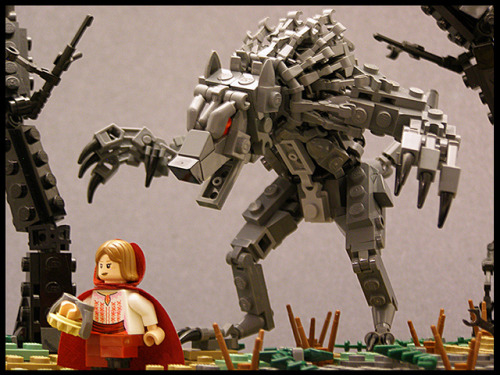
     This month’s Lego fix features Little Red Riding Hood, Beauty & The Beast and a rather startled Little Mermaid.

     Just hover over the images for extra information…

View original post

Fans of movies and fairytales will love this 1922 Cinderella (Aschenputtel), a 12 minute animated silhouette feature by Lotte Reiniger (1899-1981). Reiniger went on to create the first animated feature film in 1926. Those who appreciate the art of fantasy will want to know about Lily Wight’s blog, where so many finds like this appear.

Lily Wight's avatarLily Wight

     German animator Lotte Reiniger created the first surviving full-length animated feature, The Adventures Of Prince Achmed, back in 1926.

     An enchanting collection of Reiniger’s paper silhouette Fairy Tale adaptations is now available on DVD.

     You can watch Cinderella (1922) right here…

     Recommended…

     The Wonderful World Of Froud

     From Aliens To Vampires And Angels To Zombies

     Fantastic Fashion Fairy Tales

     Little Red Riding Hood With Christina Ricci

View original post

The Psychology of Superheroes

superheroes

Robin Rosenberg grew up with superhero comics. Later she shared them with her children, and after becoming a clinical psychologist, she studied them through the lens of psychology and discovered that “superhero stories are about morality and loyalty, about self-doubt and conviction of beliefs. I also saw that, like any good fiction, the sagas of superheroes bring us out of ourselves and connect us with something larger than ourselves, something more universal.”

Rosenberg published “We Need a Hero” in the current Smithsonian Magazine http://www.smithsonianmag.com/arts-culture/The-Psychology-Behind-Superhero-Origin-Stories-187938991.html#ixzz2IrHHrBBI.  The article inspired me to read The Psychology of Superheroes a collection of essays that Rosenberg edited in 2008 on what makes these caped crusaders tick.

Sometimes it seems that superheroes can’t get no satisfaction, but is that accurate?  Not according to the opening essay in the collection, “The Positive Psychology of Superheroes,” by Christopher Peterson and Nansook Park.  “One of the defining features of a superhero is an over-riding mission to serve the larger world and to defend it.  In this sense, superheroes have profoundly meaningful lives.”   

Peterson and Park assert that meaning is more important than pleasure in leading a satisfying life. That’s a good thing, because with a few exceptions, superheroes are challenged on the relationship front.  I’ve always thought it’s the flaws embodied in the secret identities of Clark Kent and Peter Parker that bonds us to these characters.  In one sense, they’re just like us, and their stories suggest that we too may choose the highroad.

Though superpowers isolate them from others, sometimes superheroes band together with superior results, according to the second essay in the collection, “The Benefits of a Group,” by Dr. Wind Goodfriend. This article may shed some light on why The Justice League of America functions more efficiently than your team at work or committees at church.

Another topic discussed in the book is the question of nurture vs. nature in the development of superhero psychology.  Superman may have his powers through genetics, how did he come to use them for altruistic rather than narrow and selfish ends?  Did he inherit those qualities too, or were they a result of his wholesome upbringing on a farm in America’s heartland?  What would have happened if his pod had landed in New York City?

Good and evil are usually clearly drawn in superhero stories, but not always. In “Anti-Heroism in the Continuum of Good and Evil,” Dr. Michael Spivey and Steve Knowlton discuss the ambiguous, gray-zone nature of super anti-heroes and sympathetic villains (think of Darth Vader and Gollum).  Each of the 18 essays in The Psychology of Superheroes addresses some facet of the super-psyche that you may or may not have wondered about.

Humans have relished hero tales for millennia.  Superman joined the ranks 75 years ago, and if you’ve been to the cineplex lately, you know that his saga is going to continue this summer.  The trailer for Man of Steel 2013 zeroes in on Clark’s inner struggles to understand who he is and why he is here.  Earlier incarnations of Superman did not live in a world of such moral ambiguity and mistrust of the government, themes which place this telling squarely in the 21st century.

As The Psychology of Superheroes makes clear, what we really admire is not the superpowers but the hero, the one who overcomes their doubts and demons and then acts to make the world a better place. This book is a fascinating read in its own right and will whet your appetite for the new movie.  It will give you some new perspectives on movies you’ve seen in the past as well as the comic books that once inspired some of us to run around wearing capes made out of bedsheets.

http://www.youtube.com/watch?v=6CUIsWKGHGw