
Sacred Stones in Northern California

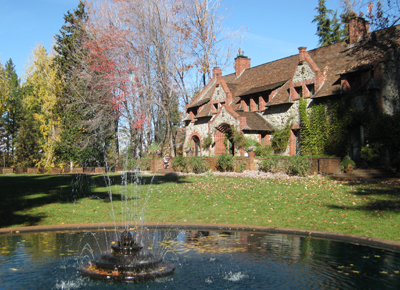
There are only two medieval structures in North America. Now a third is nearing the end of restoration in the small agricultural town of Vina, California, 100 miles north of Sacramento. It’s the 12th century Chapter House of Santa Maria de Oliva, a Spanish monastery that stood near Madrid. This building’s round the world journey makes an interesting tale.
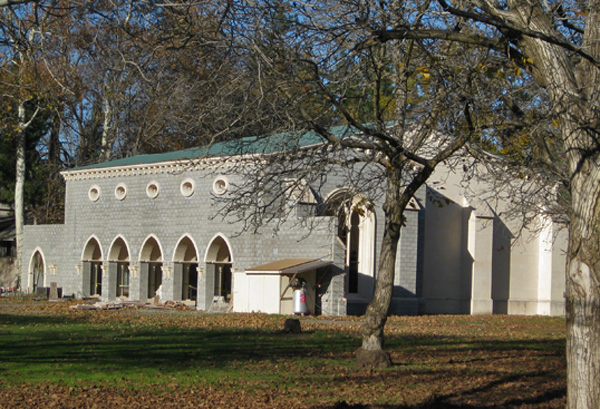
The monks began their day in the Chapter House, where a chapter of the Rule of St. Benedict, an ancient guide to monastic living, was read and interpreted. This went on through the centuries until 1835, when the Spanish government closed all small monasteries and seized their lands. Santa Maria de Oliva was sold to a wealthy family that used the Chapter House to store farm equipment.

In 1931, William Randolpf Hearst bought the Chapter House for $285,000, intending to use the stones in the interior of a house he planned near Mt. Shasta. All the stones were marked for reassembly, and sent to California on 11 separate ships. The depression and WWII delayed Hearst’s plan, and in the end he donated the stones to the City of San Francisco to erect a Medieval museum in Golden Gate Park. This never happened and the stones lay outdoors in the park. Many were damaged, lost, or used for other projects

Meanwhile, the Cistercian Abbey of New Clarvaux was founded in Vina in 1955, and the first abbot began to make inquiries. In 1994, the Fine Arts Museums of San Francisco gave the stones to New Clarvaux with the stipulation that reconstruction begin in 10 years and the completed Chapter House be open to the public.

I first went to New Clarivaux in 1998 to stay for a few days at their retreat facilities. It’s an amazing place to unwind, and I have been there a number of times, so I saw the foundation of the Chapter House laid in 2001.

Section of New Clairvaux guest rooms

I had not been there recently, however, so when I drove up this past weekend, I found the structure was almost done – almost meaning another 18 months in a 10 year effort. Only 40% of the original stones were usable. The rest had to be repaired or replaced by stonemasons the abbey employed (they’ve raised $6.3 million to date, largely through small donations from across the country).

Master stonemason, Frank Helmholz, left Vina in November, bound for Luxor, Egypt, where he will spend the winter restoring a 3,400 year old temple. He plans to return to Vina next May. In an interview for the abbey newsletter, Helmholz said:

“In this modern age when everything is done fast and often doesn’t last long and serves no higher purpose, carving stones is a bit of a refuge. To create something that takes patience, dedication, and is lasting is very rewarding. And serving the monks in their spiritual lives gives a greater sense of meaning that is rare nowadays…to be part of something that has a higher purpose than one’s own comfort is inspiring in whatever form it takes.”

The abbey newsletter points out another significant point in the life of the Chapter House. It was built by Cistercians in Spain. Now it stands in another Cistercian abbey in the land that once was called New Spain. The stones have finally come home.

I have only alluded to the retreat facilities at New Clairvaux. In addition to nut crops and a vineyard, it’s one of the ways the monks earn their living, and it’s a marvelous place to spend some time apart. I will post about it later, but meanwhile, you can follow the link below for a summary.

www.sacredstones.org

www.newclairvaux.org

Humbug Revisited: A Brief History of Christmas

It’s coming on Christmas
They’re cutting down trees
They’re putting up reindeer
And singing songs of joy and peace
Oh I wish I had a river I could skate away on
– Joni Mitchell

I can’t get the name of Walter Vance out of my mind.  He was the 61 year old pharmacist, with a history of heart problems, who collapsed in a West Virginia Target store shortly after midnight on Black Friday.  Witnesses told MSNBC that many shoppers ignored Vance and walked around or even stepped over him as he lay on the floor.

When NPR held a call-in show to ask about listeners’s Black Friday shopping experience, one caller reported that a woman had grabbed an item out of her cart, saying, “It isn’t yours until you’ve paid for it.”  The incident mirrors a scene in a commercial that ran incessantly in the days leading up to the event.

Sales receipts were no guarantee of safety either – just ask the shooting victims in several parking lot robberies.

Exhausted after an all-night shift, one Target employee drove her car into a canal.

All of these reports emerged after the infamous pepper spray story that had the media wagging its head – the very same media that helped whip crowds into a feeding frenzy during the previous days

None of this is new.  Christmas has always been the church’s most problematic holiday.  The Hallmark version we know today was in part, carefully crafted by early 19th century merchants, in a manner not different in essence, from the effort to persuade millions of seemingly sensible people to spend Thanksgiving night in big-box stores.

Santa Claus by Thomas Nast, 1865. Would you want this guy roaming around your home late at night?

The Bible does not give a date for the birth of Jesus.  Apparently, birthdays were not a big issue back then.  Origen of Alexandria, a 3d century theologian, wrote that “only sinners like Herod and Pharaoh celebrate their birthdays.”  December 25 was not fixed as the date of Christmas until the 4th century, and the nativity was largely ignored until the 9th century reign of Charlemagne.

Through the early middle ages, Christmas was overshadowed by Epiphany, which commemorates the visit of the Magi.  It was not until the high middle ages that Christmas emerged as a popular feast day.  “Feast” is an understatement.  In 1377, Richard II’s guests consumed 28 oxen and 300 sheep.  Caroling became popular then, though chroniclers complained of lewd lyrics.  The same writers blamed pagan holidays like Saturnalia and Yule for the “drunkenness, promiscuity, and gambling,” of the celebrations.

In 1645, in an effort to rid England of decadence, Oliver Cromwell and his Puritans banished Christmas in England.  The Pilgrims on the Mayflower were even stricter.  From 1659-1681, Christmas was outlawed in Boston.  English customs were shunned after the revolution, and Christmas did not become an official American holiday until 1870.

We can read on history.com that, “The early 19th century was a period of class conflict and turmoil. During this time, unemployment was high and gang rioting by the disenchanted classes often occurred during the Christmas season.”  The New York City police force was organized in 1828 in response to a Christmas Riot.  History.com continues:   “This catalyzed certain members of the upper classes to begin to change the way Christmas was celebrated in America.”  

In the absence of television, one thing 19th century chambers of commerce used to push their version of Christmas was Washington Irving’s, The Sketchbook of Geoffrey Crayon, a series of stories of life in an English manor house.  “The sketches feature a squire who invited the peasants into his home for the holiday. In contrast to the problems faced in American society, the two groups mingled effortlessly.”  Historians now claim the book does not describe any actual customs, but ones that Irving wished for and thus invented.  

Even more important to the evolution of Christmas was Charles Dickens’s, A Christmas Carol, with its strong message that celebrating this holiday can make you a better person.  Dickens’s book meshed with the Victorian emphasis on family , as well as a new appreciation of children.

Referring to the 19th century upswing of Christmas popularity, history.com says: “Although most families quickly bought into the idea that they were celebrating Christmas how it had been done for centuries, Americans had really re-invented a holiday to fill the cultural needs of a growing nation.”

The optimism of “a growing nation” that we see in historical prints and Christmas cards seems as quaint these days as the cards themselves.  For a sense of the collective mindset this year, I look at this photo of students at the Charles W. Howard Santa School in Midland, MI.  This year the Santas are learning to gently lower children’s holiday expectations.

Photo by Fabrizio Constantini, New York Times

I wonder what Santa said to the boy who showed up with a multi-page spreadsheet, cross referencing all the toys he wanted to different stores and prices. (What was he doing on Santa’s lap to begin with)?

***

Even a little research reveals that there is no “right” way to celebrate Christmas.  This holiday has been re-invented numerous times.  If individuals and families opt out of what no longer works and try to create saner traditions, no one will ever miss them.  I’ll go ahead and lead off with a clip from my favorite Christmas movie of all time, in the scene that inspired this post, and leads me to wonder if the pre-repentant Scrooge isn’t due for re-evaluation.

Meanwhile, Be Careful Out There, and in case you were wondering, I’m off to see the new Muppet Movie today.  I’ll soon be back with a report.

The Empire Mine

The visit of a friend over the holiday weekend was an excuse to drive out of the valley fog and into a stunning late fall day as we made our way to the Empire Mine State Park, a mile east of Grass Valley.  This is the site of California’s richest gold mine, in operation from the 1850’s through 1956.  We lucked out:  on Saturday they were holding a special open house.  Park personnel in historical costume were greeting visitors and explaining things in both the “cottage,” where the mine owner lived with his family, and at the diggings themselves.

The Empire Cottage

Gold was discovered in 1848, and by 1850, the rivers were panned out.  There was plenty of gold, but larger operations were needed to extract it.  The Empire Mine got off to a shaky start as it bought out numerous small claims, but faced serious difficulties in getting at veins of gold that laced the strata of quartz at deeper levels.  Starting in 1879, William Bourn Jr., who gained a controlling interest, and his cousin, George Starr, the mine superintendent, created a very successful enterprise, largely because of the technical know how and labor of a large number of miners from Cornwall, England, a region where hardrock mining for tin and copper was a thousand years old.  By 1890, Grass Valley was estimated to be 85% Cornish.

Cottage from the ornamental garden

Bourn ran the mine from 1879 until 1929 when poor health forced him to sell it to Newmont Mining. In today’s terminology, these miners, photographed in 1905, are the 99%. According to one of the living history guides, the least prestigious job was that of a “mucker.” After a blast, they would load the ore carts and push them up the tracks to one of the main shafts where the rock would be hauled to the surface. The muckers could fill six or seven carts an hour, and each held a ton of ore.  Muckers made $3 for a 10 hour shift.

Miners descending the main shaft (postcard)

In 1905, that wage beat the median income of twenty-two cents an hour.  In addition, the mine prospered during the 1930’s – The Great Depression didn’t happen in Grass Valley.  The safety record appears to be pretty clean too.  Not only are hard rock mines the safest, but after the San Francisco earthquake in 1905, when miles of steel rails were twisted beyond use by railroads, Bourn bought them up to reinforce the shafts.  In movies you see mines shored up with timber.  At Empire, the shafts were braced with steel.

Inside one of the shafts (state park photo)

Still, with more than a bit of claustrophobia, I would have sought work in one of the craft shops above ground.  Carpenters and metalworkers on site made and repaired almost everything used in the mining operations, including the ore carts and their wheels.

Empire Mine Carpentry Shop

The metal shop

The blacksmith shop (state park photo)

The mine was closed as a non-essential industry but the War Production Board at the start of WWII. It reopened in 1945 but the price of gold was fixed at its 1934 level of $35 an ounce. By 1956, each ounce cost $45 to produce, and the mine closed in January, 1957.

During its years of operation, the Empire mine produced 5.6 million ounces of gold – roughly five billion dollars at current prices. The state owns the surface structures and grounds, but Newmont mining retains mineral rights, and there’s still gold underground. If the price of rises high enough, mining operations could resume. The real value these days, however, is the historical interest and beauty of the place.

Swimming pool below the cottage

Rose gardens behind the cottage

The heritage roses behind the cottage had all been cut back, but small plaques identified the roses and their dates. Most came from the 19th and early 20th century, but a few were earlier than that. When they are in bloom, you can buy cuttings.

View from the formal gardens toward the mine

I had been to the Empire Mine once before, in the 80’s one January day when the trees were bare, the pool was dry, and no one was no one around. I’d been wanting to return for most of this year, but something always came up until this past Saturday. I had no idea how much I would enjoy the site, and I highly recommend it if you are ever in California’s central valley, with a yen to explore the foothills and the gold country.  http://www.empiremine.org/

In Flanders Field the Poppies Blow

At 11:00am, on the 11th day of the 11th month of 1918, the insanity of the First World War came to an end. Though the United States holiday was renamed to Veterans Day after World War II, it is still known as Armistice Day in France and Belgium. It is known as the Day of Peace in Flanders Field, where many of the dead from the western front are buried and one of the most famous poems of this war or any war was written.

Poppies near the Connaught British cemetery on the western front

Poppies are an annual, summer-blooming wildflower whose seeds are carried on the wind.  They can lie dormant for a long time but will bloom if the earth is disturbed – as it was, of course, during the years of trench warfare.  In many parts of the line, in the summers of 1915, 1916, 1917, and 1918, the little poppies shone as the only symbol of life amid the devastation of no-mans land.

In May, 1915, Major John McCrae, a Canadian military doctor and artillery commander, noticed the poppies growing in the disturbed ground between the graves that surrounded his artillery position near Ypres.  When the chaplain was called away, McCrae was asked to conduct the burial service for a friend.  We think he began his famous poem that evening.

In Flanders fields the poppies blow
Between the crosses, row on row,
That mark our place; and in the sky
The larks, still bravely singing, fly
Scarce heard amid the guns below.

We are the Dead. Short days ago
We lived, felt dawn, saw sunset glow,
Loved and were loved, and now we lie
In Flanders fields.

Take up our quarrel with the foe:
To you from failing hands we throw
The torch; be yours to hold it high.
If ye break faith with us who die
We shall not sleep, though poppies grow
In Flanders fields.

***

***

Even more than McCrae’s poem, Armistice Day / Veterans’ Day brings to mind a song by the Scottish musician, Andy Stewart.  His song, “Young Jimmy in Flanders,” commemorates his uncle James who served as a piper during the war, and miraculously survived.  More than any other picture or poem or story, this ballad evokes for me the terrible sadness and anger at this conflict where boys playing bagpipes led troops against machine guns and poison gas:

He played his pipes to battle,
and the laddies died like cattle,
and the brandy was drunk in Whitehall,
a million miles away.

This song is recorded on Stewart’s fine album, “Fire in the Glen,” 1991.

http://www.youtube.com/watch?v=y-IhN7IVQdk

Notes on Worldly Success

Yesterday afternoon I sat for a while on the back porch, watching the rain and admiring my neighbor’s and my handiwork.  Over the weekend, we shored up the fence and gate in preparation for winter.  My neighbor knows a lot about carpentry.  I don’t, and because of that, I felt a huge sense of satisfaction, as much or more than I did a few weeks ago, when I finished a pretty good short story for the Writer’s Digest contest.  I guess with that attitude, I’m not likely to get my face on the cover of Time, either for carpentry or for writing, even though both can bring me a great deal of satisfaction.  Sitting on the porch, I started thinking of various examples of success and failure.

***

I’ve been reading a lot about Steve Jobs in recently published tributes.  Viewing the whole sweep of his life, he seems to have had great self-confidence and an unerring instinct for doing the right thing. Much of that impression comes from his 2005 graduation speech, the reflections of a mature man, sobered by a serious brush with mortality.  I found myself wondering how he dealt with setbacks when he was young and first starting to make his way?  Lives written in history books and obituaries often leave out the messiness, the dark nights of the soul, the nights we wake up a 3:00am wondering what to do.

Somehow the story of Jobs’s trek to India leads me to think he connected with his heart and intuition – as he talked about in his speech – at a pretty young age.  You don’t venture to a strange continent, in search of something you aren’t sure of, unless you are confident enough to live with uncertainty and believe you can find the answers.  Unlike many creative people, Jobs’s passion aligned with his livelihood, but that did not prevent the devastation of getting fired at 30 from the company he had founded.   He had enough wealth to retire from active life and never know want again, but failure prodded Jobs to come back and reinvent himself – and animated films while he was at it.

Rule for success:  Find a way to believe in yourself.
Another rule of success:  Never give up.
A useful tip:  Love what you do, if possible.

There are clear parallels in the life of Thomas Edison, 1847-1931, to whom Jobs is often compared.  Edison ran numerous unsuccessful experiments (estimates range from 700 to 10,000) before discovering tungsten as a workable filament for electric lights.  Edison said, “Many of life’s failures are people who did not realize how close they were to success when they gave up.”  Did Edison ever come close to giving up?  Did he ever know dark nights of the soul?

"Genius is one percent inspiration and ninety-nine percent perspiration" - Thomas Edison, 1903

Several of the pithy statements he made in maturity sound like things Jobs might have said:  “I never did a day’s work in my life. It was all fun.”   Like Jobs, Edison never dreamed of resting on his laurels:  “Show me a thoroughly satisfied man, and I will show you a failure.”  Perhaps my favorite Edison quote is this one:  “To invent, you need a good imagination and a pile of junk.”  Might that include a pile 2×4’s and fence boards?

Tip for success:  A sense of humor and a sense of play are marvelous attributes.

***

The list of Abraham Lincoln’s failures is often used to motivate people, because he had so many of them.  Here’s a more balanced chronology of his victories as well as losses.  He won some and lost some, just like everyone else, and like Jobs and Edison, he kept on trying.  http://showcase.netins.net/web/creative/lincoln/education/failures.htm

Lincoln believed that he was an agent of destiny and spoke of “the chorus of Union” that would sound when touched by “the better angels of our nature.”  This sense of calling may have made his task possible but didn’t make it easy:  I’ve heard that he wept at the casualty counts from the last battles of the Civil War.  Like Jobs, he was aware of his own mortality:  a week before he was shot, Lincoln dreamed of lying in state in Capitol rotunda, but just like the men he ordered into battle, fear of death could not deter him.

Close to Lincoln during the last years of his life was another future president, Ulysses S. Grant, who may have been the only northern general able to win the war, but whose life outside the military reads like a litany of failure.  Born, Hiram Ulysses Grant, he discovered when he entered West Point that he had been registered as, Ulysses Simpson Grant.  He never bothered to change the name, and in a similar vein, gained a reputation as a sloppy cadet.  Though he served with distinction during the Mexican War, afterwards he failed as a businessman and a farmer.

As president, Grant was noted for enforcing civil rights and fighting the Ku Klux Klan, but his administration was was rocked by scandal and inept handling of the Panic of 1873, a world-wide financial crisis.  He left office on a note of failure, went into business with a man who cheated him, and died in debt and in great pain from throat cancer.  By force of will, he finished his memoirs before he died, which saved his wife from bankruptcy.

Like so many before and after, Grant was a poster-boy for another truth:  Worldly success is no guarantee of happiness.  This realization raises the critical question of what we really mean by success.  The purpose of life is finding happiness and sharing it with as many others as we can, according to the Dalai Lama, in The Art of Happiness, a book I will have more to say about later.

In the meantime, I come around again to the thought of fixing fences with my neighbor.  When measured by the creation of and sharing of happiness, it may have been even more important than I imagined.

Washington’s Crossing by David Hackett Fischer: A Book Review

Every now and then the fit comes upon me, and I find myself avidly burrowing into American history.  My interest most often centers on the Civil War era, but not exclusively.  David Hackett Fischer presents our struggle for freedom with an in-depth study of the second half of 1776, when the leadership of George Washington transformed the American army from a beaten rabble into a force to be reckoned with in their own eyes, those of the British, and the other European powers.

In his letters, Washington articulated his central problem – how to mold a collection of very different sorts of men, with radically different ideas of freedom, into a force that could stand against the most powerful army in the world.  Shortly after Washington assumed command in New England, a Maine regiment made up of fishermen, with freed slaves among them, got into a brawl with a Virginia regiment that included slave owners.  Others rushed into the fray and soon 1000 troops were fighting each other – more than the total number of soldiers who fought at Lexington and Concord.

Washington – who really was “larger than life” – mounted his horse and galloped into the center of the fight.  He grabbed two combatants by the neck, and alternately shook them and swore.  Everyone else ran away.

In an era when history too often debunks heroes, George Washington emerges as a leader chosen by destiny, as most of his men believed him to be.  A Virginia aristocrat, who could have lived a life of leisure, he trained himself in physical endurance and chose a military career as his means of public service.  As an aid to General Braddock, during the latter’s defeat in the French and Indian War, Washington had two horses shot from under him, and four musket balls tore through his coat, but he was unscathed.  Through the revolution, he inspired his men with courage under fire, and he inspired them in other ways:  putting aside his aristocratic background, he created the first army in the world where private soldiers were addressed as, “Gentlemen,” and their grievances were seriously considered.

The British army was was undefeated in battles on five continents.  In the summer of 1776, King George committed half his total forces to putting down “the rebellion.”  A few thousand American defenders awoke one morning in July to see 500 British transports and warships in New York Harbor.  A simple feint drew the Americans to Brooklyn while the British landed 23,000 royal troops and 8,000 Hessians.  This was just the first wave.  When they moved on Manhattan, with naval cover from the rivers, the only surprise was that most of the American army escaped.

British General Howe swept through New Jersey, pushed Washington’s army across the Delaware, and threatened Philadelphia.  Thomas Payne caught the mood of the times in a pamphlet called, The American Crisis, which begins with the famous line, “These are the times that try men’s souls.”

British forces assumed the collapse of the American “peasants” was immanent – the problem was, they did not behave like defeated soldiers.  In early December, Washington sent his forces to collect and hide every boat they could find on the Delaware.  Little by little, the story unfolds of all the telling mistakes the British made:

  • General Howe spread his forces along every ford of the river, with inland garrisons to support them.  In the end, he held numerous strongpoints, but with reduced numbers in each each.
  • Howe attempted to reconcile with the population, but his troops in New Jersey undercut those efforts by plundering farms and private homes, and in some towns, with the mass rape of women and girls.  These actions swelled the ranks of American insurgents.  When British commanders threatened this “third column” with instant execution if they were caught, even more civilians joined.  Soon there were groups of as many as 600 insurgents threatening any British troops who ventured out of their garrisons.
  • Hessian Colonel Rall, who had only 1500 men at Trenton, repeatedly asked for reinforcements, but his requests were denied by a British general who refused to believe the Americans posed a credible threat.
  • Rall’s superior, Carl Von Donop, was stationed six miles away to reinforce Rall in case of trouble, but shortly before Washington’s crossing, Von Donop marched to Mt. Holly to put down a militia attack.  While he was there, Von Donop met an attractive “physician’s widow” and sequestered himself on Dec, 24, 25, and 26.  The man ordered to reinforce Trenton was “occupied” when the Americans crossed the Delaware.  The identity of this colonial Mata Hari, if that is what she was, has never been discovered – no local physicians had died in Mt. Holly.  Some speculate that it could have been Betsy Ross:  her husband had recently died in Philadelphia, she had family in Mt. Holly, and her brother-in-law was a doctor.  There is no historical proof, but after the war, more than one British officer wrote that the colonies were lost because Von Donop could not “keep his passions in check.”
  • The Hessians in Trenton were not drunk when Washinton attacked, as the popular story goes, but they were exhausted after a week of constant alarms from militia attacks that kept them on sentry duty at night in the freezing weather, and under orders to sleep in battle garb when they did get a chance to rest.
***
These are the details and human stories that make history come alive, and David Hackett Fisher’s book is filled with such accounts.  Washington and many others believed Providence would favor the side with the greatest virtue, and Washinton’s Crossing is enough to make you a believer too, both in Providence and the genius of Washington, who repeatedly understood and used “coincidences” that happened outside his plans and even against his orders.  In a fateful period of less than two weeks, his army rose from its “crisis” with stunning victories that convinced both friends and foes that the revolution could be won.  This is a fun book to read if you are in the mood to see that history can sometimes be as fantastic as fiction.

An Important Book You Can Only Buy on Amazon

News on ebooks seems to come in clusters, and it happened again today.  While having lunch at Fresh Choice, one of those build-your-own-salad type places, I was reading and enjoying a Donovan Creed novel by John Locke who I wrote about yesterday.

I’ve said many times that I think the burgeoning option of ebook publishing is important for readers and writers.  But there is important and there’s important.   Here’s something weightier than simply a good read.

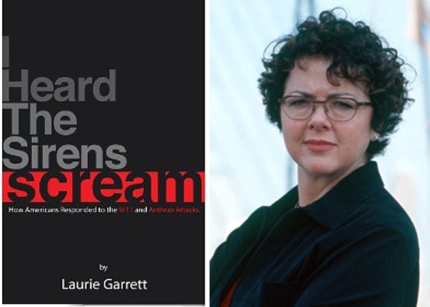
After my lunch, I got in the car and turned on NPR to listen to, “Science Friday.”  Laurie Garrett was being interviewed about her book on 9/11 entitled, I heard the Sirens Scream.

Ms Garrett is senior fellow for global health at the Council on Foreign Relations.  She’s the only journalist to win “the big three” prizes in her field, the Peabody, the Polk, and the Pulitzer, but you cannot get her book in a bookstore – it is only available on Amazon.

With all the impending chest thumping and flag waving on the occasion of the 10th anniversary of 9/11, I would suggest everyone listen to or read the transcript of this interview:  http://www.npr.org/2011/08/26/139972661/a-look-back-at-9-11-in-i-heard-the-sirens-scream

Garrett is furious that New York:  “became the reason to beat the drumbeats of war, that the attacks on our city were used by people who don’t live here to decide that we needed to invade Iraq, that the attacks on our city have been used by any number of politicians, misused, abused, with rewritten narrative, you know, the great lies told to justify all sorts of political things, everything from decreasing our civil liberties to building up a massive bioterrorism apparatus in this country, distorting our whole public health mission.

And I think the other thing is that as we approach the 10th anniversary, I should warn your listeners you’re going to be deluged with pathos.”

She contrasts this with the attempts of by Congress to deny funding to surviving Twin Towers rescue workers.  Garrett herself, who spent time near ground zero, was coughing up blood on her pillow at night, and talks of the way reports were massaged to remove the word, “asbestos.”

She summarizes worldwide response to 9/11 as unity or “singularity,” in outrage at the horror of the attacks, but goes on to say:  “You go out 120 days, that singularity has turned into the exact opposite: a moment of complete fracturing, of compete degeneration of the unity that was on one day…I think many of the ways that we responded, whether we’re talking about the public health response, the political response, the law enforcement, whatever aspect you look at, many of ways we responded set the seeds for this terrible, almost civil-war-type atmosphere that we live in in this country with such partisan dispute that the word compromise is considered evil, and the word governance is on nobody’s lips.”

You can see more of Laurie Garrett’s work on this and other topics at her blog: http://www.lauriegarrett.com