Virtual dreams

A few nights ago I had a 21st century dream in which the key event was losing my cell phone.  In days of yore – say five or ten years ago – losing a wallet was the common dream image for a disruption to one’s persona.  Now my smart phone probably tells me more about my public life than a wallet.  It shows me where I am, where I’m going, when I need to be there, how to find my way, and it gives me multiple ways to connect with people I need to see when I arrive.  In a few years time, I’m sure we’ll all have digital ID’s and credit cards.

Though I still think of dreams in terms of archaic elements, clearly the psyche will use whatever it needs to make a point.  As technology is part of our lives now, it is also part of our dreams.  All of which leads me to the heart of this post:  we ain’t seen nothin’ yet! 

Last Wednesday, I caught an amazing segment on virtual reality on the PBS Newshour.  I didn’t expect to be interested.  Since I don’t play video games or World of Warcraft, VR seems like just one more distraction in an ADHD world.  It may well be, but the Newshour piece demonstrates the power of this technology, beyond anything I’d imagined.  I instantly thought of the “Feelies” – multi-sensory movies in Huxley’s Brave New World.  We aren’t there yet, but it would be foolish to rule out the possibility.  Watch the clip and see what you think.

The power of imagined experience has long been established.  In the early 20th century, Jung developed a technique he called “active imagination” and used it in therapy.  In the 50’s, research proved that imagined practice was as useful as “real” practice for improving basketball free throws.  In reference to meditation, Lama Thubten Yeshe, a prominent 20th century Tibetan teacher, said, “What we have to learn is that the experiences we have through imagination and those we have through our senses are actually the same.”

All of these applications involve self-generated imagery, but if and when VR comes into our living rooms, it will come through the same corporate interests that flood us with adds already.  Do we want them reaching even farther into the deep psyche?

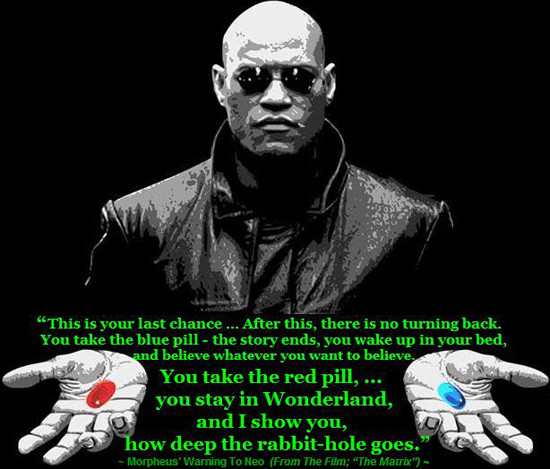
We’ll be clamoring for it!  If you have any doubt, check out Life, the Movie: How Entertainment Conquered Reality by Neal Gabler.  In terms of an obvious metaphor, The Matrix, once we have the ability turn our living rooms into personal holodecks, that blue pill of restless sleep will surge in popularity.

MorpheusWarning

To paint a huge subject in simple terms, over time, our race has transferred successive parts of our brain functions to technology.  Printed books marked the end of bards who could recite epic poems.  We don’t find the griots of Alex Haley’s Roots in literate cultures.  The imaginations of my parents’ generation got a better workout listening to The Lone Ranger on radio than mine did watching the masked man on TV.

I love technology, but I’m wary of it too, and not just the obvious stuff like the NSA.  I’m wary of all the ways we can use it to foster oblivion until, as T.S. Eliot put it, “Human voices wake us and we drown.”

James Hillman on world change and political polarization

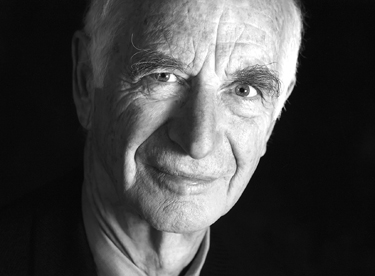
James Hillman, 1926-2011

James Hillman, 1926-2011

For decades, James Hillman brought us unique observations on modern life from the perspective of a depth psychology that embraced soul as its highest value.  Recently, I’ve wished I could hear his take on our current climate of political divisiveness, but Hillman, who died two years ago at the age of 85, wasn’t here to watch our most recent shenanigans.  Happily, I recently stumbled upon a pair of interviews in which Hillman discussed this very subject and set it in a context of massive cultural change.

Author and journalist Pythia Peay published the first interview on The Huffington Post in February, 2011 (Jungian Analyst Explains the Psychology of Political Polarization).  The occasion for their talk was the mass shooting in Tucson, which had happened a month earlier.  The most prominent victim was Representative Gabrielle Giffords.

Tragically, memory of that event, just two and a half years ago, has been lost in the wake of more recent carnage, including the Nevada school shooting earlier this week.  Though Hillman’s comments focused on the role of political divisiveness in the attempt to kill a congresswoman, his additional statements now seem eerily relevant to the 12 year old in Sparks who was so alienated that he ended his life with murder and suicide.

Hillman began with a general discussion of polarized thinking.  “Polarity,” he reminds us, is an electrical engineering term.  Batteries have poles; the psyche is far more nuanced than that, dwelling in shades of gray rather than black or white.  Ideological extremes subvert our ability to judge individual issues on their merit.

When asked if violently polarized politics caused the shootings, Hillman changed the focus to another kind of cultural rigidity and its effect on the Tucson shooter:

“I think that this kid was made a loner by an American educational system in which there is no room for the weird or the odd…We need to have an educational system that’s able to embrace all sorts of minds, and where a student doesn’t have to fit into a certain mold of learning. Our educational system has become so narrowed to a certain formula, that if you go through a weird phase, you’re dropped out — often at the age of schizophrenia, 19-23 — and that’s the danger.”

Arguments in the wake of gun violence bog down in specifics, like background checks and how many bullets a magazine should hold – we don’t ask why and how we’re producing more and more people prone to mass violence.  In the end, says Hillman, for a culture that pays so much lip service to “the individual,” we are terrified of real individuality, and attempt to stamp it out.

In the second interview, America and the Shift in Ages, Hillman suggests that much of that rigidity has to do with futile attempts to shore up outmoded systems and institutions during a period of massive change.  Not just one but “three or four” myths that are central to our culture are collapsing.

Everything we fear has already happened said Hillman:  “The fragility of capitalism, which we don’t want to admit; the loss of the empire of the United States; and American exceptionalism. In fact, American exceptionalism is that we are exceptionally backward in about fifteen different categories, from education to infrastructure. But we’re in a stage of denial.”  Other beliefs and structures are crumbling as well, he said.  White supremacy, male supremacy, the influence of monotheistic religions, and the belief that we are “the good people.”

If such institutions do not appear to be in decay, it’s because they are so staunchly defended, and that, Hillman says, is a sign of their lack of vitality — “If they were vital they wouldn’t need to be defended. And the fanaticism we’re witnessing goes along with the deterioration of the vitality of these myths.”

Many of our fundamental beliefs are under scrutiny and need to be.  Hillman mentions the meaning of “freedom.”  For many, freedom means, “I can do any goddamn thing I want on my property; that I am my own boss and don’t want government interference; that I don’t want anybody telling me what I can and can’t do.”  This, he says, is the freedom of an adolescent boy.  What of the different kinds of freedom, such as “freedom from the compulsions to have and to own and to be someone?”  What of the freedom Nelson Mandela found in prison?

Hillman cites economic assumptions that need to be questioned as well.  Falling demand needs to be stimulated, according to current assumptions, but from an ecological point of view, that’s exactly what the world needs at this time.  Sustainability models, which may be our hope for the future, terrify those in positions of power.

Many of our current fears, says Hillman – from fear of immigrants crossing our borders, to fear of failing education, to fear of cancer, to economic insecurity, terrorists, and of course fear of “the other” political party, results from the lack of a wider framework in which to understand the massive shifts that are already underway.

There is no going back, but as obsolete structures crumble, we can glimpse, if we look, new forms emerging.  Hillman gave the example of a “Bioneers” conference he attended where Paul Hawken showed a film that was simply the names of individuals and organizations involved in trying to innovate ways of building communities, economic systems, and ways of dealing with the natural world.  Hawken said there were thousands of names, and the film could roll for weeks.

Hillman said it’s important not to try to fit emerging structures into the patterns of the past.  For our peace of mind, a new kind of faith is required:   “I think it’s a matter of being free-wheeling, and trusting that the emerging cosmos will come out on its own, and shape itself as it comes. That means living in a certain open space — and that’s freedom.”

Dawn over Oostende, Belgium, 2007.  Photo by Hans Hillewaert, CC-BY-SA-3.0

Dawn over Oostende, Belgium, 2007. Photo by Hans Hillewaert, CC-BY-SA-3.0

Such words are a fitting conclusion to the lifework of a man who lived in defense of Anima Mundi, the World Soul and who taught that animals, trees, and rivers are intelligent and alive, and that at some deep level of the psyche, we can hear their voices.  In Hillman’s life work, observation of the modern psyche led to conclusions that mesh with the myths of the ancestors.

A thousand years from now, people will read of our times and shudder, as we do in contemplating the rigors of life in the middle ages.  A few visionaries stood out from the rest, those like Saint Francis, Dante, and Leonardo, who pointed toward a more benevolent and expansive future.

We cannot write our own history, but we can wonder how it will look to those in the future.  I am convinced that James Hillman will be remembered when most of what passes for news on TV is blessedly forgotten.
Jane Eyre – Charlotte Brontë

Thanks to the ever-beguiling Vickie, who blogs at Beguiling Hollywood, for the best online laugh in quite a while! She turned her readers on to Dr. Sparky, who offers 21st century literary summaries and analysis at Thug Notes. Watch his take on Jane Eyre and see why it leaves Cliff Notes in the dust!

Vickie Lester's avatarBEGUILING HOLLYWOOD

still-of-mia-wasikowska-in-jane-eyreMy favorite screen adaptation was directed by Cary Joji Fukunaga in 2011, starring Mia Waikowska and Michael Fassbender, screenplay by Moira Buffini.

Now, Thug Notes is a new fascination – I especially liked their recap and analysis of Moby Dick, but we covered that a couple of weeks ago.

Thug Notes – Classical Literature. Original Gangster..

Napkin Note Productions | Thug Notes.

View original post

Stardust: a movie review

Stardust-3-NCGZF0OUJX-800x600

One day while Neil Gaiman was driving in England, he noticed a wall by the side of the road and imagined Faerie on the other side. He conceived the story of an American author visiting Britain who would discover the wall. Shortly after this, on the night he received a literary award, Gaiman saw a shooting star, and the idea for Stardust was born.

Stardust was first released as an illustrated series in 1997 and then as a novel in 1999, which won an award from the Mythopoetic Society.  A movie version in 2007 received favorable reviews.  After my recent review of Gaiman’s 2013 novel, The Ocean at the End of the Lane, I realized I’d never seen the Stardust movie.  It’s available for rent on iTunes, and I highly recommend it.

Stardust gives us the wall, a wonderful metaphor for much of human culture, erected to keep us out of Faerie, the realm of imagination, heightened emotion, wonders, terrors, true love, and our true selves.

Responsible citizens don't cross the wall.

Responsible citizens don’t cross the wall.

Tristan Thorn (Charlie Cox), a young man who lives in the town of Wall, is a classic dummling.  He’s a klutz who can’t keep a job and is infatuated with Victoria, a girl who won’t take him seriously and whose finance delights in tormenting him.  Yet Tristan’s father, who has been over the wall, says that might be a good thing – most people who find it easy to fit in “lead unremarkable lives.”  Then he tells Tristan the secret of his birth on the other side of the wall.

Tristan and Victoria see a shooting star fall into Faerie.  Still infatuated, Tristan vows to bring the star back to win her hand in marriage.  He forces his way through the wall to begin his search, but he is not the only one who saw the star.

The murderous sons of a dying king in the realm of Stormhold set off to find the star when their father vows that the one who finds it will be his heir.  And Lamia (Michelle Pfeiffer), senior member of a trio of witches joins the hunt – when stars fall to earth, the witches cut out their hearts and eat them, a little at a time, to preserve their youth and beauty.

Tristan reaches Yvaine the star (Claire Daines) first. Still intent on winning the hand of Victoria back in Wall, he uses a Faire chain to compel her to follow him.

Yvaine and Tristan

Yvaine and Tristan

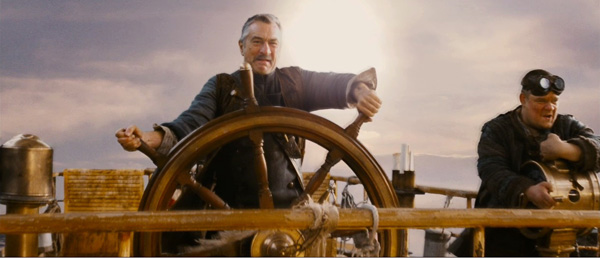
At first they bicker constantly, but their time on the road and helping each other survive attempts on their lives creates a bond of friendship and finally love between them. Ever the dummling, Tristan is the last to realize this, but is helped when he finds a mentor.  Robert De Niro, in a virtuoso role as Captain Shakespeare, the gay captain of a flying steampunk pirate ship, teaches Tristan to fight, Yvaine to dance, and with a parting gift of  wisdom, whispers to Tristan, “She is your true love.”

Captain Shakespeare at the helm

Captain Shakespeare at the helm

As with any good dummling story, the ending of Stardust will leave you happy.  Though rooted in the sensibility of a modern coming of age tale, with elements of character development that the old traditional stories lack, Stardust fits Tolkien’s paradigm of the classic fairytale – the wonders and terrors we mortals encounter when we venture into other worlds.

Faerie whispers to us in sunlight, in starlight, and in our dreams.  Those intimations may be what make us most truly human.  No wonder we have an endless appetite for wonder tales, and Stardust is one that thoroughly satisfies.

Artifacts of our ambition

artifacts1

Last night at dusk I went out to turn off a backyard sprinkler and noticed a broken garden plaque that lay among fallen leaves and plums.  It’s been there for quite some time, one of those objects I don’t know what to do with but like too much to throw away, so I leave it where it lies.  Last night, in the twilight, I noticed it.

A phrase sprang to mind:  “You look for the artifacts of their ambitions.”  This is the first line in Michael Koryta’s superb supernatural thriller, So Cold the River.  The main character goes on to say, “The reality of someone’s heart lay in the objects of their desires.  Whether those things were achieved did not matter nearly so much as what they had been.”

The plaque was a primitive image of the sun – the word “SOL” is still visible.  We got it in Mendocino a long time ago and hung it on the fence at a time when gardening was one of our major activities.  Its importance waned under the time pressures that came with more “gainful” employment,” but this little artifact, like a Velveteen Rabbit made out of stone, can still speak when I stop to listen.

After I snapped this photograph, I went looking for other such artifacts, both in a box of old pictures of mine and among vintage postcards, photos, and tintypes I’ve collected.  If you are a packrat like me, you surround yourself with such things. 

Dreams change, and ambitions, just like our lives, can be fleeting. The artifacts often outlive them. Nothing shows that more clearly than this picture of my father, my sister, and me by a stone wall I helped build.

father, me and jan

The Kodachrome is fading and my father is gone, but not long ago, I checked Google’s satellite view, and that stone retaining wall, some 3,000 miles from where I now live, still appears to be standing.  How can you even begin to say what it means when you’re five and your father shows you how to place stones in a wall and trowel the concrete into place between them?  “The reality of someone’s heart lay in the object of their desires.”

boys of summer

I’ve always liked this team photo, with its mix of bravado and shyness in front of the camera.  Did any of these boys of summer dream of playing in the majors?  Did any of them come close?  Did they love the game any less than the 2013 all stars who played in front of millions of viewers last week?  I’m guessing that at the moment this picture was taken, they may have loved it more.

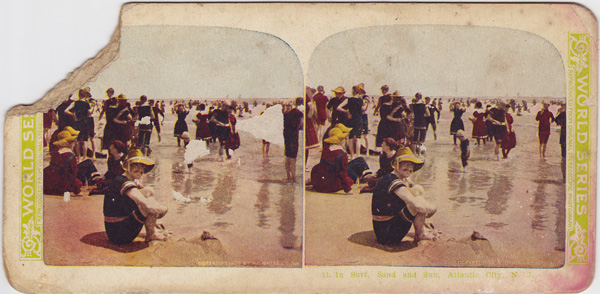
stereo picture

What about the fellow in the foreground of this stereopticon slide? Do we even want to know about his ambitions?  Close up, he looks like Groucho Marx in a yellow hat.  The picture is labelled “Surf, Sand, and Fun, Atlantic City, NJ.”

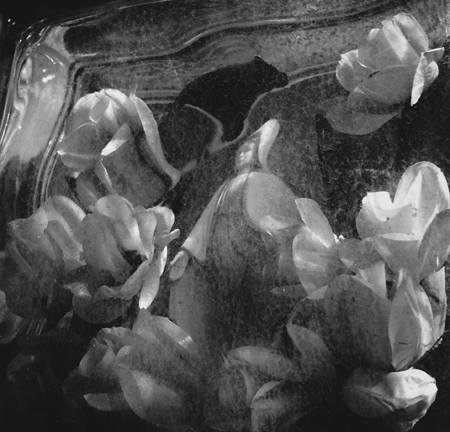
cemetary photo

This is a poignant image, from a photo I took of an arrangement in a glass box, embedded in a gravestone in an old Italian cemetery in Binghamton, NY.  Virgin Mary stands amid plastic roses, her image distorted by thick old glass.  I spent a summer there working in a factory, and returned again and again to this cemetery, which was full of angels and lambs and redeemers, for don’t these all speak of a nearly universal ambition – the longing for redemption, in the here, the hereafter, or both?  The world is alive and things within it can speak to us if we listen.

And finally, one of my more important artifacts.  I kept this photo of a young 19th century woman over my desk while writing my first novel.  This, I thought, was how the book’s heroine would have looked if she’d posed for a picture.  So this photograph, taken more than a hundred years ago, of a woman whose dreams I cannot begin to fathom, became an icon for one of my own ambitions.

old photo of young woman

I didn’t tell her story very well, but as the character in So Cold the River observes, that often doesn’t matter.  Sometimes when I look at this picture now, it holds a greater mystery than it ever did when I used it as a writer’s prompt.  Now I can see its own inscrutable mystery.

James Hillman often quoted John Keats who said, “Call the world if you please ‘The vale of Soul-making.’ Then you will find out the use of the world.”  In the same letter to his brother and sister, Keats added that our pains and troubles “school an Intelligence and make it a Soul.”

Artifacts of our ambitions are things we notice as the eyes of soul begin to open.


Your Own Damn Life: an interview with Michael Meade in The Sun

Michael Meade is an author, storyteller, and a passionate advocate of soul values in a world that increasingly ignores them; I’ve written about Meade or mentioned him in half a dozen posts.

In The Water of Life (revised, 2006) he shares his discovery that stories can be a matter of life and death.  As a teen in New York, when confronted by gang members from a rival neighborhood, Meade didn’t just lie his way out of serious injury or worse – he storied his way out, with an elaborate made-up tale that won over the assailants long enough for him to make his escape.  Readers of my recent posts will recognize a thriving trickster in Meade when he was just a kid!

I recently found an interview between Michael Meade and John Malkin in the The Sun that is as timely today, or more so, than in November, 2011, when it was published.  In the interview, “Your Own Damn Life,” Meade quotes an African proverb, “When death finds you, may it find you alive.”  Alive, he goes on to say, “means living your own damn life, not the life that your parents wanted, or the life some cultural group or political party wanted, but the life that your own soul wants to live.”

In the past, meaningful stories could guide soul evolution, but now, with the culture and the natural world both in crisis, Meade points to our lack of coherent, guiding tales.  A culture falls apart, he says, when youthful imagination and energy are stunted and when the traditional wisdom of elders is forgotten.  At one extreme, “You’re not supposed to be worrying about the end of the world as a teenager; you’re supposed to be bringing your dream to it. The world seems old and troubled now, and the young are no longer allowed to be as young as they should be.”  At the other extreme, we have a lot of “olders” but not many wise “elders.”

When traditional stories collapse, Meade says, the guiding and healing stories must come from within.  “That means going to the core of your own life and finding the story seeded within.”  Meade has tried to facilitate such explorations through his writings and talks, which first became known in the 80’s when he, James Hillman, and Robert Bly hosted a series of men’s conferences.

Meade continues to teach, write, and offer a variety of community services through the non-profit Mosaic Foundation he founded in Seattle where he lives.  If you’ve read this far, you will find Meade’s interview in The Sun and the Mosaic page hightly rewarding and likely sources for new ideas.


Lego Fairy Tales

Once again I’m pleased to feature a post by the amazing Lily Wight, who found some fairytale illustrations I doubt that you’ve seen before. I wonder what the career path is – Lego engineer has always seemed like a dream job!

Lily Wight's avatarLily Wight

     This month’s Lego fix features Little Red Riding Hood, Beauty & The Beast and a rather startled Little Mermaid.

     Just hover over the images for extra information…

View original post

The best graduation speech, ever.

It’s that time of year.  I seldom pay much attention to graduation speeches.  I can’t remember anything said at my own, nor do any quotes come to mind from celebrities whose commencement addresses get soundbytes played on the news every June.  But there is one graduation speech I’ve read and listened to many times and continues to be a source of inspiration.  You may know it.  If not, I’m happy to pass it on.

Steve Jobs at Stanford, 2005

Steve Jobs at Stanford, 2005

In 2005, Steve Jobs, whose academic career consisted of one semester of college and a few audited classes, was chosen as the graduation speaker at Stanford.  In his brief but memorable address, he spoke of finding one’s true vision, following our hearts, and not wasting our all-to-brief time walking someone else’s path.  Here are three of my favorite quotes from the speech:

“You have to trust in something — your gut, destiny, life, karma, whatever. This approach has never let me down, and it has made all the difference in my life.”

About getting fired from Apple:  “It was awful tasting medicine, but I guess the patient needed it. Sometimes life hits you in the head with a brick. Don’t lose faith. I’m convinced that the only thing that kept me going was that I loved what I did. You’ve got to find what you love…the only way to do great work is to love what you do. If you haven’t found it yet, keep looking. Don’t settle. As with all matters of the heart, you’ll know when you find it…keep looking until you find it. Don’t settle.”

“Your time is limited, so don’t waste it living someone else’s life. Don’t be trapped by dogma — which is living with the results of other people’s thinking. Don’t let the noise of others’ opinions drown out your own inner voice. And most important, have the courage to follow your heart and intuition. They somehow already know what you truly want to become. Everything else is secondary.”

I invite you hear everything this visionary had to say that day, in a  text version of the speech, and / or this video clip.