Stardust: a movie review

Stardust-3-NCGZF0OUJX-800x600

One day while Neil Gaiman was driving in England, he noticed a wall by the side of the road and imagined Faerie on the other side. He conceived the story of an American author visiting Britain who would discover the wall. Shortly after this, on the night he received a literary award, Gaiman saw a shooting star, and the idea for Stardust was born.

Stardust was first released as an illustrated series in 1997 and then as a novel in 1999, which won an award from the Mythopoetic Society.  A movie version in 2007 received favorable reviews.  After my recent review of Gaiman’s 2013 novel, The Ocean at the End of the Lane, I realized I’d never seen the Stardust movie.  It’s available for rent on iTunes, and I highly recommend it.

Stardust gives us the wall, a wonderful metaphor for much of human culture, erected to keep us out of Faerie, the realm of imagination, heightened emotion, wonders, terrors, true love, and our true selves.

Responsible citizens don't cross the wall.

Responsible citizens don’t cross the wall.

Tristan Thorn (Charlie Cox), a young man who lives in the town of Wall, is a classic dummling.  He’s a klutz who can’t keep a job and is infatuated with Victoria, a girl who won’t take him seriously and whose finance delights in tormenting him.  Yet Tristan’s father, who has been over the wall, says that might be a good thing – most people who find it easy to fit in “lead unremarkable lives.”  Then he tells Tristan the secret of his birth on the other side of the wall.

Tristan and Victoria see a shooting star fall into Faerie.  Still infatuated, Tristan vows to bring the star back to win her hand in marriage.  He forces his way through the wall to begin his search, but he is not the only one who saw the star.

The murderous sons of a dying king in the realm of Stormhold set off to find the star when their father vows that the one who finds it will be his heir.  And Lamia (Michelle Pfeiffer), senior member of a trio of witches joins the hunt – when stars fall to earth, the witches cut out their hearts and eat them, a little at a time, to preserve their youth and beauty.

Tristan reaches Yvaine the star (Claire Daines) first. Still intent on winning the hand of Victoria back in Wall, he uses a Faire chain to compel her to follow him.

Yvaine and Tristan

Yvaine and Tristan

At first they bicker constantly, but their time on the road and helping each other survive attempts on their lives creates a bond of friendship and finally love between them. Ever the dummling, Tristan is the last to realize this, but is helped when he finds a mentor.  Robert De Niro, in a virtuoso role as Captain Shakespeare, the gay captain of a flying steampunk pirate ship, teaches Tristan to fight, Yvaine to dance, and with a parting gift of  wisdom, whispers to Tristan, “She is your true love.”
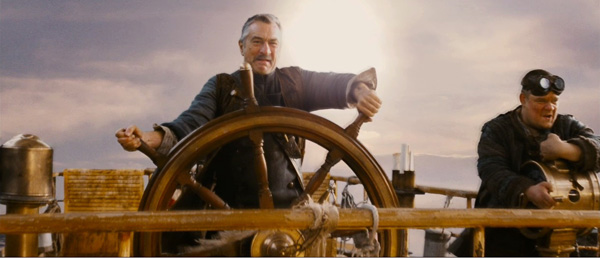
Captain Shakespeare at the helm

Captain Shakespeare at the helm

As with any good dummling story, the ending of Stardust will leave you happy.  Though rooted in the sensibility of a modern coming of age tale, with elements of character development that the old traditional stories lack, Stardust fits Tolkien’s paradigm of the classic fairytale – the wonders and terrors we mortals encounter when we venture into other worlds.

Faerie whispers to us in sunlight, in starlight, and in our dreams.  Those intimations may be what make us most truly human.  No wonder we have an endless appetite for wonder tales, and Stardust is one that thoroughly satisfies.

Despicable Me 2

despicableme2

In this year of superheroes and sequels, with intrusive digital effects everywhere you turn and an actor who should know better wearing a stupid dead crow on his head, it is July and I’ve been to the movies exactly twice.

I had the most fun at Despicable Me 2, and was delighted to find it a beautifully crafted film.  If you’ve been waiting…and waiting…and waiting some more for a movie worth venturing out to the cineplex, the drought has lifted with this one.

Disclaimer:  I get nothing in return from anyone for writing this review, but I’m still sort of hoping that karmic forces, somehow and somewhere may award me a minion or two for my efforts.  Come on – wouldn’t you like a few of the happy little guys to do the chores around your home?

http://www.youtube.com/watch?v=HwXbtZXjbVE

You know you would…

Super 8: a movie review

Super 8 poster

Even if you didn’t know that Steven Spielberg was involved in the production of Super 8, 2011, you would think of him and the parallels to ET, 1982.  Both movies appeal to all ages, but center on the courage, creativity, and compassion of young people.  Best case, the adults need to be reminded of what really matters; worst case, these are the things they oppose.  Spielberg sat on the storytelling committee with director, J.J. Abams, and helped produce Super 8.  The film won numerous awards and nominations, for its special effects and the two young stars, Joel Courtney and Elle Fanning.

It is 1979 as the film opens.  Fourteen year old Joe Lamb (Courtney) mourns the death of his mother in a factory accident.  His father, Deputy Jack Lamb, blames the father of his son’s friend, Alice Dainard (Fanning), since his wife was working the shift of the elder Dainard, out with a hangover, when she died.

Meanwhile, Joe’s friend, Charles, is making a super 8 zombie movie for an international competition.  He enlists Alice as the love interest in the film, and she and Joe are soon smitten with each other.  One night they sneak out to film a scene at the station against the backdrop of a passing train.  As the camera rolls, a pickup drives onto the track and causes a major derailment.  The pickup’s driver, Dr. Woodward, their biology teacher, is badly injured, but pulls a gun and warns them to forget all they’ve seen or their parents will be killed.  As the kids drive away, an Air Force convoy arrives to secure the scene.  The convoy leader, Colonel Nelec, discovers a super 8 film cassette and sets out to find whoever made it.

Things in town start to get weird.  All the dogs run away to the next county.  Electronic devices begin to disappear.  All the engines in all the cars at a local dealership are stolen overnight.  Nelec’s forces surround the town and begin knocking at doors.  Joe and Charles sneak into Dr. Woodward’s house and discover why he was trying to derail the train.

There are plenty of nail-biting moments, and when things come out right in the end (you never really doubt it in this kind of movie), we get to see Charles’ zombie production, which is a charming ode to amateur movie making and the creativity of young people

Super 8 is well worth a viewing.

http://www.youtube.com/watch?v=bqt9L4fIExA

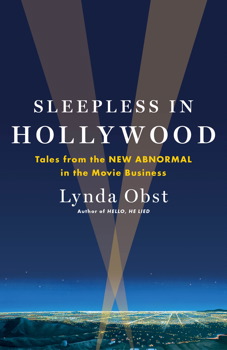
Sleepless in Hollywood by Lynda Obst

Have you been to the movies lately?  Like what you see?  Wonder if it’s a trend?

Today’s edition of Marketplace clued me in on the answer to question three via an interview with Hollywood insider Lynda Obst, producer of The Fisher King and Sleepless in Seattle.  Obst realized something had changed when her son said, “Mom, trying to get movies made because they’re good is so 2003.”  The interview concerned her new book, Sleepless in Hollywood:  Tales from the New Abnormal in the Movie Business.  

sleepless in hollywood

Obst says the “old abnormal” was when she could get movies made because they were good.  DVD sales financed half of studio profits and allowed production of the “smaller” movies she loves, like romantic comedies.  Then domestic DVD sales tanked at the same time as foreign viewership rose, particularly in China and Russia, where there’s an endless demand for our blockbusters and special effects.  You can make “small movies” anywhere in the world, she says, but so far, you can only make blockbusters here.

Which may explain why I’ve been to so few movies this year – when the trailers assault my senses with digitized special effects, I tend to give them a miss, with the exception of movies like Star Trek, because…well, it’s Star Trek.

Sleepless in Hollywood is now in my book queue, in part because Obst’s final chapter is called, “Does the future have a future?” and I want to know her answer to the question.

And a final note on 2013 movies to date – they’ve finally pushed us into the 21st century, with a subscription to Netflix, so there is at least one happy outcome.

Data-mining for Screenplays

the-history-of-3d-cinema-0

‘“It’s the movies that have really been running things in America ever since they were invented. They show you what to do, how to do it, when to do it, how to feel about it, and how to look how you feel about it.” – Andy Warhol

I had planned to continue discussing the story of Jorinda and Joringel from the Brothers Grimm, but a pair of articles I saw on successive days suggested a compelling interlude.  We’ll return to the forest shortly.

The first article, “Big data,” outlines ways that new software and methods can identify structures in parts of the oceans of data that retailers and governments have not been able to access before.  Everyone knows that advertisers target us based on our Facebook likes.  Now there are ways to do the same with the photographs we post and other aspects of our online behavior.  New algorithms find new patterns in all our activities, online and off.  This includes the movies we pay to watch.

The second article appeared in the May 5 New York Times, “Solving Equation of a Hit Film Script, With Data.” In it, Brooks Barnes writes about Vinny Bruzzese, a highly paid script consultant, who charges up to $20,000 for a sophisticated analysis of a screenplay in terms of past box office performance.  Bruzzese, a former statistics professor, can tell you which sort of demons do best in horror films and warn you that bowling alley scenes are a hallmark of low-grossing movies.

Though Bruzzese’s services are still too taboo for most movie people to cop to, Barnes says studios have hired him to analyze at least 100 scripts, including an early version of Oz the Great and Powerful.  Meanwhile, Scott Steindorff, who produced The Lincoln Lawyer said, “Everyone is going to be doing this soon.  The only people who are resistant are the writers.”

“This is my worst nightmare,” says Ol Parker, who wrote the script for The Best Exotic Marigold Hotel.  “It’s the enemy of creativity…It can only result in an increasingly bland homogenization, a pell-mell rush for the middle of the road.”

I wonder if there is a greater nightmare lurking for writers like Parker – not just computer driven analysis, but computer driven generation of screenplays?  I’m certain it’s possible.

First of all, interactive online books have been around for some time.  Secondly, I’ve seen how this works in the field of computer graphics.  My day job involved microchip design automation, starting over 15 years ago – chips helping to draw the next generation of chips.  But what really convinces me that elements of screenplays could be synthesized is a computer generated astrological profile I ordered on whim last winter.

I plugged in my birthdate, place, time and, paid $50.  Sixty seconds later, I was reading a 20 page, Jungian-style analysis of my natal chart, that was uncanny in describing my relationship with parents, among other things.  It’s not that hard to understand how it is possible.  The Sun in Aquarius, at one degree, forty-four minutes, in the second house, has a defined meaning.  Assemble text to match the possibilities, and the rest is just number crunching.  A literary outline would have fewer data points.

Colonel Mustard in the library with a wrench, for those who remember Clue.

Or this.  Pick your genre – teenage slasher movie.  Choose setting (urban, suburban, rural).  Choose decade.  Chose your villain (insane human, mutant, supernatural creature).  Choose your hero (I’ll go with brainy nerd who has a congenital limp and can’t get a date for the prom).  Choose the hair color of a cheerleader he will rescue.  Finally, pick a screenplay structure (Save the Cat), add any notes, and hit send.  A few minutes later, you’ve got your outline and pitch, with no hint of a bowling scene.

Oh brave new world!  Andy Warhol saw it coming 50 years ago when he said, “Some day everybody will just think what they want to think, and then everybody will probably be thinking alike; that seems to be what is happening.” 

The alternative is simple too – we keep our day jobs and write all the damn bowling scenes we want to.  Life is to short to let someone else dictate our demons.  As my computer generated horoscope said: “You need to face your fear of the world’s criticism, and your tendency to sabotage your creative efforts out of a deep need to be approved of by society.”

Feel free to borrow that bit of advice whenever you want to.

Secondhand Lions: a movie review

“If you want to believe in something, believe in it. Doesn’t matter if it isn’t true.  You believe in it anyway.” Hub McCann (Robert Duvall) in Secondhand Lions

The recent death of country music star George Jones, reminded me of Robert Duvall’s Oscar winning performance in Tender Mercies (1983), the story of an alcoholic country singer who finds redemption with the help of a woman, as Jones did toward the end of his life.

The truth is, I never much cared for Jone’s music, but Robert Duvall is one of my favorite actors.  I started thinking of Secondhand Lions (2003) which also stars Duvall and is one of funniest and most satisfying movies I’ve ever seen.  I have the DVD and watched it again yesterday.  Now I’m wondering why it took me so long to write a review.

*** Spoiler Alert ***

It’s the summer of 1962 when Walter Caldwell, on the cusp of adolescence, is dumped by his irresponsible mother, Mae, at the remote Texas ranch of his two great uncles, Hub (Robert Duvall) and Garth McCann (Michael Caine).

secondhandlions - mom

“The last thing we need is some little sissy boy hanging around all summer,” Garth tells Mae.  Hearing this, Walter’s misery is palpable.  The first part of the movie shows how the trio eventually bonds.

The McCann brothers are rumored to have a hidden fortune, which brings a stream of salesmen and conniving relatives to their door. Hub and Garth spend their days shooting at salesmen, until Walter suggests they listen to one to see what he’s selling.

SecondhandLions_20

After listening to a seed salesmen, the trio plants a garden, only to learn they’ve been duped and sold nothing but corn seed.  The result is a huge cornfield they never really wanted.  The uncles also order a lion from a circus supply dealer.  They plan to hunt and kill it to hang its head over the fireplace, though Walter reminds them they don’t have a fireplace.  The lion turns out to be an aged female who is too sick to crawl out of her crate.  It wouldn’t be sporting to shoot her, Garth observes.

Secondhand lions - lion

Walter names the lion Jasmine, after a mysterious woman whose fading photo he finds in an attic trunk.  He nurses Jasmine back to health, and she takes up residence in the cornfield, the closest thing to a jungle in west Texas.  The lioness proves her worth by scaring away a family of greedy relatives, who campaign to have Walter shipped to an orphanage.

The movie would be pleasant enough – and forgettable enough – if it simply dealt with two lonely old men and a fatherless boy filling a void in each other’s lives, but deeper themes comes into play, notably the tension between ideals and what’s real, between story and truth and memory.

At the time Walter found the photo of Jasmine, he spied Hub sleepwalking down to the pond each night, where he brandished a toilet plunger like a sword, challenging invisible enemies.  Garth begins a long story of Hub and Jasmine, that’s like something from the Arabian Nights or a Douglas Fairbanks movie.  Hub rescued Jasmine, a desert princess, from a rich sheik in the Sahara after the two brothers were shanghaied into the French Foreign Legion at the start of World War I.

Garth continues the story in several segments, and Walter finally persuades his uncle Hub to finish it.  He tells Walter how he ran off with Jasmine.  How her jilted suitor, the sheik, sent assassins after the pair until Hub tricked him out of a hundred pounds of gold and defeated him in a duel.  Jasmine died in childbirth a few years later , and Hub never loved another woman.

Just then Walter’s mother returns in the dead of night with her latest boyfriend who claims to be a detective on the trail of the McCann brothers, a pair of infamous bank robbers who left an accomplice named Jasmine to die by the side of the road after she was wounded during a robbery.  When Walter challenges the story, the “detective” hits him.  His time with the uncles has changed Walter, who fights back, and with the last of her strength, Jasmine the lion, rushes to defend her “cub.”

Jasmine’s heart gives out in the struggle – “She died with her boots on,” says Garth.  Mae still wants Walter to come with her, but he’s learning to stand up for himself.  “I want to stay here,” he says.  “For once in your life, do something for me.”

Seventeen years later, Walter is a successful cartoonist, who draws a strip called “Walter and Jasmine,” the adventures of a boy and his lion.  The sheriff calls with bad news – his uncles, both 90 years old, have died in a hair-brained accident – with their boots on.  Walter both weeps and laughs when he learns the details.  The sheriff hands Walter the brothers will, which reads, “The kid gets it all.  Just plant us in the damn garden, next to the stupid lion.”

In the final scene, an oil company helicopter lands, and the son of the sheik from Jasmine’s story steps out.  “I was in Houston on business when I read the news,” he says.  “My father always talked about your uncles.  He called them his most worthy opponents, but I thought they were only stories.  So they really lived?”

“Yeah,” says Walter.  “They really lived.

There are many levels to this seemingly simple movie.  On one hand, some of the antics are hilarious.  It’s also a sensitive coming of age tale.  With the notable exception of Harry Potter, most such stories and movies over the last decade have centered on girls’ awakening.  Unlike Potter, however, Secondhand Lions reflects some of the features we know belonged to classic men’s initiation rites, such as “leaving the house of the mothers to join the fathers.”

But finally, what makes this movie great, and of universal interest to me, is its take on what is real and valuable in the stories we tell.  As Hub says to Walter:

“Sometimes, the things that may or may not be true are the things that a man needs to believe in the most: that people are basically good; that honor, courage, and virtue mean everything; that power and money, money and power, mean nothing; that good always triumphs over evil; and I want you to remember this, that love, true love, never dies.  You remember that, boy.  Doesn’t matter if they are true or not.  A man should believe in those things because those are the things worth believing in.”

A solid five stars for this movie.  I haven’t counted lately, but I’m sure it’s still up in my ten best for all time.

http://www.youtube.com/watch?v=-COMJckISVY

Save the Cat Goes to the Movies by Blake Snyder: a book review

Save the cat2

What do these movies have in common: Alien, Fatal Attraction, and Godzilla? How about these: Star Wars, The Bad News Bears, and Lord of the Rings?  The first trio belong to the genre that Blake Snyder called “Monster in the House.”  The second set are “Golden Fleece” films in Snyder’s terminology.

He assigned distinctive genre names to help us think about films in a different manner and see connections we might miss with more familiar and less specific tags.  Some of the names came from Snyder’s love of the roots of our story traditions.  The Golden Fleece, for example, was the object of Jason’s quest in the myth of the Argonauts, while Theseus and the Minotaur is a “monster in the house” tale that is thousands of years old.

Snyder described his approach in Save the Cat, where he presented his top-down approach to writing a movie script, from idea to logline to pitch to outline to finished screenplay.  He presented a model of 10 movie genres and 15 critical plot points.  Save the Cat Goes to the Movies rounds out these concepts with detailed discussions of 50 well known and well respected movies – a valuable addition.  Here’s an example:

“Monster in the House” stories have three three key elements, a monster, a house, and a sin. The monster often has seemingly “supernatural” powers: Jaws is an uber-shark, while insanity lends a lot of power to human monsters.  The house may be a literal house, a spaceship, a town, or a planet, as long as escape from the monster is not an option. The sin is often greed (closing the beaches would hurt the tourist economy) or lust in a teenage slasher film. In the case of Victor Frankenstein and the atomic tests that spawned Godzilla, it is scientific hubris.  Sometimes ignorance is the “sin.”

frankenstein1

“Golden Fleece” movies are quest stories that span the millennia between Homer’s Odyssey and Bob Hope road movies.    The elements Snyder identifies are a road, a team, and a prize.  These movies run the gamut from comic (Planes, Trains, and Automobiles) to deadly serious (Saving Private Ryan), but in every case, winning the prize is less important to the story than the lessons the (surviving) team members learn.

road movie

In my previous post, I discussed Snyder’s “Fool Triumphant” genre.  His remaining seven categories also reveal unexpected similarities between movies where we don’t expect to find them.  It is also illuminating to look for his plot points in our favorite films.  Some of them are familiar through the names he assigns – “The bad guys close in,” “All is lost,” “Dark night of the soul.”  Others require explanation, which this second book in the Cat series provides.

A map is not a territory, as an outline is not the gripping story our hearts and minds crave.  That doesn’t mean a map isn’t useful in helping us reach our destination.  Blake Snyder’s Save the Cat Goes to the Movies is a useful and stimulating map to help us navigate the wilderness of a stack of blank paper.

More about Dummlings and Fools

Fool Tarot of Marseilles

In an earlier post, Tales of the Dummling, (January, 2013) I discussed a theme from folklore, and specifically from The Brothers Grimm, which has long intrigued me.  In this story type, the youngest of three brothers, whom everyone else considers a fool, triumphs because of virtues like honesty, compassion, and attention to the present moment.

I mentioned Forrest Gump, 1994, as a recent movie version of the theme, and several readers were quick to point out that Being There, 1979, with Peter Sellers also fits the type.  I’m currently reading an excellent book on screenplays, Save the Cat Goes to the Movies, by Blake Snyder (1957-2009) that widens the scope of this kind of movie by calling the genre, “The Fool Triumphant.”  This shift allows us to see the connections between many other types of tales where innocence and virtue are rewarded.

Save the cat2

I reviewed Snyder’s first book on screenwriting, Save The Cat, in January, 2012.  I expect to write a review of this book after I finish, but first I want to focus on Snyder’s words about films with “fools” as heroes.

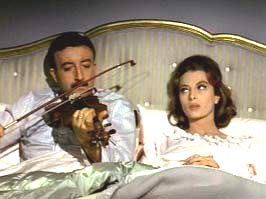
Inspector Clouseau in The Pink Panther, 1963

Inspector Clouseau in The Pink Panther, 1963

He lists three key elements:

  1. The “fool” is someone with skills or powers that are overlooked or unnoticed by everyone except (sometimes) an antagonist who resents the fool’s success.  Example:  Inspector Dreyfus in the Pink Panther movies.
  2. The fool is foolish to an establishment that opposes him or her.  In Snyder’s words, “while he does not set out to do anything but live his life, it’s usually the establishment that’s exposed as the real fool in the equation.  Have no fear, our unlikely hero won’t become a part of the system – or want to!”
  3. Finally, Snyder says, a “transmutation” occurs for the fool.   Sometimes this involves a change of name, as when Chance the gardener becomes Chauncey Gardner in Being There.  It may be a change of life circumstance, like Goldie Hawn in Private Benjamin.  It may involve gender swapping as in Tootsie and Mrs. Doubtfire.  The fool’s mission may change as it does in Legally Blonde, where Reese Witherspoon first enrolls in Harvard law to win back her fiancé, but then discovers that law is her true calling.
Reese Witherspoon for the defense in "Legally Blonde"

Reese Witherspoon for the defense in “Legally Blonde”

Blake Snyder identifies sub-genres in stories about the wisdom of foolishness.  “Political Fool” movies include Being There, Mr. Smith Goes to Washington, and The Princess Diaries.  Films like Tootsie, Miss Congeniality, and Some Like it Hot are grouped together as “Undercover Fool” stories.  Forest Gump and Zelig are “Society Fool” movies.

the-three-stooges

In addition to Legally Blonde, “Fool Out of Water” movies include Stripes, Beverly Hills Cop, and Crocodile Dundee.

Snyder is aware of the deep roots of these stories.  The fool “has a bead on the truth,” he says, whether it’s Shakespeare’s Puck, saying, “Lord what fools these mortals be,” or Forrest Gump, who “can find a whole universe sitting on a bench waiting for a bus.” In discussing Gump, Snyder suggests that ultimately, the fool opens our minds and our hearts to spiritual wisdom.

I thought of an 11th century Buddhist master, Tilopa, who lived as an itinerant sesame seed grinder.  A thousand years later, people still study his teachings, which are very complex in one sense, but can also be boiled down to these “six words of advice:”

  1. Let go of what has passed.
  2. Let go of what may come.
  3. Let go of what is happening now.
  4. Don’t try to figure anything out.
  5. Don’t try to make anything happen.
  6. Relax, right now, and rest.

Clearly such wisdom lies beyond the reach of anyone but a fool!